Monthly Archives: June 2019

Automakers fight to rescue small cars from extinction as EU rules bite

The U.S. buys big but relatively unsophisticated cars, while Europe prefers sophisticated small cars.

That truism is about to be rewritten in Europe, however, as automakers start to question their small-car strategy in response to costly new European Union legislation covering safety and tailpipe emissions, in particular the output of CO2.

“New CO2 rules will require automakers to fit thousands of euros of tech to each car,” Max Warburton, an analyst at research and brokerage firm Sanford C. Bernstein wrote in an April report. “Big cars have the price points and margins to cover these costs. Small cars simply do not. These segments may soon be abandoned by many manufacturers.”

Automakers across Europe are axing their smallest cars or preparing to do so.

  • Opel will drop its Karl and Adam minicars, while fellow PSA Group brands Peugeot and Citroen said their 108 and C1 minicars are unlikely to survive. A source at Ford confirmed that it will stop exporting the Indian-built Ka+ small car to Europe.
  • Volkswagen executives have said privately that the automaker is preparing to drop combustion-engine versions of the Up minicar, which would almost certainly mean the fuel-powered Seat Mii and Skoda Citigo would also disappear.
  • Daimler, meanwhile, has begun the process of shifting production and development of its Smart brand to China, where the small cars will be built exclusively starting in 2022 as part of a joint venture with Zhejiang Geely Holding. That decision raises a question mark over Renault’s Twingo minicar, which was developed alongside the current Smart model range.

It won’t just be minicars affected, Warburton said. VW Group could be forced to axe the Polo small car as well as the related Audi A1, Skoda Fabia and Seat Ibiza, he said. ”

This is a very big volume platform, but it will face an increasingly tough economic challenge,” Warburton said. He also flagged up the size of BMW’s task with Mini. “BMW will need to rethink or reduce the size of the Mini business. We are not convinced it’s ever made proper money,” he said.

These cars are at risk because tougher EU rules for CO2 start to take effect next year. The industry has to reduce its fleet average to 95 grams per kilometer, down from an average of 120.5g/km last year, according to JATO Dynamics. The problem is that most current minicars cannot get to below the 95g/km average without including some form of electrification (for example, the Citroen C1 achieves 95g/km).

Read more: Automotive News

The future of electric vehicles

Are we on the cusp of an electric revolution?

Electric vehicles (EVs) have been around for well over 150 years – considerably longer than their petrol and diesel fuelled cousins. But it’s only in the last couple of years or so that drivers and car-makers have begun to realise the potential for an electric car revolution. Technological advances in battery construction and rapid charging mean that, for the first time since the 1870s, electricity has the chance to displace fossil fuels as the driving force behind the world’s transport systems.

Is an all-electric future likely?

Replacing billions of petrol cars with electric vehicles obviously won’t happen overnight, but many analysts are predicting that an all-electric future is becoming increasingly inevitable. Many European countries have signed ambitious EV targets into law, with France and the UK both aiming to ban the sale of fossil-fuelled cars by 2040. And sales of EVs are booming around the world, with 70% growth in 2018 alone.

For years, electric cars were available from only a handful of companies – Tesla of course, plus the BMW i3, the Nissan Leaf or Toyota’s Prius being the most famous examples. But now almost every car company on the planet is stepping into the ring.

At the 2019 Geneva Motor Show, electrification was everywhere. Dozens of new electric models were on display as big-name brands ramp up production for mass markets, including Volkswagen, Porsche, Volvo and Audi. Mercedes’ parent company, Daimler, has announced that they too would have electric versions of its entire fleet by 2022, including popular models like the newly introduced smart car.

“ Exhaust emissions from fossil fuel transport cause 53,000 premature deaths per year in the US alone, and are especially harmful to children, the elderly, and low-income communities.”

Electric vehicles are going mainstream in a big way. But will they truly be able to topple the might of the petrol engine? And why might consumers be persuaded that their next car should fill up at a wall plug rather than a petrol pump?

Read more: Green Economy Coalition

Milton Keynes 'Mushrooms' Charging Hub (Image: T. Larkum)

Electric revolution: There are MORE UK public charge points for plug-in vehicles than petrol stations for the first time ever

  • New figures show there are 8,471 charging locations across the UK as of 22 May
  • In comparison there are currently 8,400 petrol stations in the country

The electric car revolution is well and truly taking shape as new stats reveal there are more public charging locations for plug-in vehicles than there are fuel stations in the UK for the first time in history.

New figures from Zap-Map revealed that – as of 22 May – there are 8,471 charging locations across the UK with a total of 13,613 individual plug-in points.

In comparison there are currently 8,400 petrol stations in the country.

While more charge point locations are being added by the week, petrol station numbers are in decline.

Milton Keynes 'Mushrooms' Charging Hub (Image: T. Larkum)
Milton Keynes ‘Mushrooms’ Charging Hub (Image: T. Larkum)

In fact, the charge-point website says there has been a 57 per cent increase in EV charge points across the UK in the last 12 months alone.

‘Charging points can now be found across the length and breadth of the country, from the Shetland Islands to the Cornish Riviera, from Giant’s Causeway to the White Cliffs of Dover,’ it said.

The growing infrastructure is much needed if the network is to cope with the growing demand for charge points.

Uptake of electric vehicles has been rapid in recent years, increasing from only 3,500 cars on the road in 2013 to more than 210,000 examples currently.

Analysts have forecast that there will be 1 million EVs in use in the UK by the end of 2022, a figure backed by government policy that looks to electrify all new cars and vans by 2040.

Read more: This is Money

Figure 4: Charging on Christmas Day (Image: T. Larkum)

Electric vehicle charging points ‘not needed’ according to developer

BRADFORD Council’s policy of requiring new homes to include electric car charging points is being tested by a developer.

In recent years the authority has made it a condition of all housing applications that include car parking to have a charging point.

But now a developer has submitted a planning application to remove that condition from a development of houses in Shipley, saying the charging points are not needed, as none of the new residents have electric cars.

POD Point installed (Image: T. Heale)

In 2016 Bradford Council granted planning permission to Oak Tree Developments for the demolition of the Bradford Hebrew Congregation Synagogue on Springhurst Road and the construction of 14 houses in its place.

One of the conditions of the approval was that a plan for electric vehicle charging points in each of the homes be approved by the Council before the homes were completed.

Planning officers said the condition was necessary “to ensure the development is constructed in an appropriate sustainable manner which takes into consideration air quality with in the District.”

With the homes now built, Oak Tree has submitted an application to the Council calling for this condition to be removed from its planning approval.

Read more: Telegraph and Argus

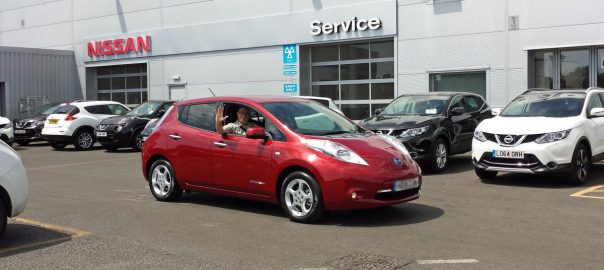
Nissan Leaf collection in St Albans (Image: T. Larkum)

Values of used pure electric vehicles surge 11%

Values of used pure electric cars surged 11 over the past year with growing demand and limited supplies hitting the market.

The performance is in marked contrast to the overall used car market which rose just 1.5%.

Whilst internal combustion engines (ICEs) are stumbling, their electric powered counterparts are thriving.

Nissan Leaf collection in St Albans (Image: T. Larkum)

With an average sticker price of £21,560 in April, used alternatively fuelled vehicles (AFVs) grew at a rate of 4.7%, up from last month’s 3.7% and, indeed, the highest rate of growth since August 2018. But the star of the show is pure electric; at £23,361, the highest price to date, EVs are growing at a double-digit rate (11%), according to the latest Auto Trader Retail Price Index.

The surging prices of low-emission vehicles can be attributed to supply and demand. On Auto Trader, the UK’s largest automotive digital marketplace, AFVs currently account for just 1% of stock listed, whilst petrol and diesel account for 52% and 47% respectively.

Read more: Motor Trader

Octopus Energy and IONITY partner to bring ultra-rapid EV charging network to the UK

Octopus Energy and EV charging firm IONITY have announced a partnership which sees the latter’s ultra-rapid charging technology installed in the UK for the first time.

The deal will see Octopus supply IONITY’s 350kW, high power charging (HPC) stations with 100% renewable electricity.

It comes just two months after Octopus Energy launched its Electric Juice service, designed to offer EV charging networks with guaranteed renewable power.

The first ‘Electric Juice station’ is to be installed in Maidstone on the M20, and more sites are planned to open in the coming weeks. More than 40 stations are planned to be installed across the UK by 2020.

Zoisa Walton, director at Octopus Energy for Business, said that the company was committed to bringing a “fundamental change” to the country’s electric vehicle landscape.

“By improving the affordability, practicality, convenience and green credentials of e-mobility options, IONITY and Octopus Energy are making EV ownership more accessible. Both companies are intent on providing for the future, with forward-thinking plans and technology – pushing boundaries to deliver the fastest, cleanest, most affordable charging power on the market,” she said.

Read more: Current News

Mercedes-Benz EQC (Image: Mercedes-Benz)

Has the country that invented the car fallen behind on tech?

The relief was palpable from Berlin to Munich when Germany – announced its latest GDP figures.

After months of gloom, modest growth of 0.4pc in the first quarter was heralded as a sign Europe’s largest economy might weather the global slowdown better than most experts predict.

For the first time in six months, Germany is growing again, and the figures follow last week’s announcement that exports rose unexpectedly by 1.5pc in March.

That such lean figures are seen as something to celebrate is a clear indication of how Europe’s industrial powerhouse has slowed – and behind the numbers lurk unpalatable truths.

That there is any growth is down to the service sector and a construction boom fuelled by housing shortages.

Mercedes-Benz EQC (Image: Mercedes-Benz)

The manufacturing sector that is the engine of the German economy, in particular its fabled car industry, is in trouble. Automotive orders fell 5.3pc in the first quarter. In mechanical engineering, the outlook is more bleak, with orders down 7.3pc.

But its growth strategy is built around industrial exports, and that has left it exposed. The car industry – the jewel in Germany’s economic crown – has been through a torrid time since the emissions scandal in 2015, when Volkswagen admitted it had installed software in millions of cars to help cheat emissions tests.

This year EU regulators accused BMW, Mercedes-Benz owner Daimler and VW of colluding to block the development and introduction of clean air technology, raising the spectre of multi-billion euro fines.

Already facing expensive recalls, carmakers have run into the growing wave of diesel bans as cities struggle to bring air quality within EU limits. In Germany alone, Berlin, Hamburg, Munich, Stuttgart and Frankfurt have outlawed older diesel cars.

VW announced investment in a new battery cell production plant this week but German carmakers lag far behind US and Chinese rivals in battery technology. The country that invented the car is rapidly falling behind.

Read more: Stuff

Horns of plenty: concerns raised about electric car alert systems

EV engine might be silent, but an EV traffic jam could be deafening

Scientists are sounding the alarm about potential hazards associated with tones, whirs, beeps, or other sonic-alert systems by which electric and hybrid-electric vehicles generate artificial noises to announce their presence.

These warning signals — technically referred to as acoustic vehicle alerting systems (AVAS) — are being instituted in Europe and the US, and are designed to alert pedestrians, especially those who are blind or vision-impaired, to the ultra-quiet vehicles.

They operate whenever the vehicle is moving below a certain speed, generally between 20 and 30 kilometers per hour. At higher speeds, even the quietest vehicles generate enough tyre noise for warning signals not to be needed.

It sounds like a good idea, but there’s a downside.

“A lot of people are not very happy about these sounds,” says Klaus Genuit, a psycho-acoustic expert and founder of HEAD acoustics GmbH, a German company that provides sound and vibration analysis to a number of clients, including the automobile industry.

Overall, he reported at a recent meeting of the Acoustical Society of America, in Louisville, Kentucky, “more than 50% of people complain of traffic noise. Electric cars could be a good tool to reduce traffic noise, but if we add traffic warning signals, it could become worse.”

One of the biggest problems, he says, is that in designing these signals, researchers are working under the implicit assumption that only one car will be emitting them at any given time.

But in an urban setting, with a lot of slow-moving vehicles, that simply isn’t realistic. Instead, Genuit says, there could be many cars creating a cacophony of different sounds that might clash unpleasantly.

Read more: Cosmos Magazine

Are Electric Vehicles Really Better For The Environment?

Since the first modern electric vehicles (EV) took to the roads in the 2000s, critics have been quick to question the ‘clean’ label attached to them

From manufacturing concerns to battery power sources as well as overall autonomy, EVs have been under scrutiny from sceptics. With the amount of debate and misinformation troubling the waters, the facts behind the efficiency of electric vehicles have become somewhat clouded – so just how clean are these vehicles?

Battery Production

An argument that is routinely put forward to contrast the clean image of electric cars is the pollution behind the manufacturing process of their batteries. There is indeed a range of rare earth metals that make up the composition of the battery, and their extraction and manipulation can contribute to carbon emissions. However, as a 2018 International Council on Clean Transportation (ICTT) report illustrates, the country in which the batteries are being produced as well as the battery composition has a much higher level of impact on emissions.

A comparative study between EVs and internal combustion engine vehicle (ICEV) in China corroborates the ICTT report, indicating that infrastructure and efficient manufacturing techniques are the keys to reducing emissions during production. Chinese EV battery manufacturers produce up to 60% more CO2 during fabrication than ICEV engine production, but could cut their emissions by up to 66% if they adopted American or European manufacturing techniques. As such, the pollution created through the extraction process and production of batteries remains on par or slightly higher than the manufacturing process of petrol or diesel-based engines.

Read more: Forbes

The urgency of the shift to electric cars isn’t just about climate change

Vehicle emissions regulations are meant to promote clean air and reduce carbon dioxide in order to combat climate change.

In Europe, aggressive new rules are also a direct response to a massive diesel-emissions scandal, accelerating the shift to electric vehicles, said Renault CEO Thierry Bolloré.

The tightening of emissions limits has created huge tension in the automotive industry, Bolloré said in Paris at Viva Technology, a flagship European tech conference this week. In 2017, the European Commission proposed reducing CO2 emissions for new cars and vans by 30% in 2030, compared with levels in 2021. The aggressive rules are seen, in part, as an attempt to regain credibility after regulators failed to prevent Volkswagen and other automakers from cheating existing standards.

Bolloré said he was surprised by the backlash on emissions rules following the “dieselgate” scandal: Volkswagen admitted in 2015 that software was used to cheat on pollution tests for as many as 11 million of its diesel vehicles. Later, a host of other automakers, including Renault, were reported to have made diesel vehicles that produced more pollution than tests seemed to indicate.

“It’s not fully rational,” Bolloré said of the regulatory response, which is reshaping the industry. He added that it’s giving a boost to electric vehicle development, and that the French car giant he runs is already making a “modest” amount of money from its electric-vehicle business. (Bolloré also credited Tesla’s efforts to build mass-market electric cars as a kind of revolution for the industry, but noted that the company is having a hard time making money.)

Read more: Qz