Category Archives: Niro EV

Hyundai Kona Electric (Image: Hyundai)

EV sales stalling as customers left waiting more than a year for a car

Britain’s electric vehicle revolution is being hampered by a “bottleneck” in global battery production, as demand far outstrips supply of zero-emission vehicles.

An investigation by the Press Association found that some dealers were telling customers they could be waiting more than a year if they placed an order for an EV today, with some manufacturers confirming they couldn’t guarantee the number of vehicles coming to the UK in the future.

Kia and Hyundai appear to be the worst affected, with the former’s e-Niro and latter’s Kona and Ioniq Electric experiencing 12-month-plus wait times.

Hyundai Kona Electric (Image: Hyundai)

Jaguar, Tesla, Nissan, Smart, Audi and Volkswagen are all also experiencing delays with their electric vehicle offerings of between two and five months.

A Kia spokesperson blamed global demand and battery supply, calling the e-Niro “a victim of its own success” and adding that the South Korean firm’s 2019 UK allocation of about 800 cars sold out within two weeks of going on sale in January.

He said: “The simple fact is our battery suppliers cannot make battery packs quickly enough for the demand, and if we haven’t got battery packs, we cannot sell the cars.”

Both Kia and its sister company Hyundai said they were taking reservations for 2020 deliveries and would contact interested customers once pricing and delivery time frames were clearer.

Read more: Evening Express

Hyundai Kona Electric (Image: Hyundai)

Kia e-Niro versus Hyundai Kona EV: which of these ostensibly similar electric cars is the best?

The modern history of electric cars can be defined by five crucial models.

First came the G-Wiz in 2001, a slow and unsafe contraption which everybody laughed at but which nevertheless cemented the plausibility of EVs in Britain’s collective consciousness.

Next came the Nissan Leaf, and with it the notion that battery-electric cars could actually be quite good. And then came the Tesla Model S, which confirmed all of the above, but added the sort of desirability we had previously only expected from large-displacement petrol engines.

Then, a few months ago, came the Hyundai Kona EV and the Kia e-Niro. Eighteen years after the G-Wiz whirred into our world, the electric car has come of age.

Obviously there have been other electric cars – I particularly like the Jaguar I-Pace and the BMW i3 – but the Hyundai and the Kia offer a specific mixture of affordability, practicality and versatility that make them family-friendly in a mainstream sense.

The number of households that could rely on one of these cars as their primary vehicle is much higher than the pricey Jag or the tiny i3.

We discuss these cars in the same breath because they’re so similar. Hyundai and Kia are closely related, and the mechanical underpinnings of the e-Niro and the Kona EV are very similar.

Their performance is comparable, and the logistics of their electric powertrains is almost the same; they can travel roughly the same distance before needing to be recharged, and that process takes the same amount of time for the Kia as it does for the Hyundai.

Read more: MSN

Kia e-Niro EV (Image: Kia)

All-electric Kia e-Niro sold out after a month on sale

The initial UK production run of 900 Kia e-Niros has already sold out, and new orders will be delayed due to a supply chain bottleneck

Kia has sold all 900 e-Niros allocated for the UK market in 2019 in a matter of weeks. Lead times are set to increase for future orders, with the next batch of e-Niros not being set to land in the UK until 2020 due to a manufacturing bottleneck.

Demand for the all-electric Kia e-Niro, as well as its sister-model the Hyundai Kona Electric, has been greater than expected. As a result, the firms’ battery suppliers (which include Samsung and LG) have been unable to cope with the e-Niro’s production volumes, despite doubling their outputs.

Deliveries for the new Kia e-Niro were supposed to commence in April. However, as a result of the e-Niro’s popularity and the production bottleneck, buyers who managed to snag one of the initial 900-model run may have to wait until the end of 2019 before taking delivery.

Read more: Auto Express

2019 Kia Niro EV First Review

  • New electric Kia Niro has a 239-mile range
  • 64-kWh lithium-ion battery, 201-horsepower electric motor
  • Full recharge in under 10 hours with 220-volt AC charger
  • DC Fast Charger gives 80 percent in 75 minutes
  • On sale by late February
  • Sold in 12 states
  • Pricing expected around $37,500

The Kia Niro, when it arrived in 2016, was designed to accommodate a variety of electrified powertrains. The Niro hybrid came first, followed by a plug-in hybrid (PHEV) version in 2017 and now the fully electric model. KBB recently drove this 2019 Kia Niro EV, which goes on sale soon in 12 U.S. states and has an EPA-estimated range of 239 miles. Competitors include the Chevrolet Bolt, Nissan Leaf, Tesla Model 3 and the Hyundai Kona EV.
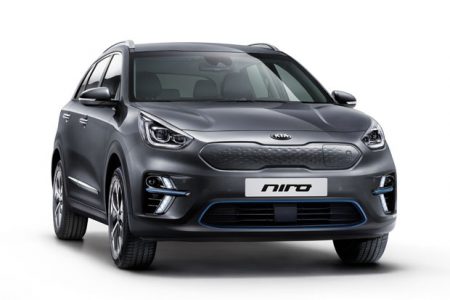
While some people may think of the new Niro EV as Kia’s version of the Hyundai Kona EV, it’s not. Rather, the Niro EV shares its chassis with the Hyundai Ioniq. As such, it has a much roomier back seat than the Kona EV, but as a slightly heavier vehicle it can’t quite match the impressive 258-mile range of the Hyundai, even though it does have the same 201-horsepower electric motor and 64-kWh lithium-ion polymer battery pack.

That Niro EV’s liquid-cooled battery pack — mounted low and flat in the chassis, between the front and rear axles — is huge, so large that one Kia engineer likened it to a queen-size mattress. By itself, it tips the scales at 1,008 pounds, which means it represents more than 26 percent of the Niro EV’s 3,854-pound curb weight. The battery in the Niro PHEV, for the record, weighs only 85 pounds. Ponder that for a few.

How does the new Kia Niro EV drive?

With that big chunk of weight so low to the ground and between the axles (where chassis engineers like it), the Niro EV drives remarkably well. This new electric Kia feels substantial, not the least bit tinny, and it takes corners with minimal body roll and excellent composure thanks to its low center gravity. It’s a quiet car, and there’s plenty of space for a 6-foot-tall passenger to ride behind a driver of the same size.

A rotary-dial controller on the center console is used to engage Drive, and while the front seating position is about an inch higher than that of the standard Niro hybrid, it’s because the whole vehicle is raised, not because the seat has been raised within the 5-seat cabin. The same, though, can’t be said in back, where the battery has pushed up the Niro EV’s floorboard and rear seat a small but noticeable amount.

Power from the permanent-magnet electric motor is good, with enough juice on tap to screech the front tires away from a stoplight and propel the Niro EV to a top speed of 103 mph. Moreover, there are noticeable differences among the four driving modes (Eco, Normal, Sport, Eco+), which tailor the motor response, regen braking, air conditioning, heating and the other systems to satisfy driver tastes.

Read more: Kelley Blue Book

Kia e-Niro EV (Image: Kia)

Kia e-Niro picks up coveted Car of the Year award

An electric car made by South Korean automaker Kia has taken home the prestigious What Car? “Car of the Year” award, beating out contenders like BMW’s 3 series, the Jaguar i-Pace and the Renault Zoe.

It’s the first time the South Korean automaker has won the coveted award, also marking a milestone in automotive history as the first time an electric car has taken home the award.

According to What Car?, the e-Niro won “by knockout” (as opposed to points), saying on its website that “it’s the first sensibly priced electric car that can fit into most people’s lives.”

The battery electric e-Niro, a compact SUV with 455km range (WLTP), which also picked up “Electric Car of the Year” award, is due for release in the UK this April. Pricing was announced last December at £32,995 ($A57,000) after the UK’s plug-in car grant is applied).

Affordability of electric cars remains a barrier to ownership for many – and this was a major factor of consideration for the What Car? judging panel.

“Uncompromised electric car ownership has, so far, been the privilege of those able to afford a Tesla, which is why the e-Niro is such a game-changer.”

Other models in the running included the Jaguar i-Pace and Renault Zoe.

“While the Renault Zoe deserves credit for offering a decent range for less than £20k, and the I-Pace for giving Tesla buyers a better option, we think Kia’s success in making a long-range electric car that’s within the reach of many deserves the most credit,” the judges said.

Read more: The Driven

Kia e-Niro EV (Image: Kia)

Kia e-Niro SUV (2019 – ) review

The Kia e-Niro is a five-door small electric SUV which will be competing with the likes of the Hyundai Kona electric, Nissan Leaf, Hyundai Ioniq and smaller Renault Zoe.

Arguably, the two biggest buzzwords in motoring right now are ‘SUV’ and ‘electric’. The Kia e-Niro is both, which means it’s probably on to a winner. The size and range of the e-Niro, along with its reasonable price, make it a very tempting package, that could sway some reluctant folk towards electric motoring. It does have a very credible rival in the Hyundai Kona electric, though.

The e-Niro is a small SUV, but its styling makes it look more like a raised-up estate car than a chunky off-roader. The electric version of the Niro has a few design features to differentiate it from the hybrid and plug-in hybrid variants, but it has been kept relatively conventional, and doesn’t look too futuristic. As it’s an electric car, the grille is closed off, and this is where the integrated charging port is. It also has redesigned air intakes, new LED daytime running lights, and a few blue trim highlights about the place. As well as redesigned front and rear bumpers, the e-Niro comes with new 17-inch alloy wheels.

The e-Niro’s interior is pretty conventional, too. If you’ve been in any other new Kia, you’ll recognise the solidly built interior. You’ve got some nice soft-touch plastics on the dashboard and in all the important places, but there are some hard, grainy plastics further down in the cabin.

Like the exterior, there are a few bits exclusive to the e-Niro. The most obvious is that there’s no traditional ‘gear stick’, which has been replaced by a rotating dial drive selector. That same panel houses buttons for the electronic parking brake – compared with the foot-operated parking brake of the hybrid – heated seats, heated steering wheel, parking sensors and the auto-hold function.

Design wise, there are some bright blue trims, along with some subtle mood lighting and high-gloss black panels (which will quickly get covered in fingerprints) on the doors.

The 8.0-inch infotainment system is easy to use from the driver seat, with clear graphics and logical menus. It’s better than the system in the Hyundai Kona electric and Renault Zoe, and as easy to use as the Nissan Leaf’s system.

Read more: Auto Trader

2019 Kia e-Niro review: the family EV that banishes range anxiety

Earlier this year, we were seriously impressed by the new Nissan Leaf. The original mainstream electric car had, in second-generation guise, moved the game on again. Those seeking a (relatively) affordable EV need look no further.

But it’s a sign of how quickly the electric car market is developing that the new Leaf has already been outsmarted by a brand-new electric car from Kia: the e-Niro. The firm is very excited by it, and says it simply won’t be able to meet expected demand when it goes on sale in April 2019.

Why the excitement? Because, unlike the now-meagre 40kWh battery pack in the Leaf, it offers a far greater capacity of 64kWh. The range improves accordingly: in latest-era WLTP testing, the Leaf achieves 168 miles. The e-Niro can cover 282 miles. That’s a vast, 114-mile advantage.

Of course, it costs more – adding capacity to batteries is expensive – but it’s not as pricey as you’d think. After the Plug-in Car Grant, the Leaf costs from £26,190, or £29,390 in top-spec guise. Kia’s only selling the e-Niro in range-topping First Edition form – for (post-grant) £32,995.

For early adopters, more range is more important than paying less. Kia already has an enormous advantage here. And, as we’ll see, it’s not the only area in which the e-Niro betters the Leaf.

First impressions

The Kia Niro has been on sale for a couple of years, first as a hybrid and later as a plug-in hybrid. The e-Niro is the third electrified version – making it the only crossover SUV on sale with three choices of alternative fuel power.

It sits neatly between the Ceed family hatch and the Sportage SUV. Length of 4,375mm makes it 115mm shorter than a Leaf, but it’s wider and taller. It’s visually squarer too, a more space-efficient shape than the angular Leaf, with contours on the sides taking the edge off its boxiness.

You can tell an e-Niro apart from a regular Niro because the electric version has new front and rear bumpers. The front end has lots of blue accents and ‘arrowhead’ daytime running LEDs. It also has a closed-off grille, into which the charge socket is integrated. Polished 17-inch alloys are standard.

Read more: Motoring Research

Kia e-Niro EV (Image: Kia)

Kia e-Niro review

The Kia e-Niro is our favourite electric family car. It’s a great compact SUV with a 282-mile official electric range and an affordable price

The Kia e-Niro is a compact family SUV with a claimed 282-mile range (on the WLTP cycle) from a 64kWh lithium-ion battery pack, and single electric motor that powers its front wheels.

If any of this is ringing any bells, that’s because it’s a non-identical twin to the Hyundai Kona Electric, which has shaken up the electric-car market by offering virtually double the driving range of almost any other model in the £30-£35,000 price range. That range is no hollow marketing line, either; we saw 250-260 miles in varied driving, including regular stints on the motorway.

The Kia e-Niro differs from its Hyundai sibling in that it’s a fraction larger and more spacious in the rear seats and boot, and is also only available in one high-spec trim that includes everything from leather seats to a full suite of advanced driver aids. It’s also only available with this large battery pack, whereas the Hyundai offers the choice of a cheaper, 200-mile-range car.

Charging is done using a CCS or Type 2 cable that fits into the port in the car’s nose, hidden behind that conspicuously vent-free, solid nose that’s becoming a telltale sign of many electric cars. Standard cables include a Type 2 public charging cable and a three-pin plug for charging from a wall socket at home. As with any car featuring a large-capacity battery like this, the latter method will be torturously slow, with a full top-up taking some 29 hours. A dedicated 7.2kW charger of the sort that most electric-car drivers will have fitted at home, and are often found in car parks and town centres, will do the same in around nine hours.

Find a 50kW rapid charger in a motorway services and you’ll get an 80% charge in 75 minutes, while the e-Niro is also capable of taking a 100kW charge (chargers of this performance will start to appear in 2019), which will do the same top-up in under an hour.

Read more: Driving Electric

Kia e-Niro EV (Image: Kia)

DrivingElectric 2019 Car of the Year is the Kia e-Niro

DrivingElectric has named its first Car of the Year, the Kia e-Niro, at the first ever DrivingElectric Awards

Our inaugural awards have been won by the all-new Kia e-Niro, and it’s not hard to see why. This pure electric, compact family SUV gets a range of 301 miles, and promises to be comfortable and great value when sales start later this year.

Other success stories from the Driving Electric Awards include the Jaguar I-Pace, our best large electric car for 2019, while the Hyundai Ioniq Plug-In and the Volvo XC60 T8 won the compact and large plug-in hybrid awards respectively. Toyota and Lexus took the prizes for conventional hybrids with the Toyota Prius and Lexus RX winning in the compact and large categories for non-plug-in cars.

Read more: Driving Electric

Kia e-Niro EV (Image: Kia)

Kia Niro EV offers over 300 miles of real world range for half the price of its rivals

KIA has confirmed that the new Niro EV’s real-world range which rivals the likes of Tesla and beats car such as the new Jaguar I Pace, Audi e-Tron and Mercedes EQC but will cost half the price.

Kia has confirmed the impressive real world range for the new Niro EV.

It will be able to achieve range of up to 301 miles on a single charge when it goes on sale towards the end of 2018.

Powering the car is a high-capacity 64 kWh lithium-polymer battery.

Its range was confirmed on the WLTP combined cycle. On the WLTP ‘urban’ test cycle, the e-Niro is capable of travelling for up to 382 miles (615 km) – further than many petrol cars.

Kia has also optimised the battery to be able to use a ‘fast charger.’

When plugged into a 100kW fast charger the Niro’s battery pack can be recharged from zero to 80 per cent in just 54 minutes.

There is also a smaller 39.2 kWh battery pack variant which produces 193 miles of real-world range on a single charge.

Models equipped with the 64kWh battery pack are paired with a 150 kW (204 ps) motor, producing 395 Nm torque.

This allows the vehicle to sprint from zero-62mph in just 7.8 seconds.

Standard 39.2kWh battery pack variants are paired with a 100 kW (136 ps) motor, also producing 395 Nm torque.

It enables the car to travel from zero-62 mph in 9.8 seconds.

The car is expected to costs around £30,000 when it goes on sale which makes it over half the price of a lot of its rivals including the Tesla Model X, Jaguar I-Pace, Audi e-Tron, and Mercedes EQA.

Read more: Express