Category Archives: Energy and Climate Change

News and articles on climate change, vehicle pollution, and renewable energy.

Solar-plus-storage: 3 reasons why they’re better together

Adding storage to your commercial on-site solar power asset is a numbers game. When you save on your overall electricity bill, you definitely come out ahead. Here are three reasons to add storage to your solar PV:

Reason #1: Use solar when you need it most (even if it’s cloudy)

Most utilities have time-based rates for commercial and industrial (C&I) customers, which means you pay more when the grid is delivering at its peak capacity. For summer-peaking utilities, that’s generally late afternoon.

With a storage system connected to your solar array, you can store some of your solar generation when rates are low and discharge the battery to lower your grid-supplied energy consumption when grid power costs rise. This is known as time shifting your energy usage, and it’s a great way to improve the ROI on your solar investments.

Read more: UtilityDive

It’s Time to Go Green!

If you would like to know more about Solar Panels and the PowerBanx range of home battery systems, and get a free instant quote, please complete our online form:

Comment: Connecting EV batteries to the grid is key to solving energy crisis

To solve the energy crisis and green the grid, we need to massively ramp up battery storage to help power the national and international grid; the successful trials of ‘Vehicle to Grid’ technology proves that electric vehicles could do just that, argues Aidan McClean, CEO of UFODrive.

Through charging the vehicle during periods of low energy cost, such as at night, and powering the national grid or home during periods of high cost, users reduced energy costs by at least 40%, some to zero.

Furthermore, charging the car during periods of high renewables generation and powering the home during fossil fuel generation (when renewable sources aren’t producing) allowed for reductions in carbon emissions of at least 25%, with some achieving 100% when timed correctly.


59210374 – beautiful isometric design of energy efficient house using renewable energy and home energy storage

At a similar time, an Open Letter to the European Commission was penned by major market leaders in battery storage technologies. It argued that Europe’s net zero, geopolitically independent energy goals, summed up in the REpowerEU plan, require a huge increase in battery storage infrastructure.

This letter argues that a renewable-powered grid needs a backup energy source when the sun isn’t shining or the wind blowing. Traditionally, this may have been gas, but this is now clearly not feasible due to the EU’s over-reliance on Russian gas supplies.

Read more: fleetworld

It’s Time to Go Green!

If you would like to know more about Solar Panels and the PowerBanx range of home battery systems, and get a free instant quote, please complete our online form:

Copyright: sifotography / 123RF Stock Photo

Octopus Energy and National Grid ESO hail ‘line in the sand’ moment for V2G tech

Octopus Energy Group and National Grid ESO have used electric vehicles (EVs) to help balance the grid in what they are dubbing a first for vehicle-to-grid (V2G) technology.

The ESO directly sent a series of signals to Octopus between 17:00-05:00 over 3-5 August 2022, which then charged and discharged 20 EVs depending on the needs of the Balance Mechanism, helping to balance the system in real-time.

Opel Corsa-e Rally Car (Image: Opel)

“This is a real ‘line in the sand’ moment for V2G tech. We have shown that this technology is capable of helping to balance our future, green grid, to the benefit of people and the planet,” said Claire Miller, director of technology and innovation at Octopus Electric Vehicles.

“We’ve proved what is possible with the technology and cars that are currently on the market, and this is only going to grow. Soon we will have millions of electric cars sitting on driveways capable of storing and exporting green energy back to the grid when it needs it most – and once the vehicle-to-grid proposition is ready to be launched, these cars will help to support our renewables expansion and taking us a huge step closer to net zero.”

Read more: Current+

It’s Time to Go Green!

If you would like to know more about Solar Panels and the PowerBanx range of home battery systems, and get a free instant quote, please complete our online form:

Electric cars to solar panels: tax breaks in Biden’s climate law for Americans

The giant $369bn bill signed by the president on Monday promises to bring big savings by offering tax rebates for green investments

The giant climate bill signed by Joe Biden on Tuesday is set to touch upon myriad aspects of Americans’ lives, helping shape everything from the cars they drive to the stovetops in their kitchens.

Biden has lauded the $369bn of climate spending in the Inflation Reduction Act as the “largest investment ever in combatting the existential crisis of climate change” and predicted it will save people hundreds of dollars each year in energy costs. This claim is based upon a series of investments aimed at shifting buying habits away from a polluting status quo towards cleaner, electrified vehicles and appliances.


A US household could save $1,800 on their energy costs each year, according to a recent estimate, although this would require the installation of electric heat pumps for hot water and air conditioning, replacing a gasoline-powered car with an electric vehicle and installing solar panels on the roof.

But even without these modifications, the climate bill is expected to lower costs by funneling support to renewable energy projects, such as wind and solar, that will provide a less price volatile source of electricity than gas, coal and oil.

Read more:

It’s Time to Go Green!

If you would like to know more about Solar Panels and the PowerBanx range of home battery systems, and get a free instant quote, please complete our online form:

Copyright: maridav / 123RF Stock Photo

Inflation Reduction Act passes the US House of Representatives

The Inflation Reduction Act, which also includes the reform of the EV tax credit, has now passed the House of Representatives after the Senate and is expected to be signed by President Joe Biden in the coming days. The new eligibility requirements will make most electric models ineligible for the tax credit.

Copyright: maridav / 123RF Stock Photo

After the package was repeatedly reduced in the Senate in numerous rounds of negotiations, the vote in the House of Representatives was considered a formality due to the majority ratios there. The same applies to the final signature of US President Biden. Even in its greatly reduced scope, the climate-related expenditure of 369 billion US dollars is the largest climate package ever passed in the USA.

For the tax credit on the purchase of an electric car, the changes are massive – it remains at the maximum $7,500 subsidy amount, but the requirements to qualify for the full subsidy have been tightened enormously. And the requirements will continue to increase in the coming years. The Alliance for Automotive Innovation, whose members include the US corporations GM and Ford, as well as BMW, Mercedes-Benz, Porsche and Hyundai-Kia, estimates that 70 per cent of BEVs and PHEVs will no longer be eligible for subsidies as early as 2023.

Read more: electrive

It’s Time to Go Green!

If you would like to know more about Solar Panels and the PowerBanx range of home battery systems, and get a free instant quote, please complete our online form:

Kia Soul EV 2020 (Image: Kia.com)

Have booming EV sales crossed the mass-adoption tipping point?

Analysts suggest the world could be nearing a critical electric vehicle sales tipping point, when volatile early adoption trends are overtaken by mainstream demand.

It is widely acknowledged that we are not acting quickly enough to address climate change. Global emissions have now exceeded pre-pandemic levels, China and India continue to build coal plants across their countries, and even the EU – long lauded as a climate leader – was told this month it needs to double the pace of its wind and solar roll-out to be on track for 1.5°C.

One area where progress has been pleasingly apace is the adoption of electric vehicles (EVs). Sales of EVs – defined in this article as both battery electric vehicles (BEVs) and plug-in hybrid vehicles (PHEVs) – doubled in 2021 on a year-on-year basis, to hit 6.6 million worldwide. Back in 2012, just 120,000 electric cars were sold.


Kia Soul EV 2020 (Image: Kia.com)

The International Energy Agency (IEA) said in its net-zero pathway that 60% of new passenger cars must be EVs by 2030 for the world to be on a trajectory for net zero by mid-century, with all cars being so by 2050. While sales of EVs only made up 8.3% of cars sold in 2021, projected exponential growth means that EVs are one of the few areas the IEA believes to be on track for net zero 2050.

Read more: EnergyMonitor

It’s Time to Go Green!

If you would like to know more about Solar Panels and the PowerBanx range of home battery systems, and get a free instant quote, please complete our online form:

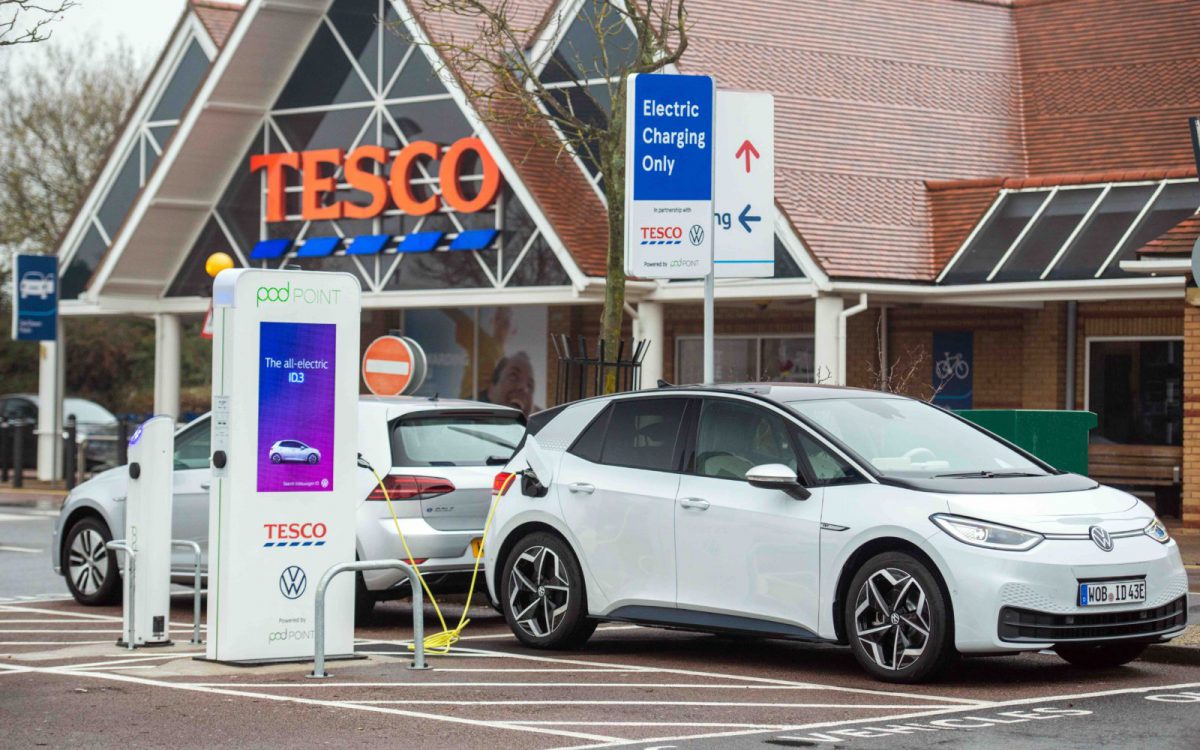
POD Point Rollout at Tesco Stores (Image: Tesco/POD Point)

‘Brilliant’: Electric car owners could charge for free using hack as charging costs rise

ELECTRIC car owners without off-street parking are paying up to £1,320 a year to charge, but a clever hack could allow them to charge for free.

With inflation at its highest in 30 years and public charging costs rising fast, many drivers across the UK may be concerned about their finances in the future. New data has found that an electric car could cost an average driver without access to off-street parking up to £1,320 per year to “fuel”.

This is more than £1,155 more than those with a driveway, based on average charging costs.

This is still cheaper than the cost of refuelling a petrol car, but owners can top up for free, according to Electrifying.com.

Supermarkets including Tesco, Sainsbury’s, Lidl and Aldi all offer free charging at many stores across the country, which could help to offset the rising cost of food bills.

The National Trust also has free charging at 36 of its English and Welsh properties.

POD Point Rollout at Tesco Stores (Image: Tesco/POD Point)

Many hotels across the UK also offer their customers free charging.

In some instances, car dealerships will have charge points which customers will be able to access.

According to Zap Map, as of June this year, nearly 5,500 of the 35,000 public charge points across the UK were free to use.

Read more: Express

It’s Time to Go Green!

If you would like to know more about Solar Panels and the PowerBanx range of home battery systems, and get a free instant quote, please complete our online form:

Electric vehicle breakthrough as UK’s ‘amazing’ progress set to save Britons £12billion

BRITAIN has performed “better than expected” as its electric vehicle masterplan is set to save Britons £12billion, experts told Express.co.uk.

Last week, the independent Climate Change Committee(CCC) released a landmark 600-page assessment of the Government’s various policies and strategies surrounding the energy crisis and climate change. While the report slammed several aspects of the Government’s handling of the energy crisis, particularly surrounding insulation and emissions reduction, experts involved in the report hailed the incredible progress that the UK has made in the past few years, surpassing expectations.

The Government has previously announced plans to ban the sale of all new petrol and diesel cars by 2030, as the report noted that the UK was “on track” to hit this target.

Speaking to Express.co.uk, David Joffe, the Head of Carbon Budgets at CCC, and one of the leads on the report said: “We’re really happy with most of the plans in the sort of road-transport area where electric vehicles seem to be adopted quite widely now.

“We’re optimistic now on the path to every new car being all-electric by 2030, so that’s really positive and the government has policies to ensure that it’s properly funded.

“The latest data says 12 percent of new car sales is electric and that’s more than we expected at this point and that’s growing at this time.”

Read more: Express

It’s Time to Go Green!

If you would like to know more about Solar Panels and the PowerBanx range of home battery systems, and get a free instant quote, please complete our online form:

Europe’s ‘most powerful’ EV charging hub opens in Oxford

Pivot Power has opened Europe’s “most powerful” electric vehicle (EV) charging hub in Oxford, with 42 fast and ultra-rapid chargers.

As part of the Energy Superhub Oxford project, the hub located at Redbridge Park and Ride could scale up to provide charging for 400 vehicles as EV adoption increases.

It will be entirely powered with renewable energy, with 10MW of installed capacity on-site.

“Electric vehicles form a key part of our strategy to decarbonise transport, so I’m pleased to see Europe’s most powerful EV charging hub opening in Oxford,” said Trudy Harrison MP, transport decarbonisation minister.

“Both the Government and industry, working together, are investing billions in projects like this to help provide the infrastructure to support the UK’s electric revolution and soaring EV sales. This in turn will help us decarbonise transport, create high-skilled jobs, and provide cleaner air across the UK.”

Several providers installed chargers at the facility, which has been developed by EDF Renewables subsidiary Pivot Power with the participation of the Oxford City Council, including 10 300kW charging bays from Fastned, 20 7-22kW from Wenea and 12 250kW Tesla Superchargers.

Read more: Current+

It’s Time to Go Green!

If you would like to know more about Solar Panels and the PowerBanx range of home battery systems, and get a free instant quote, please complete our online form:
Vehicle-to-grid charging: could your electric car pay the bills?

EV owners can now charge their cars when energy costs less and then sell back what they don’t use

With the price of electricity through the roof, buying it at a low price during off-peak times and then selling it back at a higher one when demand returns sounds very appealing.

To do this, you need to be able to store your surplus power until the price is right, which is where electric cars, with their large batteries, are essential. It’s why the process is known as vehicle-to-grid or, more modishly, V2G.

The idea is being hotly debated and is regarded, at least by some, as the answer to smoothing out the peaks and troughs in renewable energy supply, making it more practicable and thus reducing our dependency on fossil fuel. The possibility of consumers selling their unwanted renewable energy for a profit is a welcome side benefit, but the real prize, say many, is accelerating the world’s shift to renewables.


Charging with an Ohme smart charging cable

A major step on the road to testing V2G’s viability has just been completed, and the results appear to be positive. Electric Nation, a project involving partners including Western Power Distribution (WPD) and Crowd Charge, a demand management provider, equipped the homes of 100 Nissan EV owners with Wallbox Quasar V2G chargers that charged and discharged their cars’ batteries and gave them a choice of four energy suppliers offering at least two different tariffs, including off-peak.

Read more: Autocar

It’s Time to Go Green!

If you would like to know more about Solar Panels and the PowerBanx range of home battery systems, and get a free instant quote, please complete our online form: