Category Archives: Model S

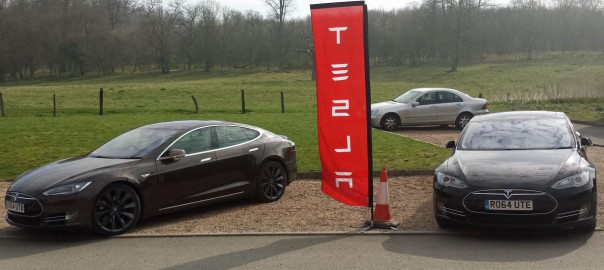
Tesla showroom in Milton Keynes (Image: T. Larkum)

Tesla refreshes Model S with 520-mile range, goofy steering wheel

Tesla unveiled the first major refresh of its flagship Model S electric performance sedan on Wednesday, and it was not an over-the-air update. The interior gets a major overhaul with an airplane-inspired steering wheel and the powertrain adds a third motor in some versions. Top-performance versions will be capable of a 520-mile range and a 0-60 mph time in less than 2.0 seconds, Tesla announced on a quarterly call with shareholders and the media.

Launched for 2012, the Tesla Model S electric sedan supercharged the electric vehicle revolution with an 85-kwh battery pack that provided an EPA-confirmed 265 miles of range. At the time, the Nissan Leaf, which was its main competitor with nationwide availability, had a 73-mile range.

The Model S presaged the reality that blistering performance and high-tech luxury could be packaged in a vehicle with no tailpipe emissions. Tesla juiced performance and range capability along the way, and the 2020 Model S can accelerate to 60 mph in just 2.4 seconds.

Now, as traditional automakers play catch-up to Tesla with dozens of electric vehicles coming to market within the next year, Tesla has reset the bar once again.

Tesla showroom in Milton Keynes (Image: T. Larkum)

The latest Model S range improves from a peak of 387 miles of range in the 2020 Model S Performance model to more than 520 miles in the Plaid+ version, but that estimate hasn’t been confirmed by the EPA. Tesla claims the range-topping Plaid and Plaid+ will have three motors, two on the rear axle and one on the front, generating more than 1,100 hp. That could rocket the Model S to 60 mph in less than 1.99 seconds and a quarter-mile in less than nine seconds, making it the quickest production sedan on the market.

Its estimated range of 520 miles would make the Model S the longest-range electric vehicle, narrowly edging out the 517-mile range on the forthcoming Lucid Air.

The Model S Plaid+ undercuts the Lucid Air’s top version at just below $140,000, and it won’t be available until late 2021. There are two less expensive options for the new model year expected in the first quarter of this year. The American-made electric vehicle maker has been characteristically reluctant to share key details such as the battery pack size and even the model year. The tamer 1,020-hp Plaid model, which itself follows the cheeky naming of hyperspeed modes from the Mel Brook’s spoof masterpiece, “Spaceballs,” has the same “Tri Motor” all-wheel drive setup with a 390-mile range, a 0-60 mph time in 1.99 seconds, and the same 200 mph top speed as the Plaid+. It costs just under $120,000.

The entry-level Model S Long Range is quicker than most other performance sedans out there, for a similar price. For under $80,000, it has a dual-motor setup with one motor on either axle for all-wheel drive that hits 60 mph in 3.1 seconds, and has an estimated 412-mile range and a top speed of 155 mph.

The Model X three-row SUV adopts the same changes as the Long Range and Plaid versions of the Model S.

The most jolting difference in the new Model S might come from inside the cabin, not the propulsion sources that bookend it. Tesla reoriented its large 17-inch touchscreen that serves as a hub for all vehicle functions, from navigation and climate settings to adjusting the side mirrors, from a portrait orientation to a landscape orientation same as in the Model 3 compact sedan.

Read more: The Car Connection

It’s Time to Go Green!

If you would like to know more about Solar Panels and the PowerBanx range of home battery systems, and get a free instant quote, please complete our online form:

Red Tesla Model S (Image: T. Larkum)

Tesla upgrades Model S with 402-mile range

Tesla has upgraded the Model S, its flagship electric sedan, with a new range of 402 miles — thanks to several improvements, including new wheels.

Earlier this year, Tesla released a new “Long Range Plus” version of the Model S with an EPA-rated range that was later updated to 391 miles on a single charge.

Red Tesla Model S (Image: T. Larkum)

The new version of the vehicle was achieved through several small changes over the last year, and Tesla needed to change the name in order for the EPA to give it new rating.

Around the same time, CEO Elon Musk claimed that Tesla is close to having a 400-mile electric car.

During Tesla’s Q1 2020 results, Musk claimed that they already achieved it because the EPA made a mistake when testing the new Model S Long Range Plus.

The CEO claimed that the Environmental Protection Agency (EPA) left a door open with the key inside the vehicle during their cycle test — resulting in the electric car not going to “sleep” and draining the battery a little too much.

The EPA has denied that.

Now a few months later, Tesla is announcing that it achieved an official EPA range of 402 miles:

This significant achievement reflects Tesla’s obsession with efficiency and energy frugality, and is realized through several changes, both iterative and transformational, in core hardware and system architecture development by the Tesla engineering, design, and production teams. These changes went into production earlier this year when we first started manufacturing Model S Long Range Plus at our factory in Fremont, California. All Model S Long Range Plus vehicles will receive the new 402-mile rating.

It should mean that all Model S Long-Range vehicles produced since February should achieve this range.

Read more: Electrek

It’s Time to Go Green!

If you would like to know more about Solar Panels and the PowerBanx range of home battery systems, and get a free instant quote, please complete our online form:
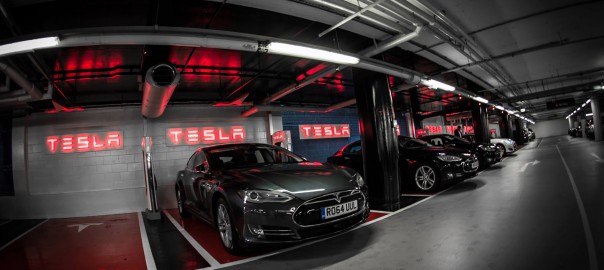
Tesla Supercharging Station at Westfield, London (Image: Tesla)

New Tesla Supercharger Goes Live in UK, Can Add 75 Miles in Just Five Minutes

New Park Royal Supercharger station marks 500th in Europe

TESLA has launched its first ‘V3’ Superchargers in the UK, offering British owners of its electric cars the ability to recharge their vehicles at up to 250kW — equal to 75 miles of range added every five minutes, or a rate of 1,000 miles per hour.

The batch of eight V3 points are located at Tesla’s new Park Royal charging station in London, and sit next to a further eight V2 Superchargers, which, with a peak output of 150kW, are still pretty quick as public charging points go.

Tesla Supercharging Station at Westfield, London (Image: Tesla)

However, the V3 posts have all-new architecture that is not only capable of delivering more kilowatts to the battery packs per second, but also won’t split the power supply between vehicles charging nearby, allowing owners to charge at the maximum power their battery can take.

New software in the cars will also pre-warm the batteries while en route to a Supercharger, which is claimed to reduce average charge times by 25% by ensure they are already at the optimal temperature to receive an ultra-fast charge on arrival.

Read more: Driving

It’s Time to Go Green!

If you would like to know more about Solar Panels and the PowerBanx range of home battery systems, and get a free instant quote, please complete our online form:

Red Tesla Model S (Image: T. Larkum)

3 Reasons Why Even Skeptics are Turning Bullish on Tesla (TSLA)

  • Skeptics of Tesla have turned bullish on the electric car manufacturer.
  • Tesla has matured in 2019, operating more like a traditional automotive company.
  • It’s already too far ahead of the pack in the electric car market, no other company comes close.

The market cap of Tesla (NASDAQ:TSLA) has surpassed the $60 billion mark, supported by the rising popularity of the newly released Cybertruck. The firm’s turnaround has even led skeptics to turn bullish.

Red Tesla Model S (Image: T. Larkum)

Up until October, Tesla was criticized for being a little bit too different from traditional automakers in the way the company handles conferences, earnings and other crucial aspects of the business.

As the company evolved, and so did its market cap, high profile investors like Jim Cramer and Pierre Feragu started to believe that Tesla is now far ahead of the automotive industry. Three reasons support that claim.

1. Highly innovative

Tesla has stood out from its competitors since its inception. The public’s reception of its newest products like the Cybertruck have changed the mind of investors who previously thought such products would only appeal to a niche market.

Jim Cramer, host of CNBC’s Mad Money, said that he was blown away by the demand for the Cybertruck. With an improving balance sheet, beloved CEO in Elon Musk, and an active following, Cramer said that Tesla has all signs of a great company:

Even better, on that last conference call, he revealed his true rigor without the sardonic quips. Musk, it turns out, is a great CEO when he can get out of his own way, and that seems to be what he’s doing. Cult product? Check. Sound balance sheet? Check. Charismatic Leader? Check. If you’re going to invest in a battleground stock, Tesla’s got all the ingredients of a winner.

So far, 250,000 orders for the Cybertruck have been made. That’s equivalent to $25 million in revenue once the cars ship.

Read more: CCN

It’s Time to Go Green!

If you would like to know more about Solar Panels and the PowerBanx range of home battery systems, and get a free instant quote, please complete our online form:

Tesla Model 3 (Image: Tesla.com)

2019 was the year electric cars grew up

Electric cars had their biggest year ever in 2019, even as storm clouds gathered over their future.

The numbers were huge. Automakers committed $225 billion to electrification in the coming years. Electric vehicles (EVs) grabbed 2.2% of the global vehicle market over the first 10 months of 2019 as a slew of new models hit the road. Ford, which has yet to sell an all-electric vehicle, showed off the upcoming electric Mustang Mach-E (a crossover SUV) and an electric F-150 pick-up. Tesla, of course, shocked everyone by turning a profit and previewing a strange future with its “cybertruck,” potentially the Hummer for Millenials.

Tesla Model 3 (Image: Tesla.com)

But it wasn’t all rainbows. Outside of China and Norway, where car buyers enjoy generous incentives, the market is still driven by early adopters rather than the mainstream. EV sales for the year have been sluggish. While some states such as California have seen EVs capture 8% of new sales (all-electric and plug-in hybrid), the rest of the country has not yet caught on. After doubling between 2017 and 2018, EV market share in the US had crept up from 1.6% last March to 1.8% a year later (pdf).

That hasn’t slowed automakers’ ambitions. They’re betting it’s better to get ahead of the now-inevitable shift to EVs than play catch up to established rivals and Tesla. But if demand fails to pick up the big bet may mean consolidation and bankruptcy for some.

Here are the highlights from 2019.

EVs sold even as the car market dipped. The Model 3 can claim most of the credit.

The year started off strong for electric cars. After selling a record 361,000 EVs in 2018, automakers foresaw a robust 2019. Yet for carmakers not named Tesla, sales sputtered out mid-year. Sales for the three dozen or so other EV models on the market declined by an about 20% in 2019 compared to a year earlier, while Tesla’s Model 3 sales tripled between January and September. Tesla represented an astonishing 78% of US EV sales as of October, estimated CleanTechnica, delivering about 123,000 Model 3s, and 30,000 Model S and Model X vehicles. But EVs proved to be a rare bright spot amid what appears to be a long-term decline in global auto sales now entering its third year, what industry analysts call “peak car.”

Read more: Quartz

It’s Time to Go Green!

If you would like to know more about Solar Panels and the PowerBanx range of home battery systems, and get a free instant quote, please complete our online form:

Red Tesla Model S (Image: T. Larkum)

James May: Cars Have to go Electric, Whether You Like It or Not

“I’m convinced that cars ought by right to be driven by electric motors”

WHILE JEREMY Clarkson has gone on record to say he will never, ever buy an electric car, his colleagues on The Grand Tour appear to be more open-minded about motoring minus petrol or diesel.

James May in particular has started to stand out as an especially big fan of zero emission vehicles. As well as owning an assortment of them, including Tesla Model S and leasing a Toyota Mirai hydrogen fuel-cell car (which is also powered by an electric motor), and testing a new electric superbike, he has gone on the record to say that today’s crop of EVs are “already as exciting as petrol-powered cars“.

Red Tesla Model S (Image: T. Larkum)

In fact, writing in today’s Sunday Times, May goes as far to suggest cars will be considerably better once the motoring industry finally decides to ditch fossil fuels for good.

He writes: “We’ve known since we have had the word “car” that the electric motor (which, by the way, predates the internal combustion engine) makes more sense. It’s light, compact, smooth-running, famously reliable, has excellent power and torque characteristics, is easy to produce and is virtually maintenance-free. It’s a bit of a 19th-century no-brainer.”

If those comments weren’t enough for dyed-in-the-wool petrolheads to get rubbed up the wrong way, May adds that he’s convinced cars “ought by right to be driven by electric motors”.

Read more: Driving

Electric cars with the longest range

EV range is a hot topic right now so we’ve listed the new electric cars with the longest range you can buy now…

The first question most people have when a new electric car comes out is how much range it has. ‘Range anxiety’ is a phrase often thrown around to describe the fear EV owners could face when driving their electric car with a level of remaining battery charge that may not get them to their destination. As a result, there’s a certain kudos attached to the electric cars with the longest range as well as a valuable competitive advantage manifested as electric car buyers are attracted to them. If you’re wondering which electric car has the longest range, you can find out below.

Manufacturers have quickly realised the importance of range to existing petrol or diesel car owners and now some electric cars can travel just as far on a single charge as an internal combustion engined (ICE) equivalent can manage on a full tank – all the while producing zero emissions at a cheaper running cost to the owner. The fact that most drivers will very rarely travel the kind of distances in a single day that would deplete a modern electric car’s battery is seen as less important than the need to reassure motorists considering the switch to the new technology.

There’s no doubt that the UK’s charging infrastructure still remains a stumbling block for electric cars and their owners. Charging points are increasing in number across the country and charging times are dropping but the chargers that there are are still often in use compounding the fact that recharging an EV is still noticeably slower than filling up a petrol or diesel vehicle.

With increasing investment from the Government and charging infrastructure providers to improve EV charging options coupled with the appeal of emission-free motoring and cheaper running costs than ICE vehicles, electric cars are more appealing than ever. Manufacturers too are in a race to develop enhanced batteries and electric car technology that will increase the range available in electric cars to the point that range anxiety will become a thing of the past.

Read more: Auto Express

Our very own Tesla Model S – for a while anyway (Image: T. Larkum)

Traveling with an electric vehicle: Making a cost-effective and efficient trip

As recently as 10 years ago, people laughed at the idea of an electric vehicle being a viable mode of transportation for a daily short-haul driver, let alone one who goes on long road trips.

They were mocked as unsafe, unreliable, and able to only travel very short distances before requiring a ton of time to recharge.

Fast forward to today. Technological advancements in batteries used in electric vehicles now allow you to travel long distances. Charging is quick and seamless. And electric car company manufacturers like Tesla have shown they’re a viable (even preferable) alternative for daily drivers, winning awards like MotorTrend’s Car of the Year.

Electric vehicles can also be much more economical. I personally own a Tesla Model S, and it has saved me over $500 a month on gas. Over an 8-year period of ownership, that will add up to $48,000.

Our very own Tesla Model S – for a while anyway (Image: T. Larkum)
Tesla Model S (Image: T. Larkum)

To give you confidence that an electric vehicle can be used for traveling long distances, we’ll go over current trends and options, as well as some of the pros and cons compared to traditional gasoline-powered vehicles.

Electric vehicle options

If you’re thinking about going electric, you can choose between a hybrid car or a fully electric vehicle.

Hybrid vehicles use two different types of power. The most common ones combine a gasoline-powered engine with an electric motor. Some of the most efficient hybrids have a fuel efficiency rated as high as 60 mpg on the highway, according to CarsDirect. That’s a lot higher than the overall average U.S. vehicle fuel economy, which Reuters says is 24.7 mpg.

Fully electric vehicles, however, deliver the most in terms of fuel efficiency. Vehicles like the Tesla Model 3 have been rated as high as 136 mpg equivalent (the EPA energy measurement for electric vehicles), and can save you tons of money you would otherwise spend on gas.

Road trips in an electric vehicle

With technological advancements in batteries, electric vehicles can now go just as far on a charge as gasoline-powered cars can on a tank of gas.

Read more: Million Mile Secrets

Update: Covid considerations for road trips

It’s Time to Go Green!

If you would like to know more about Solar Panels and the PowerBanx range of home battery systems, and get a free instant quote, please complete our online form:
People are starting to buy electric cars for the same reason they buy any other car

The concerns of the average electric-car buyer are starting to look more like those of any other car buyer. Their biggest worry? How much the cars will cost.

Range anxiety, how far an electric vehicle (EV) can travel before needing to be recharged, has topped the list of prospective EV buyers’ concerns for years. And it remains one, especially for those unfamiliar with the technology. But in August, a survey by Autolist, an online car marketplace, ranked range and price in a dead heat (about 40%) as the most important factors concerning buyers. Recharging time and the proximity of charging stations followed as top considerations.

Range anxiety has faded into the rearview mirror for luxury car owners as well. According to another recent Autolist poll, among those deciding between Tesla’s Model S and Porsche’s electric Taycan, range wasn’t even a factor. Instead, brand reputation, performance, charging networks, and styling topped buyers’ list.

Part of the reason for reduced fears is that EVs are shipping with more potent battery packs capable of covering 300 miles or more per charge. The $79,000 Tesla Model S (before tax incentives) promises a 370-mile range, while the 2020 Porsche Taycan ($130,000 estimated) is expected have a range of least 300 miles per charge.

Read more: Quartz

Could an electric car work for your business?

We meet the businesses who’ve taken the plunge by buying Teslas to deliver goods – and find out how they’ve never looked back since

We hear a lot about electric cars being the future of transport, but it’s easy to forget there are over four million vans on the UK’s roads, delivering vital goods to homes, businesses and institutions up and down the land.

But while the number of electric vans on sale continues to grow, there has been a wider choice of electric cars for some time. Similarly, although early EV vans had limited ranges, often of 100 miles or less, Tesla’s Model S could travel up to a claimed 300 miles from launch in 2012.

Now the likes of the Jaguar I-Pace and Audi e-tron have caught up, but for years if you wanted a large EV with a long range, the Tesla was the only real option.

Small wonder, then, that instead of a van, some forward-thinking business owners saw the financial and environmental advantages a Tesla could offer, and took the plunge. Auto Express met the owners of two such businesses to see how an EV works as a delivery vehicle.

Amore Bakery

For seven years, Amore Bakery has been selling personalised cupcakes on a business-to-business basis from its rural Buckinghamshire HQ. And the company’s in-house delivery service has been a tremendous success for owner, Paulo Benfeito.

“Cupcakes are quite delicate,” he says. “If you use a courier service, they often end up getting damaged on their way to the customer. What sets Amore apart from our competitors is that we deliver all of our goods ourselves.”

But Benfeito wondered if there were a way of streamlining the cost of running the delivery side. So, in 2014, he bought a Tesla Model S to join his conventional diesel delivery van. He admits this sounds extravagant, joking: “Often, when we want something, we tell ourselves we need it.”

Read more: Auto Express