Monthly Archives: August 2017

Electric cars to account for all new vehicle sales in Europe by 2035

Falling battery costs to drive sales but European carmakers will lose out to rivals in the US and Asia, forecasts Dutch bank

All new cars sold in Europe will be electric within less than two decades, driven by government support, falling battery costs and economies of scale, a Dutch bank has predicted.

However, ING warned that with battery-powered vehicles accounting for 100% of registrations in 2035 across the continent, European carmakers would lose out to their rivals in the US and Asia who already lead on battery production.

The forecast is much more aggressive than most other projections, such as the UK’s National Grid which on Thursday said it expects 90% of new cars in Britain to be electric by 2050.

France’s commitment last week to banning new petrol and diesel car sales by 2040 suggests it also thinks the roll-out of electric vehicles will be slower than ING’s report expects.

However, the bank said that it believed pure electric cars would “become the rational choice for motorists in Europe” sometime between 2017 and 2024, as their car showroom prices fall, their ranges increase and charging infrastructure becomes more widespread.

By 2024, the report’s authors forecast that in Germany the cost of ownership for an electric car – including buying and fuelling it – would be the same as a conventional petrol or diesel model.

Read more: The Guardian

Fleet in focus: Chargemaster

Chargemaster uses electric vehicles on its own fleet to prove to companies that plug-in cars make good business sense, John Maslen discovers.

The company behind the country’s biggest electric vehicle (EV) recharging network is now using its fleet to prove the significant potential of zero-emission motoring in business.

Chargemaster is used by thousands of private owners, businesses and councils, with more than 50,000 customers across the UK and Europe. In the UK, it operates the Polar network, which has more than 5,000 recharging points.

It is also the official charging partner for most of the leading plug-in vehicle manufacturers, including BMW, Kia, Mercedes-Benz, Mitsubishi, Nissan, Renault and Toyota, along with a range of other fleet providers, such as leasing giant Alphabet.

For Chargemaster’s founder and chief executive officer, David Martell, the company’s own vehicle choice is a public vote of confidence in the future of electric vehicles within the fleet market.

He says:

“We are showing customers through our vehicle choices that we are serious about the potential growth in the market. We are also giving them confidence that plug-in vehicles are a viable fleet choice.”

Chargemaster operates a fleet of around 40 electric cars, including battery electric vehicles (BEV), range-extenders and plug-in hybrid electric vehicles (PHEVs).

They are used for everything from management cars to vehicles for sales staff and pool cars, with models including the BMW i3, Nissan Leaf, Mitsubishi Outlander, Renault Zoe, Vauxhall Ampera, Volkswagen e-Golf and Tesla Model S.

From its Luton headquarters, the company serves customers throughout the country, so different types of technology are allocated for different types of usage.

For example, drivers who cover higher mileages, such as sales staff, will receive range-extenders or PHEVs, while managers with lower mileages can operate BEVs.

Read more: FleetNews

OVO Vehicle-to-Grid (V2G) charging (Image: T. Larkum/Fuel Included)

UK to fund research into letting electric cars return power to grid

Vehicle-to-grid technology could help meet demand for electricity at peak times, with owners paid in money or free parking

OVO Vehicle-to-Grid (V2G) charging (Image: T. Larkum/Fuel Included)

British businesses will be able to bid for £20m of government funding for undertaking research and trials of vehicle-to-grid technology, which officials believe holds “enormous potential” benefits for drivers and the energy system.

The announcement comes on the heels of a week of good news for electric car manufacturers and battery-makers.
Volvo said it was turning its back on cars powered solely by an internal combustion engine, France declared it would ban sales of diesel and petrol cars by 2040 and Tesla revealed plans to build the world’s largest battery storage plant in South Australia.

There are now more than 90,000 electric or plug-in hybrid cars on UK roads, which currently only draw electricity from the grid when owners recharge them overnight at home or for half an hour at rapid charging stations in towns, cities and motorway service stations.

But with vehicle-to-grid, their batteries could also provide services to local power networks and National Grid – returning electricity to the grid at times of peak demand, or filling the gap if the output from windfarms or solar panels were suddenly less than expected.

Read more: The Guardian

Nissan Expects 20% Of Its European Sales Will Be EVs By 2020

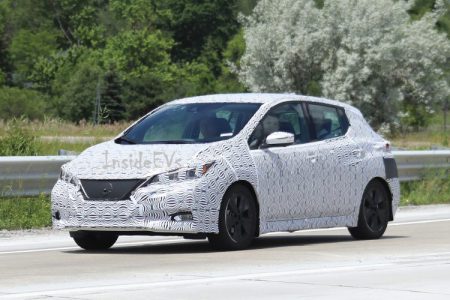
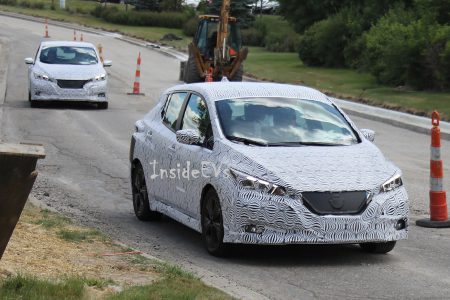
Nissan must be pretty sure of finding success with the next generation 2018 LEAF (which debuts in September), as the Japanese company expects that up to 20% of its new auto sales in Europe to be zero emission in just 3 years time. Nissan has also stated that two more all-electric vehicles will arrive between now and the end of this decade.

2018 Nissan LEAF spyshot

The statement on EV sales in Europe comes from Gareth Dunsmore, Electric Vehicle (EV) Director for Nissan Europe, after the French environment minister hinted at end of gas and diesel sales entirely by 2040.

“By 2020, where the market conditions are right, I’m confident we’ll be selling up to 20 percent of our volume as zero emissions vehicles and this will only grow,”

Dunsmore via Reuters.

What does 20% mean for Nissan in raw sales?

Well, in fiscal year 2016 Nissan sold 735,725 vehicles in Europe, so 20% of that would be more than 147,000 EVs! That’s a lot, but if the new LEAF is reasonably priced, and the new offers are competitive, then it also seems doable at the same time.

As for those “other” offerings: Freshly minted Nissan CEO Hiroto Saikawa has said his company will bring two new all-electric vehicles to market over the next two years, while recently retired Nissan Chief Engineer Shiro Nakamura gave some background on what those new EVs might be, as he said Nissan plans for a BEV sedan and a utility vehicle.

The pending arrival of the new 2018 Nissan LEAF has had little effect on current generation sales…thanks to some deep discounting!

In 2016 Nissan sold some 23,000 EVs (18,500 LEAFs and less than 4,500 e-NV200).

But what do we really like about this 20% figure Nissan is putting out there? It’s the fact that Nissan isn’t just talking about a new EV to being introduced in 2020, or an ambitious fleet goal set for so far away that they can’t be accountable for it (like 10 years from now)…but one that is only some ~30 months away.

Source: Inside EVs

Increased consumer interest helps used electric vehicle values rise 7% says Cap HPI

Chris Plumb, a motoring expert from HPI, said: “Interestingly it appears to be the range extender models which is driving the recent strong performance as values of pure electric have struggled of late.

BMW i3

“The BMW i3 is a popular choice and is a great second-hand buy. It brings a good level of specification and badge prestige.

“The optional range extender can increase the range of the BMW i3 in comfort Mode from up to 125 miles to a total of 206 miles. The small, rear-mounted, quiet two-cylinder petrol engine powers a generator that maintains the charge of the battery at a constant level, so that the BMW i3 can continue to drive electrical.”

The Nissan Leaf with the 30KWh power train is attracting higher used values than the 24kWh as it has a larger range, with an NEDC range of up to 124 miles (Leaf 24kWh) or up to 155 miles (LEAF 30kWh).

Demand for petrol hybrid used vehicles remains high. Used values bucked market trends in June and prices strengthened overall, moving up by an average of 0.2% at three years 60,000 miles.

Certain derivatives performed particularly well such as the Toyota Prius (12-17) Plug-In which increased by 3.9%, Lexus RX (12-16) Hybrid which saw values rise by 2% as too did the Prius+ (12- ) Hybrid.

Source: FleetNews

Will autonomous and electric vehicles kill the petrol station?

Pulling up to the pumps and filling your car with fossil fuels will soon become a thing of the past.

Yesterday, France announced its intention to ban the sale of all petrol and diesel cars by 2040, while manufacturer Volvo have pledged to stop making them by 2019.

Autonomous cars might take a little longer to reach the masses, but they won’t be far behind. But what does the driverless, electric revolution mean for the petrol station?

According to Shell’s head of business development Stuart Blyde, who Professional Engineering spoke to at the recent Frost & Sullivan Intelligent Mobility event in London, fuel providers will have to adapt their offering.

“I think there’s going to be this different animal of what a station will be in the future and how it serves people,”

he says.

“I think there will be a diversification not only around digital and energy, but the products that you’ll serve in the store, whether it’s food, goods or experiences. They’ll need to be far more compelling for people to want to stop and dwell for 15 minutes.”

Instead of filling up themselves and then driving off, drivers will have time to kill while their cars are charging.

In the short-term, a lot of infrastructure needs to be built to support a move towards electric vehicles. Currently, there’s a mish-mash of different charging providers and operators, and different brands have different sockets and connections.

There’s no guarantee that the station you pull up to will have a source of electricity that’s in your price plan, with a socket that works with your car.

“There is more investment in charging infrastructure needed,”

said Lucy Yu, head of innovation at the Centre for Connected and Autonomous Vehicles, at a recent event.

“In more urban areas, people are probably more interested in a faster charge, and less interested in long range.”

Blyde has first-hand experience of that frustration.

“I rented a BMW i3 and drove around London, this was 12 months ago,”

he remembers.

“I stopped when I was being told to stop on the dashboard, at six different places, and at all six places I couldn’t charge up. Either the plug was wrong, the car didn’t work, the infrastructure was switched off and had a sticker on it saying out of use on it. On the road the infrastructure is terrible. At home it’s down to you.”

Read more: Institute of Mechanical Engineers

Is UK really ready for electric car revolution?

Volvo is betting big on the vehicles, but the UK needs to invest in infrastructure to truly bring electric cars into the mainstream.

With Volvo’s announcement that the company is turning to only electric and hybrid engines in its new models from 2019, the industry is taking stock of how the energy network could cope with an influx of electric cars.

The uptake of electric or partly electric cars is already increasing at an impressive rate. Last year the number of registered vehicles rose by more than 50%.

But that’s still only around 100,000 – out of around 30 million cars in the country.

Volvo has bet big that this will change fast.

Philip New from Energy Systems Catapult says in the short term our energy grid should cope, but there could be problems.

“The likely pace of growth is something that the system can absorb for the next few years,”

he said.

“The caveat there is that if there’s clustering where too many people in one street are trying to charge their electric cars at the same time, that could cause a problem for the low voltage network and cause localised blackouts.

“In the future, if we get to penetrations of electric cars that are in the 60, 70, 80% range of take-up, that becomes part of the overall transformation of the energy system that needs looking at.”

Nothing is unfixable, but it will cost money. For example, putting in a thicker or entirely new cable down a cul-de-sac where a lot of residents have electric cars could cost tens of thousands of pounds. The question is who will pay for that?

Other solutions could be to install smart systems either in cars or in homes that help coordinate the charging of vehicles around peak times in the day and night.

Read more: Sky News

The World Is on the Brink of an Electric Car Revolution

The internal combustion engine had a good run. It has helped propel cars — and thus humanity — forward for more than 100 years.

But a sea change is afoot that is forecast to kick gas-powered vehicles to the curb, replacing them with cars that run on batteries. A flurry of news this week underscores just how rapidly that change could happen.

Robots at the Tesla factory in Fremont, Calif. put together electric cars. Credit: Tesla Motors

A quick recap: On Monday, Tesla announced that the Model 3, its mass-market electric car, would start rolling off production lines this week with the first handful delivered to customers later this month. Then on Wednesday, Volvo announced that every car it produces will have a battery in it by 2019, putting it at the forefront of major car manufacturers. Then came France’s announcement on Thursday that it would ban the sale of gas-powered cars by 2040.

All this news dropped just in time for Bloomberg New Energy Finance’s latest electric car report, which lays out why electric cars are the way of the future and when they’re projected to take over the market. The authors said although electric vehicles are currently a tiny fraction of the car market, that market could reach an inflection point sometime between 2025-2030. After that, electric car sales are slated to increase rapidly.

Driven by the falling cost of batteries and the growing number of automakers producing a wider variety of electric cars, Bloomberg NEF expects that electric cars will account for 54 percent of all car sales globally by 2040. That’s a huge uptick from its forecast last year of electric vehicles accounting for 35 percent of all sales.

The shift to electric vehicles will disrupt the fossil fuel industry. The 530 million total electric cars forecast to be on the road by 2040 will require 8 million fewer barrels of oil a day to run.

One of the big pitches for electric cars is their positive benefit for the climate because they reduce the use of oil. But they will require a lot more power from the electric grid. Energy use from electric vehicles is expected to rise 300 times above current demand, putting more strain on power generation.

Read more: Live Science

Milton Keynes 'Mushrooms' Charging Hub (Image: T. Larkum)

When Will Electric Cars Go Mainstream? It May Be Sooner Than You Think

As the world’s automakers place larger bets on electric vehicle technology, many industry analysts are debating a key question: How quickly can plug-in cars become mainstream?

Milton Keynes 'Mushrooms' Charging Hub (Image: T. Larkum)
Milton Keynes ‘Mushrooms’ Charging Hub (Image: T. Larkum)

The conventional view holds that electric cars will remain a niche product for many years, plagued by high sticker prices and heavily dependent on government subsidies.

But a growing number of analysts now argue that this pessimism is becoming outdated. A new report from Bloomberg New Energy Finance, a research group, suggests that the price of plug-in cars is falling much faster than expected, spurred by cheaper batteries and aggressive policies promoting zero-emission vehicles in China and Europe.

Between 2025 and 2030, the group predicts, plug-in vehicles will become cost competitive with traditional petroleum-powered cars, even without subsidies and even before taking fuel savings into account. Once that happens, mass adoption should quickly follow.

“Our forecast doesn’t hinge on countries adopting stringent new fuel standards or climate policies,”

said Colin McKerracher, the head of advanced transport analysis at Bloomberg New Energy Finance.

“It’s an economic analysis, looking at what happens when the upfront cost of electric vehicles reaches parity. That’s when the real shift occurs.”

If that prediction pans out, it will have enormous consequences for the auto industry, oil markets and the world’s efforts to slow global warming.

Read more: The New York Times

It’s a world of worry for oil companies

Volvo Cars CEO Hakan Samuelsson announced last week that all Volvo cars will be electric or hybrid within two years. The Chinese-owned automotive group plans to phase out the conventional car engine.

India hopes to sell only electric vehicles by 2030. China is offering incentives to buy electric cars and investing heavily in renewable technologies. Volvo will scrap the pure internal combustion engine in favor of hybrids and electric cars.

And on Thursday, France announced it plans to ban the sale of diesel and gasoline-fueled cars by 2040.

The world’s major oil companies might disagree when global demand for petroleum will peak, but the news of the past seven months suggests that they should be worried, if they aren’t already. Nations, states and private companies are demanding cleaner energy, leaving the world’s oil producers to face a reckoning that many haven’t yet accepted.

European companies, analysts say, are at the forefront of recognizing this new reality.

Royal Dutch Shell and the Norway’s Statoil foresee peak demand hitting by 2030; others, like the French oil major Total and the British company BP, predict 2040. In contrast, American companies such as Chevron and Exxon Mobil don’t foresee oil demand peaking anytime soon, if ever.

Even as U.S. demand wanes with more efficient cars and changing commuting patterns, companies like Chevron and Exxon Mobil are banking on the rising middle classes of China, India and other emerging nations to buy more cars, demand more consumer goods and suck up the juice that the companies sell.

But recent developments show they may be disappointed. In January, China, already offering incentives for electric vehicles, said it would spend $360 billion on renewable energy. That news was followed by India setting an ambitious goal of electric-only car sales in a little more than a decade.

Around the world, more car manufacturers are offering electric-only models. Last week, Volvo became the first company to plan a complete phase-out of traditional cars.

To be sure, Volvo’s goal of 1 million electric vehicles by 2025 would only cut 20,000 barrels a day in gasoline demand, and it will likely be years beyond that for electric vehicles to make big impact on global petroleum consumption.

Read more: Houston Chronicle