Monthly Archives: January 2017

2017 Volkswagen e-Up review

What is it?

The Volkswagen e-Up is the pure-electric version of VW’s popular Up city car. When it was launched the EV market was still in its early stages, but now, three years on, the alternative-fuel market is bigger and continuing to grow.

The e-Up has received a light update to keep it fresh, but nothing mechanical has changed. The main alterations are a revised front bumper and rear light clusters, and aside from that it’s all very familiar. As such, its claimed range stays at 99 miles and it’s powered by the same 18.7kWh lithium-ion battery pack that generates 81bhp and 155lb ft of instantly available torque. For a full charge, expect a three-point plug to take around nine hours, although a fast-charger will take 30 minutes to provide 80%.

Although electric cars are growing in popularity, the usual caveat applies: the compromises that their limited range and our still-limited infrastructure bring means they have to suit your lifestyle. Still, if you’re after a city car, you’re unlikely to be covering big miles, so is the e-Up the ideal electric car?

What’s it like?

This is no standalone electric model like the Nissan Leaf or BMW i3. Being based on the five-door Up means the e-Up is very familiar in appearance and dynamics.

That’s no bad thing. The Up is one of the best city cars you can buy, so it’s a great grounding to base an electric car on. With instant torque, off the line the e-Up feels much sharper than its petrol-powered equivalent, and its silent cruising makes it relaxing to drive through congested cities.

Read more: Autocar

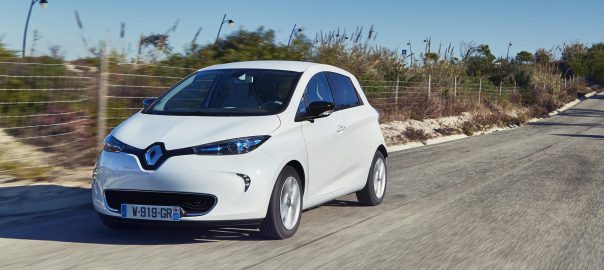
Renault Zoe Signature Nav R90 Z.E. 40 (2017) review

► Upgraded Renault Zoe tested
► New batteries offer improved range
► Rivals the i3, Leaf and e-Golf

Renault’s revamped the batteries in its all-electric Zoe , turning an already excellent little car into a grown-up – one with a claimed 250-mile range, and one that runs rings around the BMW i3, Volkswagen e-Golf and Nissan Leaf.

But as with everything electric, it’s not quite as simple as that…

So it goes for longer? Who wouldn’t be happy with that?

In the real world, Renault reckons this new Z.E 40 version will cover around 190 miles in summer conditions and 120 in the winter, still putting it out of sight of the Nissan Leaf and BMW i3.

This is thanks to a series of battery upgrades, including packaging changes and modifications to the chemical make-up of the cells, resulting in a 41kW battery. The pack itself remains the same size and shape as the 22kW 80-mile range version, which stays in the line-up as a cheaper entry level model. And here’s where it all gets a bit complicated.

Without a doubt, longer range in an electric car is a good thing. It offers up all sort of possibilities, ownership profiles and ways of using the car. But the cost of this new battery tech isn’t cheap: even after the £4500 Government grant the basic entry level price of a 40 is £4500 more than a 22kW car – although it does admittedly also feature more kit. The question effectively is then, then, is double the range worth the extra cost?

Handily, this issue is mitigated to an extent by Renault’s leasing offer, which mean you can lease car and battery together. And why wouldn’t you? There seems no reason to take the risk on the used value of the batteries.

As an early indication of pricing, for a Dynamique Nav (the second-highest model in the range) doing 7500 miles a year it costs of £270 after a £1995 down payment.

Time to get the back of a fag packet out then?

The beauty of running a Zoe is its elegant simplicity; charging at home from a free 7kW wallbox supplied with the car, the point-and-go drivability. But before you get to this point you really do have to test the grey matter and envisage its role in your life and do your sums. Certainly the 40 version is likely to play a more prominent one with its range – and we’ve found with our 22kW long termer that in fuel used you can save way more than £100 every 1000 miles compared to a very economical petrol supermini.

So the more you use it, the more you save, but at the same time the extra cost of the new model counts against that a bit. Put it this way: the 22kW’s price and range makes a brilliant second car, the more expensive 40 version makes it a decent first-and-a-half car, its cost now pitching into choppier waters full of competitively priced conventional cars.

I’m not entirely sure about the top-of-the range specification version either, where shiny leather seats and dark colours add a more sober air to a car that tripped along with a wonderful lightness of touch.

And it now takes six to seven hours to fully charge from a conventional charger, rather than four, although most owners do this overnight anyway – and you can get to 80 percent in an R90 model in one hour 40 minutes when connected to a fast charger.

There’s also a more expensive quick-charge model that takes 65 minutes to get to 80 percent when plugged into a fast charger, but eight to nine hours to full charge from a home point. I do hope you’re keeping up. I barely am myself.

Verdict

After all that you might be thinking that you’re better off with the cheap, short range one – but no! The 40 is a brilliant car. Renault launched this Zoe in Portugal, with the launch route taking in a four-hour drive up the coast road, which snaked up clifftops and down inlets. Bonkers – most EVs get launched in Holland, starting at the top of a very small hill and ending at the bottom.

At the end of this drive, where the car still does everything the Zoe did before, which means zippy acceleration from standstill, tidy steering a restful silent cruising, we still had 80 miles of range left. The level of smugness I felt at this result is at the Trump end of the scale.

The Zoe is the best electric car on the market and the option of the longer range models enhances its appeal even more, but you do need to take your time to work out which suits what you need most.

The big thing is though that now that thanks to the Zoe, the electric car is about to go mainstream.

Source: Car Magazine

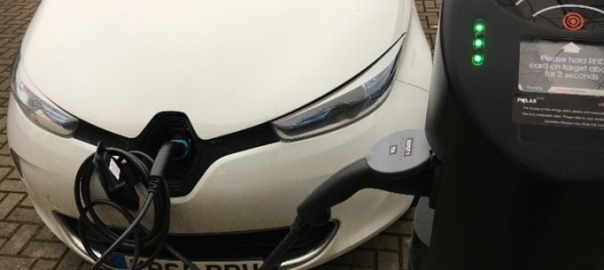
Charging my Renault ZOE in Milton Keynes (Image: J. Pegram-Mills)

How an electric car can work without a home charge point

Enthused by the technology and the idea of being an everyday Eco Warrior, I traded petrol for electric and became part of the EV revolution – despite not being able to charge my car at home! Yes that’s right … I charge my car publicly all the time!

The fact I don’t have an electric charge point installed at home seems to surprise a lot people I talk to about my EV (Electric Vehicle). In most cases it seems they wouldn’t even consider an EV if they couldn’t charge it up at home. I must admit if I were doing long journeys each day I think I would struggle a bit – but I’m not. My Renault Zoe is my ‘run around’ (albeit a High Tech run around). It gets me from A to B and serves exceptionally well as a city car, certainly in Milton Keynes which is a major hub for EV owners.

Charging my Renault ZOE in Milton Keynes (Image: J. Pegram-Mills)

When deciding to go electric I found out I couldn’t have a charge point installed at my home but rather than give up on the idea I started to look into other charging options, there were plenty! And all of these options made me realise it wasn’t actually a necessity and would still be much cheaper than running a petrol car. Fifteen months on I love my Renault Zoe and I do only charge publicly; Charging has become almost second nature when parking my car – it’s simply an additional thing to do like paying for a parking ticket. In fact I do it instead of paying for a parking ticket because electric car parking is free. As a result the cost of charging is actually less than the cost of parking.

So, If you want to go electric but can’t get a charge point installed at home, don’t be deterred – do some research (and FuelIncluded.com helped with this)….

* How often are you likely going to charge your car each week? Look at the real-world mileage range of the EV you are considering against how many miles you travel each week.

* Where is your nearest charge point to Home or Work, and what are the parking and charging terms?

* Check if there are charge points in the areas you regularly visit.

* Find out where your nearest Free charge points are – The Holy Grail!!

* Where are your closest ‘Rapid’ Charge points – these can be a bit more pricey but always great to use as a fall back if you need a full charge fairly quickly.

What’s important is you make charging your EV fit around your lifestyle, rather than make it a chore. Once you familiarize yourself with the Electric Charging Network available to you, public charging can actually work in your favour and you may be surprised to learn of additional perks and cost savings in doing so.

f

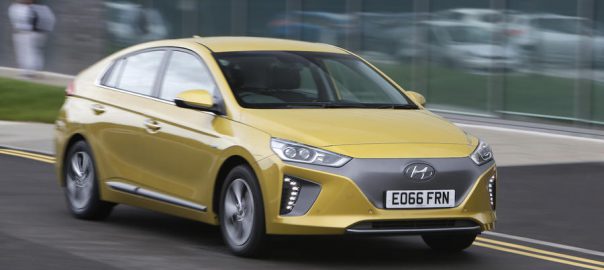
2016 Hyundai Ioniq Electric

What is it?

Apart from another opportunity to make poor Alanis Morissette-based jokes, this is our first chance to drive the all-electric version of the Hyundai Ioniq on UK roads. If that name looks familiar, that’s because we’ve already sampled the hybrid version.

Hyundai Ioniq

With a plug-in hybrid to follow, the Ioniq is a key part of Hyundai’s plan to have 22 ‘green’ cars in its range by 2020. Underneath all three versions is the same platform that underpins the Kia Niro. There’s plenty of high-strength steel to help rigidity, along with aluminium panels and other componentry to reduce weight.

Unlike the Niro and the two hybrid Ioniqs, the all-electric version does without independent multi-link rear suspension, despite costing nearly £29,000 before any government grant. There is good reason for the fitment of a torsion beam rear axle, though. As it’s more compact, Hyundai has been able to shoehorn in a larger battery pack without sacrificing too much boot space.

Indeed, the lithium ion cells have enough juice to give the Ioniq a maximum potential range of 174 miles. Like official fuel economy figures, we’d take that number with a pinch of salt. Even so, you’re still left with enough range to make all but the longest commute viable. The question is whether you’d want to spend an hour or two every day in one.

What’s it like?

With 118bhp, the Electric may be the least powerful Ioniq, but it is, nevertheless, the fastest. A substantial 218Ib ft of torque from rest and no pauses to change gear result in a 0-62mph time that just squeaks under 10 seconds. At urban speeds, the Ioniq feels even quicker than that.

That instant torque can overwhelm the economy-biased tyres, though. In the wet, the traction control has to cut in hard if you try to accelerate quickly. Turn it off and the Ioniq will spin its front wheels all the way up to 35mph.

Not that performance is really a selling point of the Ioniq, more a handy by-product of the electric powertrain. More important is the smooth power delivery and complete absence of vibration from under the bonnet. Like other electric cars, it proves far more serene than a diesel or even petrol engine.

Read more: Autocar

Longer Range BMW i3 on Business Lease


Warning: preg_match(): Compilation failed: invalid range in character class at offset 4 in C:\inetpub\vhosts\fuelincluded.com\httpdocs\wp-content\plugins\maxbuttons\assets\libraries\simplehtmldom\simple_html_dom.php on line 1389

Warning: preg_match_all(): Compilation failed: invalid range in character class at offset 4 in C:\inetpub\vhosts\fuelincluded.com\httpdocs\wp-content\plugins\maxbuttons\assets\libraries\simplehtmldom\simple_html_dom.php on line 694

Warning: foreach() argument must be of type array|object, null given in C:\inetpub\vhosts\fuelincluded.com\httpdocs\wp-content\plugins\maxbuttons\assets\libraries\simplehtmldom\simple_html_dom.php on line 701

Warning: preg_match_all(): Compilation failed: invalid range in character class at offset 4 in C:\inetpub\vhosts\fuelincluded.com\httpdocs\wp-content\plugins\maxbuttons\assets\libraries\simplehtmldom\simple_html_dom.php on line 694

Warning: foreach() argument must be of type array|object, null given in C:\inetpub\vhosts\fuelincluded.com\httpdocs\wp-content\plugins\maxbuttons\assets\libraries\simplehtmldom\simple_html_dom.php on line 701

Fatal error: Uncaught Error: Attempt to assign property "href" on array in C:\inetpub\vhosts\fuelincluded.com\httpdocs\wp-content\plugins\maxbuttons\blocks\basic.php:171 Stack trace: #0 C:\inetpub\vhosts\fuelincluded.com\httpdocs\wp-content\plugins\maxbuttons\classes\button.php(382): MaxButtons\basicBlock->parse_button() #1 C:\inetpub\vhosts\fuelincluded.com\httpdocs\wp-content\plugins\maxbuttons\classes\button.php(476): MaxButtons\maxButton->parse_button() #2 C:\inetpub\vhosts\fuelincluded.com\httpdocs\wp-content\plugins\maxbuttons\classes\button.php(903): MaxButtons\maxButton->display() #3 C:\inetpub\vhosts\fuelincluded.com\httpdocs\wp-content\plugins\maxbuttons\classes\maxbuttons-class.php(525): MaxButtons\maxButton->shortcode() #4 C:\inetpub\vhosts\fuelincluded.com\httpdocs\wp-includes\shortcodes.php(434): MaxButtons\maxButtonsPlugin->shortcode() #5 [internal function]: do_shortcode_tag() #6 C:\inetpub\vhosts\fuelincluded.com\httpdocs\wp-includes\shortcodes.php(273): preg_replace_callback() #7 C:\inetpub\vhosts\fuelincluded.com\httpdocs\wp-includes\class-wp-hook.php(324): do_shortcode() #8 C:\inetpub\vhosts\fuelincluded.com\httpdocs\wp-includes\plugin.php(205): WP_Hook->apply_filters() #9 C:\inetpub\vhosts\fuelincluded.com\httpdocs\wp-includes\post-template.php(256): apply_filters() #10 C:\inetpub\vhosts\fuelincluded.com\httpdocs\wp-content\themes\twentythirteen\content.php(43): the_content() #11 C:\inetpub\vhosts\fuelincluded.com\httpdocs\wp-includes\template.php(812): require('...') #12 C:\inetpub\vhosts\fuelincluded.com\httpdocs\wp-includes\template.php(745): load_template() #13 C:\inetpub\vhosts\fuelincluded.com\httpdocs\wp-includes\general-template.php(206): locate_template() #14 C:\inetpub\vhosts\fuelincluded.com\httpdocs\wp-content\themes\twentythirteen\archive.php(42): get_template_part() #15 C:\inetpub\vhosts\fuelincluded.com\httpdocs\wp-includes\template-loader.php(106): include('...') #16 C:\inetpub\vhosts\fuelincluded.com\httpdocs\wp-blog-header.php(19): require_once('...') #17 C:\inetpub\vhosts\fuelincluded.com\httpdocs\index.php(17): require('...') #18 {main} thrown in C:\inetpub\vhosts\fuelincluded.com\httpdocs\wp-content\plugins\maxbuttons\blocks\basic.php on line 171