Monthly Archives: July 2015

US Crude Oil Consumption Peaked a Decade Ago

A world without crude oil is almost unthinkable. And yet, there are indications that such a transition is happening.

OPEC is jockeying for market share. Russia is increasing production and US tight oil producers as well as their Canadian oil sands counterparts have found themselves priced out of the market.

So what is going on?

As humans, we tend to like to place things in neat little boxes. So we look at coal and natural gas and think electricity generation. We look at crude oil and think transportation sector. And all this is correct. But trends are emerging that are likely to turn this on its head. For instance, on shore wind and solar are gaining traction as viable energy production means. Costs are falling rapidly and Lazard now estimates that onshore wind is the cheapest provider of electricity on a levelized cost basis. Solar is not far behind due to a rapid and precipitous drop in costs and is expected to compete with onshore wind as soon as 2018. This means that coal and natural gas will then be the higher cost producers and almost certainly lose market share for electricity generation. Investment going into new capacity additions is already hinting at this trajectory in that investment in renewable capacity has outpaced hydrocarbons each year since 2011. This is occurring globally. Michael Liebreich, founder of BNEF, recently stated:

“The electricity system is shifting to clean. Despite the change in oil and gas prices there is going to be a substantial buildout of renewable energy that is likely to be an order of magnitude larger than the buildout of coal and gas.”

And 2015 started strong right out of the gate. According to FERC, total new generating capacity additions in January and February amounted to 89% renewables, 11% natural gas. March was even stronger with about 94% of new capacity coming from renewables.

Now you may be wondering what this has to do with crude oil. In a word, everything.

It used to be that nothing could compare to crude oil for transportation use. And yet that is changing now. Electric vehicles (EVs) are already cheaper to run than internal combustion engine (ICE) automobiles. The U.S. Department of Energy, using data from the Idaho National Laboratory, estimates that the cost to run an ICE car is just under 16 cents/mile whereas the cost to run an EV is about 3 cents/mile. And EVs are not anywhere near scale so we can reasonably assume that these costs could fall further.

Now suppose that wind and solar continue to gain market share and costs continue to plunge. Those cost savings will be translated into cheaper electricity costs which in turn makes running an EV that much cheaper. And yet EVs are already about five times cheaper than a traditional car. You begin to get the picture. Simple economics tell us that it is in our best interest to buy an EV rather than an ICE automobile. Hence we do not need crude oil to the extent that we have in the past. And crude oil is overwhelmingly used only for transportation.

Automakers like BMW have grasped this reality and have announced that they will no longer make a stand alone ICE automobile by 2022, a mere seven years away. All of their vehicles will be either pure EVs or hybrids.

Interestingly, crude oil consumption in the US has stalled over the past decade. This is attributed to a large degree to greater fuel efficiencies in vehicles worldwide. Demand has essentially flatlined beginning about 2004-2005. At the same time this was happening, shale production began in earnest in the US. As production ramped up in tight oil, supplies flooded into the international market. But this was a market that was already struggling due to lesser demand. With burgeoning supplies, a tipping point was reached last summer and prices began their current plunge.

Perhaps what is most interesting, however, is that the roles played by major actors in this story have changed dramatically in the past six months. OPEC decided to protect market share and not stabilize prices as they had typically done in the past. Indeed for many decades. So why would they choose to change their policy?

The answer is actually quite simple.

If the world is indeed moving away from hydrocarbons then it makes sense if you have abundant hydrocarbon sources, you would want your source to be last to be used.

Tight oil is expensive to produce. So are deep water and oil sands. These are the marginal producers and can fairly easily be removed from the picture with low pricing. We are seeing this happening right now. Interestingly, however, other producers like Russia, which desperately need cash, have stepped up production. According to the Wall Street Journal quoting the IEA:

“…other non-OPEC producers continue to ramp up production. Russia’s output jumped an unexpected 185,000 barrels a day year-on-year in April and Brazilian production was up 17% in the first quarter…Meanwhile, production in China, Vietnam and Malaysia has also shown persistently strong growth. The IEA expects Chinese oil production to increase by 100,000 barrels a day this year to 4.3 million barrels a day.”

This may prove an interesting phenomenon in that producers worldwide are now locked into a battle for market share in a market that may be dying. Only time will tell. But simple economics like cheaper electricity costs speak loudly to consumers. Combine that with cheaper driving costs too and the combination is that much more powerful. And symbiotic.

The days of crude oil’s strangle hold on the transportation market may be coming to an end as incredible as that may seem. Producers appear to be acting like a snake swallowing its tail. They are dumping more and more crude into a market with less and less demand.

Source: Resilience.org
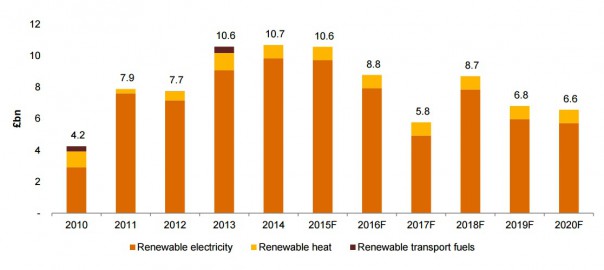
Historical and forecast investment in renewables 2010-20 (Image: PwC)

UK Renewable Energy Investment And Generation Surges In 2014

A new report shows that renewable energy investment in the United Kingdom hit a record high in 2014, with electricity generated from renewables increasing by 20% as well.

In fact, in 2014, not only did renewable energy investment hit a record of £10.7 billion, but renewable jobs increased by 9% as well.

Nevertheless, the authors of the report — PricewaterhouseCoopers (PwC) and Innovas, and commissioned by the UK’s Renewable Energy Association (REA) — are sure to warn that complacency will severely hurt the country’s renewable energy industry, especially in light of future decisions about Feed in Tariffs (FiT), the Renewable Heat Incentive (RHI), and transport.

The specifics of the report include a total electricity generation of 64,404GWh in 2014, up 20% from 53,667GWh in 2013. This news comes only a few weeks after the Renewable Energy Association announced that the UK’s renewable energy industry saw a 9% increase in jobs, with regions such as the East Midlands, North West, London and Scotland showing stronger than average employment growth. These are promising figures for the UK renewable energy industry, with the UK’s 2020 obligations quickly coming up.

“We are delighted that renewable energy sources are becoming an ever greater contributor to the UK’s energy mix,” said Dr Nina Skorupska, Chief Executive of the Renewable Energy Association. “Today’s figures show excellent progress in a number of sectors, both in terms of generation and installed capacity.”

However, according to the REA, the growth rate required to meet these 2020 obligations — 15% of the UK’s energy (including electricity, transport, and heat) from renewable sources by 2020 — currently sits at 16%, one of the highest rates in the European Union.

Subsequently, newly re-elected Prime Minister David Cameron has some serious decisions to make regarding the FiT review and whether or not to extend the RHI, which has only been allocated funding through to April 2016. And according to the REA, “renewable transport remains stagnant” ahead of the UK government needing to make a decision on the Renewable Transport Fuel Obligation.

“But we cannot be complacent,” Dr Skorupska continued. “Our analysis shows that where regulatory and financial support for renewable energy has been stable and sufficient, there has been considerable success, but where there has not, technologies have either stalled or gone backwards.

“In light of the growth rate for renewables needed for the UK to meet its 2020 targets, it is vital that the new government demonstrates the necessary leadership and ambition to enable our industry to thrive.”

The country’s investment figures also surged over 2014, though there are similar concerns over the future of the industry’s investments.

According to the report, 2014 saw investment of £10.7 billion, its highest levels, bringing the total investment into the UK renewables industry up to £50 billion forecast for the end of this year.

Historical and forecast investment in renewables 2010-20 (Image: PwC)

“2014 has been another strong year for investment in the renewable energy sector, bringing the total investment since 2010 to £40 billion,” said Ronan O’Regan, director, Renewables and Cleantech, PwC. “The majority of investment during 2014 was in renewable electricity generation, attracting almost £10 billion of capital, with solar the big winner representing £4.5 billion of investment.

“However, reaching the 2020 targets is estimated to require a further £50 billion of investment, The sector will be looking to the new Secretary of State to provide the investor certainty through to the end of the decade and beyond both in terms of funding and technology preferences.”

Source: Clean Technica

Climate modelling scenarios out to 2100 (Image: Global Carbon Project)

The awful truth about climate change no one wants to admit

There has always been an odd tenor to discussions among climate scientists, policy wonks, and politicians, a passive-aggressive quality, and I think it can be traced to the fact that everyone involved has to dance around the obvious truth, at risk of losing their status and influence.

The obvious truth about global warming is this: barring miracles, humanity is in for some awful shit.

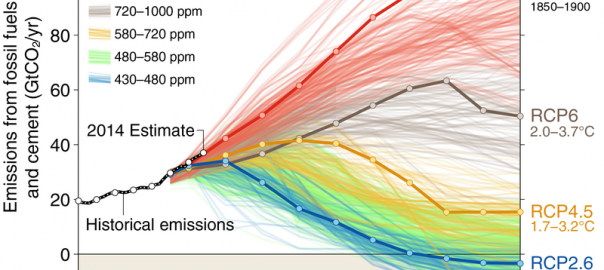
Here is a plotting of dozens of climate modeling scenarios out to 2100, from the IPCC:

Climate modelling scenarios out to 2100 (Image: Global Carbon Project)

The black line is carbon emissions to date. The red line is the status quo — a projection of where emissions will go if no new substantial policy is passed to restrain greenhouse gas emissions.
Related 6 reasons conservatives should take climate change seriously

We recently passed 400 parts per million of CO2 in the atmosphere; the status quo will take us up to 1,000 ppm, raising global average temperature (from a pre-industrial baseline) between 3.2 and 5.4 degrees Celsius.

That will mean, according to a 2012 World Bank report, “extreme heat-waves, declining global food stocks, loss of ecosystems and biodiversity, and life-threatening sea level rise,” the effects of which will be “tilted against many of the world’s poorest regions,” stalling or reversing decades of development work.

“A 4°C warmer world can, and must be, avoided,” said the World Bank president.

But that’s where we’re headed. It will take enormous effort just to avoid that fate. Holding temperature down under 2°C — the widely agreed upon target — would require an utterly unprecedented level of global mobilization and coordination, sustained over decades. There’s no sign of that happening, or reason to think it’s plausible anytime soon. And so, awful shit it is.

Nobody wants to say that. Why not? It might seem obvious — no one wants to hear it! — but there’s a bit more to it than that. We’ll return to the question in a minute, but first let’s look at how this unsatisfying debate plays out in public.

Read more: Vox

The rise and rise of the 2015 El Niño

The Bureau of Meteorology has officially declared that we are in an El Niño, shifting its tracker from ALERT (a greater than 70% chance of El Niño forming) to an actual event.

Speculation began in early 2014 that the world would see an El Niño, possibly a significant “super” event, by the end of that year. However the event development hit a few setbacks, and many thought the El Niño was already dead.

In March this year, US National Oceanic and Atmospheric Administration officially declared that the “most-watched” 2014-15 El Niño had finally arrived. Now our own Bureau has followed suit.

So what’s going on? And how severe could the 2015-16 El Niño turn out to be?
Ghosts of El Niño past

El Niño usually develops over the southern autumn-winter, peaks around Christmas, and decays in the southern autumn.

So this event is unusual as an El Niño would generally be decaying by this time of the year, but observations over recent weeks show otherwise. Sea surface temperatures in the El Niño core region (eastern equatorial Pacific) are actually still warming and the pattern is now looking more like a classic El Niño.

In fact, the warm anomaly over the eastern equatorial Pacific – the typical indicator for an El Niño – has in the past three weeks exceeded 1C. Assuming this El Niño peaks at Christmas of 2015, this recent 1C temperature anomaly is unprecedented during the autumn of all developing El Niño years since at least the early 80s.

We’ve seen a similar size temperature anomaly in the autumn of 1987, but that was in the middle of two, back-to-back El Niño events: the summers of 1986-87 and 1987-88. At that time ocean heat under the surface was already on the decline following the peak of El Niño on Christmas 1986, while sea surface temperatures received a second boost to peak in August of 1987.

This year though it looks like the 2014-15 El Niño is yet to reach its peak. Both the temperature anomaly and amount of ocean subsurface heat are still building. The ocean heat has in fact surpassed last year’s massive value and is now rivalling that during the development of the 1997 super El Niño.

Read more: The Conversation

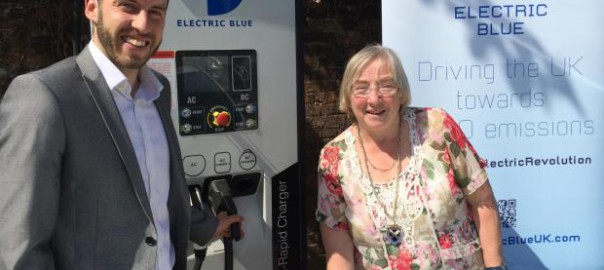
The Deputy Mayor of St Albans, Gill Clark, is pictured with the MD of Electric Blue, Alex Calnan, who is from Redbourn

St Albans switches on the Electric Revolution

The first fully electric taxi and rapid charging point has been unveiled in St Albans.

A new scheme, run by St Albans based business, Electric Blue, is introducing the city’s 300 licensed taxi drivers to the benefits of switching to all-electric cars, which are emission free and more cost-effective to operate than current cars.

The Deputy Mayor of St Albans, Gill Clark, is pictured with the MD of Electric Blue, Alex Calnan, who is from Redbourn

Powered by 100 per cent renewable energy, Electric Blue has also unveiled the first Rapid Charger point in the city centre, located in Adelaide Street, which allows a driver to recharge his cab fully in 25 minutes.

In partnership with St Albans District Council, local Nissan dealer Glyn Hopkin, and other electric infrastructure partners, such as Evalu8 and APT Controls, Electric Blue offers taxi drivers the complete package and the opportunity to trial a taxi before they make the switch.

The first Nissan Leaf EV taxi will take to the streets of St Albans next week, according to Managing Director of Electric Blue, Alex Calnan, from Redbourn, who started the business in 2014.

He said: “Today marks an important step forward in the city’s ambitions to improve air quality for residents, as well as helping to reduce carbon emissions by harnessing electric power on our busy streets.

“We’ve received an extremely positive response from drivers so far and once the first taxi is operational, we expect take up to increase exponentially, as owners and customers see the benefits.”

Last month saw the launch of a Rapid Charger and the first all-electric taxi in Watford and Electric Blue will be expanding its network across a number of major UK towns and cities during 2015.

A recent nationwide consumer survey highlighted St Albans as the worst UK city outside of London for vehicle emissions.

Confused.com surveyed 2,000 motorists and ranked cities on a league table based on average emissions produced by each registered car across the UK, using data from a given postcode.

Source: St Albans Review

Living with the Kia Soul EV

ECO FACTS

Model/Engine size: Soul EV

Fuel: Electric

Fuel economy combined: N/A

Green-Car-Guide rating: 9/10

INTRODUCTION

We’ve already driven the Kia Soul EV at its UK launch, but what is it like to live with, and does it have a more practical range than rivals in real-life?

SUMMARY

• All the normal electric car qualities: very refined, quiet, strong acceleration

• Attractive benefit in kind company car tax and low running costs

• Reasonably spacious, practical shape for an EV

• Limited range may not suit everyone, and subjective styling

BACKGROUND

Having some degree of electrification on our cars is the only way to achieve our emission reduction targets. Plug-in hybrids provide a practical overall driving range, but a small electric range, but pure EVs mean zero-tailpipe emissions – if you can cope with the limited overall driving range. A number of manufacturers are bringing EVs to market, even with the prospect of small sales numbers; the Soul EV is Kia’s offering, and it promises a longer range than rivals, with an individual shape and styling.

DESIGN & ENGINEERING

Two distinct types of electric cars are now emerging – ones that are designed from the ground up as electric cars – such as the Nissan LEAF and BMW i3 – and ones that are standard models with the petrol engine replaced by an electric powertrain – such as the Volkswagen e-Golf, and now the Kia Soul EV, which is built on the same production line as the petrol and diesel Souls.

006-low-res_Kia_Soul-EV_GCG

So this is a regular Soul, but with a 275kg lithium-ion polymer battery bolted underneath the floor and the electric motor (producing the equivalent of 109bhp) under the bonnet.

The rest of the interior and exterior is virtually the same as a petrol or diesel Soul, apart from aerodynamic features such as the blanked-off front grille and special lightweight alloy wheels (the basic Soul body is not the most aerodynamic of shapes). There are also super-low rolling resistance tyres, which can reduce energy consumption by as much as ten per cent compared with regular low rolling resistance tyres.

The electric powertrain has no impact on space inside the car apart from an 80mm higher floor for rear seat passengers, and luggage capacity is reduced by 31 litres to 281 litres to accommodate charging cables under the boot floor.

The Soul EV’s interior heating controls can just be used by the driver only, to save energy. It also has an intelligent heating, ventilation and air conditioning (HVAC) system which includes a heat pump to recycle air that has already been heated or cooled within the cabin. The interior can be heated or cooled while the car is plugged in, so saving battery power on the move.

Kia claims that its battery has a class-leading energy density of 200 Wh/kg and an energy storage capacity of 27 kilowatt-hours, and there’s a heating and cooling system to keep it at an ideal operating temperature.

The Soul EV can be recharged using a standard domestic socket, a wallbox supplied as standard with the Soul EV, a public fast charger, or a public rapid charger. Using a UK 230-volt domestic power supply, the Soul EV can be fully recharged in 10 to 13 hours. With the wallbox or a public fast charge point, the time can be reduced to around five hours. Using a public rapid charger the batteries can be topped up to 80 per cent of capacity in 33 minutes.

KIA SOUL EV DRIVING EXPERIENCE

We previously drove the Kia Soul EV on its launch on a fairly short route in London, and initial impressions were good, but what is it really like to live with over a longer period, as part of everyday life?

We drive a range of different cars every week, including petrol, diesel, hybrids and EVs, and it’s always the EVs that provide the best experience in urban driving. They’re virtually silent, very refined, have great response when accelerating, and with no gears or clutch, they’re easy to drive. However these are qualities that are common to all EVs, so how does the Soul differ?

The key difference is that the Soul does genuinely appear to have a longer driving range than most rivals. We’re not talking about a huge difference, but when you need to cover 80 miles in one day, in a car that has a range of around 80 miles in real-life driving, an extra 10 miles range makes a big difference.

You notice this most when keeping an eye on the remaining range during driving – the range displays of other EVs have a habit of plummeting under many driving conditions, whereas the indicated range left on the Soul EV remains much more constant.

The outcome of the range not plummeting is that you find yourself not having to recharge the car every night – you can go two to three days without charging.

Another practical benefit of the Soul EV is its spaciousness. Although based on a supermini footprint, because it is essentially a square box, it does have more room inside for people and luggage than most other EVs. Having a compartment under the boot floor for cables may reduce some of the official luggage space, but it’s a neater solution than having cables lying in the boot. It has a very clearly laid out dashboard which features an excellent reversing camera.

The Soul EV has a comfortable ride and decent handling, helped by the low centre of gravity due to the batteries, and the steering is well-weighted, but the brakes, due to focusing on regenerating energy, have a different feel to conventional petrol or diesel cars and take a bit of getting used to.

The main issue with the Kia Soul EV is its styling. The ‘normal’ Soul looks perfectly acceptable, however the EV version has features such as the blanked off grille, flat wheel covers, high profile, energy efficiency tyres, and in the case of our test car, blue bodywork and a white roof. Overall this gives the impression of a ‘cartoon car’. This contrasts to the likes of the BMW i3, which has super-cool styling. We would suggest that Kia needs to look at the styling of the Soul EV and make it less ‘eco’ and more desirable for both private and business buyers.

KIA SOUL EV ECONOMY AND EMISSIONS

The whole point of living with the Kia Soul EV for a week was to find out what its range was in real-life, and to see if that was sufficient to live with. The official range of the Soul EV is 132 miles on one charge. Just like the discrepancy between official and real-life mpg figures, the same discrepancy also exists between official electric range and real-life electric range. On average over a week we achieved a range of 82 miles between charges. This is obviously less than the official 132 miles, but is better than some other EVs that we’ve tested, which have only managed around 64 miles in real-life.

We would stress that this range was achieved after typical driving; we’ve achieved a 40% improvement on the official range of an electric car on the RAC Future Car Challenge event, so with very careful eco-driving, we’re fully confident that you could achieve a range of over 100 miles in the Soul EV (in an urban environment rather than in any higher speed driving). The trouble is, there’s usually not the time, the inclination or the traffic situation to drive in an eco-fashion consistently.

Of course the big idea behind pure electric cars is that they have zero tailpipe emissions. It’s impossible to have missed all the stories in the media over recent months about the air quality problems in our cities, with diesel engines being responsible (particularly old diesel buses, taxis and trucks rather than modern diesel cars). Pure electric cars such as the Kia Soul provide a solution to this problem.

However EVs can be accused of just moving the emissions problem from the tailpipe to the power station, so ideally electric car owners would charge their cars using a renewable energy source, which would mean both the car and its energy would be zero CO2.

PRICE, EQUIPMENT AND MODEL RANGE

There’s only one Soul EV model and it costs £24,995 after the £5,000 government Plug-in Car Grant. You can choose between two colours, blue (with a white roof) or silver. Kia will also install a recharging point at your home if you buy a Soul EV – as long as you have suitable off-road parking. The Soul EV is no different from any other Kia in terms of the reassurance offered; it comes with a seven-year, 100,000-mile warranty.

CONCLUSION

So, after a week of living with the Kia Soul EV, would we buy one?

The first consideration has to be whether a pure EV is suitable for your driving needs. Pure EVs are ideal for use in urban areas, where they can help combat issues of air pollution. However off-street parking to allow charging is often a challenge in urban areas. Although an infrastructure of public charge points is being built up, all the statistics show that people mostly charge at home or work.

So although the ideal is that a pure EV such as a Kia Soul is a person’s only urban mode of transport, the reality is that many EVs are bought as a second car, when there is also typically a decent-sized, diesel-powered estate car in the household. In this scenario cars such as the Soul EV are ideal for shorter journeys. The issue is whether the whole life costs stack up, which may be an issue if only low mileages are covered.

From a business perspective, the Soul EV would be ideal for regular short journeys, and the company car BIK tax rate from April 2015 is just 5% (it was zero prior to this date). Although the purchase price is high compared to conventional cars in this class, running costs are very low – around one-fifth of a petrol car.

So, if you think a pure electric vehicle would be suitable for you, should you choose a Kia Soul EV? It has a better real-life driving range than some rivals, and it’s a practical shape. It drives equally as well as other EVs. On the downside, the styling may not be to everyone’s tastes.

So after a week living with the Soul EV, overall it remains a perfectly acceptable car to live with if it’s suitable for your driving requirements, and it offers another choice in the fairly limited pure EV market place; it maintains its original Green Car Guide rating of 9 out of 10.

Source: Green Car Guide

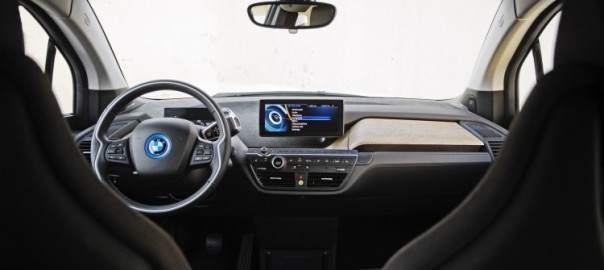
BMW i3 interior

BMW i3 Wins Ward’s 10 Best Interior Award

Only one plug-in vehicle was selected by Ward’s Auto for its “10 Best Interior Award” and that vehicle is the BMW i3.

BMW i3 interior
BMW i3 interior

Here’s why Ward’s deems the i3 worthy of this award:

The i3 electric vehicle comes across as the type of interior seen in concepts at auto shows, often followed by production versions that lose some of the far-out edginess.

The i3 boldly goes where many automakers have yet to tread: deeply into the future. WardsAuto editors pick the i3 for its utility, use of recycled materials and for breaking ground with clever new interior design elements.

From a materials perspective, editors consider the i3 an absolute moonshot, not only for its carbon-fiber tub and thermoplastic exterior body panels but also for the recycled pop bottles and hemp used extensively throughout the cabin and the leather tanned with olive-leaf extract.

It’s a wild, surprisingly roomy interior that manages to be beautiful while fitting with the offbeat exterior

Source: Inside EVs

Renault Cléon announces 100 new jobs to accompany the launch of the alliance’s new electric engine

The Renault Cléon plant will create 100 jobs with open-ended contracts in 2015 as part of a plan announced by Carlos Ghosn on February 12. The plan involves the hiring of 1,000 people in 2015, including 500 in French plants.

More than 50 years after it was built in 1958, the Cléon plant is taking on the production of the all-Renault electric engine, the R 240. Combined with optimised battery management, this engine extends the ZOE’s range to 240 kilometres[1] – a boost of 30 kilometres.

To enable the launch, €50 million were invested from the €300 million earmarked for the plant in 2011. This new technology is part of the Alliance’s electric strategy and will also benefit Renault partners.

100 jobs created

By creating 100 new jobs, the Cléon plant is reinforcing its skills to meet high commercial demand from the Alliance partners. These permanent positions will go to candidates in a range of occupational categories and having varied qualification levels, from vocational training certificates to two-year post-baccalauréat diplomas.

This job creation program follows a training plan developed in 2012, which features approximately 6,000 hours of training in preparation for the production of the R 240. The plan includes general theoretical training on the electric engine for all players involved in the project as well as technical training on the machines, in cooperation with the suppliers, for operators and maintenance staff.

Renault’s acquired electrotechnical expertise serving the alliance

Cléon has been leveraging its experience for a little more than two years with the production of the ZOE Junction Box, the system developed by Renault Technocentre engineers that manages the car’s energy transfers. The Cléon plant has mastered the assembly of electronic modules and gained invaluable experience for the production of the powerful R 240 electric engine. This expertise has made it possible to extend the ZOE’s range to 240 kilometres[1] – a boost of 30 kilometres – and will also benefit Alliance partners.

For the comparable common components of Renault and Nissan engines, the engineering and operating teams drew inspiration from Nissan’s experience in producing the LEAF engine. Cléon also gained from the expertise of local businesses that manufacture electric engines for other purposes.

Recognised industrial activity

The engines and gearboxes produced at the Cléon plant have been a true success which, in the first quarter of 2015, translated into an overall increase in activity and proportionally more business from partners (Nissan, Dacia, Samsung, Daimler, General Motors). These partners accounted for 43% of the plant’s engine and gearbox production in Q1 2015 compared to 37% at end-2014.

In addition to this burst in activity to meet high demand from Renault, Nissan and Daimler, the Cléon plant is also gearing up for several launches. The plant, which already supplies engines and gearboxes for the Trafic, recently delivered the first engines for the Opel version of the van. New vehicles in the Renault range such as the Espace and the Kadjar also benefit from powertrain components produced at Cléon. And the ZOE already features the Alliance’s brand new electric engine, the R 240. These recent and upcoming launches should help increase the site’s manufacturing volumes.

“This is fantastic news for the Cléon plant. These new hires will reinforce Renault’s skills in terms of designing and manufacturing electric vehicles. This activity in France, at the heart of the European market, is part of the Alliance’s electric strategy and will benefit its partners as well.” Stefan MUELLER, Executive Vice-President, Chairman of the Europe Region

Source: Renault Media

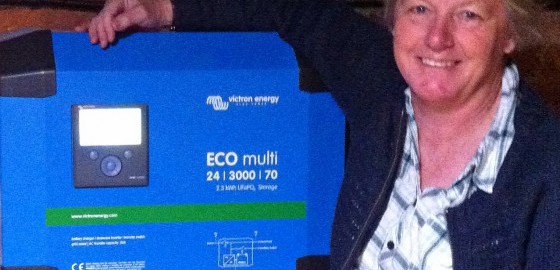
Jill Goulder with lithium battery for storing solar electricity (image: YouGen)

New lithium battery technology to store energy from solar PV panels

A houseowner in Lewes has become one of the first in the area to use state-of-the-art lithium battery technology to store energy from solar PV panels.

Jill Goulder has installed a lithium battery storage system linked to her solar PV panels. These recharge during sunlight hours and provide power in the evenings – very useful for households who use most of their electricity outside sunlight hours.

Jill Goulder with lithium battery for storing solar electricity (image: YouGen)

The system switches seamlessly between battery and mains supply as needed; a good system will cover a household’s normal needs, though major appliances such as washing machines and vacuum cleaners drain the batteries rapidly and will need mains top-up.

Jill says

“Lithium batteries are the new generation of energy storage, and they’re decreasing in price.  My electricity bills are already very low, but I liked the idea of using all the electricity that I generate with my solar PV panels; and it gives me supply security in case of the mains power cuts.”

The system can be monitored online by the user on their own computer, with graphics showing consumption and battery usage throughout the day.

The system is housed in a blue metal box about the size of an airline carry-on bag, bolted to a wall, for example in an attic. The installed price for a small-to-medium system is likely to be £4,000 – £8,000, so it is not for everyone, though it’s becoming a favoured investment for householders with solar PV panels who are looking to take the next energy reduction step. Jill thinks that sooner or later Britain will follow Germany’s lead in providing a subsidy for householders investing in these systems.

Importantly, this particular system will also work in a power cut. Jill comments

“I do know that some companies are selling systems that don’t work during a power cut (and unscrupulously not telling customers), but it was a no-brainer for me to have that – it was a major factor in buying it, as outages are increasing.”

Jill adds

“Do use a reputable supplier for your installation – there are cold callers in this area offering quick sign deals that are less good value than they seem; and check too that the system you buy will continue to work during a power cut. Analyse your electricity use carefully beforehand: when are your peak times for using electricity each day, and can you install more energy efficient appliances or LED lighting? And ask around for advice – in Lewes the Transition Town Lewes Energy Group will be able to help you.”

Jill’s installation is a Victron EcoMulti Hub-2 (2.3kWh storage, 3kVA inverter) installed by Bright Green Energy Ltd of Beckenham, linked to her 1.29kWp solar PV system.

The appearance of Tesla’s new battery solution we wrote about here has not gone unnoticed by Jill. She comments

“I’m simply boggled at seeing front page stories last week in the UK about Tesla unveiling magical new technology which would allow you to store the energy from your solar panels. Hello, storage batteries have been around for 200 years… Certainly lithium is a new, better technology, but Tesla certainly aren’t the first by a long mile.”

On the plus side, she says

“It all helps generally in focusing on storage. As you doubtless know, some sunny countries are pressing solar panel owners to invest in storage as the daily surge into the grid from the panels are causing problems!”

Jill Goulder is an archaeologist and also a SuperHomer. Jill has refurbished her Victorian terraced cottage and achieved a radical 61% carbon saving. See Jill’s SuperHomes page for more about her continuing house improvements including this latest addition of lithium battery technology.

Source: YouGen

Severe Flooding, Against a Background of Wind Turbines: November 2012, Tyringham, Bucks. (Image: T. Larkum)

Extreme El Niño expected to wreak havoc on weather this year

The bad boy of global weather is on its way. El Niño can cause floods, droughts, fires and epidemics around the world, and the next one could be a humdinger.

Severe Flooding, Against a Background of Wind Turbines: November 2012, Tyringham, Bucks. (Image: T. Larkum)
Severe Flooding, Against a Background of Wind Turbines (Image: T. Larkum)

El Niño crashes on to the scene once every four years or so as hot water emerges in the Pacific and moves towards the Americas. This can bring drought to Australia and parts of Asia, while parts of the Americas experience heavy rain, flooding and outbreaks of waterborne diseases. Pacific Islands all the way from Tonga to Hawaii experience more frequent storms. And valuable fish stocks move all around the globe, following water of their preferred temperature.

Many experts are warning of a “super El Niño” this time round.

“We have this enormous heat in the subsurface that is propagating eastward and it’s just about to come to the surface,” says Axel Timmermann of the University of Hawaii in Honolulu. “I looked at the current situation and I thought, ‘oh my dear’.”

Similar forecasts were made last year, too, and proved wide of the mark. This time it’s different. For one thing, we are already in an El Niño year, which makes it easier for an extreme one to form.

“It’s much easier to build up from warm temperatures than from neutral temperatures,” says Timmermann.

Also, this year ocean temperatures seem to be coupled with atmospheric winds in a feedback loop that makes the El Niño stronger, says Wenju Cai at the CSIRO, Australia’s government research agency. US climate models, on average, are pointing to an El Niño comparable to the devastating 1997/98 event, says Timmermann.

Another thing likely to give this year’s El Niño an extra kick is the presence of the Southern Hemisphere Booster. A low-pressure system near Australia that boosts westerly winds across the Pacific, it helps unlock the heat fuelling El Niño, says Fei-Fei Jin of the University of Hawaii at Manoa.

“The chance of a large El Niño is quite large,” he says.

Timmermann says we should be preparing, clearing rivers of debris in flood-prone areas and storing water in drought-prone areas.

“There are lots of win-win things you can do,” he says.

He has already installed hurricane clips on his roof, as El Niño also increases the chances of hurricanes making landfall on Hawaii.

Source: New Scientist