Category Archives: Opinion

Was 2018 the peak for internal-combustion car sales?

Electric-car sales are growing. Total car sales around the world are shrinking.

Put the two together, and the conclusion from many analysts is that sales of cars powered by internal combustion engines around the world have already peaked.

From 2019 onward, they’re likely to do nothing but shrink, according to several automotive analysts interviewed in the Financial Times (subscription required) for a piece published late last month.

The FT quotes several analytics firms forecasting that global auto sales will fall in 2019 compared with a record 95.5 million cars sold in 2018, according to Moody’s Analytics.

There are several factors at play: an international trade war among the U.S., China, and Europe; tighter consumer credit in the world’s largest auto market, China; troubled Brexit negotiations; and tighter European restrictions on carbon-dioxide emissions.

Other analytics firms, including Evercore ISI, Accenture, and Jato Dynamics told the FT that they expect a structural downturn in 2019, based on slower sales in the second half of 2018.

At the same time, sales of electric cars are rising. AlixPartners, a British consulting service, says it expects electric car sales to grow by 1.5 million in 2019, reaching about 1.6 percent of the global market.

“Peak ICE” may already have occurred at the end of 2018, Elmer Kades, global co-leader of AlixPartners’ automotive practice told the FT. “It’s this slowing growth of the overall pie that the industry should be most concerned with, even as it has to … pay for the continuing switchover to electric vehicles.”

Read more: Green Car Reports

Millions could miss out on benefits of electric vehicles

Millions of people could miss out on the environmental and financial benefits of electric vehicles (EVs), according to a new report.

The report by the think tank Localis warns poorer parts of the country could get left behind unless local authorities are given to power to draw up their own ‘smart city’ plans and energy policies.

In addition, it argues local authorities should be able to form their own consortiums using existing knowledge of their local areas, and also be empowered to work with private energy network providers to deliver the infrastructure they need for the future.

The report also emphasised that families across the UK are at risk of sharing the cost for necessary new energy infrastructure, but not being able to access for themselves the benefits of EVs and other ‘smart’ technologies – driving further inequality between richer and poorer parts of the country.

‘Without a change in regulation, behaviour and a wholesale transfer of powers for local energy policies, we risk a tale of two cities in our major urban centres – deepening levels of inequality between the prosperous and more deprived parts of town,’ said Localis chief executive, Jonathan Werran.

‘A ‘devolution revolution’ in locally-regulated energy markets has the potential to accelerate the nation’s switch to clean growth, turn UK cities into powerhouses for sustainable and inclusive prosperity and improve livelihoods in towns and cities across the UK.’

Read more: Environment Journal

Milton Keynes 'Mushrooms' Charging Hub (Image: T. Larkum)

Milton Keynes Mushrooms: A New Generation of Charging Stations

Driving from Northampton to Surrey to visit my family over Christmas I was due to go past the new Milton Keynes Charging Hub so took the opportunity to call in.

The Hub was developed by Milton Keynes Council with a government grant, with the charging infrastructure provided by BP Chargemaster. I had heard on social media that the hub was recently completed. However there’s been nothing in the mainstream press about it – I’m guessing there’ll be an official launch soon.

Milton Keynes 'Mushrooms' Charging Hub (Image: T. Larkum)
Milton Keynes ‘Mushrooms’ Charging Hub (Image: T. Larkum)

It is quite difficult to find. It is tucked away at the far corner of the Coachway bus station (near Junction 14 of the M1) and there’s no signage in place yet. There were fresh road markings in place though.

The location is pretty good, not just because of proximity to the motorway. Being co-located with the bus station means that while you wait to charge there’s easy access on foot to its cafe and toilets (though you have to pay 30p for the latter).

The hub consists of a triangular island with 8 rapid chargers around its edge (why not 9?) all covered over with three large concrete ‘mushroom’ canopies for rain protection. I was there mid-week and it was pretty quiet, however two other EVs did call in even during the short time I was there topping up my i3.

Charging is through BP Chargemaster’s Polar network so requires either the Polar Instant app or Polar Plus subscription as described previously.

BP Chargemaster Rapid Charger at Milton Keynes Charging Hub (Image: T. Larkum)

The Hub is a great idea and seems to be implemented well. It also gives an exciting view into the future of organised EV charging, being potentially a bit like using an airport lounge. It represents another nail in the coffin of fossil fuel motoring – who would want to relax and eat at a petrol station?!

If there’s a criticism it’s just the usual one of uneven rapid charger allocation, and one can hardly blame MK council for taking every opportunity to support EVs. But for sure MK alone has more rapid chargers than anywhere else in the UK, including the entire country of Wales.

Electric cars charging in Milton Keynes (Image: T. Larkum)

Electric cars could herald return of the ‘weekly shop’

An increase in electric car usage could be the saviour of the bricks and mortar retail sector, it has been claimed, as people may visit shopping parks and supermarkets to recharge their vehicles.

The “weekly shop” will see a comeback as drivers, especially those living in city centres who do not have a personal charging point in their homes, combine shopping with a regular charge of their car.

Scottish ministers want to phase out the need for petrol and diesel vehicles by 2032. However, those living in city centres, who do not have access to personal driveways and individual charging points will have to use public points to recharge their electric vehicles (EVs).

Electric cars charging in Milton Keynes (Image: T. Larkum)

Barry Carruthers, head of innovation at ScottishPower, said that people would change their behaviour to find convenient charging points, including potentially ditching online grocery shopping in favour of visiting a physical supermarket where they could charge their car while they shop.

He said:

“A lot of people have recently been shopping online or using local convenience stores a few times a week, but when you have the added need to charge your car, you are likely to go back to a once a week shop at a supermarket where you can do that. We do see a potential renaissance for the weekly shop.”

Mr Carruthers, who has his own electric car which he charges at a range of locations including park and ride car parks at train stations for his daily commute, said:

“As electric cars progress, we could be looking at a range of 200 to 300 miles per charge, which would mean that people would only need to charge their vehicles once a week, which could easily be done while shopping.”

Read more: Scotsman

Cheap Motoring

In the Switch to Electric Vehicles, Expect a Few Giants to Crash

“Every manufacturer feels like, ‘We’ve got to at least have a dog in this hunt or we’ll be completely left behind.’”

The future of the auto industry is going to look like the history of the cell phone. The two even share technology: the lithium-ion battery. As the world’s automakers gradually switch from combustion to charging, some of today’s dominant car companies will share the fate of a few former titans of the smartphone. Remember BlackBerry, Nokia and Palm?

“Who will be the winners in the electric car race? Who knows?” said Mike Ramsey, senior director of research at Gartner Inc. “The incumbents could be, or they could be cut out entirely.”

This transition will play out as a plethora of electric options land in showrooms. In the next two years, an additional 85 battery-powered models will be marketed, bringing the global fleet to 357, according to the latest tally by Bloomberg New Energy Finance. Volkswagen AG is near the front of the pack, promising 20 new electric models by 2020 and another 80 by 2025. Just this month, the German automaker said the internal combustion vehicles being designed now will be its last.

Cheap Motoring

“Every manufacturer feels like, ‘We’ve got to at least have a dog in this hunt or we’ll be completely left behind,’” said Karl Brauer, executive publisher for Autotrader and Kelley Blue Book. “If you ignore it and act like the market is never going to be ready, then you’re setting yourself up for real trouble.”

Being first, however, is no guarantee of success. Honda’s Insight promised a space-age 70 miles to the gallon on the highway when it rolled into dealerships as the first U.S. hybrid in December 1999. Yet the Toyota Prius, which reached the market months later, became the icon of greener wheels. A crowd of copycat hybrids arrived but none came close to matching the Toyota model’s cachet.

“An entire segment can be sucked up by one or two models,” Brauer said. Two decades later, the Prius accounts for almost half of electric vehicle sales to date.

The automaker that can capture this kind of icon status in the electric-vehicle space will be in a different gear for years. At the moment, Tesla Inc. appears to have that advantage, although there’s probably room for another paragon vehicle or two—a more affordable SUV, for instance, or an electric pickup truck.

Read more: Industry Week

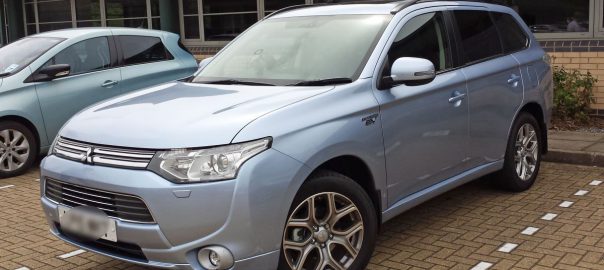
Mitsubishi Outlander PHEV (Image: T. Larkum)

PHEVs’ exclusion from the Plug-In Car Grant was inevitable

The government’s announcement that Category 2 and 3 hybrid cars will no longer be eligible for its Plug-In Car Grant seems totally incongruous in terms of environmental and societal policies, CO2 targets and other influences.

Private motorists, company car drivers and fleet managers have been buffeted around by continuously changing messages and strategies for too long.

Hybrids are now widely perceived by many as the obvious step amidst today’s anti-diesel climate and the near future looked very promising thanks to the procession of new hybrid models in the pipeline, such as PHEV iterations of the Honda CR-V, SKODA Superb and Volvo XC40.

Mitsubishi Outlander PHEV (Image: T. Larkum)

The government’s cessation of monetary support for plug-in hybrid vehicles will leave many prospective car leasing and finance customers scratching their heads, with monthly rentals or repayment costs set to rise by around £65 on a 3-year contract.

Between now and 2020, only eligible fully-electric vehicles that can travel at least 70 miles without emitting any CO2 will receive the reduced level of £3,500 support.

Although it’s understandable that the government wants people and businesses to adopt full EVs sooner rather than later, this move is a blow because only a small number of vehicles like the Nissan Leaf and Renault Zoe will be eligible and their compactness may limit interest, as does the Tesla’s price tag.

In other ways, though, the exclusion of plug-in hybrids from the PICG hasn’t come as a surprise. Introduced in 2011, the PICG was never expected to be a limitless pot of gold and was originally widely expected to expire around five years later.

Read more: Fleet News

Electric vehicles are going to render the fight over fuel economy standards moot

The auto industry is headed for revolution, Trump notwithstanding.

Though it may seem like several dozen scandals ago, the Trump administration is just now finalizing plans to freeze national fuel-economy standards in place, rather than steadily increasing them as Obama planned.

This is a terrible idea, for reasons I have detailed at length — it will cost consumers more, ensure more air and climate pollution, and, obviously, yield less fuel-efficient vehicles. It’s a bad idea economically, environmentally, and in terms of America’s international reputation.

I’m not going to go through all that again, though. Instead, in this short post, I want to do two things: point out a fact about the political calculations of this plan, namely, that it is opposed by the very corporate entities for which it was designed; and, second, make a bold prediction about the effect of electric vehicles on this fuel-economy debate. Basically, I think EVs are going to render the whole dispute moot!

First, the fact.

Car companies don’t like this plan

Car companies have acted with grotesque dishonesty throughout the history of the fuel-economy debate. It was only when Obama bailed them out — literally saving them from bankruptcy — that they agreed to come to the table to work out increased national standards.

When Trump took over, they immediately reversed course and, like jackals, descended on the new administration, pleading for regulatory relief, for a few more years of SUV profits.

And as in so many other areas, Trump gave business what they wanted. More than what they wanted. So much of what they wanted that they don’t want it anymore! Let me explain.

The administration has been holding public hearings on its proposal, and not surprisingly, it has received a torrent of opposition from the usual suspects — environmentalists, health groups, California. What is somewhat surprising is that considerable opposition has come from the auto companies themselves. (Also speaking out against, Axios reports: Shell Oil! When you’ve lost Shell …)

Ford has opposed it, along with the United Auto Workers. “Let me be clear,” said Bob Holycross, Ford’s global director of Sustainability & Vehicle Environmental Matters. “We do not support standing still.” GM and Chrysler have also lobbied the administration to alter its plans.

The Alliance of Automobile Manufacturers, a major automaker trade group, has also opposed the plan. “We support standards that increase year over year,” said AAM CEO Mitch Bainwol at a hearing.

“The industry is united in its request that the agencies work out an agreement with California” for a single, rising national standard, Honda said in recent comments.

As for Trump’s plan? “We didn’t ask for that,” Robert Bienenfeld, Honda’s assistant vice president in charge of environment and energy strategy, told the New York Times. “The position we outlined was sensible.”

Read more: Vox

How to approach driving in the face of climate change

Can you be an environmentalist and still drive a car?

The question came to mind last week, when the United Nations’ Intergovernmental Panel on Climate Change released a report that gave us 12 years to stave off cataclysmic climate change. If the world’s governments, businesses and people don’t act and act dramatically, global warming could rise more than 1.5 C and cause droughts, famine, floods and heat.

It’s a dire prediction.

As a driver, it forces you to think about your culpability. The automobile, after all, is a significant contributor to climate change. The Environmental Protection Agency maintains that cars and trucks account for 14 per cent of greenhouse gas emissions. So, you can either draw up a list of “10 Cars You Should Drive Before the Apocalypse”, or you can take a hard look at what you drive, how much you drive and whether you should be driving at all.

I’ve decided to do both. Some dream drives, some environmental action. A little sweet and a little sour.

SAY NO TO THE SUV

Sport-utility vehicles are behemoth gas-guzzlers, and their ever-soaring world-wide popularity is depressing. They’ve never been to my taste. Car makers are supposed to be introducing electric SUVs in 2019. But really, does the world need the SUV that much? Can’t we get by with fewer? Looking at their sales figures, the answer is no.

DRIVE HYBRID
I’m in the market for a new car. An electric, or at the very least a hybrid, increasingly seems like the more responsible choice. Of course, the most responsible choice (environmentally speaking) would be to hole up in a cement box and live on insects, water and music. To some people, the very act of owning an automobile is an assault on our climate and the future of the planet. We could shut down the automobile sector entirely, but that would trigger a global economic collapse and social unrest that could cause – you guessed it – Armageddon. I think I’ll go electric or hybrid – maybe a Tesla Model S, Volvo XC, BMW i3 or a Camry Hybrid LE.

Read more: Globe and Mail

Electric and hybrid cars: Cuts to Plug-in Car Grant condemned

Motoring groups have condemned the government’s decision to cut subsidies for buying greener cars.

From 9 November, grants for new plug-in hybrids will be scrapped, while discounts on all-electric cars will be cut from £4,500 to £3,500.

Cash incentives have been offered since 2011 to help promote cleaner cars and meet emissions targets.

The RAC and AA motoring groups said the change was a backward step, and the SMMT trade body called it “astounding”.

The Department for Transport (DfT) said that the Plug-in Car Grant was introduced seven years ago to help the market become established.

It was now time to focus support on zero-emission models such as pure electric and hydrogen fuel cell cars, the DfT added.

The change comes three months after the government published its Road to Zero strategy, with a proposal to remove petrol and diesel cars from UK roads by 2050, forcing all motorists to own electric models.

Ultra-low emission vehicles currently available for discounts are placed into three categories:

  • Category 1: CO₂ emissions of less than 50g/km and a zero emission range of at least 70 miles
  • Category 2: CO₂ emissions of less than 50g/km and a zero emission range between 10 and 69 miles
  • Category 3: CO₂ emissions of 50 to 75g/km and a zero emission range of at least 20 miles.

The government said the cut in the support for Category 1 cars to £3,500 reflected recent reductions in the price of electric vehicles.

But motoring groups denounced the changes, saying it would leave the government struggling to meet its emissions reduction targets.

Read more: BBC