Category Archives: Energy and Climate Change

News and articles on climate change, vehicle pollution, and renewable energy.

Why running out of battery in an electric car gave me hope for the future | Opinion

You’ve heard about how electric cars have things like flat floors, so-called ‘frunks’ for additional storage, and how the removal of engines, transmissions and drivelines allow automakers to experiment with more unconventional designs. It’s all good stuff, but the really life-changing features of EVs will come from how we use the battery.

Features like vehicle-to-load – which allows you to power devices externally using an EV’s charging port in reverse, or the more advanced vehicle-to-grid (V2G) which uses the same technology to dispense enough power for your whole home, or even sell energy back to the power grid.


This technology isn’t just a pipe dream. While the promising vehicle-to-grid technology is currently experiencing some bureaucratic hurdles in Australia, there are already a few models which are ready to support the technology when it can be used, like the Nissan Leaf and Mitsubishi Outlander PHEV, which are V2G capable thanks to their Japanese-standard CHAdeMO charging port.

Read more: CarsGuide

It’s Time to Go Green!

If you would like to know more about Solar Panels and the PowerBanx range of home battery systems, and get a free instant quote, please complete our online form:

You’re Being Lied to About Electric Cars

Science has repeatedly shown EVs are better for humans, despite the meme you just retweeted.

I’ve heard all the supposed arguments. It seems every time anything even tangentially related to electric cars is published, certain people feel compelled to share their own research. You’ve probably heard it all, too: A Prius is worse for the planet than a Hummer. EVs are coal-powered cars. Electric cars produce more CO2 than internal combustion engine (ICE) vehicles. Lithium mining is uniquely bad for the environment. Cobalt mining relies largely on slave labor, if not child slave labor. Actually, that last part is sadly true. But the rest? Lies. And I’m not even going to get into the hypocrisy of posting anti-EV rhetoric from a lithium-ion-battery-powered phone or laptop.

Gear Selector (Image: T. Heale)
 The first thing we should talk about is direct versus indirect emissions. Gas-powered vehicles have both direct and indirect emissions, while electric cars—I’m specifically talking about battery-powered vehicles, or BEVs, but we will just call them EVs—only have indirect emissions. How so? Both types of cars/trucks/SUVs are manufactured, and the process of building cars involves a global manufacturing effort that uses energy from all sorts of sources. This includes everything from the diesel fuel used to mine and transport metal to the electricity used to manufacture tires. A big knock on EVs is that because most battery production is centered in China, itself a notorious coal-burning country, battery-powered cars begin their service lives with more indirect emissions to their credit.

Read more: MotorTrend

It’s Time to Go Green!

If you would like to know more about Solar Panels and the PowerBanx range of home battery systems, and get a free instant quote, please complete our online form:

Shift to electric cars happening too slowly to avoid “climate catastrophe,” report finds

Major automakers and governments have avowed that the future of cars is electric. And with transportation making up about a quarter of the carbon pollution emitted by humanity, scientists say phasing out gas- and diesel-powered cars is imperative for there to be any hope of avoiding the worst effects of global warming.

But the shift away from fossil-fuel burning cars is happening too slowly to stave off climate catastrophe, according to a report released by Greenpeace this week.

“Leading auto manufacturers, including Toyota, Volkswagen, and Hyundai, are transitioning far too slowly to zero-emission vehicles, which has dangerous consequences for our planet,” Benjamin Stephan, climate campaigner at Greenpeace Germany, said in a statement. “Toyota, Volkswagen and other leading automakers are on a collision course with the climate.”

The researchers calculated how many new gas-guzzlers humanity can afford to put on the roads, assuming that global temperatures are on track to rise 1.5 degrees Celsius above pre-industrial levels. Keeping global heating below that level is essential to avoid catastrophic effects, including runaway ice melt and sea-level rise, scientists say.


Under that limit, the world’s carmakers can build and sell 315 million gas-burning cars between now and 2050, Greenpeace calculated. However, carmakers have already planned to produce and sell nearly twice that number of gas-burning cars, the group’s analysis found — 645 million to 778 million light-duty vehicles over the next 25 years.

Read more: CBSNews

It’s Time to Go Green!

If you would like to know more about Solar Panels and the PowerBanx range of home battery systems, and get a free instant quote, please complete our online form:

Blades Being Installed on Turbine 5, Yelvertoft Wind Farm (Image: T. Larkum)

Wind power could save UK households £250 per annum compared to gas, says RenewableUK

Wind power could save each UK household nearly £250 in savings per year compared to gas, says new analysis conducted by RenewableUK.

The analysis showed that the 19GW of wind farm capacity that won Contracts for Difference (CfDs) support will generate around 93TWh by the time it is all operational in 2027. This is around 30% of the annual UK electricity generation at present. This will be at a total cost of £5 billion.


Blades Being Installed on Turbine 5, Yelvertoft Wind Farm (Image: T. Larkum)

RenewableUK stated that the equivalent cost of getting that electricity from gas would be around £26 billion at current prices, so this represents a saving to consumers of over £20 billion, with every UK household benefitting by £246 a year.

The CfD scheme has been a resounding success for the wind industry. The most recent CfD auction saw offshore wind farms win contracts at a fixed electricity price four times cheaper than the current cost of gas power stations. Auction Round Four saw the five offshore wind projects win contracts to secure a strike price of £37.35/MWh.

As well as this, CfD projects are predicted to pay back £25 this winter, and around £45 a year to each household from next winter. This is set to continue to grow as more low cost windfarms come online.

Read more: Current+

It’s Time to Go Green!

If you would like to know more about Solar Panels and the PowerBanx range of home battery systems, and get a free instant quote, please complete our online form:

French farmers are covering crops with solar panels to produce food and energy at the same time

Agrivoltaics – the practice of using land for both solar energy and agriculture – is on the rise across France.

In the Haute-Saône region, in the northeastern part of the country, an experiment is being conducted by solar-energy company TSE.  It is hoping to find out whether solar energy can be generated without hindering large-scale cereal crops.

Previous attempts to experiment with agrivoltaics have been through smaller-scale projects. But, keen to see if it can thrive on an industrial level, 5,500 solar panels are being spread over this farm in the commune town of Amance by TSE.

If successful, the crossover could be revolutionary for both the agricultural and solar panel industries.

How do solar panels help protect crops from climate change?

“The aim was to be able to meet France’s needs in terms of renewable energy development, without pre-empting agricultural land,” says Xavier Guillot, head of agronomy research and development at TSE.

Read more: EuroNews

It’s Time to Go Green!

If you would like to know more about Solar Panels and the PowerBanx range of home battery systems, and get a free instant quote, please complete our online form:

Mazda MX-30 EV (Image: Mazda)

The American EV boom is about to begin. Does the US have the power to charge it?

States have plans to ban gas-powered cars and the White House wants chargers along highways, but implementation is a challenge

Speaking in front of a line of the latest electric vehicles (EVs) at this month’s North American International Auto Show, President Joe Biden declared: “The great American road trip is going to be fully electrified.”

Most vehicles on the road are still gas guzzlers, but Washington is betting big on change, hoping that major federal investment will help reach a target set by the White House for 50% of new cars to be electric by 2030. But there are roadblocks – specifically when it comes to charging them all. “Range anxiety,” or how far one can travel before needing to charge, is still cited as a major deterrent for potential EV buyers.


The welcoming entrance of Disney’s magic kingdom (Image: L. Larkum)

The auto industry recently passed the 5% mark of EV market share – a watershed moment, analysts say, before rapid growth. New policies at the state and local level could very well spur that growth: the Inflation Reduction Act, which passed this summer, offers tax credits of $4,000 to purchase a used EV and up to $7,500 for certain new ones. In August, California, the nation’s largest state and economy, announced rules that would ban all new gas-powered cars by 2035. New York plans to follow.

Read more: TheGuardian

It’s Time to Go Green!

If you would like to know more about Solar Panels and the PowerBanx range of home battery systems, and get a free instant quote, please complete our online form:

California’s ban on gas-powered vehicles: Huge victory in the 50-year war for the electric car

It took 50 years, but California clean-air regulators never surrendered — and the electric future is here

The California Air Resources Board’s recent decision to phase out all sales of gasoline-powered vehicles by 2035 marked the culmination of a 50-year struggle by CARB to clean up California’s vehicular pollution, which has long been the largest source of the state’s infamous and sometimes horrendous smog syndrome, and is now its biggest contribution to the climate crisis.

The story begins with two defeats, more than 20 years apart: All the way back in 1969, the California legislature came within one vote of phasing out the internal combustion engine. Even then, nearly enough legislators were convinced that the gasoline-powered engine could never be sufficiently clean. A generation later, in 1990, CARB tried again to mandate a shift  to electric vehicles (EVs) in place of oil-dependent gasoline and diesel — this time with new concerns about climate change as a driving force. On that occasion the oil and auto industries dug in their heels — while making seemingly insincere efforts to produce a few thousand electric cars — and then managed to roll back the entire EV mandate as a failure. The cars that had actually been built were almost all scrapped, leaving behind, as this effort’s principal legacy, the powerful but plaintive 2006 documentary “Who Killed the Electric Car?” narrated by Martin Sheen.

Read more: Salon

It’s Time to Go Green!

If you would like to know more about Solar Panels and the PowerBanx range of home battery systems, and get a free instant quote, please complete our online form:

Kia Soul EV 2020 (Image: Kia.com)

Used Kia EV Batteries Have A New Purpose Now – Energy Storage Systems For The Grid

Kia Europe has revealed a new partnership with Deutsche Bahn to reuse former EV batteries to develop scalable energy storage systems. The prototype is in works in Germany using Kia Soul EV batteries and marks the beginning of the automaker’s Europe-wide initiative.

The Hyundai Motor Group, Kia has fully adopted electrification as it moves toward zero-emissions and carbon neutrality throughout its businesses. Additionally, Kia and Hyundai Motor Group have invested in new technologies, like robotics and autonomy, to increase sustainability.

However, EV battery recycling is an issue. To address this issue, major manufacturers like CATL and recycling specialists like Redwood Materials are already helping reduce and reuse precious materials across the globe.


Kia Soul EV 2020 (Image: Kia.com)

Deutsche Bahn (encore DB) has been partnering up with many businesses to procure used batteries and give them a second life as energy storage solutions.

Kia announced the details of its new partnership with encore DB in a press release today, explaining how its EV batteries will be dismantled and repurposed for a second life cycle. Under the new agreement, Kia Europe will be the first mobility solutions provider to officially partner with encore DB.

Read more: WonderfulEngineering

It’s Time to Go Green!

If you would like to know more about Solar Panels and the PowerBanx range of home battery systems, and get a free instant quote, please complete our online form:

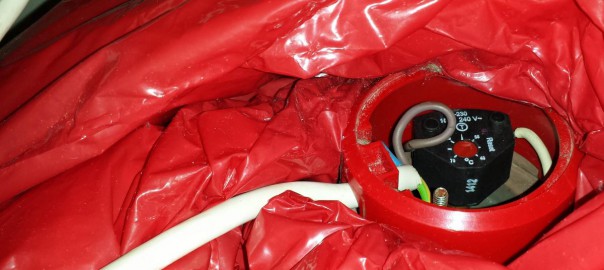
Figure 3: New thermostat installed, note temperature adjustment (Image: T. Larkum)

The energy price cap is a relic of another era

What’s the point in a consumer energy price cap that does very little to cap consumer energy prices?

When it was introduced, the UK energy price cap aimed to solve the problem of the “loyalty penalty” — higher prices for people who didn’t regularly shop around for a new supplier. The problem is, that’s now a non-issue. What it wasn’t designed for is the conundrum we face: unaffordable energy prices. As a result it is failing to serve any function well.

Figure 3: New thermostat installed, note temperature adjustment (Image: T. Larkum)

To recap, the default price cap in 2019 was introduced against a backdrop of concerns that suppliers were overcharging disengaged consumers.

That wasn’t a trivial problem. The competition watchdog found in 2016 that 70 per cent of the Big Six energy companies’ domestic customers were on “expensive ‘default’ standard variable tariffs”, now known as the only show in town. At the time, it was the case that if consumers switched, they could save perhaps £300 a year. Across the market the loyalty penalty added up to £1.4bn a year on the Competition and Markets Authority’s estimates.

The cap on the default tariff was designed as a fallback to stop companies from using loyal customers to subsidise switchers, beyond a price determined by the energy regulator Ofgem. It also aimed to solve a fairness problem: that no one should have to pay more than the watchdog-determined fair price for energy.

Read more: MSN

It’s Time to Go Green!

If you would like to know more about Solar Panels and the PowerBanx range of home battery systems, and get a free instant quote, please complete our online form:

Home solar panels will now pay for themselves in just four years as energy bills soar

As energy costs rise, households with rooftop solar save money each month by using their own power rather than expensive grid electricity

The time it takes to repay the cost of installing rooftop solar has dropped dramatically as energy costs have spiked, with new data suggesting it could soon take just four years to pay off a new system through savings on energy bills.

Homes fitted with rooftop solar panels can now cut their electricity bills by hundreds of pounds a month, by using home-generated electricity instead of expensive grid power.

That means solar systems pay for themselves within just a few years.


Analysis from climate website Carbon Brief suggests the payback period for a £4,300 rooftop solar system, with a power capacity of 3kW, has dropped from 16.7 years in October 2020 to 11.1 years under the current price cap.

By April, by which time analysts predict the average energy bill could hit £5,277, the payback time is set to drop to just 4.1 years.

“Stratospheric gas prices are driving our energy bills through the roof,” said Dr Simon Evans, senior policy editor at Carbon Brief, who conducted the analysis.

“That’s making low-carbon options even more cost effective. Whether it’s large-scale windfarms now costing four times less than gas power, or home solar systems that could pay back the initial outlay within less than five years, the economic case for net-zero has never been stronger.”

Read more: inews

It’s Time to Go Green!

If you would like to know more about Solar Panels and the PowerBanx range of home battery systems, and get a free instant quote, please complete our online form: