Monthly Archives: April 2021

KIA EV6 (Image: kia.com)

Kia EV6 Shows South Korea Is Now A Major Electric Vehicle Contender

The electric vehicle revolution is proving to be a hugely disruptive moment in automotive manufacturing. Everyone talks about how Tesla has shifted the market, and increasingly about the new Chinese or reborn European brands coming out of China. But there is another player that appears to see EVs as a clear opportunity grab a bigger chunk of the vehicular sales pie – South Korea.

I have already discussed how Hyundai is clearly seeing a big opportunity in EVs, but Hyundai has developed the E-GMP electric platform for its Ioniq 5 in partnership with the other major South Korean car brand: Kia. The Ioniq 5 looks great, but Kia’s EV6 looks equally good or, in my opinion, even better. It is extremely easy to fall into the trap of calling every new EV a “Tesla beater” or “Tesla challenger”, but the EV6 could well have new car buyers thinking twice about their Model 3 or Y purchase.

First, let’s get the headline specifications out the way. The EV6 sits in the popular “crossover utility vehicle” (CUV) segment – which basically falls between SUVs and regular cars, riding a bit higher than the latter but with no off-roading 4×4 pretentions (in most cases). However, as CUVs go, the looks are far closer to a regular car. Where the Ioniq 5 had a vague air of the AMC Pacer about it, the EV6 is much sleeker and has even been likened to the Jaguar I-Pace, one of the best-looking EVs yet.

The most telling specifications are the performance and range. Kia is offering a plethora of powertrain configurations – rear motors with two different power levels, and three different all-wheel-drive power levels. There are 58kWh and 77.4kWh battery options. These are apportioned between three different trim levels, including the basic EV6, an EV6 GT-Line, and the top-of-the-range EV6 GT. The latter is the headline act because it will boast 430kW (577hp) dual motors and the bigger battery, which Kia claims will give it “over 510km” (319 miles) of range.

KIA EV6 (Image: kia.com)

The performance figures are mouth-watering, too, with a 0-62mph sprint of 3.5 seconds and a top speed estimated to be 260km/h (163mph). A Tesla Model 3 performance is slightly quicker, but the more direct competitor will be the Tesla Model Y, which is slightly slower. The range looks even better than the Model Y Performance, too. Kia is also promising 800V charging capable of delivering 10 to 80% battery capacity in just 18 minutes, or 100km (62 miles) in less than 4.5 minutes.

Cargo space will be good as well, with 520 litres as standard and 1,300 litres with the rear seats down. This is quite a bit less than a Tesla Model Y, but quite a bit more than the Model 3. There is a small frunk at the front of the car too, and the EV6 will be rated to tow up to 1,600kg. Perhaps the most innovative practicality feature, however, is that, like the Ioniq 5, the Kia EV6 will have an external power output capable of delivering up to 3.6kW. This will mean you could easily power appliances when camping.

So in terms of specification, the EV6 looks like a contender, although the less powerful models won’t be anywhere near as quick as the GT. No US pricing has been announced yet, but UK pricing is available and very promising. The basic EV6 is £40,895 ($56,500), the GT-Line is £43,895 ($60,650), and the GT £58,295 ($80,500). These prices start at £2,595 ($3,600) cheaper than the Tesla Model 3 Standard Range Plus, and even the GT is £1,695 ($2300) cheaper than the Tesla Model 3 Performance.

If you look at Tesla pricing in the UK compared to the US, it is highly likely that the EV6 will be relatively cheaper than our US dollar conversions the other side of the Atlantic. The Tesla Model Y, which is perhaps the closer competitor, is $5,000 more expensive than the Model 3, too. Although we are yet to know the full specification other than engine power and battery capacities for the models below the Kia EV6 GT, the Kia EV6 is likely to be extremely competitive on range and performance with Tesla’s Model 3 and Y.

Read more: Forbes

It’s Time to Go Green!

If you would like to know more about Solar Panels and the PowerBanx range of home battery systems, and get a free instant quote, please complete our online form:

Ubitricity Electric Avenue project lamppost charging (Image: Siemens)

EV sales skyrocketed in 2020; petrol, diesel car sales in steep decline

European sales of fossil fuel vehicles took a massive hit last year, dropping by 5 million vehicles or more than a third compared to 2019. Meanwhile, electric vehicles appeared immune to the coronavirus as their sales more than doubled. EVs are gaining a foothold in Europe.

The success of electric vehicles (battery electric vehicles – EVs/BEVs) despite the pandemic goes to show that an increased availability of different models, improved technology and favourable framework conditions are altogether starting to convince consumers to make the switch to electromobility.

In 2020 Europeans reduced their spending overall due to the pandemic[1], and cars were no exception. EV sales, though, appeared unphased by COVID-19 as their sales increased by 107 %. The very same pandemic saw fossil fuel vehicle (internal combustion engine vehicle – ICEV) sales plummeting.

Looking at the data from most European markets[3], diesel vehicle registrations had been in decline for a few years already, partly due to Dieselgate and rigorous air pollution measures across Europe. In 2020 they continued their downward trend in new car registrations, albeit at an accelerated pace, ending up at just over 3 million units. That’s a decrease of 35 % compared to the almost 4.8 million units registered in the previous year.

Petrol vehicles had a similar decline at 37 % in the same markets; however new petrol car sales had been steadily rising prior to 2020, meaning the pandemic impact on petrol cars was even greater. New petrol car registrations ended up at just above 5.7 million, a reduction of 3.4 million from the almost 9.2 million new vehicles registered in 2019.

Ubitricity Electric Avenue project lamppost charging (Image: Siemens)

Overall, then, cars relying solely on combustion engines for propulsion lost more than 5 million sales last year, slashed by more than a third from the year before.

Turning our attention to pure electric vehicles (battery electric vehicles, BEVs), sales skyrocketed – at least relatively speaking. EV sales more than doubled in 2020, from 359,000 in 2019 to 745,000. A 107 % increase is a huge one, even though total sales volume is still not up there with petrol and diesel.

Put differently, it becomes instantly clear that electric vehicles are closing the gap to fossil fuel vehicles: In 2019 Europeans bought one EV per every 39th fossil fuel vehicle. In 2020, the balance shifted to one EV per every 12th fossil fuel vehicle.

Hybrid vehicle sales went up as well. Plug-in hybrid vehicle (PHEV) sales actually more than tripled. In total numbers, though, hybrids were still outsold by pure EVs.

One might think that demand for EVs is more resilient to a pandemic because their buyers are more financially resilient, given the higher purchase price of an EV compared to a fossil fuel equivalent. Actually, the numbers suggest this is not the case. For new cars in general, demand dropped for both compact cars and large SUVs, by 24 and 6 percent respectively[4], meaning cars at both ends of the price range were negatively affected – albeit SUVs a tad less so. This in stark contrast to the aforementioned sales increase of EVs by 107 percent.

Moreover, due to falling production costs and EV-friendly incentive schemes across Europe, EVs are not that comparatively expensive anymore. The average price paid for a new car in the UK regardless of fuel type was £33,600[5] in 2018. The new average-sized “people’s EV” from Volkswagen, the ID.3, starts at £31,700[6]. And that’s just the purchase price – factoring in the total cost of ownership, even the most expensive ID.3 at £42,300 will likely outperform the average petrol car in terms of cost within a few years. Romania will give you a €10,000 grant to purchase an EV if you scrap a fossil fuel vehicle at the same time. In fact, 26 out of 27 EU countries plus the UK, Norway, Iceland and Switzerland all favour EVs in their taxation system, through grants and/or by other means[7].

In other words, economic inequalities between the average car buyer and the average EV buyer may only explain a small part of the discrepancy in new car registrations. At Bellona, we firmly believe that the numbers prove that car buyers have more faith in electric vehicle technology than conventional vehicle technology – the pandemic has just proved that EVs are future-proof.

If we try to imagine what would have happened without the pandemic, by just following the trendlines, diesel would probably have continued its decline whilst petrol sales could still have been increasing. Actually, already by the third quarter of 2020 new car registrations had bounced back to near pre-pandemic levels, and from Q3 to Q4 total sales remained almost level whilst petrol decreased notably, and electric sales increased by 128,000 units quarter-on-quarter. This strengthens the hypothesis that EVs didn’t just experience a temporary pandemic boost.

Read more: BELLONA

It’s Time to Go Green!

If you would like to know more about Solar Panels and the PowerBanx range of home battery systems, and get a free instant quote, please complete our online form:

KIA EV6 (Image: kia.com)

New 2021 Kia EV6: dual-motor EV6 GT gets 577bhp

Flagship performance-focussed crossover will be faster than a Porsche Taycan 4S; priced from £58,295

Kia says it is taking “electric performance to another level” with the GT-badged hot version of its new EV6 electric flagship, which will top out a range comprising two- and four-wheel-drive variants with a choice of different battery sizes.

The dual-motor EV6 GT sends 577bhp and 546lb ft to both axles, and is expected to get from 0-62mph in just 3.5 seconds and reach a top speed of 162mph, making it not only the quickest Kia yet built, but also more powerful and faster than the Porsche Taycan 4S.

Lower down the range, the EV6 is available in either rear-wheel-drive form with a 77.4kWh battery giving 316 miles of range, or with four-wheel-drive and a smaller 58.0kWh power pack, which will likely give a range of around 250 miles. The two-wheel-drive version uses a 226bhp motor on the rear axle and is capable of 0-62mph in 6.2 seconds, while the non-GT four-wheel-drive version ups power to 321bhp and packs 446lb ft for a 0-62mph time of 5.2 seconds.

The EV6’s powertrain line-up can be expected to be adopted by the closely related Hyundai Ioniq 6, which will arrive later this year as a performance-focused electric saloon to rival the Mercedes-Benz EQS and Audi E-tron GT.

The EV6’s E-GMP platform, which it shares with the recently revealed Hyundai Ioniq 5, is equipped with 800V charging architecture. This will allow charging from 0-80% capacity in as little as 18 minutes, depending on battery size, and can take on 62 miles of range in less than four and a half minutes. The EV6 is also equipped with a ‘vehicle-to-load’ function which can supply up to 3.6kW of power to external devices – including other EVs – and, with more than 35% charge, has a towing capacity of 1600kg.

KIA EV6 (Image: kia.com)

Range-maximising features include an innovative heat pump which “scavenges waste heat from the car’s coolant system” to ensure that, at temperatures of -7degC, the EV6 offers 80% of the range it would at 25degC. Adjustable regenerative braking is fitted across the range, too, with paddle shifters behind the steering wheel allowing drivers to choose from six different modes.

Kia has also given new details of the EV6’s headline tech features, including an augmented reality head-up display which shows ADAS alerts, speed data and turn-by-turn navigation instructions. The latest iteration of Kia’s connectivity package features, too, with inbuilt EV-specific functions, as does a raft of advanced driver safety aids.

The South Korean-built EV6 will be available in the UK from October 2021, with prices starting at £40,895 for the EV6. The EV6 GT-Line starts at £43,895, while the top-of-the-line GT will come with a significant premium, of £58,295. A pre-reservation process opens from today.

As Kia’s first bespoke production electric car, the EV6 pairs a radical new design with unprecedented levels of performance for the brand. It will also spearhead a wave of new-era electric cars from Kia.

Each will be badged EV followed by a number corresponding to its size. So the EV6 crossover is a mid-sized car, which leaves room below for compact SUVs, hatchbacks and saloons, and for larger SUVs at the top of the range. Kia will launch a further six bespoke EVs by 2026, with the model nomenclature ranging from EV1 to EV9.

The new model’s design pioneers a new ‘Opposites United’ styling ethos that leans on “contrasting combinations of sharp stylistic elements and sculptural shapes”. Future models will take similarly dramatic design cues, with key tenets of the new philosophy including ‘daring’ colour schemes, simple lines and “bold, everchanging surfaces”.

The influence of Kia’s 2019 Imagine concept is clear. Although the overall silhouette has evolved to give a lower, less overtly SUV-oriented stance, there’s a new interpretation of Kia’s trademark ‘tiger nose’ grille and an obvious emphasis on aerodynamic optimisation.

Read more: AUTOCAR

It’s Time to Go Green!

If you would like to know more about Solar Panels and the PowerBanx range of home battery systems, and get a free instant quote, please complete our online form:

VW Group to partner with BP to expand ultra-fast EV charging network

Volkswagen Group and BP will join forces to accelerate the roll-out of ultra-fast electric vehicle (EV) chargers across the UK and Europe.

The two companies will install new 150kW chargers at existing BP retail sites, as part of the partnership. They have signed a memorandum of understanding for their collaboration and intend to finalise agreements in the coming months.

The new partnership will make BP the car maker’s official charging partner, enabling the integration of BP’s charging network into VW Group vehicles to make finding and paying for charging simpler.

Thomas Schmall, member of the board of Volkswagen Group and CEO of Volkswagen Group Components, said: “Ultra-fast charging is the key enabler for e-mobility and therefore a main pillar for Volkswagen´s transformation.

“Together with strong partners like BP, we take this important matter into our hands and will build up to 18,000 new chargers in Europe. That is about a third of the estimated ultra-fast charging demand in 2025.”

The partnership is expected to provide EV drivers with greater confidence in being able to access nearby, reliable, quality charging options. BP estimates approximately 90% of people in the UK and Germany live within a 20-minute drive of one of its sites.

Emma Delaney, BP’s executive vice president, customers and products, said: “Enabling the rapid expansion of electric vehicles is core to Bp’s plans to grow our convenience and mobility business, and supports our net zero ambition.

“Partnering with Volkswagen Group we intend to address a key concern for people considering buying an EV: range anxiety.

“Together we can provide drivers in the UK and Europe with the fast, reliable and convenient charging solutions they need to feel more confident about making the switch.”

Read more: SMART TRANSPORT

It’s Time to Go Green!

If you would like to know more about Solar Panels and the PowerBanx range of home battery systems, and get a free instant quote, please complete our online form:
Kia XCeed PHEV (Image: Kia)

This is the new Kia EV6, and the fast version will do 0-62mph in 3.5s

It’s an XC60-sized electric family car that, in GT guise, will outrun a Lamborghini Urus

This is the Kia EV6. EV presumably standing for electric vehicle, because that’s the only sort of drive it has.

Yup, Hyundai and Kia have an all-new electric platform, used in this EV6 and the Hyundai Ioniq 5. Like Volkswagen’s ID range, they’re a swerve away from doing cars where you can choose hybrid or PHEV or all-battery.

Kia in the past did a remarkably solid job of packing a long-range good-value electric drivetrain into the (admittedly pretty dreary) body of the Niro. Now imagine how good this dedicated electric car might be.

One number to get you imagining, then. Zero to 62mph in 3.5 seconds. Or another one, probably more relevant: adding 220 miles range in under 20 minutes of recharging. Both those numbers have small print attached of course, but even so this is a serious bit of kit.

The EV6 gets to UK buyers in autumn 2021. The base one is £40,895, including the bigger of two battery sizes, getting it 316 miles range. Sounds like value. More amazing, the GT, the one that does 0-62 in 3.5 seconds, is £58,295, which is an insanely cheap way to get near-supercar acceleration off the line. But it doesn’t arrive until autumn 2022.

Kia XCeed PHEV (Image: Kia)

In size, it’s somewhere between the VW ID.4 and Ford Mustang Mach-E. OK, you probably haven’t seen either of them on the road yet. So to make it more relatable let’s say Volvo XC60, but with more cabin space because of the long wheelbase and flat floor.

No-one’s going to mistake it for a car with an engine. It’s got the big-cabin-short bonnet proportions of a vehicle that needs no room under the bonnet for a bundle of reciprocating metalwork. Instead, you’ve got a front boot – froot, if you please, not frunk.

The roof teardrops away, the smoothly modelled wings bulge purposefully and the details are sharp. A slash along the lower doors sweeps upward at the rear to aim at the rear lights. The lights by the way are a loop: indicators in the lower half, brake/tail lamps in the upper half of the loop.

Kia’s new design buzzphrase is ‘opposites united’, says design director Karim Habib. He talks about soft organic volumes meeting more technical lights and jewellery.

As for the overall form, he says it’s a blend of hatch, crossover, and even rally car in the wide bulging stance with big ground clearance.

Inside, the pair of curved display screens sit behind a single glass panel. Custom shortcut keys should keep it simple to use. There’s also an augmented-reality HUD. As with most EVs, absent the transmission tunnel they could carve out bins and storage spaces below the centre screen.

More than 100 recycled plastic water bottles go into the cabin fabrics. OK, not a lot if you throw away one every day, but if you’ve stopped drinking from them (you should have) then it’s a decent deal for the planet.

The specs are a matrix of battery sizes mated to rear-only or front-and-rear motors. Base one has RWD and a 58kWh battery for about 235 miles WLTP. That gives 170bhp. Go for AWD and the extra motor boosts total power. More power too if you go for the bigger 77.4kWh battery, which gives 316 miles’ WLTP range in the RWD version. Again, adding an extra motor brings more power and quicker acceleration.

Incidentally, the related Hyundai Ioniq 5 has a smaller battery, topping out at 72kWh, and so goes slightly less far.

Big Daddy EV6 is the GT. That gets the bigger battery with punchier motors, good for 584bhp and that kidney-punch acceleration number. It’s got an electronically controlled limited-slip diff too, to help when things get bendy. But that same battery only gets this one 254 miles in the WLTP test, and of course less if you drive it like it seems to invite.

To prove its mettle, Kia filmed a 400m drag race against a Carrera 4 and Lambo Urus among others. It beat them, and was only a car length behind a McLaren 570S. Which counts as pretty stealthy, given the GT looks almost exactly the same as the base version that competes with mainstream family crossovers.

Read more: BBC Top Gear

It’s Time to Go Green!

If you would like to know more about Solar Panels and the PowerBanx range of home battery systems, and get a free instant quote, please complete our online form:

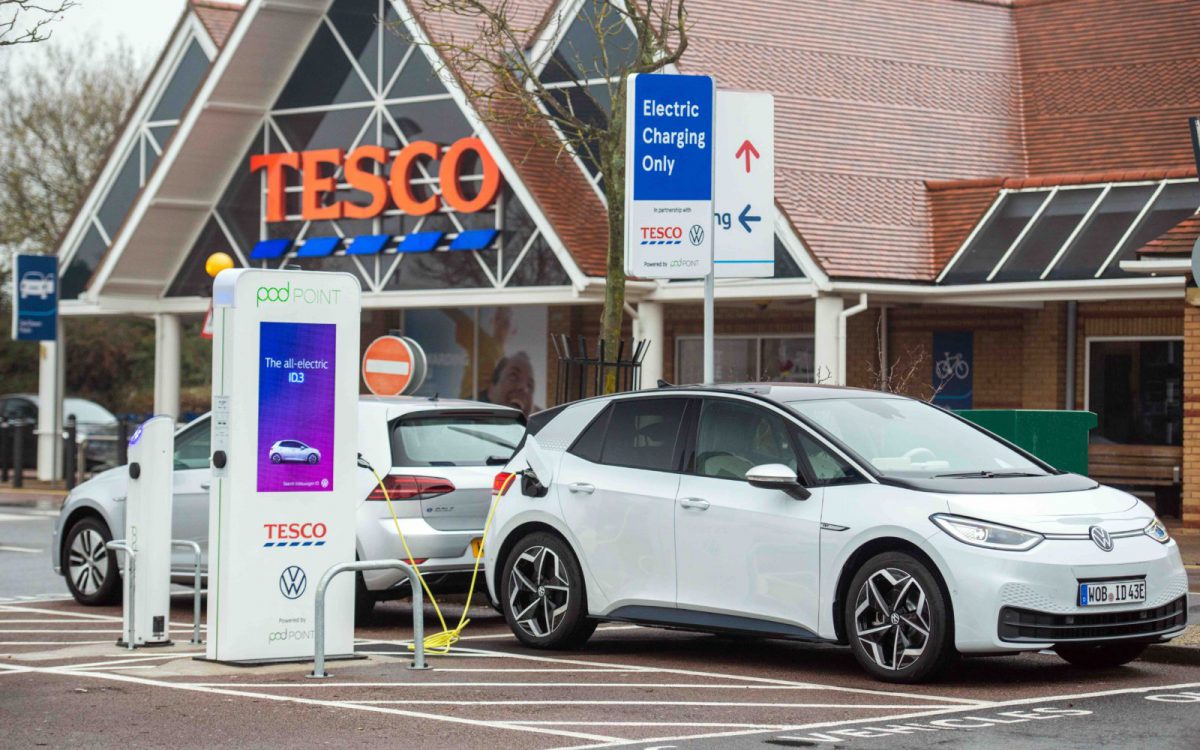
POD Point Rollout at Tesco Stores (Image: Tesco/POD Point)

IT’S ELECTRIFYING Driving an electric vehicle is cheaper than you think – costing just from 1p per mile!

We spoke to Go Ultra Low ambassador Ben Fogle all about it. In association with Go Ultra Low.

Having seen the positive impacts lockdown has had on the environment, we’re all keen to continue doing our bit – but the advice can be confusing.

From giving up meat to reducing your waste there’s so much you can do – but have you considered an electric vehicle (EV)?

Last year, we caught up with Ben Fogle, Go Ultra Low ambassador, to tell us all about his experiences with EVs.

Go Ultra Low is an industry and government campaign aiming to educate the UK about EVs.

When it comes to going green, Ben says it’s important to focus on what you can do and not what you can’t.

“I don’t think anyone is perfect and I’m the first one to put my hands up and say I’m not the perfect green citizen,” he told us. “The important thing is to realise the impact we have and work out what we CAN do.”

POD Point Rollout at Tesco Stores (Image: Tesco/POD Point)

For Ben and his family, switching to an EV seemed like a sensible and exciting decision and it wasn’t one they took lightly.

“As a family we looked at our mode of transport. We use public transport where we can – we use trains and we use buses but we also have a car and we need a car.”

“No one likes change, we’re all creatures of habit, but we’ve been an EV household for the best part of a year now – and we wouldn’t go back!”

Although switching to an EV seems like a big change, as they are at the forefront of technology, if you’re at the stage of life where you’re looking for a new car it can be an economically friendly decision as well as an ecologically friendly one.

There are now a lot of comparable price points available for EVs and plenty of leasing options, too. We’re also reaching the point where there are second hand EVs coming into circulation, so the price tag isn’t as large as you might think- and they can be cheaper to run.

When Ben used to live in London it used to cost £7 to fill the car at the chargepoint near his house, and he would combine the charge time with a dog walk. It would only take 30 minutes to fully charge and it would last them a week. Now Ben charges as home, so it’s even cheaper.

You can install a chargepoint at home or you can access one of the 38,000 public chargepoint connectors across the country. You can also get a government grant of up to £350 to help install a chargepoint in your home.

“I’d love to meet other people who get a full week’s driving from less than £7 petrol.”

Read more: The Sun

It’s Time to Go Green!

If you would like to know more about Solar Panels and the PowerBanx range of home battery systems, and get a free instant quote, please complete our online form:

Electric cars will electrify and electrocute the housing market

Of all the issues facing the broker market in 2021, possibly the biggest is staring us in the face. And yet I can find hardly any expressions of concern or advice, on line or in person.

We know now that sales of new petrol and diesel cars are to end in the UK by 2030, but do we know how this momentous decision will impact the housing market?

Certainly I have not seen any lender, estate agents or surveyor factoring the impact of electric vehicles into their pricing.

But neither does it follow that as professionals, we should not be bringing the issue to the attention of our clients – especially in such a topsy-turvy market where people in search of a home as a long term investment have never been as in need of, or receptive to, expert advice.

Brokers are faced with a genuinely unique opportunity to gen up on this dynamic subject, study local authority plans and debates and put themselves in a position of strength with which to help their clients.

This will, after all, be one of the most important development effecting house pricing over the next two decades.

The broker is still the only provider of sound and objective financial advice to whom most of us can turn when it comes to a buying a home, and right now our customers want more than just figures.

They want opinions. It’s not just about finances when societal issues are about to play such a massive part in undermining asking prices and second guessing conventional valuations.

No broker, no comment
EastEnders and Coronation Street live in a cosy parallel reality, but any broker serving an urban market is faced with a different scenario.

The fictional street scape of the 1920s bears no relation to the densification of the 2020s.

Universal charging points will see cuts to parking spaces of upwards of 60% on some residential roads.

This will have a direct effect on demand. Blocks of flats with no parking and terraced houses are the most vulnerable of all to stagnating prices.

Smart houses in leafy suburbs, where off and on street parking is plentiful, however, will enjoy an easier path to electrification, with a direct effect on price.

That said, there are no simple answers. Urban locations won’t be the only one to suffer. The hearts of many small to medium more rural towns and villages are also strangulated with parking problems.

A loss of around a quarter of local parking spaces will have a dramatic impact.

You might argue that demand for housing will rise, that the economy will prove resilient to Brexit and that valuations will maintain conventional trajectories.

But it’s by no means a stretch to suggest that the value of properties without parking or designated electric vehicle bays will suffer, while those with their own car charging or designated bays could easily increase by 15%-20% – over and above the 5-10% increase in value that having parking spaces already commands.

It’s micrographics, not just demographics
That’s why the advice you give has to be granular. For homeowners and landlords, demand will invariably fall for certain types of property. But rise for others.

In many London boroughs car ownership is already falling among younger people, motivated by electric scooters and excellent public transport.

Read more: Mortgage Introducer

It’s Time to Go Green!

If you would like to know more about Solar Panels and the PowerBanx range of home battery systems, and get a free instant quote, please complete our online form:

BP Pulse unveils UK rollout of ultra-fast EV charging hubs

BP Pulse has unveiled new plans to rollout ultra-fast charging hubs across the UK, with these to be developed in partnership with the Electric Vehicle Network (EVN).

The first of these sites – which will have 24 ultra-fast charging points – is to open later this year, with “a significant number” of rapid and ultra-fast charging locations expected to be developed.

The rollout will include “state of the art” hubs of between six to twelve chargers as well as e-forecourts with up to 24 ultra-fast 300kW chargepoints alongside on-site solar PV and battery storage systems. The e-forecourts will have both retail and convenience facilities for the drivers while they wait for the cars to be charged.

BP Pulse has signed an agreement with energy efficiency investment firm Sustainable Development Capital LLP (SEEIT) – which made a £50 million investment commitment to EVN as its development partner in EV charging infrastructure in August – for the rollout.

The EV charging locations are to be developed and constructed by EVN, contracted through a 20-year, fixed price CPI inflated Energy Service Agreement. EVN is also to manage the operation and maintenance of all the sites.

Matteo de Renzi, CEO of BP Pulse, said the new hubs will complement the company’s existing plans to launch a number of ultra-fast chargers on BP’s forecourts, adding that “it’s exciting to be launching this new additional option for drivers”.

It follows BP Pulse announcing it has made £2 million available to deliver “radical improvement” in the reliability of older UK electric vehicle (EV) charging infrastructure.

Jonathan Maxwell, CEO of SEET, said that EV sales are at an “inflection point”, adding that “this investment, in partnership with the Electric Vehicle Network, is a significant commitment to EV charging infrastructure in the UK”.

EVN is currently planning to develop a further c.400 EV charging sites, with SEEIT having the right of first refusal to provide an additional c.£150 million in the next 24-36 months.

Read more: CURRENT

It’s Time to Go Green!

If you would like to know more about Solar Panels and the PowerBanx range of home battery systems, and get a free instant quote, please complete our online form:

UK growth in EV sales driven by businesses, figures suggest

A car industry body has called on the government to support uptake among private buyers.

Two-thirds of all new electric cars bought in the UK are purchased by businesses, rather than private buyers, according to a leading industry body. The Society of Motor Manufacturers and Traders (SMMT), which records ‘official’ figures on new car sales and production, says the growth in the electric car market is being driven by the corporate sector.

According to the SMMT data, sales of electric cars rocketed in 2020, with the market up 185.9 percent compared with 2019. In total, more than 108,000 new electric cars were registered, giving the technology a total market share of 6.6 percent.

But the picture looks different when you split those sales between private consumers, who registered 34,324 electric cars in 2020, and companies, which registered 73,881 new electric cars. And battery-electric cars made up 4.6 percent of all new cars sold to private buyers last year, whereas they accounted for almost nine percent of corporate registrations.

Of course, the corporate sector has always made up a large proportion of new car sales, and these figures may not come as a great shock to industry insiders. In total, so-called ‘fleet’ sales made up 53 percent of all new car registrations last year, while private customers accounted for just 44 percent of the market.

And when it comes to electric cars, it’s companies and company car drivers that get the lion’s share of incentives. Tax rates have been cut, so electric cars now only incur Benefit-in-Kind (BiK) tax at one percent for the 2021/22 financial year. And in 2020/21, drivers didn’t have to pay a penny in company car tax.

However, both private and corporate customers will have felt the impact of changes to the government’s Plug-In Car Grant, which was slashed for cars costing £35,000 or more. The grant was also reduced, so eligible cars only saw their prices cut by £2,500, rather than the earlier £3,000.

Now, the SMMT says more must be done to help consumers into electric vehicles – particularly in light of the government’s plan to ban the sale of new petrol and diesel cars from 2030. The organisation says consumer acceptance of the technology is still low because of “concerns over affordability, charge point availability and infrastructure reliability”.

And the SMMT claims encouraging customers to make the switch will require more than just a few financial incentives; it also wants to see accelerated growth in electric vehicle charging infrastructure. In fact, the trade body says its estimates suggest the UK will need around 2.3 million public charge points in service by 2030 to provide “adequate coverage”. To achieve that figure, the country will need to install more than 700 charge points a day until the end of the decade. At the moment, the UK is installing around 42 chargers a day.

“While last year’s bumper uptake of electric vehicles is to be welcomed, it’s clear this has been an electric revolution primarily for fleets, not families,” said SMMT chief executive Mike Hawes. “Manufacturers are committed to the consumer, reducing costs and providing as wide a choice as possible of zero-emission capable vehicles with many more to come.

“To deliver an electric revolution that is affordable, achievable and accessible to all by 2030, however, government and other stakeholders must put ordinary drivers at the heart of policy and planning. We need incentives that tempt consumers, infrastructure that is robust and charging points that provide reassurance, so that zero-emission mobility will be possible for everyone, regardless of income or location.”

Read more: motor1

It’s Time to Go Green!

If you would like to know more about Solar Panels and the PowerBanx range of home battery systems, and get a free instant quote, please complete our online form:

Vauxhall Corsa-e (Image: Vauxhall.co.uk)

Vauxhall cuts electric vehicle prices so customers can still use Plug-in Car Grant

Vauxhall is the latest car maker to have tweaked pricing for its electric car range in the wake of the government’s changes to the Plug-in Car Grant.

Vauxhall’s new pure-electric Mokka-e in SE Premium trim now starts at £33,040 while the top-of-the-range Launch Edition starts at £34,995.

As for the Vivaro-e Life people mover, prices have been cut by £2,000 so the entry-level Edition model is now £34,995.

The Corsa-e supermini’s pricing remains unchanged as this model falls beneath the new £35,000 threshold.

The price cuts are in response to the government changing the Plug-in Car Grant last week.

Vauxhall Corsa-e (Image: Vauxhall.co.uk)

The grant was first introduced in 2011 as an incentive for motorists to purchase a pure-electric vehicle. But last week the price cap for eligible vehicles was reduced from £50,000 to £35,000, while the discount dropped from £3,000 to £2,500.

Paul Wilcox, Vauxhall’s recently-appointed new managing director, said: ‘At Vauxhall, we believe in making sure our vehicles are as accessible as possible to the greatest number of people, and especially so when it comes to zero emissions-in-use motoring, so I am pleased to confirm that all Corsa-e, all Mokka-e and the new Vivaro-e Life Combi are eligible for the government Plug-in Car Grant.’

The announcement of the changes to the grant came out of the blue and Vauxhall is one of a number of manufacturers who reacted quickly and changed prices for their pure-electric models.

The government’s announcement caught the car industry off guard, with Mike Hawes, SMMT chief saying it was ‘the wrong move at the wrong time’ that ‘moves the UK even further behind other markets’.

Read more: CarDealer

It’s Time to Go Green!

If you would like to know more about Solar Panels and the PowerBanx range of home battery systems, and get a free instant quote, please complete our online form: