Monthly Archives: December 2020

Ford Mustang Mach-E (Image: Ford.co.uk)

The 2021 Ford Mustang Mach-E Is Not a Real Mustang

The electric Mach-E is competent, cool, and composed, an excellent car to drive. But it’s not a Mustang, and Ford’s decision to portray it as such is a head-scratcher.

Despite an epic media blitz, a gallimaufry of tacked-on design elements, and a 0-60 time that trounces some of its two-door equine cohorts, the all-new, battery-powered Ford Mustang Mach-E SUV is not a real Mustang. Before you accuse me of being a pedant or a purist, know that I love brand experimentation, even when it overreaches. I’m a devotee of front-engined Porsches, of convertible trucks, of stick-shift EVs, of Honda pickups. I don’t even really like pony cars—they’re generally noisy, flashy, and cheap, and thus remind me too much of myself. So I don’t have a horse in this race.

But a Mustang is supposed to be exuberant, unbridled. (It is, after all, a wild horse.) It’s supposed to make driving an occasion of joy. And while the Mach-E Premium AWD that I tested is a very competent and well-constructed electric crossover with some features that offer minor delight, the experience of driving it around the streets and parkways, interstates and beachfront back roads of New York City and Long Island was about as exhilarating as shopping for chest freezers.

Mustangs are meant to draw attention. Despite its Rapid red metallic paint, glistering 19-inch wheels, and galloping pony emblem up front, my passenger noted, a little sadly, “No one is even looking at us.”

Ford Mustang Mach-E (Image: Ford.co.uk)

The Mach-E is a smooth operator, especially in its tamest “Whisper” mode. This is true for its acceleration and ride, which feels expeditious and well-damped, as well as its slippery-yet-muscular shape. The smooth profile is aided by trick doors that open with the touch of a button on the B- or C-pillar, obviating the need for bulky door handles. (There is a little plastic finger-hook on each door, which almost feels designed to snap off.) The vegan interior—no leather or animal-derived products here—is high quality, with the same sort of nubbly, near-luxury, Pendleton-esque finishes first seen in the BMW i3. It is handsome for a crossover, a form factor that’s about as easy to make alluring as a burlap sack of yams. Its mesomorphic sculpturality is aided by its clever roof, which simulates a coupe-like fastback silhouette while hiding additional rear-seat headroom under a second-level roofline that’s painted black for visual camouflage.

This winking chicanery extends to the interior. Select the highest-performance drive mode—named “Unbridled,” we kid you not—and electric drivetrain whinge is piped in over the excellent B&O sound system. Since humans tend to associate speed with sound, and are terrified of silence (and wind howl and tire slap), I’m not opposed to some Eno ambiance in the cabin. But does every electric car have to sound like a spaceship gargling a milkshake? The other two drive modes, Whisper and Engage, offer enhanced quietude and improved balance, respectively, toning down the intergalactic hamburgling while also reducing the regenerative braking. This diminishes the capacity for one-pedal driving, one of the proclaimed joys of driving an EV, at least among those who find slowing down joyous.

Not that adding range is so much of an issue. Ford claims that the AWD Premium Mach-E will go 270 miles on a charge; the RWD version is said to hit 300. In our days of galavanting around NYC and the North Shore of Long Island, I never worried about juicing up. Clear and accurate range graphics, access to a broad national charging network, and a handy “Charge” button on the nav system to find the closest electron juice stations alleviated any concerns about being stranded.

I was, however, a bit enervated by the black-fronted plastic box that sits atop the steering column, looking like a pill-minder attempting to sneak into a nightclub. None of the operator’s manuals explained its purpose, and I couldn’t find anything online to explain it, so I had to text a Ford public relations representative. “It’s the Active Drive Assist camera for eye gaze monitoring when driving hands free,” he wrote back, as read aloud to me wirelessly via Apple CarPlay and my wirelessly-charging iPhone. “Monitors head position too, to make sure you’re paying attention to the road.”

Read more: Road and Track

It’s Time to Go Green!

If you would like to know more about Solar Panels and the PowerBanx range of home battery systems, and get a free instant quote, please complete our online form:

2020 Renault Zoe (Image: Renault)

The Internal Combustion Engine Apocalypse Is On The European Horizon

Morgan Stanley analyst Adam Jonas wrote in a note to clients on Friday that global EV sales will grow 50% or more next year, while sales of internal combustion engine vehicles are expected to grow 2% to 5%. He also predicted that global EV penetration will rise from 4% to 31% by 2030.

Those predictions may or may not come true, but one thing is certain and that is 2021 is shaping up to be a critical year for EV adoption. Mercedes-Benz just announced its Tuscaloosa plant will build large, electric SUVs starting from 2022 as part of what it calls its electric-vehicle “fireworks display”. Aiming to take the lead in premium EVs from Tesla Inc (NASDAQ: TSLA), Mercedes-Benz announced plans to deliver eight new all-electric models starting from early 2022.

But near-term, Europe remains the most fertile EV ground. Stricter emission regulations and government subsidies that make these vehicles much more affordable are speeding up the de-adoption of internal combustion engine (ICE) vehicles. Here are six electric vehicles that could bring on the “ICEpocalypse” to European roads.

Volkswagen’s ID.3 And ID.4

Volkswagen’s (Pink: VWAGY) ID3 was the top-selling EV in Europe only one month after being launched. But Europe has been shifting toward larger vehicles, so the ID.4 should grow in popularity quickly and, with its highly competitive price considering the range and specs, it should give the ID.3 a run for its money.

Renault ZOE

ZOE (Pink: RNLSY) has been the top-selling electric vehicle on the continent in most of the last decade. As it continues to improve and range increases, the ZOE should replace the Clio, which sold 230,000 units in Europe during the first 10 months of the year. Although the ZOE, which was the top-selling EV in Europe until the ID3 came along and took its throne in October, was at 73,403 units, it’s only a matter of time before it reaches 100,000 in European sales per year. But it needs to fend off the competition and grow a backbone.

2020 Renault Zoe (Image: Renault)
The improved Renault Zoe has a longer range and posher interior (Image: Renault)

Tesla’s Model 3 and Model Y

Tesla’s Model 3 is the top selling EV in the world. In Europe, it is second on the top-selling list. It’s not exactly on track to beat 100,000 sales in 2020, but Tesla is determined to win over Europe considering its ambitious developments at its upcoming Berlin factory. However, it has been ordered again to suspend its preparations due to a successful court injunction by environmentalists. This time round, Tesla was stopped by snakes and lizards. But its Model Y will arrive to Europe eventually and it is probably going to sell considerably better than the Model 3, due to its features and an overall preference for its class of vehicle.

Peugeot e-208

Peugeot’s (Pink: PUGOY) 208 was the 7th best-selling vehicles in the first 10 months of the year. So, while the e-208 had only about 25,000 sales in that time period, it could gradually rise up the rankings as tech improves, range increases, and cost drops in the coming year. It is considered by many as one of the best European EV offerings on the market, a testament to Peugeot’s upswing.

Read more: yahoo!finance

It’s Time to Go Green!

If you would like to know more about Solar Panels and the PowerBanx range of home battery systems, and get a free instant quote, please complete our online form:

2020: When electric vehicle excitement kicked into high gear

Washington, DC (CNN)Tesla’s fortunes have made quite a journey since April 2018, when CEO Elon Musk posted a photo on Twitter of himself apparently asleep, lying on a Model 3, holding a ragged cardboard sign that read “Bankwupt!”

“There are many chapters of bankruptcy and, as critics so rightly pointed out, Tesla has them *all*” Musk tweeted, in an apparent April Fools Joke.

But at the time, Tesla’s finances were nothing to laugh about. Tesla came within about a month of bankruptcy when bringing the Model 3 to mass production, Musk said last month.

Tesla persevered through the dark stretch and begin reporting a string of profitable quarters in 2019, even ending the year with a slight profit. Tesla’s 2020 on its own has been a roller coaster. Its stock began to surge in early 2020, before plummeting to its low for the year on March 18, as the pandemic hit and the world’s economy unraveled.

On the same day that Tesla’s stock bottomed in March, Nio, a Chinese electric vehicle company, warned for the second time in three months that it was running out of cash to operate in the future. It had just lost $1.6 billion in 2019.

Tesla Model S

But those low moments appear to be forgotten as the stock prices of Tesla and Nio have sky-rocketed. Tesla became the world’s most valuable automaker this summer, and is now worth more than Toyota, VW, Daimler, Ford, GM and Honda combined. Tesla’s stock has surged more than 600% this year even as it sold about 1% of the vehicles those automakers sold in 2019.

And Nio’s stock rallied this summer, too. It’s grown roughly 1200% this year, and it is now worth nearly as much as General Motors.

Electric vehicle experts say that excitement and energy around the industry hit a new peak in 2020. The stock prices and fundraising fortunes of electric vehicle companies worldwide have thrived in stark contrast to businesses that have generally stumbled through 2020’s pandemic.

“People are betting that this is a new soda pop market, and Tesla represents Coca-Cola, the dominant name brand,” said Reilly Brennan, a venture capitalist at Trucks VC, which invests in transportation startups.

Some view the electric vehicle excitement as overzealous and resembling a mania, as unproven and unprofitable companies have enjoyed soaring stock prices and raised huge sums of cash.
Electric vehicle companies have raised more than $10 billion this year in fundraising rounds, initial public offerings, and special purpose acquisition companies (SPACs), which offer companies an alternative way to go public by merging with an existing company, and which some investors say is an easy way for flawed companies to go public and avoid the scrutiny of a traditional initial public offering.

Read more: CNN BUSINESS

It’s Time to Go Green!

If you would like to know more about Solar Panels and the PowerBanx range of home battery systems, and get a free instant quote, please complete our online form:

Tax most polluting cars to speed up transition to electric vehicles, experts say

Covid has caused a slump in new car sales that could slow the switch to electric vehicles, pushing up emissions

The Government should slap a 50 per cent tax on the most polluting cars from next year to accelerate the transition to electric vehicles over the next decade, experts have said.

New analysis from the UK Energy Research Centre (UKERC) suggests the dramatic slump in car sales during the pandemic could have worrying consequences for transport emissions over the next decade and beyond unless the government takes radical action.

Sales of new cars this September were the worst in a century, as the financial impact of Covid-19 began to take its toll. UKERC analysis suggests the slowdown in the car market could last until 2025, keeping older, more polluting cars on the road for longer.

Meanwhile people who put off buying a new car in 2020 or 2021 may buy a similar model later in the decade, delaying the date they make a switch to electric, UKERC added. Manufacturers may also try and offload stock of petrol and diesel models ahead of the 2030 ban on their sale.

Higher emissions
Such a scenario could lead to an extra seven million tonnes of tailpipe CO2 emissions between 2021 and 2030, UKERC’s director Professor Rob Gross told i.
“You might think that people not buying cars is a good thing for the environment. But it’s not a good thing if they delay buying a relatively inefficient car, and that car is still being used for longer,” he said.
Those cumulative emissions matter, he said: “Every gram of CO2 that enters the atmosphere stays there, potentially for hundreds of years.”

Tax polluting cars
UKERC says more must be done to make polluting cars less attractive to buyers. It proposes imposing a 50 per cent levy on the purchase price of the most polluting vehicles. The tax would start in 2021 with the highest emitting cars, such as performance SUVs and sports cars. It would gradually tighten over the decade until only zero emission cars were exempt.

New cars with high tailpipe emissions already pay a higher rate of tax under the Vehicle Excise Duty, but only for the first year. After that, petrol and diesel motors face a flat charge regardless of their emissions.

“As the car market recovers we think the government needs to strongly steer it towards cleaner vehicles, not just by providing subsidies for electric vehicles but also strongly steering people away from relatively inefficient models,” Professor Gross said.

Relatively cheaper
UKERC’s proposals are similar to Norway’s system, where all non-electric cars are subject to a tax on their purchase price based on their tailpipe emissions.

The system makes most EV models cheaper to buy compared to a similar petrol model, even if the import price for the EVs is much higher.

Read more: inews

It’s Time to Go Green!

If you would like to know more about Solar Panels and the PowerBanx range of home battery systems, and get a free instant quote, please complete our online form:

Renault ZOE Van (Image: Renault)

Renault Zoe Is Europe’s Best-Selling EV With More Than 84,000 Units Delivered Year-to-Date

The Renault Zoe has managed to beat every other electric model in the market so far and is the best-selling EV in Europe year-to-date.

According to the numbers posted by the French automaker, the zero-emission supermini accounted for over 84,000 units from January to November 2020, almost twice as many compared to the same period of last year.

The Zoe was also the best-selling electric passenger vehicle in Germany, France, Italy, Spain and Portugal. Ever since production started back in 2012, Renault has managed to shift more than 268,000 units of the model in Europe.

Renault ZOE Van (Image: Renault)

Almost one third of the electric vans sold in the Old Continent year-to-date was a Kangoo Z.E., so Renault also holds the crown for the best-selling electric light commercial vehicle (LCV), with 8,498 units. 57,595 units have been sold since the Kangoo Z.E. was launched in Europe 10 years ago.

In addition to the Zoe and Kangoo Z.E., Renault’s zero-emission portfolio also includes the tiny Twizy and the Master Z.E. van with a payload of up to 3.5 tons (7,716 lbs).

In other Renault related news, the automaker wants to reinvent the compact hatchback with the introduction of a new vehicle next year, which was previewed by the Megane eVision Concept and will rival the likes of the Volkswagen ID.3.

Based on the CMF-EV platform, shared with the Nissan Ariya, the concept uses an electric motor that generates 217 HP and 221 lb-ft (300 Nm) of torque. It’s powered by a 60 kWh battery that supports fast charging of up to 130 kW and can hit 62 mph (100 km/h) in less than 8 seconds from a standstill.

Read more: CARSCOOPS

It’s Time to Go Green!

If you would like to know more about Solar Panels and the PowerBanx range of home battery systems, and get a free instant quote, please complete our online form:

Volvo Polestar 2 (Image: Volvocars.com)

Top 5 EV Trends Of 2020: The Year Electric Cars Came Of Age

Although 2020 will be primarily remembered for the pandemic, it has also been a watershed moment for electric vehicles. The rest of the car industry has seen massive drops in sales every month during the worst months of COVID-19, but the EV market has continued to grow. In the UK, by November, 162% more battery electric vehicles had been sold over the year compared to 2019. This was echoed across Europe, with EVs (including hybrids) outselling diesels in September and every month since. Here are the important events that have helped to make 2020 the year EVs came of age.

VW Takes The EV Market Seriously
After Dieselgate, Volkswagen has clearly felt the need to make amends, and is now the German carmaker with the most mainstream EV plans. The ID.4 SUV sold out overnight on launch in the USA, and in Europe the ID.3 compact was already the bestselling EV in October, just a few months after launch, surpassing the ever-popular Renault Zoe and leaving Tesla’s Model 3 in its dust. Considering VW’s heritage of taking cars to the masses – “people’s car” is what the word Volkswagen means, after all – the fact that the Teutonic giant is now going for the mainstream electric market really means something. VW is aiming to sell 28 million electric cars by 2028. Putting that in perspective, that would be three quarters of all cars currently on UK roads, and around 10% of current US motor vehicle registrations. It’s highly ambitious, but the ID.3 is great start despite software glitches in early vehicles. Volkswagen clearly sees how big EVs are going to be, very soon.

Tesla Promises $25,000 Car
Tesla hasn’t actually released a $25,000 car in 2020, but the company’s Battery Day 2020 showed in great detail how it was about to enter the battery business in a big way, potentially more than halving costs by 2023/24. Batteries are the most expensive component of an EV, costing as much as a third of the entire sticker price. Halving the costs of these would mean electric cars hit cost parity with fossil fuel ones, and then start becoming cheaper. This led Musk to promise a “fully autonomous $25,000 small Tesla” around 2023/24, which would mean from then on that fossil fuel cars would become the more expensive option. But VW is already discounting the ID.3 to this kind of level in some countries, MG has an SUV and a station wagon around the equivalent of this price, and in France the Renault Zoe can be had for as little as 20,000 Euros ($24,000) with all the discounts available. So the $25,000 Tesla by 2023/24 is no pipe dream. It may even be cheaper than that, and there will certainly be even less expensive options by then too.

Volvo Polestar 2 (Image: Volvocars.com)

Polestar 2 Challenges Tesla Model 3
Tesla has a huge technological lead over its competitors, and a teardown of one of the company’s cars in February by Nikkei Business Publications put it six years ahead. It’s no surprise, therefore, that most other companies entering the EV market have chosen to target sectors Tesla isn’t currently in. Even the luxury electric SUVs from Mercedes, Jaguar and Audi aren’t directly competing with the Model X, and VW has clearly aimed its ID.3 at a European mass market that Tesla won’t be entering until it releases the much-vaunted $25,000 “Model 2” mentioned above. But one company has had the courage to go head-to-head with Tesla: Polestar. The Polestar 2 is priced and specified to go directly against the Tesla Model 3 Long Range. In fact, in the UK, it’s £90 ($120) cheaper. It doesn’t have the latest 2021 Model 3 Long Range’s massive 360 miles of WLTP range, and it’s not quite so fast either. But its 292-mile WLTP range and some great design features show that there will be some serious competition for the American giant, and likely sooner than in six years. Most telling of all is the fact that Polestar is part of Geely – a Chinese company that also owns Volvo, the LEVC taxi company, Malaysian carmaker Proton, and Lotus. So the Polestar 2 is just the beginning of the EVs we will see coming out of China very soon.

Read more: Forbes

It’s Time to Go Green!

If you would like to know more about Solar Panels and the PowerBanx range of home battery systems, and get a free instant quote, please complete our online form:

foxaon / 123RF Stock Photo

Electric vehicle sales expected to grow 50% in 2021

Global electric-vehicle sales will grow 50% or more next year, while sales of internal combustion engine vehicles are expected to grow 2% to 5%.

That’s the view of analysts at Morgan Stanley, who in a note to clients on Friday also predicted that global EV penetration would top 4%, rising to 31% by 2030.

The year 2021 “is shaping up to be a critical year for EV adoption and (internal combustion engine) de-adoption that will dictate the pace of multiple expansion, contraction, consolidation and proliferation” among the stocks, Morgan Stanley analyst Adam Jonas said in the note.

Investor interest in electric-vehicle and adjacent stocks continued unabated this week, as exemplified by Tesla Inc. TSLA, +5.96% closing the books on $5 billion worth of shares in just one day.

foxaon / 123RF Stock Photo

In other news this week:

Analysts at Morgan Stanley estimated that Tesla has a $20 billion “war chest” to fund expansion plans in 2021, which include two factories going up in Germany and in Texas and new vehicles such as the Cybertruck, its pickup truck.
Tesla Chief Executive Elon Musk made waves this week. Speaking at The Wall Street Journal’s CEO Council annual event, Musk confirmed he has moved to Texas, where his company is building a factory. He took jabs at California and Silicon Valley, which influence in the world he called “too much.”
Nio Inc. late Thursday announced that it plans to sell at least 60 million American depositary shares, with an additional 9 million shares available to underwriters. Nio stock dropped more than 4% in after-hours trading following the announcement, and on Friday dropped nearly 7%.

Nio ADRs have gained nearly 950% this year, compared with gains of around 13% for the S&P 500 index. SPX, -0.35%

Nio’s and Tesla’s moves followed XPeng Inc., which said Monday it planned to sell 40 million ADRs. Li Auto Inc. announced last week its own plan to sell 47 million new ADRs. Both stocks struggled in the wake of those announcements.
Despite the momentary dips amid stock offerings, EV stocks are enjoying a 2020 stock surge that is more widespread than Nio’s jaw-dropping 2020 gains. Tesla is up 625% this year, while XPeng is up more than 111% and Li Auto around 100%.

Electric vehicle company Electric Last Mile Inc. has agreed to go public via a merger with a blank-check company, or special purpose acquisition corporation, Forum Merger III Corp. FIII, +2.73%
The deal would value Last Mile at about $1.4 billion, and once it closes, likely in the first quarter, the combined company will be renamed Electric Last Mile Solutions Inc. and trade on Nasdaq under the ticker “ELMS.” The company plans to launch electric delivery vans later in 2021.

Read more: MarketWatch

It’s Time to Go Green!

If you would like to know more about Solar Panels and the PowerBanx range of home battery systems, and get a free instant quote, please complete our online form:
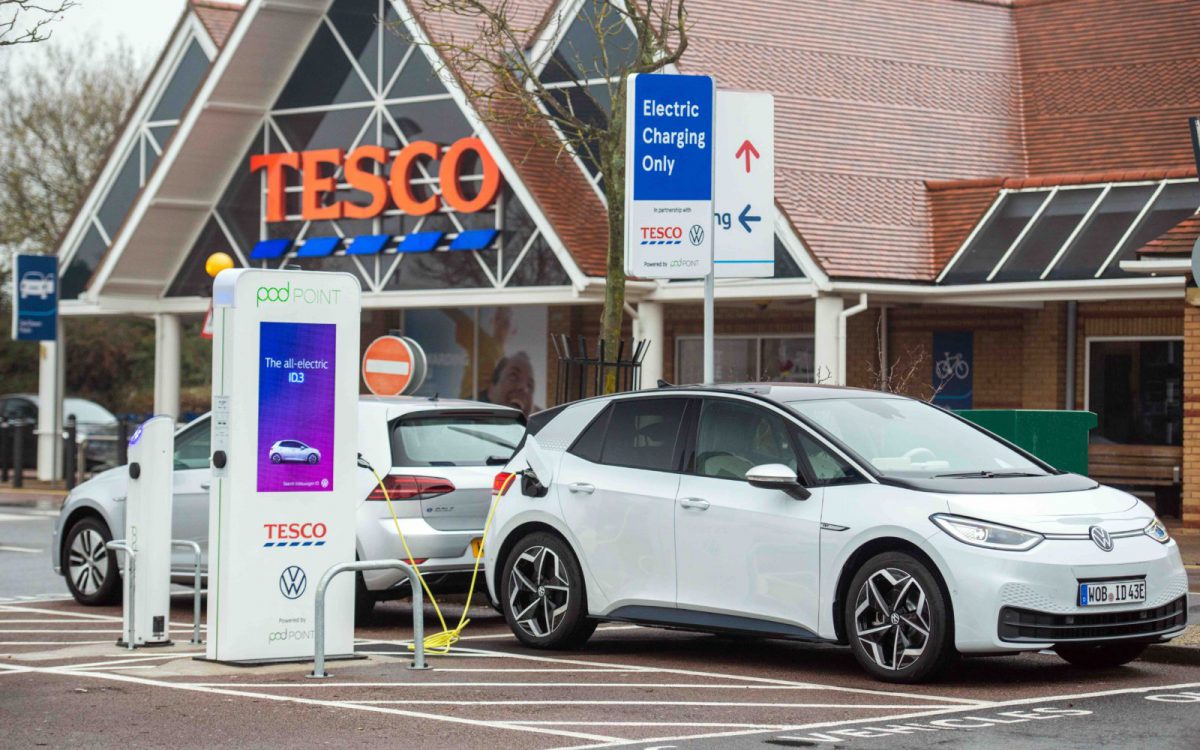
POD Point Rollout at Tesco Stores (Image: Tesco/POD Point)

EDF launches its cheapest EV tariff under GoElectric umbrella

EDF has launched its cheapest electric vehicle (EV) tariff to date to help make it easier and cheaper for drivers to switch.

The zero carbon GoElectric 35 tariff offers an off-peak rate of 4.5p/Kwh, which EDF is claiming to be the cheapest on the market. For this tariff, off peak is classified as 12am-5am daily. At this rate, it would allow customers to fully charge a standard 40kW Nissan Leaf for £1.80.

The GoElectric single rate is also available, offering a fixed price, as well as the GoElectric 98 tariff which offers 98 hours of off-peak electricity per week at 9p/kWh, which EDF said is ideally suited for high consumption households or high mileage drivers with bigger batteries that need to be recharged for longer. For this tariff, off peak is classified as all weekend and 9pm-7am on weekdays.

POD Point Rollout at Tesco Stores (Image: Tesco/POD Point)

Drivers also have the option to lease an EV through EDF from £170 a month for a Skoda CITIGOe iV, or buy an EV smart home charger. Earlier this year the supplier acquired EV charging firm Pod Point and in 2019 acquired battery storage and EV charging firm Pivot Power.

It also powers ubitricity’s EV charging network with 100% renewable energy, and in September was awarded a contract with the Crown Commercial Service to help accelerate the electrification of public sector fleets.

It isn’t the only supplier to launch an EV tariff, with others on offer including ScottishPower’s SmartGreen EV tariff and the 1 Year Fix and Drive tariff offering up to 2,000kWh of electricity free per year if charging overnight launched by SSE Energy Services before it was acquired by OVO.

Read more: CURRENT

It’s Time to Go Green!

If you would like to know more about Solar Panels and the PowerBanx range of home battery systems, and get a free instant quote, please complete our online form:

Dacia Spring 2021 (Image: Dacia.co.uk)

Even The World’s Oil Giants Are Getting Ahead Of The Electric Vehicle Curve

In a virtual press conference recently, Dan Yergin, energy guru and vice-chair of IHS Markit recounted the stunned surprise that a Middle Eastern oil executive had recently shared with him upon traveling to California and seeing the plethora of Teslas on the road.

It was a foretelling sign, he said, one that spoke volumes not just about oil’s future but also about climate security. Could EV’s really displace demand for all that petroleum this executive was trying to sell?

Indeed, even the most oil-leveraged countries are now coming to terms with such future shock. “We are seeing the impact of climate change with the various extreme events: the Australian fires, the cyclones and the droughts,” says Dr. Thani Ahmed Al Zeyoudi, Minister of the Ministry of Climate Change and the Environment for the United Arab Emirates, in an earlier interview with this reporter. “We can no longer pass this to future generations to deal with.”

Dacia Spring 2021 (Image: Dacia.co.uk)

The UAE, which just discovered 22 billion barrels of unconventional oil reserves, says that it is planning on a world with no oil — that it is investing in green energy projects domestically and in new technologies all over the world. The country is home to several solar plants, hosting one of the world’s largest: the Noor Abu Dhabi. It generates more than 1,100 megawatts of power.

Yes, “peak oil” and climate change are interrelated. Enter electric vehicles, which according to Bloomberg New Energy Finance will gain speed: it says that EVs are now 10% of the global passenger market. But that number will grow to 28% in 2030 and 40% in 2040. Why? National policies will favor decarbonization while the cost of batteries that power the cars will keep falling. The cost of EVs and cars with an internal combustion engine will even out in the mid-2020s, it says.

And China and Europe are where the growth will occur: 72% of all such cars by 2030. That’s because their governments are taking bold action to curb CO2 and to get folks to decarbonize their transportation. The United States, it adds, will fall a bit behind but it will catch up by 2030. UAE’s Abu Dhabi National Oil Company proudly proclaims that the country has to be ready to celebrate the sale of its last barrel of oil. Right now, renewables make up 10% of its generation portfolio.

Read more: Forbes

It’s Time to Go Green!

If you would like to know more about Solar Panels and the PowerBanx range of home battery systems, and get a free instant quote, please complete our online form:

Citroen e-C4 (Image: citroen.co.uk)

Citroen e-C4 electric review

Citroen’s first proper go at an electric family car has been successful, offering good all-round ability with a unique character

Pros
Very comfortable and refined
Practical family transport
Great charging capability

Cons
Soft chassis can feel a bit loose
Some rivals offer a longer range
Light steering doesn’t inspire confidence

PSA – the parent firm of Peugeot, Vauxhall, DS and Citroen – is on something of an electrification mission, with lots of new electric cars popping up from each of its brands. However, while its sister brands have had electric cars on sale for over 12 months, Citroen is only just launching its electric effort – the e-C4. It shares much of its DNA with the Peugeot e-2008 and DS 3 Crossback E-TENSE, yet retains a character all of its own.

While in the metal the C4 has a very distinct crossover vibe, the French manufacturer labels this as a family hatchback rather than an SUV. Forget the protective cladding and slightly raised ride height – Citroen’s latest electric car has been developed to take on the Nissan Leaf and Volkswagen ID.3.

Citroen has set the e-C4 apart from its Peugeot and DS siblings in appearance, but underneath it uses the same 50kWh battery and 134bhp electric motor as those cars. The result is a 0-62mph time of 9.7 seconds, a 93mph top speed and a 217-mile range on a charge.

Citroen e-C4 (Image: citroen.co.uk)

The Citroen e-C4 also benefits from the same 100kW charging technology as its stablemates, which allows for a 80% rapid charge in just 30 minutes. Topping up at home from a 7kW wallbox overnight takes around seven and a half hours.

Citroen is keen for the e-C4 to be a viable family-car option, so particular attention has been paid to its interior and to practicality. In the e-C4’s cabin, quality is very good and a distinct step up from Citroens of old; standard digital dials and large touchscreen give a high-tech feel, while clever practical touches like hidden storage ahead of the gearlever and a tablet holder on the passenger side make it adept at dealing with family life. The boot measures in at 380 litres – just five litres off the Volkswagen ID.3’s – and there’s decent room in the back seats despite the sloping roof.

The car’s unique approach is also apparent once you’re on the road. Citroen’s ‘Progressive Hydraulic Cushions’ suspension is standard across the range, so the e-C4 sticks to the brand’s traditional comfort-orientated approach as it ably takes the edge off any nasty lumps and bumps in the road. It’s not perfect, however; the system can feel slow to react at lower speeds, while faster changes of direction often cause the car to feel loose or a little unwieldy.

The e-C4’s light steering helps with parking, but we’d prefer a little more weight for extra confidence at higher speeds. It’s less of an issue on the motorway, where the e-C4 really excels on refinement and comfort. Performance from the e-C4’s electric motor is adequate: punchy but without making you feel queasy with every prod of the accelerator. A dedicated ‘B’ mode ramps up the regenerative braking to good effect.

Read more: Driving Electric

It’s Time to Go Green!

If you would like to know more about Solar Panels and the PowerBanx range of home battery systems, and get a free instant quote, please complete our online form: