Monthly Archives: August 2019

Tesla Model3 (Image: Wikimedia/Carlquinn)

The Tesla Conspiracy… or Am I a Dead Whistleblower?

I generally eschew conspiracy theories under the rubric that little explained by conspiracy cannot as well be explained by incompetence and that the occurrence of stupid is vastly more common than the occurrence of evil in the hearts and minds of men.

But it is also true that it can only be a conspiracy theory if there is NOT an underlying conspiracy. And it is only paranoia if they are NOT all out to get you.

In the case of Tesla, the car and the company, if you eliminate all other possible causes, what remains is the answer. And I have the increasingly uncomfortable feeling that not all is right with the world.
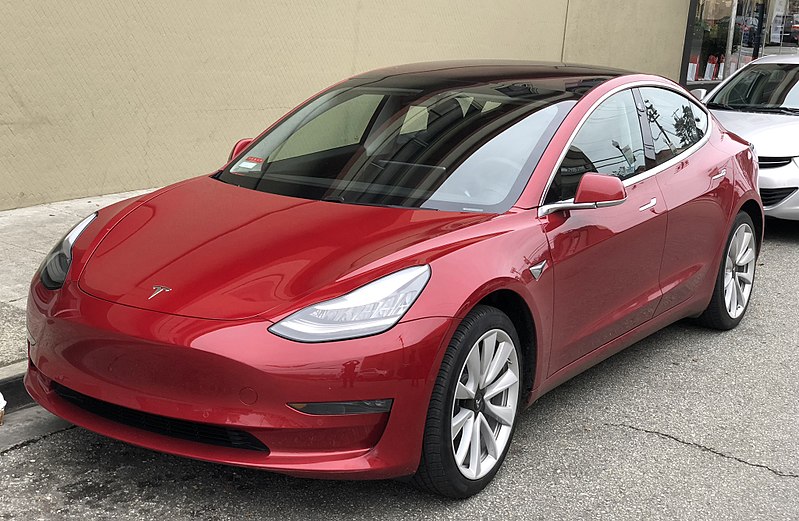
Tesla Model3 (Image: Wikimedia/Carlquinn)

Let’s start with the car. I suppose it’s a matter of opinion, and I’m certainly given to having one, but what is emerging is a stunning lack of challenge to the premise that the Tesla, in all its variants, is the most advanced automobile ever designed and manufactured on purpose, and the best car ever made in all respects. Basically ALL voices and opinions to the contrary have simply disappeared from the scene – poof – gone.

I presume you are aware that the Model 3 won Detroit News Magazines 2018 Car of the Year award. As it happens, it was also named car of the year by Popular Mechanics March 2018 Automotive Excellence awards. AutoExpress Car of the Year 2019: Tesla Model 3
Automobile Magazine 2018 Design of the Year: Tesla Model 3.

The grandfather of ALL automotive magazines is MOTOR TREND. Motor Trend started publication in September 1949 with the Kurtis Sportscar on the cover. A car so beloved they later acquired one of the 16 ever built for display in their publishing offices.
This magazine has from 1949 existed by the hand of car lovers for car lovers and represents the largest collection of photographic automotive pornography ever assembled by man.

Also in 1949, they named their first CAR OF THE YEAR – THE 1949 CADILLAC SERIES 62 SEDANETTE.

In 2013 they rather shockingly named the Tesla Model S CAR OF THE YEAR with the astonishing admission that since 1949, there was NEVER A CAR LIKE THIS.

Read more: EVTV

Charging Station in Sunderland (Image: Fastned)

MP welcomes new electric car charging points at South Western Stations

South Western Railway has installed 60 new electric car charging points at six station car parks on its network.

The charging points cost a total of £100,000 and Basingstoke MP Maria Miller welcomed the investment by SWR.

The charging points help make rail travel more sustainable, and passengers can charge their electric vehicles free of charge between now and the end of October, just having to pay the car park fee.

As well as Basingstoke, the charging points are also installed at five other stations – Farnborough, Andover, Haslemere, Wokingham and Fleet.

SWR worked with mechanical and electrical engineering specialists, SSE Enterprise Rail, to install Rolec EV WallPod charging units at each station.

The electric car charging points are 13-amp trickle chargers, allowing passengers to leave their vehicles on charge for the day.

The new charging points can be upgraded for higher currents to cover future developments.

Read more: RailAdvent

There are now more electric vehicle charging points than petrol stations in UK

The latest figures have revealed there are 9,300 EV charging stations in the UK compared to 8,400 fuel stations

Electric car owners now have almost 1,000 more places to publicly charge their vehicle than petrol and diesel owners have to fill their tank, in a landmark tipping point for motorists.

The latest figures have revealed there are 9,300 EV charging stations in the UK compared to 8,400 fuel stations.

The crossover has taken place a year before Nissan’s 2016 prediction of August 2020 – a result of the fast-improving infrastructure for electric vehicles in the UK.

Sales of pure EVs are up by 70 per cent this year as buyers take advantage of government grants and perks such a road tax exemption and, from 2020/21, no company car tax.

In fewer than 100 years since Britain’s first fuel station opened at Aldermaston in Berkshire in November 1919, the number of forecourts has peaked, declined and been overtaken by charging stations designed for battery-powered cars.

Almost 80 per cent of UK petrol stations have closed since 1970, while the number of electric vehicle charging locations has increased from a few hundred in 2011, when Nissan launched its LEAF electric car in the UK, to 9,300 in August 2019, according to the charging platform Zap-Map.

More than 1,600 of these locations provide ‘rapid charging’, where a typical EV battery can be charged to around 80 per cent in under an hour.

Kalyana Sivagnanam, managing director, Nissan Motor (GB) Ltd, said: “Many consumers are saying their next car will be electric.

Read more: Mirror

2020 Renault Zoe (Image: Renault)

All-New Renault ZOE Z.E. 50 In The Lens Of Fully Charged: Video

The new Renault ZOE is ready to compete with new contenders like the Peugeot e-208 and its Opel/Vauxhall Corsa-e derivatives, as well as some VWs.

Fully Charged was present at the unveiling of the third-generation Renault ZOE Z.E. 50 in France in June, but as it sometimes happens, it took some time to edit and release the episode.

Renault presented several trims of the new ZOE to showcase exterior and interior design. Fully Charged’s Jonny Smith noted it’s familiar to the previous generation, but improved – especially in the front (modified face and LED lights) and inside with new 10-inch digital dashboard display and vertical infotainment touchscreen. It seems also that the materials in the new ZOE are better.

2020 Renault Zoe (Image: Renault)

The new ZOE is also a much better EV with a higher battery capacity (52 kWh), more range (up to 390 km/242 miles WLTP), DC charging capability (up to 50 kW), higher power motor (100 kW) and better acceleration.

First test drives and reviews are expected any time now as the new ZOE is scheduled for market launch this Autumn.

Renault ZOE R135 specs (see full description here):

52 kWh lithium-ion battery (air-cooled)
Battery pack: 400 V nominal, 192 cells, 10 modules, 326 kg of weight, 160 Wh/kg
up to 390 km (242 miles) of WLTP range
0 to 100 km/h (62 mph) in less than 10 seconds
80-120 km/h (50 to 75 mph) in 7.1 seconds
top speed of 140 km/h (87 mph)
R135 electric motor: 100 kW of peak power and 245 Nm of peak torque
R110 electric motor (option): 80 kW of peak power and 225 Nm of peak torque
DC fast charging using CCS Combo 2, up to 50 kW
AC charging of up to 22 kW (3-phase)

Read more: INSIDE EVs

Renault ZOE in contactless car vending machine (Image: Taylor Herring)

UK’s first car vending machine unveiled – and you can pay with your phone

It contains a brand-new Renault Zoe with a “pre-haggled” price of £16,000

Britain’s first contactless car vending machine has been unveiled by Auto Trader, offering motorists a haggle-free way to purchase a new car.

The bespoke vending machine, installed at Spitalfields Market, allows purchases of up to £21,000 via contactless payment using a smartphone.

Renault ZOE in contactless car vending machine (Image: Taylor Herring)

It contains a brand-new Renault Zoe, which is one of the most searched for electric cars in the country, according to Auto Trader.

The vehicle comes with a “pre-haggled” price of £16,000 – down from the recommended retail price of £22,470.

Auto Trader said a team of six engineers spent three months designing and building the automatic car dispenser.

Read more: Mirror

Figure 4: Charging on Christmas Day (Image: T. Larkum)

UK electric vehicle development: rising investment, concerns over Brexit

As the UK government announces a range of schemes investing in UK electric vehicle development, concern has grown over the post-Brexit future of the industry.

Last week the government launched a consultation on proposals to compel all newly built houses in the UK to be fitted with a chargepoint for electric vehicles, a legislative world first aimed at supporting UK electric vehicle development and uptake of electric mobility. The proposal follows the implementation of a government scheme offering homeowners a £500 (€555.71) grant to cover the cost of installing a chargepoint at their home.

Figure 4: Charging on Christmas Day (Image: T. Larkum)
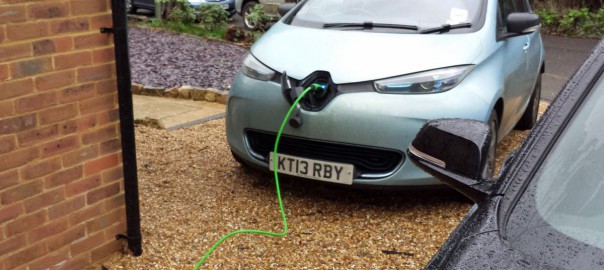
Charging my ZOE (Image: T. Larkum)

Separately, the government has announced the deployment of £80m (€88.91m) through its Industrial Strategy to support UK electric vehicle development and innovation. In addition to supporting new research and development in on-road electric vehicles, the funding will go towards exploring potential development of a hybrid-powered aircraft. Business Secretary Greg Clark said:

“Building on our Faraday Battery Challenge and Battery Industrialisation Centre this co-investment from Government and industry is a key part of our modern Industrial Strategy, building on our strengths and helping to create the next generation of net zero technologies that will transform entire industries. The UK leads the world on combatting climate change and is the first major economy to legislate for net zero.”

The UK’s e-mobility industry is growing exponentially, with projected growth of more than 200% in the next three years. However, analysis by sustainable transport body Transport & Environment published this week highlights concerns over whether the growth of UK electric vehicle development can be maintained once the UK has left the EU. Greg Archer, Transport Environment’s UK Director, said:

“Thanks to new EU rules, a wave of new, longer range, and more affordable electric cars will be on sale across Europe. But if the UK leaves the EU with no deal it will no longer be part of these rules and the cars sold in the UK won’t count towards meeting the carmakers’ targets. As a result, cars simply won’t be made available in large numbers in the UK, slowing progress in the shift to zero emissions cars here.”

Read more: Government Europa

Extra £2.5m for electric vehicle chargepoints

The Government has allocated an additional £2.5 million to fund more than 1,000 new chargepoints on residential streets.

Announcing the additional cash today (Monday, August 12), transport secretary Grant Shapps says the funding will support the on-street residential chargepoint scheme, launched in 2017, which aims to help people access charging infrastructure near their homes when they don’t have off-street parking.

It will go towards helping local authorities to install these chargepoints, which can be built into existing structures like lamp-posts.

The scheme aims to encourage even more people to choose an electric vehicle (EV) by making it easier to charge their cars near home and has already seen 16 local authorities say they will install 1,200 chargepoints this year.

The Transport Secretary is now doubling funding for the scheme to meet demand and accelerate the take-up of electric vehicles as the UK moves towards net zero emissions by 2050 and further improve air quality.

Shapps said: “It’s fantastic that there are now more than 20,000 publicly accessible chargepoints and double the number of electric vehicle chargepoints than petrol stations, but we want to do much more.

“It’s vital that electric vehicle drivers feel confident about the availability of chargepoints near their homes, and that charging an electric car is seen as easy as plugging in a smartphone.

“That’s why we are now doubling the funding available for local authorities to continue building the infrastructure we need to super-charge the zero emission revolution – right across the country.”

The allocation of funding for on-street residential chargepoints is part of the £1.5 billion investment underpinned by the Road to Zero Strategy.

Read more: FleetNews

West Sussex Council Fleet Goes Electric With Renault ZOE (Image: Renault)

Demand for used EVs is strengthening residuals

Residual values for used electric vehicles (EVs) are growing as demand for zero-emission vehicles ramps up.

Shoreham Vehicle Auctions says the UK has reached a “tipping point of acceptance”.

The electric van market is growing with low mileage business users accepting the benefit of running a used van with very low running costs.

SVA’s managing director Alex Wright said the secret is the education given to dealers and consumers about the features and benefits of an ever-growing range of new and used cars now available.

West Sussex Council Fleet Goes Electric With Renault ZOE (Image: Renault)

“EVs need a used market that is alive and prospering. That’s why we have seen greater acceptance during 2018 and into 2019 which has boosted residuals.

“Companies have worked hard on education, including the SVA team’s training courses run in partnership with the Energy Saving Trust,” explained Wright.

“Leasing companies and finance companies can now underwrite EVs confident of a vehicle’s value in three-to-four years’ time which makes monthly rentals more competitive for companies and drivers alike.

“The next step is for the charging infrastructure to respond to market needs and provide a more reliable joined-up network of chargers across the country,” he added.

Wright cites the Nissan Leaf as a recent example of how the used market has changed. In 2017, a 2015 Nissan Leaf 6.6KW Acenta with 20,000 miles on the clock booked at £8,850. In 2019, a 2017 Nissan Leaf 6.6KW Acenta with the same mileage is booking at £11,000, a rise of £2,150.

Read more: FleetNews

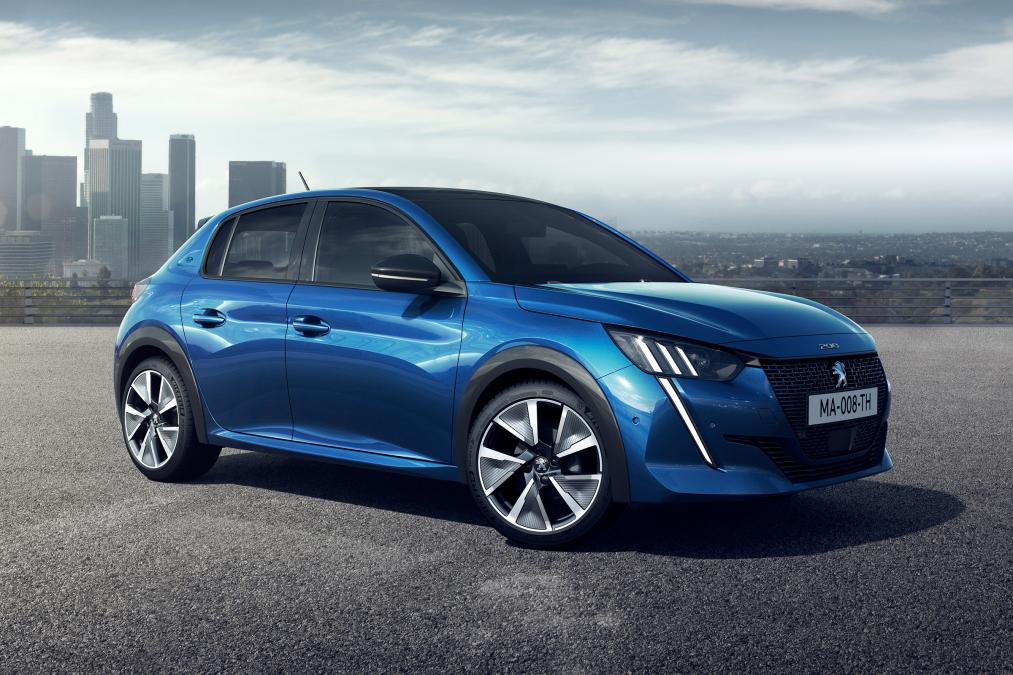
Peugeot e-208 (Image: Peugeot)

Electric Peugeot e-208 prices revealed

Peugeot’s first-ever electric car will have a range of up to 211 miles and start from £25,050

Prices have been revealed for the new Peugeot e-208, the brand’s first electric car. It’ll start from £25,050 (after the Government’s £3,500 plug-in car grant), which is around £1,500 less than the Vauxhall Corsa-e but slightly more than the Renault ZOE. First deliveries will take place in early 2020.

Peugeot is offering the e-208 in the same trim levels as the petrol and diesel versions, to help normalise electric cars. All versions feature active safety braking with pedestrian detection, heated door mirrors and LED daytime running lights. The e-208 also features cabin pre-heating and automatic air conditioning but the entry-level Active does miss out on the alloy wheels that come with petrol and diesel models.

Peugeot e-208 (Image: Peugeot)

Moving up from Active (from £25,050) to Allure (£26,250) brings a lot more equipment, including alloy wheels, leather-effect seats, Peugeot’s i-Cockpit system, a head-up display and LED rear lights. GT Line starts from £28,100 and features front and rear parking assistance, ambient lighting, night-time automatic emergency braking, full LED headlights and styling upgrades. The e-208 is also available in GT trim level for £29,650, which emphasises its range-topping status with equipment like automated parking assistance, semi-autonomous driving capability, heated front seats, sat nav and a 10-inch touchscreen.

While it’s priced similarly to other electric cars, the e-208 is much more expensive than the petrol and diesel versions of the new Peugeot 208, which cost between £16,250 and £22,200 depending on engine and spec. The Vauxhall Corsa-e, which shares the e-208’s underpinnings, can be had for £270 per month after a £5,550 deposit, so it’s likely that Peugeot will offer a similar PCP finance deal.

Read more: CarBuyer

Reducing air pollution could cut 44,000 cases of asthma in children

Reducing pollution could prevent more 44,000 cases of childhood asthma in the UK, a study has found.

A major new analysis suggests that up to a third of new cases of childhood asthma in Europe are being caused by air pollution.

Around 1.1 million children are believed to suffer from asthma in the UK.

It is thought that pollution from traffic can damage airways, leading to inflammation and the development of asthma in children who are genetically predisposed to the condition.

The study, led by the Barcelona Institute for Global Health (ISGlobal), looked at the burden of asthma on 63,442,419 children across 18 European countries, including the UK, in 2016.

They compared asthma incidence rates with estimations of levels of exposure to pollutants in more than 1.5 million square km areas in 2010, which are often traffic-related in urban areas.

Finally, they estimated how rates could be affected if levels were reduced in two different scenarios.

They found that 11.4 per cent of the total cases of asthma – 66,567 – could be prevented each year if countries adhered to the maximum air pollution levels recommended by the World Health Organisation (WHO) for the tiny particles known as PM2.5.

This alone equates to more than 10,000 cases in the UK being prevented annually.

The researchers said they believe these guidelines are outdated and need to be lowered.

If countries went further, tens of thousands more cases of childhood asthma could be avoided, the researchers predict.

Read more: The Telegraph