Monthly Archives: January 2019

Hyundai Kona Electric (Image: Hyundai)

Electric vehicles are suitable for higher-mileage drivers, says Arval

High-mileage drivers can use electric vehicles if their daily driving profile is suitable.

Hyundai Kona Electric (Image: Hyundai)
The higher-spec Kona Electric model brings an official range of 279 miles (Image: Hyundai)

So says Arval, adding that the persistent belief that pure electric vehicles are only suitable for low annual mileage needs to be overturned.

According to head of consulting Shaun Sadlier, the myth that EVs are not a suitable choice for drivers covering more than a few thousand miles a year is still frequently bandied around.

He explained:

“This argument is really an extension of range anxiety, the idea that because an EV has a limited range and takes time to recharge, that it cannot cover a longer distance annually.”

However, Sadlier added, the real-world suitability of EVs depends much more on the range of a particular model and each driver’s actual needs on a day-by-day basis.

“If you look at a driver who covers 25,000 miles a year, towards the upper end of the typical fleet spectrum, then the suitability of an EV rests entirely on their daily mileage.

“If that driver covers 246 miles, twice a week, for 46 weeks of the year, then an EV is probably not for them. They are exceeding or getting close to the maximum range of even the best EVs that are now available on the market.

“However, if they drive 110 miles, five days a week, for 46 weeks of the year and this mileage pattern is very predictable, then an EV could absolutely be suitable because it is well within the range for most models and the car can be recharged overnight.”

Sadlier added that there was an argument that the financial model of EVs meant that the higher the mileage, the more cost-effective an EV becomes.

Read more: Fleet World

It’s Plug-Ins Versus Pickups in Newest Culture Crash

Electric vehicle sales are on the rise all over the world. That doesn’t mean some traditionalists are taking it well.

2018 is shaping up to be a record year for electric vehicles. My Bloomberg NEF colleagues expect 1.9 million EVs will have been sold last year, up from 1.1 million the year before, with the bulk of those sales in Asia. Overall, China’s new passenger vehicle sales were in significant decline for the first time in more than 20 years.

Rapid growth requires the infrastructure to keep those electric vehicles charging on road trips, at offices or any time their owners aren’t plugging in at home. That infrastructure is being built in major auto markets — and some new behaviors are cropping up, too, as electric vehicle charging outlets are being built at retailers, apartment complexes and especially at gas stations.

There are currently about 50,000 fast-charging outlets in the U.S., and Germany and Japan have 30,000 to 40,000 each. However, as Bloomberg News’s Marie Mawad found out during her recent drive from Paris to Mannheim, Germany, there are still not enough charging outlets to set a road-tripping EV driver’s mind at ease.

China has … a few more. And for good reason: Very few drivers in China have personal garages in which to slow-charge overnight.

Meanwhile, by the end of last year, there were reports of U.S. drivers being “ICEd out”: drivers of internal combustion engine cars deliberately occupying dedicated charging spots, preventing EV drivers from using them. Besides being deliberate and hostile, it’s not an exaggeration to call such behavior the result of a culture clash between the environmentally minded and coal-rolling enthusiasts. More plainly, perhaps, it is new versus old.

Read more: Bloomberg

Nissan Leaf 3.Zero e+ (Image: Nissan)

It’s an A-plus for the new Nissan Leaf e+

Same car, more power

The latest version of Nissan’s Leaf has been unveiled at CES 2019, and it features a subtle but reassuring twist for any potential owners who suffer from range anxiety.

Nissan Leaf 3.Zero e+ (Image: Nissan)

Top of the pile is the Nissan Leaf 3.Zero e+ Limited Edition, which boasts a higher output. The fun and funky saloon, best known for its wonderfully addictive e-Pedal, will deliver 160kW (217 PS) of power, 340Nm of torque and a predicted 239 mile range from one charge of the 62 kWh capacity battery.

The Leaf 3.Zero e+ Limited Edition will deliver a 40% range increase over another cheaper edition of the car, the Leaf 3.Zero, which is equipped with a 40 kWh battery. Anyone worried about making it from A to B will most likely want to plump for the model with the beefier battery, which is predicted to deliver up to 62 miles more on one charge.

Read more: Tech Radar

Report: 2018 was ‘most successful year yet’ for UK’s EV market

The UK’s electric vehicle (EV) market grew by a record-breaking 19% in 2018, with one EV being registered every nine minutes.

That is a key finding of a new research paper from pro-EV campaign group Go Ultra Low, which found that almost 60,000 fully-electric and plug-in hybrid electric vehicles were registered in the UK last year.

Published today (21 January), the research draws on the latest official Government figures, revealing that the uptake of EVs grew at a similar rate between the UK’s business and domestic car users throughout 2018.

Electric car sales are expected to overtake petrol by 2040

In total, 59,911 EVs were registered in the UK last year, of which 74% were plug-in hybrids, the paper claims. While only 26% of EV registrations were for fully-electric models, this was still an increase on 2017’s 14% proportion.

The registrations mean that the nation’s total EV stock now stands at more than 196,300 vehicles, following seven consecutive years of growth.

Go Ultra Low has predicted that the EV revolution will continue to take hold in 2019, as carmakers launch new electric models and the Government begins distributing the first string of funding set out in its Road to Zero strategy.

“In the context of the wider new car market, it is fantastic to see plug-in car registrations continue to go from strength-to-strength” Go Ultra Low’s head, Poppy Welch, said.

“With even more new models being released, coupled with the introduction of initiatives such as London’s Ultra Low Emission Zone, we’re confident that the next 12 months will be a landmark year for the nation’s switch to electric.”

According to Go Ultra Low, some of the more noteworthy EV releases in 2019 will be the all-electric Kia e-Niro, Audi e-tron and Nissan LEAF. The Nissan LEAF 3.ZERO e+ Limited Edition – of which only 5,000 units will be produced for the European market – is expected to deliver a driving range of up to 239 miles on a single charge of the 62kWh capacity battery.

Read more: Edie

Was 2018 the peak for internal-combustion car sales?

Electric-car sales are growing. Total car sales around the world are shrinking.

Put the two together, and the conclusion from many analysts is that sales of cars powered by internal combustion engines around the world have already peaked.

From 2019 onward, they’re likely to do nothing but shrink, according to several automotive analysts interviewed in the Financial Times (subscription required) for a piece published late last month.

The FT quotes several analytics firms forecasting that global auto sales will fall in 2019 compared with a record 95.5 million cars sold in 2018, according to Moody’s Analytics.

There are several factors at play: an international trade war among the U.S., China, and Europe; tighter consumer credit in the world’s largest auto market, China; troubled Brexit negotiations; and tighter European restrictions on carbon-dioxide emissions.

Other analytics firms, including Evercore ISI, Accenture, and Jato Dynamics told the FT that they expect a structural downturn in 2019, based on slower sales in the second half of 2018.

At the same time, sales of electric cars are rising. AlixPartners, a British consulting service, says it expects electric car sales to grow by 1.5 million in 2019, reaching about 1.6 percent of the global market.

“Peak ICE” may already have occurred at the end of 2018, Elmer Kades, global co-leader of AlixPartners’ automotive practice told the FT. “It’s this slowing growth of the overall pie that the industry should be most concerned with, even as it has to … pay for the continuing switchover to electric vehicles.”

Read more: Green Car Reports

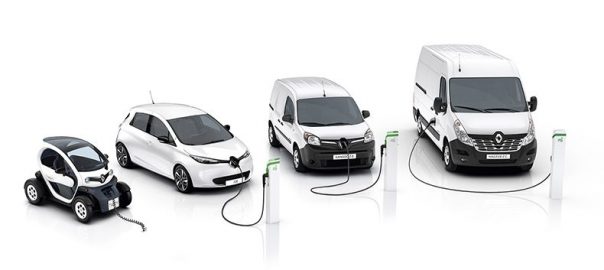
The Renault Electric Z.E. Range (Image: Renault)

Renault announces cargo Zoe

In connection with the announcement of their German sales figures for 2018, Renault has announced that a Cargo version of the Zoe will be added to their range of electric models this year.

To create more cargo space, Renault remodeled the rear seat area in the vehicle. More details on the cargo version are not yet available, as of yet though. Together with the Kangoo Z.E., Master Z.E. and a cargo version of the Twizy, the French will soon be offering a total of four purely electric delivery vehicles with the addition of the Zoe Cargo.

The Renault Electric Z.E. Range (Image: Renault)

As far as new registrations of electric vehicles by Renault in Germany in 2018 are concerned, there was an increase of 46.9% to a new record of 7,400 new vehicle registrations. According to the German federal motor transport authority KBA, the Renault Zoe recorded 6,360 new registrations in Germany alone. This is also due in no small part to the doubling of Zoe production to 440 units per day. The Kangoo Z.E. was responsible for 758 new registrations. And with the e-transporter, Renault is now even reaching its own limits. According to Renault’s German boss Uwe Hochgeschurtz, the car manufacturer is currently unable to meet the rapidly growing demand for electric delivery vans. This is also due to bottlenecks in battery production. The company hopes to get the problem under control in 2019.

Source: Electrive

Millions could miss out on benefits of electric vehicles

Millions of people could miss out on the environmental and financial benefits of electric vehicles (EVs), according to a new report.

The report by the think tank Localis warns poorer parts of the country could get left behind unless local authorities are given to power to draw up their own ‘smart city’ plans and energy policies.

In addition, it argues local authorities should be able to form their own consortiums using existing knowledge of their local areas, and also be empowered to work with private energy network providers to deliver the infrastructure they need for the future.

The report also emphasised that families across the UK are at risk of sharing the cost for necessary new energy infrastructure, but not being able to access for themselves the benefits of EVs and other ‘smart’ technologies – driving further inequality between richer and poorer parts of the country.

‘Without a change in regulation, behaviour and a wholesale transfer of powers for local energy policies, we risk a tale of two cities in our major urban centres – deepening levels of inequality between the prosperous and more deprived parts of town,’ said Localis chief executive, Jonathan Werran.

‘A ‘devolution revolution’ in locally-regulated energy markets has the potential to accelerate the nation’s switch to clean growth, turn UK cities into powerhouses for sustainable and inclusive prosperity and improve livelihoods in towns and cities across the UK.’

Read more: Environment Journal

Charging Hub with eVolt Rapid Chargers (Image: SWARCO eVolt)

SWARCO eVolt reports record year for its EV charging business

SWARCO eVolt, the award-winning Electric Vehicle (EV) Charging business, has reported a record year in which it has continued to innovate, deliver the highest levels of customer satisfaction, and increase its market share through the strength and reliability of its technology and engineering teams.

The company, which began installing its first charging points more than eight years ago, has now grown to become one of the largest providers of single, dual and multiple commercial charging points across the UK.

It currently has more than 6,250 of its eVolt-branded charging points installed throughout the country, in addition to a further 343 Rapid Charging stations to meet the needs of an expanding customer base that includes more than 88 Local Authorities and a large number of private businesses. It also launched SWARCO E.Connect, a highly sophisticated EV recharging network for eVolt and third party-manufactured charging stations across the UK and Europe.

Charging Hub with eVolt Rapid Chargers (Image: SWARCO eVolt)

It ended 2018 with news of a major new contract to deploy several hundred of its DC Rapid Charging stations for Engenie over the next 12-18 months, as well as being named Charging and Refuelling Infrastructure Provider of the Year at the 2018 Green Fleet Awards.

It has also announced plans to recruit a further nine front-line engineers and call centre staff, a new Head of Sales, Anne Buckingham, the former Head of Electromobility at Siemens, and launch new 100KW and 150KW versions of its proven Raption Rapid Charger.

Justin Meyer, General Manager at SWARCO eVolt, says the key to its success has been the reliability of its products: “In 2018 we recorded a network uptime of 99.38% which is exceptional,” he says, “and of course leads to exceptionally high levels of customer satisfaction. Our investment in EVs for our service engineers also contributes to the highest level of first-time fixes for any issues that do occur.”

Justin believes the company’s growth and increased market share also reflect the growing popularity of EVs, as more local authorities and private businesses look to meet their ‘green’ responsibilities and realise the benefits that EVs can deliver. Fleets of electric buses, taxis and council vehicles are all increasing, leading to an increased demand for charging points, and the opening of the first ever EV Rapid Charging ‘hub’ in Scotland. Two more ‘hubs’ have been installed by SWARCO eVolt since.

“We have an established reputation as the ‘go to’ supplier for commercial EV charging infrastructure solutions, respected for the range and reliability of our systems and a strong support network right across the country,” Justin continues. “But we realise that to stay on top we need to continue to innovate.

“To that end we will be launching a series of new e-mobility products and services in 2019, with a particular focus on further integration with intelligent traffic technologies inherent within the SWARCO Group.”

Source: Gravity London PR

Nissan Leaf 3.Zero e+ (Image: Nissan)

New Nissan Leaf e+ launched with extra power and range

Limited edition of Nissan’s popular electric car gains bigger batteries and produces 214bhp

Nissan has launched a new range-topping version of the Leaf EV, which features a boost in power and a longer range.

The Leaf 3.Zero e+ Limited Edition, launched at CES in Las Vegas, replaces the electric car’s standard 40kWh battery with a 62kWh unit. Nissan says it can achieve 239 miles on the WLTP test cycle, a 62-mile increase on the standard model.

Nissan Leaf 3.Zero e+ (Image: Nissan)

The special edition, of which 5000 units will be offered in Europe, has also had its power increased to 214bhp, compared with 148bhp for the standard model. The car also features 250lb ft of torque and an increased top speed of 97mph.

The new 62kWh battery features 288 cells, compared with 192 in the standard unit. Nissan says it offers an increase of 25% in energy density and 55% in energy storage capacity but is a similar size to the 40kWh battery. The car sits 5mm higher on 16in wheels to account for the underfloor battery, but all other dimensions are unchanged.

Read more: Autocar

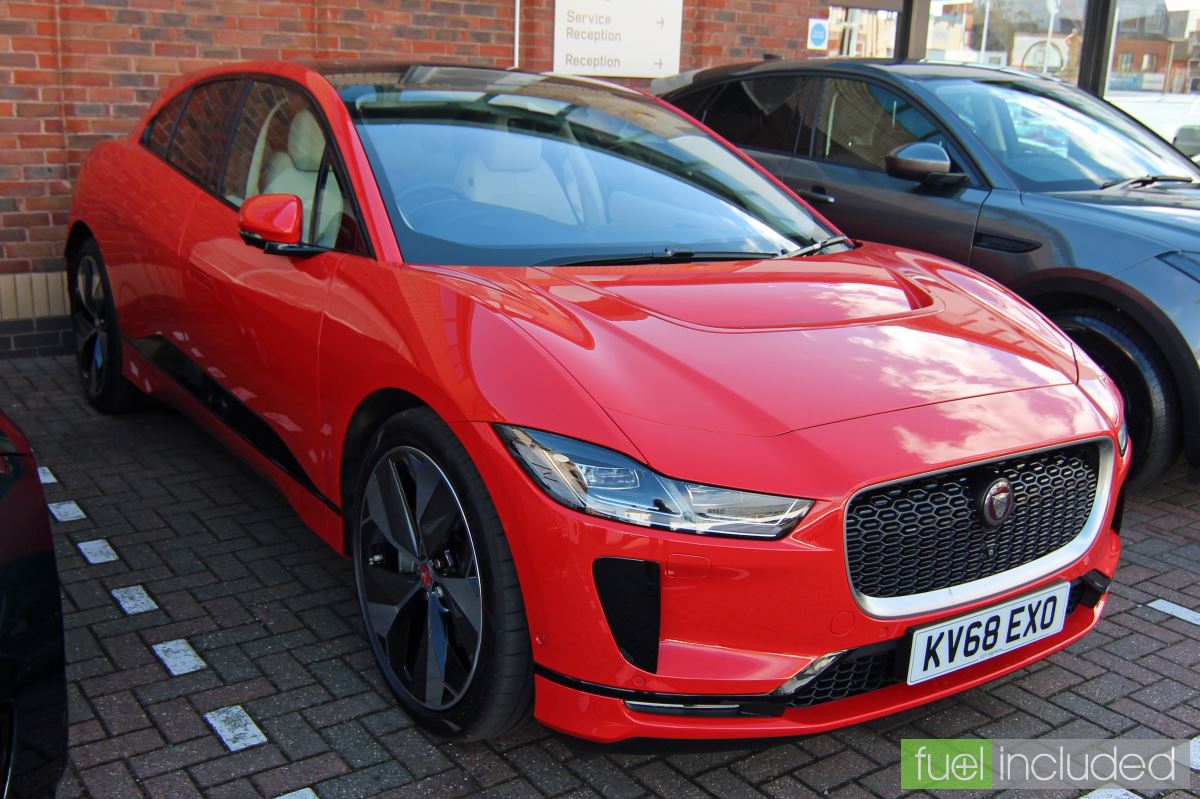
Jaguar I-PACE Electric Car (Image: T. Larkum)

Lease costs for electric vehicles fall in 2018

Leasing costs of battery electric vehicles (BEVs) have fallen throughout 2018 according to data experts at Cap HPI.

The study looked at five of the best-selling models in the UK and discovered that monthly lease costs had fallen by 9.5% on average.

The UK’s best-selling electric car, the Nissan Leaf saw monthly lease values fall by 6.6% between January and November 2018. Monthly lease prices for the Renault Zoe fell by 16% between June and November.

Between in the 12 months up to November 2018, the BMW i3 saw lease prices drop by 9.2%. The Volkswagen e-Golf saw prices drop 14% over the same period.

The Jaguar I-Pace saw the smallest price drop with a fall of only 1.7% since April 2018.

Jaguar I-PACE Electric Car (Image: T. Larkum)

Mark Turnbull, global head of consulting at Cap HPI, said: “Over the next few years the new price of BEVs will come down as more affordable ‘mainstream’ model ranges are introduced by many manufacturers.

“Used buyer perception will continue to improve as battery ranges are extended and charging times are reduced, and electric car technology proves to be robust and reliable. So subject to adequate investment in charging infrastructure, and positive government legislation, I believe their residual values will be stronger.

“A pincer movement of lower new prices and improved RVs will mean less depreciation in pound terms, and cheaper lease rates will speed up the adoption of this technology.”

Read more: Fleet News