Monthly Archives: August 2018

West Sussex Council Fleet Goes Electric With Renault ZOE (Image: Renault)

West Sussex Council Fleet Goes Electric With Renault ZOE

  • West Sussex County Council takes delivery of four 100 percent electric Renault ZOE
  • Vehicles will be used as pool cars and form part of the council’s drive to reduce emissions
  • Local authority was convinced by the ZOE’s class-leading real-world range of 174 miles
  • All-electric Renault ZOE priced from £18,420 OTR (after PiCG, plus battery rental)
  • Renault continues to be the best-selling manufacturer of all-electric vehicles in Europe

West Sussex County Council has become the latest in a long line of public sector organisations to take its first steps into electric motoring with the 100 per cent electric Renault ZOE.

The local authority has added four ZOE Q90 Dynamique Nav models with the Z.E.40 battery to its 530-strong fleet – its first pure EV cars – after being convinced by the model’s 174-mile estimated real world range.

West Sussex Council Fleet Goes Electric With Renault ZOE (Image: Renault)

Based at County Hall in Chichester, the models are already in service as pool cars, helping the council reduce emissions by tackling grey fleet car use and cut costs by offering staff an alternative to using their own vehicles.

Already, the vehicles are proving extremely popular and are booked out everyday. Between them, the vehicles will complete several thousand journeys per year, allowing users to travel from council HQ to points as far afield as Crawley and Shoreham and back on a single charge.

Loretta Haddow, Team Leader – Fleet Resource and Support, at West Sussex County Council, said:

“We have had electric vehicles on trial and extended demos before and must have looked at every model out there but they have never been quite right for us.

“But the latest ZOE was the game changer for us and the extended range made it a viable option for the first time.

“We are really pleased that the ZOE is able to get across the county and back and we wanted to give everyone who’s going to take one of these cars the confidence to know that wherever they’re going to go they’re going to get back again.

“Since going into service we’ve been really impressed with how easy and relaxing they are to drive. The team love them. They’re really popular.”

Haddow added:

“While range and emissions were the biggest factors for us, as a public sector organisation we still have to present a compelling business case before adding new vehicles to our fleet. In this case, the ZOE ticked all the boxes in terms of whole life costs.”

Ben Fletcher, Head of Z.E., Renault UK said:

“We are delighted to have supplied four Renault ZOE to West Sussex County Council. The ZOE provides low running costs with no emissions as well as a relaxing environment. This is proof of another public sector body recognising the business and environmental benefits of adopting the Renault ZOE.”

ZOE is the best-selling electric car in Europe with more than 100,000 ZOE sold since launching in 2013 with over 6,000 in the UK. ZOE is one of three models in Renault’s diverse electric vehicle range which also includes the Twizy quadricycle, the Kangoo Van Z.E., Europe’s best selling electric van, and the forthcoming Master Z.E. large panel van.

The Renault ZOE is available in a choice of two trim levels, Dynamique Nav and Signature Nav, both of which come with the new R110 electric motor, combining extra power with driving enjoyment and the Z.E 40 battery that provides a 174-mile real world range. For customers more likely to use public rapid chargers whilst travelling longer distances, the Q90 option is available with both trim levels. This charges the ZOE from 0-80 per cent full in just over an hour when using a 43kW charge point. The MY18 ZOE Q90 with Z.E.40 battery provides an estimated real-world range of 174 miles.

The Dynamique Nav offers a comprehensive specification, which combines comfort with convenience, safety and security. Standard features include Hands Free keycard, automatic lights and wipers, rear parking sensors, cruise control, climate control, 7-inch R-Link infotainment system with voice-controlled TomTom sat nav, electric windows and LED Daytime Running Lights. The top-of-the-range Signature Nav adds further luxury with features such as supple premium leather upholstery, BOSE® audio system, heated front seats, electrically folding door mirrors and a rear parking camera. Renault’s Range OptimiZer technology ensures ZOE is highly efficient with its heat pump, a bi-modal braking system and Michelin ENERGY E-V tyres.

ZOE continues to be available to purchase in two ways. First, under a battery hire scheme, where ZOE pricing starts at £18,420 (OTR) after the Government Plug-in Car Grant, with battery leasing from £59 per month. It is easy to purchase a used ZOE with a battery lease – the new owner simply chooses which leasing option suits their needs the best and starts monthly payments based on their lease plan. You can also buy the ZOE outright. ZOE i ‘full purchase’ models start from £24,020 (OTR) after the Government Plug-in Car Grant, giving the buyer full ownership of the battery with no monthly battery lease payments.

Source Renault Press

Electric cars charging in Milton Keynes (Image: T. Larkum)

Here’s what charging your electric car will look like in 2030

EVs to hit 11 percent of new car market by 2030, with up to 40 million charging stations worldwide.

A new study finds that electric vehicles (EVs) and their charging stations are poised to see explosive growth over the next decade.

At the same time, utilities, car companies, and other businesses are pursuing a variety of charging strategies — many of which will be very cheap and possibly even free for consumers.

By 2030, EVs are projected to comprise 11 percent of the new car market, with up to 40 million charging points worldwide, according to a new study by Greentech Media (GTM), a division of Wood Mackenzie.

Electric cars charging in Milton Keynes (Image: T. Larkum)

So power demand for EV charging will soar, led by China, North America, and Europe.

To reach this kind of exponential growth in charging infrastructure, GTM explains, “utilities, along with manufacturers, oil and gas giants and sector-specific specialists, will need to test new business models.”

One of the most innovative business models comes from a U.S. startup, Volta Charging, which bills itself as “the largest free electric car charging network in the US.” It has raised nearly $60 million to create an EV charging network that shows video ads, providing revenue designed to allow free charging for customers.

So far “sponsored stations have delivered over 22 million free electric miles,” the company says, “saving over 9 million pounds of CO2.”

Read more: Think Progress

Figure 4: Charging on Christmas Day (Image: T. Larkum)

Electric car charging could offer selling point for new-build homes

By 2040, the UK government wants all new cars to be either electric or hybrid, and the switchover could have major implications for the UK housing industry.

The government’s “Road to Zero” strategy, set to be phased in over the next 20 years which will lead to a complete ban on non-electric cars being sold in the UK, is a huge step forwards in reducing emissions and promoting a cleaner, greener way of life for the country.

Figure 4: Charging on Christmas Day (Image: T. Larkum)
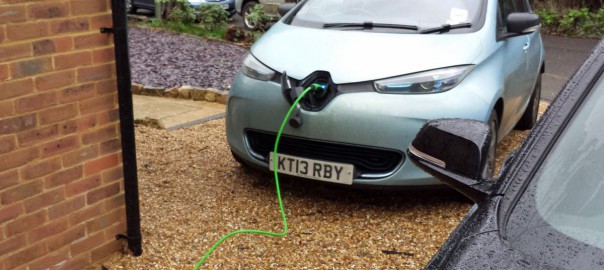
Charging at home (Image: T. Larkum)

While there is still debate over exactly which vehicles will be affected, with recent news that petrol and diesel hybrid cars could be exempt from the new rules, as well as a target for 50% of all new cars to be ultra-low emission by 2030, it will undoubtedly have a huge effect on the country’s housing market, which will need to be ready to cater to the changes.

Best and worst places for electric cars

One study conducted recently by Motorway.co.uk has revealed that much of the country is largely unprepared for such an overhaul in terms of its property stock, with many areas having very low levels of off-street parking available – which will be a necessity after the switchover so that people are able to charge their electric cars near their homes.

Read more: Buy Association

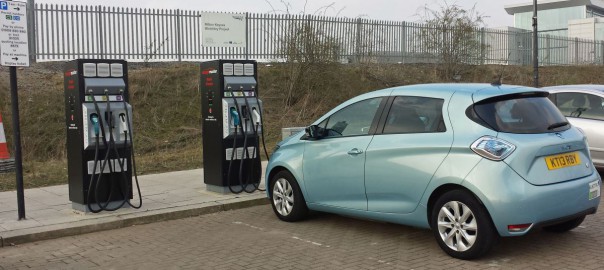
Rapid Chargers next to Milton Keynes Central railway station parking (Image: T. Larkum)

Chargemaster and BP to boost UK EV charging network

Chargemaster is offering to install 4,000 plug-in vehicle charging points at AA hotels and B&Bs for free across the UK to boost infrastructure for drivers.

The strategic partnership between the AA, Chargemaster and its new parent company BP, will see hotels fitted with 50kW rapid chargers for any EV driver to use on the POLAR network.

Rapid Chargers next to Milton Keynes Central railway station parking (Image: T. Larkum)
Chargemaster Rapid Chargers next to Milton Keynes Central railway station parking (Image: T. Larkum)

The first hotel to benefit from the offer is Sandford Springs Hotel in Kingsclere, Hampshire.

Chargemaster will work with any AA-inspected establishments interested in taking up the offer to determine the best charging points for their location

Research by Chargemaster shows that 90% of EV drivers will seek out destinations that have charging points over those that don’t, meaning that having a charging point provides an additional draw for hotels while the EV market continues to develop.

David Martell, chief executive of Chargemaster, said: “We believe that within the next five years, all hotels will offer EV charging, just like they provide Wi-Fi today.

“Our offer for AA hotels is a great opportunity for hotel owners and operators to get a competitive advantage with a facility that could attract hundreds of thousands of customers in the coming years.”

Read more: AM Online

Nissan Leaf (Image: Qurren/Wikipedia)

All-New 2018 Nissan Leaf Conquers The 3 Highest Peaks In A Day

A team from Nissan, together with the all-new 2018 Nissan Leaf, were involved in an extreme test of both electric and human endurance in support of an all-electric attempt at the National Three Peaks Challenge in the UK recently.

The National Three Peaks Challenge involves ascending and descending the three highest peaks of Scotland (Ben Nevis, 1,345 metres), England (Scafell Pike, 978 metres), and Wales (Snowdon, 1,085 metres), and driving between all three, in just 24 hours.

Nissan Leaf (Image: Qurren/Wikipedia)

With the Leaf offering a larger capacity battery (40 kWh) and longer range (270 km combined), and the UK’s rapid charging infrastructure well developed along the route, two teams joined forces on a warm June day to take on the challenge.

Split into two units of Nissan Leaf, the teams started at 12 pm at Ben Nevis on one of Scotland’s hottest days of the year, with temperatures nearing 30-degrees Celsius. Descending the mountain mid-afternoon, the journey continued south to England, the Lake District and Scafell Pike, which was climbed in the very early hours of the morning with ambient temperatures still topping 20-degrees.

The morning of the second day brought the teams into Wales and towards their final destination of Snowdonia and the final peak – Snowdon.

Read more: Carlist

Europe Electric Car Sales Up 37% In June

The European passenger plug-in market continues pushing forward. In June, the continent registered some 38,000 plug-in electric vehicles (PEV), up 37% relative to the same period last year and the continent’s second best performance ever.

That showing pulled the year-to-date (YTD) count to some 185,000 deliveries (+43% year over year, or YoY). In total, the 2018 PEV market share of the overall car market there is up to 2.2% (2.4% in June).

This time, fully electric cars (BEVs) grew slower (+20%) than PHEVs (+55%). Will we see all-electrics bounce back in the second half of the year?

Looking at Europe’s fuel mix, diesel continues to drop significantly (-16% YoY) in a growing market (+5.2%), while all other fuels (including CNG, LPG, …) are on the rise, profiting from the diesel-fleeing stampede. At this pace, the new registrations of diesel-powered vehicles will be virtually dead by 2025.

June saw the Renault Zoe beat the Nissan Leaf for the first time since February, with BEVs continuing to own the top positions. The Tesla Model S, meanwhile, profited from the usual last-month-of-quarter peak to join the top 5. It landed in the #4 position.

The Mitsubishi Outlander PHEV managed to score another top 5 presence as well, winning at the same time the bestselling PHEV award.

Among models that landed in 2018, the best selling one is the Land Rover Range Rover Sport PHEV, which registered 235 units in June, adding to the current 498 registrations made this year.

Read more: Clean Technica

Highways England on track to meet electric vehicle charging goal by summer 2019

Highways England is on track to reach its targets for deployment of electric vehicle chargers next summer after revealing that 83% of its network is within 20 miles of a charger.

The government body set a target of ensuring 95% of its strategic road network was served by an electric vehicle charger within this distance by 2020. This work is being carried out as part of a £15 billion investment promised in a road investment strategy up to 2021.

Through a programme of grant initiatives, collaboration with local authorities and use of a specialist framework of suppliers, the former Highways Agency has made significant progress towards this target.

In addition, plans are already in place to deliver the remaining chargers as a Highways England spokesman explained to Current±.

“We continue to work collaboratively with local authorities to provide grants to install charge points on local authority land, which will help us achieve a further 4% of coverage towards our commitment. We anticipate this could be achieved by summer 2019.

“We will be awarding a specialist framework for the installation of a further 65 rapid chargers, again by summer 2019, to provide a further 8% coverage.”

Read more: Current News

Fuel Included BMW i3 on static display (Image: T. Larkum)

Renault Zoe Climbs To #1 In Germany

The German plug-in electric car (PEV) market grew 23% in June, to 5,709 registrations, with plug-in hybrids (+25%) and fully electric cars (+21%) growing at a similar pace. In 2018, all-electrics are reaching 1% share, while plug-in hybrids have also grown their share to 1%, resulting in a total PEV share of 2%.

But the most interesting story on the fuels mix is the Titanic-like drop of diesel vehicles sales. In June, their sales sank 16%, to the benefit of all other kinds of fuels. Diesel now represents only 31% of the market. At this pace, diesel sales could be tot in this market by 2021. Inconceivable? Well, in 12 months, diesel lost 9% share, going from 40% to 31%.

Fuel Included BMW i3 on static display (Image: T. Larkum)

Looking at June best sellers, BMW had a 1–2 win, with the i3 scoring 509 units, a new year best, while the 225xe Active Tourer registered 500 units, a new record for the German MPV.

The Renault Zoe was 3rd, while the surprise of the month was the #5 Mini Countryman PHEV. With 300 deliveries, it had its best result ever in Germany.

Just outside the top 5, the VW e-Golf registered only 290 deliveries, its worst performance in 11 months. Is the German brand already starting the sunset mode of its BEV hatchback?

Read more: Clean Technica

Solar EV Charging Hub on Princes Street, Dundee (Image: eVolt)

eVolt installs rapid charging units for first solar power hub in Dundee

eVolt UK, the nationwide supplier of electrical vehicle (EV) charging units, has installed the latest versions of its rapid charging units for the first and largest purpose-built charging hub in the UK that includes solar power and energy storage.

The hub is located on Princes Street in Dundee city centre and features rapid charging units, 18 bays of solar canopies and an integrated energy storage system utilising second-life EV batteries. eVolt has also installed six of its Raption 50kW Rapid Chargers, capable of charging two vehicles simultaneously in approximately 30 minutes, and three 22kW eVolve chargers.

Solar EV Charging Hub on Princes Street, Dundee (Image: eVolt)

Fraser Crichton, Transport Officer at Dundee City Council, says the hub is a landmark development for the city

“We are so excited to have completed our latest EV infrastructure project as we continue to drive our e-mobility vision. With over 100 pure electric taxis in the city this hub will be vital to support our taxi fleet as well as benefitting the wider EV community ”

This is the second of three hubs to be introduced this year in Dundee through the Office for Low Emission Vehicles (OLEV) Go Ultra Low programme. The first hub was introduced at Aimer Square in April and has been used frequently since its launch. Six rapid chargers and two eVolve chargers will also be installed at Queen Street car park later this year.

Justin Meyer, General Manager of eVolt UK, says:

“This is the first hub of its kind, combining EV charging, solar canopies and energy storage, we are proud to be supporting Dundee Council’s project to lower emissions and to encourage more people to make the switch to sustainable e-Mobility.”

Source: eVolt / Gravity London

Smart charging mandated by law as Automated and Electric Vehicle Bill passes

The UK has taken ‘a major step’ towards the electric vehicle revolution according to the government after the Automated and Electric Vehicles Act completed its passage through parliament.

First published in its draft form in October 2017, the AEV Bill constitutes the government’s main route to greater provision of charging infrastructure, which it sees as the main barrier to uptake of EVs in the future.

Upon receiving royal assent, a series of measures around deployment and access to charge points are set to become enforceable by law once transport secretary Chris Grayling selects a date for implementation.

Speaking on Thursday when the bill passed, roads minister Jesse Norman said:

“The UK is becoming a world leader in the roll-out of low-emission transport. Today we have passed a significant milestone in that journey.

“This act will ensure that the UK’s infrastructure and insurance system is ready for the biggest transport revolution in a century.”

Read more: Current News