Preconditioning is one of the lesser-known but brilliantly useful features of electric cars. On both cold winter days and hot summer days, you can benefit from it.
Put simply, preconditioning allows you to pre-heat or pre-cool the car’s cabin before you start your journey. Not only will you feel more comfortable, you’ll maximise the car’s driving range and prolong the life of its battery.
It’s a win-win-win situation, in other words.
How does preconditioning work?
Preconditioning can be activated via the car’s infotainment system or a connected smartphone app. By scheduling your daily departure times, the car will heat or cool its interior to optimum temperature – you just climb in and go.
Crucially, when the car is plugged in, electricity is drawn from the mains and not the car, so this has no impact on driving range. You start your journey with a full battery.
Also, because the car’s windows will be free of mist and ice when you enter the cabin, you won’t waste time waiting to clear or defrost them.
If you would like to know more about Solar Panels and the PowerBanx range of home battery systems, and get a free instant quote, please complete our online form:
42% of electric vehicle (EV) drivers are not on the best charging tariffs for their vehicles because they are not using a dedicated home charging point to charge their car
Less than 50% of people have a time-of-use tariff, enabling them to take advantage of cheaper overnight electricity prices, and
Just three in 10 EV owners have a specific EV tariff with their energy provider
The research points to significant missed opportunities in engaging new EV owners in smart charging and maximising their car’s potential to cut their costs and carbon emissions. By charging their vehicle through a smart domestic charger able to optimise charging to times of low demand when energy is cheapest and greenest, customers can not only save on their energy bills but reduce their carbon footprint.
In fact, if a customer buys an EV and home charger they typically reduce their car running costs by ~50% and triple their CO2 savings per kilometre. Add smart charging or bidirectional vehicle-to-grid technology and emissions can be decreased by a further 30% with customers able to actually earn money – up to £800 a year – for importing cheap energy and selling it back to the grid. At scale, this technology can accelerate the energy transition by increasing the use of renewable power and preventing fossil fuel backup generation to be switched on at peak times, and do so in an affordable way for customers.
If you would like to know more about Solar Panels and the PowerBanx range of home battery systems, and get a free instant quote, please complete our online form:
The latest advertising from General Motors promotes the company’s slogan: Electric vehicles for everyone! The EVs look great, and the prices are very attractive. But — who educates the masses? Who dispels the FUD (much of which was, until recently, promulgated by GM)? I had hoped that established carmakers would do so. But it looks like the ad campaign is based on feelings, not facts. Maybe that is the only way to sell a car?
So, who educates the masses? Will the slick ads and low prices get buyers into the dealership where well trained and enthusiastic sales staff will inform the innocent about range and charging times? “No sir, you don’t have to hold the charging cord for 10 hours as the car charges overnight.” Amazed gasp! No, madam, there is nowhere to put petrol in the vehicle. I hope so. I would like to hear of training programs for sales people.
I think that the reality will be that I will still be explaining EVs to people for several years to come at EV and off-grid expos (I have been to 8 in the last year), coffee mornings (we have one once a month at the local tavern), and even in my driveway as I water the garden. Yesterday morning, a lovely couple who were walking their dog saw the Tesla and stopped to ask the usual questions: How much does it cost? How far does it go? How long does it take to charge? Where do you charge it?
If you would like to know more about Solar Panels and the PowerBanx range of home battery systems, and get a free instant quote, please complete our online form:
States have plans to ban gas-powered cars and the White House wants chargers along highways, but implementation is a challenge
Speaking in front of a line of the latest electric vehicles (EVs) at this month’s North American International Auto Show, President Joe Biden declared: “The great American road trip is going to be fully electrified.”
Most vehicles on the road are still gas guzzlers, but Washington is betting big on change, hoping that major federal investment will help reach a target set by the White House for 50% of new cars to be electric by 2030. But there are roadblocks – specifically when it comes to charging them all. “Range anxiety,” or how far one can travel before needing to charge, is still cited as a major deterrent for potential EV buyers.
The welcoming entrance of Disney’s magic kingdom (Image: L. Larkum)
The auto industry recently passed the 5% mark of EV market share – a watershed moment, analysts say, before rapid growth. New policies at the state and local level could very well spur that growth: the Inflation Reduction Act, which passed this summer, offers tax credits of $4,000 to purchase a used EV and up to $7,500 for certain new ones. In August, California, the nation’s largest state and economy, announced rules that would ban all new gas-powered cars by 2035. New York plans to follow.
If you would like to know more about Solar Panels and the PowerBanx range of home battery systems, and get a free instant quote, please complete our online form:
Despite the soaring electricity prices, research shows you’ll still save money running an EV ‒ plus top tips from the experts on how to save even more
There’s been a flurry of energy-price fluctuations over the past couple of months, but despite the dropping of fuel prices and energy price rises (and more to come), the latest research shows that it’s still cheaper to run an electric car.
The planned rise of electricity to around 34p per kWh (a jump from the current average unit of 28p) on October 1 will bump up the price of running an EV, but, according to the RAC, it’s still cheaper than driving a petrol car. Comparing similar cars under comparable conditions, the organisation found that an EV driver would pay 9p per mile while a petrol driver would pay 19p.
Still, with electricity at an all-time high, EV drivers will be looking to save all the charge, and pounds, they can. With the help of Stuart Masson, editor of car ownership advice site The Car Expert, and Simon Williams, EV lead at the RAC, here’s our list of money-saving tips to help keep costs as low as possible…
Charge at home overnight on the off-peak rate. Most chargers have smart-charge software that powers up when electricity is cheapest at around 2am ‒ so if you’re charging a home only do so overnight.
If you would like to know more about Solar Panels and the PowerBanx range of home battery systems, and get a free instant quote, please complete our online form:
What’s the point in a consumer energy price cap that does very little to cap consumer energy prices?
When it was introduced, the UK energy price cap aimed to solve the problem of the “loyalty penalty” — higher prices for people who didn’t regularly shop around for a new supplier. The problem is, that’s now a non-issue. What it wasn’t designed for is the conundrum we face: unaffordable energy prices. As a result it is failing to serve any function well.
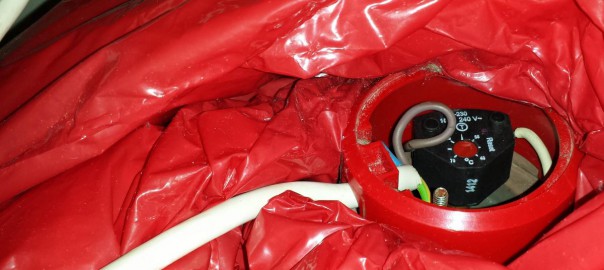
Figure 3: New thermostat installed, note temperature adjustment (Image: T. Larkum)
To recap, the default price cap in 2019 was introduced against a backdrop of concerns that suppliers were overcharging disengaged consumers.
That wasn’t a trivial problem. The competition watchdog found in 2016 that 70 per cent of the Big Six energy companies’ domestic customers were on “expensive ‘default’ standard variable tariffs”, now known as the only show in town. At the time, it was the case that if consumers switched, they could save perhaps £300 a year. Across the market the loyalty penalty added up to £1.4bn a year on the Competition and Markets Authority’s estimates.
The cap on the default tariff was designed as a fallback to stop companies from using loyal customers to subsidise switchers, beyond a price determined by the energy regulator Ofgem. It also aimed to solve a fairness problem: that no one should have to pay more than the watchdog-determined fair price for energy.
If you would like to know more about Solar Panels and the PowerBanx range of home battery systems, and get a free instant quote, please complete our online form:
Active Commuters Experience Better Air Quality than Car Drivers
The study was carried out by University of Leicester academics in collaboration with Leicester City Council, and it was released in the Journal of Transport & Health, as cited by Phys.org
Researchers discovered that weekday morning commuters commuting by automobile had greater in-cabin levels of nitrogen dioxide (NO2) than their counterparts going by bike or foot.
NO2 is a major indication of air quality and is detrimental to people when breathed in.
However, it was discovered that drivers had a somewhat lower concentration of small particulate matter (PM2.5).
To evaluate the amounts of NO2 and PM2.5, researchers used backpack-mounted air quality sensors to collect data on four typical routes taken by commuters in Leicester between the suburbs and the city center.
The Nissan Leaf electric car’s cabin also had the same gadgets installed.
To measure driver exposure to contaminants without the car’s exhaust interfering, an electric vehicle was employed.
If you would like to know more about Solar Panels and the PowerBanx range of home battery systems, and get a free instant quote, please complete our online form:
Naysayers argue that electric vehicles have too many obstacles yet to make them appealing to mass consumer audiences. Yet the numbers seem to indicate that we’re a lot closer to making EVs the better financial choice than many so-called experts want to admit.
Germany will end sales of new ICE vehicles in 2030. What has long been seen as a massive gap between the appeal of ICEs and EVs is quickly fading. Globally, EV sales grew 80% in 2021.
Kia Ceed Sportwagon PHEV and XCeed PHEV (Image: Kia)
The National Academies of Sciences, Engineering, and Medicine declares that “the period from 2025-2035 could bring the most fundamental transformation in the 100-plus year history of the automobile” as battery costs fall and EVs reach price parity with internal combustion engine vehicles, leading them to become the “dominant type of new vehicles sold by 2035.”
It is expected that, by 2030, battery EVs will account for 81% (25.3 million) of all new EVs sold.
Besides eliminating exhaust emissions and tackling part of the 23% of global CO2 emissions contributed by the transportation sector, EVs will also provide key flexibility to the grid as we transition to a greater share of renewable energy supply.
If you would like to know more about Solar Panels and the PowerBanx range of home battery systems, and get a free instant quote, please complete our online form:
More than 40 4x4s were targeted in the dead of night in Primrose Hill, Kensington and Chelsea, Dulwich, and Notting Hill by a group calling themselves The Tyre Extinguishers.
The group declared they want SUVs banned in urban areas, pollution levies to tax SUVs out of existence and investment in public transport.
London Climate March – the Rally (Image: T. Larkum)
SUVs have already been “disarmed” in Paris, Bristol, Bordeaux, Glasgow, New Jersey and now London where Last Gasp vowed to make it “impossible to own one”, Extinction Rebellion claimed on Twitter.
In a manifesto on their website, The Tyre Extinguishers said the vehicles “exist purely for the vanity of their owners, who see them as a status symbol” and “SUV drivers tend to be richer and therefore tend to be white”.
A Dulwich Society spokesperson, a community group representing the leafy south London neighbourhood, said: “Several cars were vandalised in Dulwich last night with tyres deflated and this poster left on windscreens.
“We are environmentally friendly but this is not who we are as a community.”
Andy Meyer, a councillor for the City of London, called the activists “narcissists”.
He added: “Vandalising vehicles that may include doctors on call. Just pathetic and dangerous.”
If you would like to know more about Solar Panels and the PowerBanx range of home battery systems, and get a free instant quote, please complete our online form:
First impressions on British roads are very favourable – make no mistake, this is VW flexing its muscles after several tough years
What is it?
Like opening one of those brown envelopes from HMRC, climbing aboard the Volkswagen ID 4 for the first time is an ordinary act loaded with trepidation.
Which seems ridiculous, I’ll admit. While this is only the second car after the ID 3 hatchback to be built under the grand banner of Wolfsburg’s ID electric sub-brand, the ID 4 is just (yet?) another crossover, albeit one whose pebble-like curvature hints at something unusual. And as for being an electric crossover, lots of those exist already. Hyundai makes one, as does Ford, as does Vauxhall. So why the suspense?
It’s because the ID 4, fresh to UK roads and tested here in £37,800 1st Edition trim, could do more than any other car to shape the market over the next decade, at least in Europe. With dimensions just inside those of the Volvo XC60 in every direction, it taps richly into the crossover zeitgeist. And coming from the one ‘legacy manufacturer’ whose ambitions in the EV sphere trump all others’ (we’re promised 70 new electric models by 2028 and told that 70% of new Volkswagens sold in 2030 will be EVs), its volume potential is simply colossal. If the ID 4 is properly good, you have to imagine that it will light the fires beneath the ID offensive. And if not? Well, the ghost of Dieselgate still lingers.
As for the hardware itself, under a body that’s somehow bulbous and rakish in equal measure (the ID 4 isn’t exactly handsome, but neither is it unattractive) lies the same MEB platform used by the ID 3, only with the wheelbase and tracks extended. In the forseeable future, both Audi (with the Q4 e-Tron) and Skoda (with the Enyaq iV) will also make use of the MEB platform.
For now, the sole ID 4 derivative is this Pro Performance 1st Edition, which pairs a 201bhp rear-mounted motor with a 77kWh battery for a 310- mile range and 0-62mph in 8.5sec. Expect a 52kWh battery offered with 146bhp or 168bhp motors to arrive later this year, and eventually an ID 4 GTX with four-wheel drive courtesy of another motor on the front axle and more than 300bhp all in. A coupé version, the ID 5, will also sprout.
Volkswagen ID 4 (Image: Volkswagen.co.uk)
What’s it like?
Beyond the exterior design, the ID 4 further departs from traditional Volkswagen fare within its cabin.
The dashboard topography is loosely inspired by that of the Golf but, as with the ID 3, the cockpit is even more minimalistic. The conspicuous lack of buttons and switches might even seem quite shocking to someone coming from, say, a Tiguan.
In our test car, the white plastic that wraps around the dainty 5.2in digital display also seems to be exactly the same sterile-looking, medicinally reassuring material they use for the cases of MRI scanners (absolutely intentional), and it branches off to form the new gear-selector rocker, à la BMW i3.
In addition, the attractive and superbly comfortable ‘Style’ seats, plus organic shapes in the door-card mouldings, and Volkswagen’s modern reluctance to use much in the way physical switchgear, do create quite a special ambience. And, yes, one that is genuinely very relaxing, not least because the scuttle is relatively low and forward visibility thus effortless.
Still, there are some quirks I don’t get. Why, for example, use a (not particularly) touch-sensitive pad to switch the driver’s pair of window switches between controlling the front and rear windows, instead of just fitting four switches?
And if you see the dashboard putting on a light-show, that’s the new ID. Light concept, which blinks in different colours and patterns to relay everything from satnav directions to charging status to incoming calls. It’s moderately useful at times, but mostly a bit distracting.
The fundamental ergonomics are excellent, though, and you might not be expecting to find such generous rear leg room. The ID 4 is akin to the Mercedes-Benz E-Class in the back, and overall it’s clear that Volkswagen has brought all its packaging knowhow to bear with this first electric SUV. You really do get an impression of spaciousness.
And to drive? It’s inoffensive but not inert; far from what you might call engaging but very intuitive. Like so many electric cars, the ID 4 could easily have ended up feeling like an appliance, and it does have appliance-like virtues, such as its high perceived quality and its straight-forward driveability.
But there’s also enough character to ensure that it doesn’t leave you cold: neatly tuned control responses, sharp initial performance, interesting little design cues and a sense of maturity on the move. That the ride quality, even on 20in wheels, is mostly fluid and well-mannered elevates the ID 4’s game further.
If you would like to know more about Solar Panels and the PowerBanx range of home battery systems, and get a free instant quote, please complete our online form: