Category Archives: FAQ

We can help with a cheap car lease

Cheap Car Lease

Cheap Car Lease

Many people are in the market for a cheap car lease, and that’s something we can help with. We source our cars from around the UK and have negotiated some great deals, so talk to us.

"<yoastmark

We provide all of our cars on a monthly contract so it’s much like a mobile phone tariff. These contracts take two different forms and it’s worth outlining them:

  • Personal Contract Hire (PCH) or Business Contract Hire (BCH). These are straight leases, also known as contract hire. Essentially they are a form of long term rental, and are becoming increasingly popular.
  • Personal Contract Purchase (PCP): this is like a lease. However it has the benefit that at the end of the lease you can choose to keep the car. This is done by making a large one-off or ‘balloon’ payment. A PCP is now the most popular way for people to buy their new car.

Cheap Car Lease – Electric Car

We specialise in selling electric cars. With an electric car you get a new car at a low monthly cost, and it’s also especially cheap to run. The technology of electric cars is developing very fast with new models coming out all the time with longer range and greater performance. Our advice, therefore, is always to expect that you will give the car back at the end of the contract. Then you can upgrade to a new and better model.

Most popular electric cars on cheap car leases (Image: Fuel Included)

Essentially you don’t want to be in a situation like someone paying off an iPhone 4 contract when everyone else is upgrading to an iPhone 8. That’s why for our purposes you can consider leases and PCP to be equivalent. They are just finance contracts where you get a new car with an initial upfront payment plus a regular monthly payment. The key thing is what the car is costing you per month.

The beauty of electric cars, of course, is that you can save a lot of money each month on fuel and road tax. This can virtually pay for the car, i.e. you can get a new car for free. It’s because of the low ‘fuel’ costs (i.e. charging with electricity) that many of our cars are offered with free charging. Specifically we provide the first 10,000 miles of charging at home for free. This, along with email and telephone support, is the Fuel Included service.

Cheap Car Lease – Saving Money

If you’d like us to work out how much money you can save with a cheap car lease on an electric car, try out the Fuel Included ‘total cost of ownership’ service.

If you just want to see how much an electric car would cost check out our most popular deals below. We provide both fully electric vehicles (EV) and plug-in hybrid vehicles (PHEV):
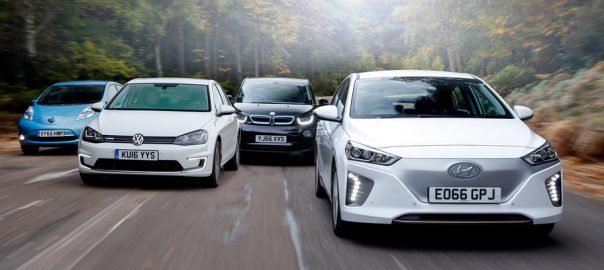
Electric Cars (Image: Autocar)

Electric Cars For Sale

Electric Cars For Sale

If you’re looking to buy a new or used electric car then you’ve come to the right place. Electric cars are getting very popular very fast and we have lots of electric cars for sale from a wide range of manufacturers.

Electric Cars for Sale

We are a leading independent broker with wide experience of electric cars so we are able to advise you about all the ones on the market and which ones would suit you best. We are based in Milton Keynes in the East Midlands and are able to supply electric cars throughout the UK.

In addition to pre-sales support we offer our special Fuel Included service with many of our deals. This provides ongoing telephone and email support as well as refunding the cost of your first 10,000 miles of charging.

Going Electric

If you don’t know whether an electric car would work for you economically then talk to us. We provide a ‘total cost of ownership‘ (TCO) service, for free, to help you calculate how much you might save by going electric compared to a fossil-fuelled car.

Just get in touch with us or fill in the form on our TCO page.

Widest Range of Electric Cars For Sale

We source electric cars from all the main manufacturers including BMW, Nissan, Renault, Volkswagen, Kia and Mitsubishi. We get good deals and pass them on to you.

By being independent we can advise you best on what would suit you – whether it’s price, long range, performance, looks or a combination of all these. We can also help with installing a charge point.

Prices and details for the offers on our most popular cars are below. We provide both fully electric vehicles (EV) and plug-in hybrid vehicles (PHEV):

Cheapest Electric Cars UK (Image: Fuel Included)

Car Leasing Deals

Car Leasing Deals

Traditionally in the UK we have tended to buy cars outright and then run them into the ground. That has changed in the last few years so that most people buy cars on some form of finance, and there are some good car leasing deals available. The main kinds of finance are Personal Contract Purchase (PCP), and leasing also known as Personal Contract Hire (PCH).

These forms of finance both tend to come to be nearly the same thing for a driver who wants to change their car regularly. In both cases, there is an upfront payment and then a regular monthly payment and the term of the contract will typically be 3 years. It’s much like a mobile phone contract.

Car Leasing Deals

With a PCP you can keep the car at the end of the contract (by paying a larger final payment). With a lease you generally give the car back (though there are even exceptions to this). If you plan to upgrade at the end of the term, they basically come to the same thing. They are both a form of long term car rental (though there are some pros and cons). Therefore people may talk about car leasing deals and actually mean PCP deals or PCH/lease deals. Really they are just looking to get into a new car for a low monthly payment – which is what we do.

Electric Car Leasing Deals

What’s interesting to note is that car leasing deals work really well with electric cars like the BMW i3 or VW e-Golf. They save you a lot of money on fuel (a fill up is typically about £3). Plus the fixed term contract means you get to upgrade your electric car every few years. So it’s just like upgrading to the latest iPhone 7 or whatever rather than being stuck with old technology.

With an electric car that means every few years you’ll get a new car with longer range and better performance. Yet they remain cheap to run and you don’t pay road tax (and often get free parking).

Electric Car Leasing Deals (Image: Fuel Included)`

If you’d like us to work out how much money you can save with a cheap car lease on an electric car, try out the Fuel Included ‘total cost of ownership’ service.

If you just want to see how much an electric car would cost – and in many cases with the first 10,000 miles of fuelling included – take a look below. We provide both fully electric vehicles (EV) and plug-in hybrid vehicles (PHEV):

Cheap cars for sale

Cheap Cars for Sale

Cheap Cars for Sale

Like lots of people we are always looking for cheap cars for sale/cheap cars to buy. This is because so many of us spend a considerable amount of our income on our car and are naturally interested in saving money. However, it is still relatively uncommon for people to consider getting an electric car. This is despite them being notoriously cheap to run, and therefore good value when considered in terms of the ‘total cost of ownership‘. For example, what other new cars can you buy from £200 per month including fuel? That’s certainly worth considering if you’re looking for cheap cars to buy.

Cheap cars for sale
Cheap cars for sale

Most people’s hesitation with going electric is probably because they assume they’ll be expensive to buy. To be fair, they do tend to be more expensive than an equivalent fossil-fuelled car to purchase. However, it’s not true across the board. Electric cars vary in price all the time and if you’re looking for cheap cars to buy there are bargains to be had (especially on car leasing deals).

Nissan Leaf and Renault ZOE: Cheap Cars to Buy

It’s interesting to note, for example, that the Renault-Nissan alliance seems to price its Renault and Nissan vehicles alternately high and low. This means that when one is expensive the other is cheap. Of course, this may be an accidental result of launch timing. When the Leaf 30kWh launched it was expensive and the ZOE 22kWh was a cheap alternative. Then the ZOE ZE40 launched at a high price. The Leaf had been around for a while so then it looked like the cheap alternative.

Renault ZOE and Nissan Leaf - cheap cars for sale
Renault ZOE and Nissan Leaf

Currently the Leaf is sells at very low prices, partly because the long range ZOE has the spotlight. It is probably also in part because the market knows there’s a long range Leaf on the way. If you’re wanting a cheap car for sale then the current Leaf is your best bet.

The new Leaf will launch in September and should be available to buy by the end of the year. If it follows the usual trend it will initially be at a higher price. Suddenly the ZOE will again look like the cheap alternative.

Both are great cars though and, like all electric cars, are considerably cheaper to run than their combustion equivalents. Please use our ‘Total Cost of Ownership’ calculator if you’re looking for cheap cars to buy and you want to know how much money you could save.

Cheap Cars for Sale Near Me

If you’re specifically searching for ‘cheap cars for sale near me’ then note that we have bases and electric car suppliers in Milton Keynes, St Albans, London, Northampton, Bedford, Cannock, Leicester and Liverpool. This allows us to supply all around the Midlands (including London, Cambridge, Luton, Oxford, Rugby, Kettering, Coventry, Nottingham and Birmingham). However we can deliver all around the country – just contact us for details.

A Total Cost of Ownership Comparison of ZOE Vs CLIO

At Fuel Included, we have run our Total Cost of Ownership (TCO) Calculator on a real-life example to help show the way the costs break down, and the considerable savings that can be made.

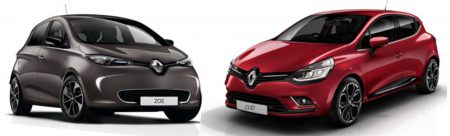
Today we have gone head to head with an all Electric Renault ZOE Dynamique 40 kWh, and a Petrol engined Renault CLIO Dynamique Nav TCe 90.

Renault ZOE and Renault CLIO

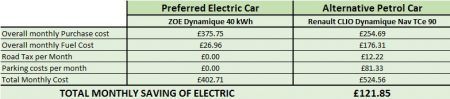
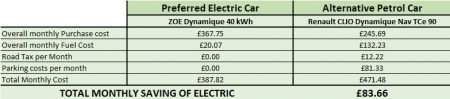
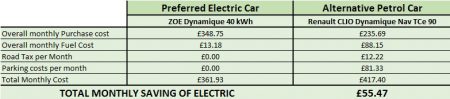
We have taken a commuter travelling into central Milton Keynes each day and parking as our representative driver. These tables show the total monthly cost* by summing all costs for the three year period of the lease and dividing them by 36.

Total Cost of Ownership

Electric ZOE Vs Petrol CLIO cost comparison for 20,000 miles per year
Electric ZOE Vs Petrol CLIO cost comparison for 15,000 miles per year
Electric ZOE Vs Petrol CLIO cost comparison for 10,000 miles per year

Conclusions

Even at the lower ranges of driving there are significant cost savings to be made. However, we see that as the mileage increases, the money to be saved is simply staggering.

Please contact us if you would like us to assess the cost of ownership of an electric car for your use case.

*Assumptions made for these calculations:

  • Petrol price from Sainsbury’s Bedford £1.21 per litre.
  • Electric charging is home charging plus 10 charges per year at £6 per charge from the Ecotricity rapid charge network.
  • CLIO mpg 52 from https://www.honestjohn.co.uk/realmpg/renault/clio-iv-2013
  • Both cars taken on 3 year PCP. Clio prices from http://offers.renault.co.uk/cars/clio/selection?offer=305 and ZOE prices from our current Fuel Included offer.
  • ZOE miles/kWh 4.5 from manufacturers real-world mileage figure divided by battery capacity.
  • Home charging Economy-7 unit cost 7.5p
  • Tax: Clio 1.2L 118 g/km CO2 = £160 in year 1 and £140 per year subsequently.
  • Parking costs based on person parking 200 working days per year in Milton Keynes town centre
Copyright: convisum / 123RF Stock Photo

Total Cost of Ownership – Price Comparison of Electric Vs Petrol Cars

We are asked all the time to help people make sense of the Price to Value balance between Electric and petrol cars. The way the two types of cars work is quite different so it is not always straightforward.

To help, Fuel Included have today launched their Total Cost of Ownership calculator and information service to help you look at the actual costs associated with owning an electric car and comparing it to the actual costs associated with a petrol or diesel car.

This is available for both private and fleet enquirers

Copyright: convisum / 123RF Stock Photo

Our Total Cost of Ownership Calculator takes many factors into account, including the following:

  • Lease costs
  • Deposits
  • Comparison with petrol alternatives
  • Benefits (savings) of electric cars where you live i.e. congestion charge, parking
  • Different forms of charging (home vs public and rapid vs standard)

We know that cost is only part of the story, but now you can at least answer the cost part simply and clearly.

We provide access to a simple form on-line, that will provide a straightforward Total Cost of Ownership Report to help you make the right decision.

If you want a more detailed assessment, we will work directly with you to refine your circumstances.


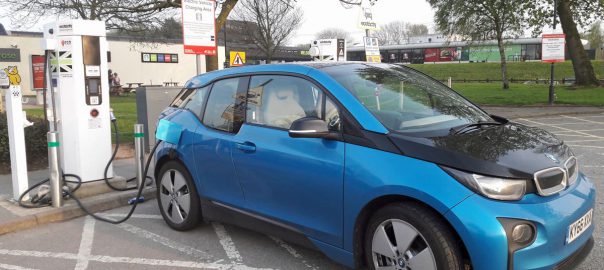
Our BMW i3 on charge at Corley Services (Image: T. Larkum)

Rapid Charging with an Ecotricity Charge Point

Rapid Charging on the Motorway

Our BMW i3 on charge at Corley Services (Image: T. Larkum)

Once you’ve had an electric car for a short while you’ll want to venture beyond its initial range and you can only do that by charging away from home. The most popular method is to use one of the network of Ecotricity rapid chargers, their ‘Electric Highway‘; there is at least one located at virtually all service stations on the UK motorway network.

In advance you need to have installed the Electric Highway smartphone app (available for Apple and Android devices) and set up an account with Ecotricity to allow you to use it. Ecotricity home customers get 52 free uses per year, otherwise the charge is £6 per half hour charge.


Step-by-Step Guide

Here is your guide to charging your electric car at an Ecotricity rapid charger:

1. On arrival, park up so the required cable can reach the charge socket on your car. Typically that means facing forward if your car has the charge point in the nose (e.g. the Nissan Leaf, Renault ZOE or Kia Soul) but reversing in if the charge point is near the rear (e.g. BMW i3, Mitsubishi Outlander, Hyundai IONIQ or Tesla Model S).

Rapid Charging Step 1: Access the Rapid Charger (Image: T. Larkum)

2. Get out of the car and check the screen on the rapid charger to confirm it’s working. Assuming the charge point is not already in use, the rapid charger will show a screen saying ‘Welcome! To charge your car, use the Electric Highway smartphone app’ or ‘Welcome! Select the correct charger for your vehicle’.

Rapid Charging Step 2: Welcome Screen (Image: T. Larkum)

3. Start the Electric Highway app on your phone. If it has been correctly setup it will show your car type at the top. The screen will say ‘What would you like to do?’ with two big green buttons labelled ‘Charge: charge your vehicle now’ and ‘Find pumps: find compatible pumps’.

Rapid Charging Step 3: Choose to Charge (Image: T. Larkum)

4. Press the ‘Charge’ button. The screen will change to say ‘Charging your car’. Press the ‘Get Started’ button.

Rapid Charging Step 4: Get Started (Image: T. Larkum)

5. The screen will change to say ‘To start, scan the pump’s QR code or enter the pump ID’. Here ‘pump’ is Ecotricity’s term for a rapid charge point. For simplicity we’ll choose the latter – press the ‘Enter pump ID manually’ button.

Rapid Charging Step 5: Identify the ‘Pump’ (Image: T. Larkum)

6. This will bring up a box to enter the pump identification number; selecting in this box will bring up your ’phone keyboard. Type in the four digit number as written below the screen on the charge point.

Rapid Charging Step 6: Enter the Pump Number (Image: T. Larkum)

7. The app will look this up and specify the location of the rapid charger with that number. If the number matches your location press ‘YES’.

Rapid Charging Step 7: Identify the Pump Location (Image: T. Larkum)

8. The screen will change to allow you to select the appropriate cable and connector for rapid charging your car. This is essentially straightforward: the Renault ZOE uses AC rapid, the Leaf, Outlander and Kia Soul use CHAdeMO and most others use CCS. You should know the connector type for your car, and the app will also exclude the ones it believes are incompatible. However, you should be aware that most cars can use the AC at low speeds as well as the DC at high speeds and so you may accidentally use AC but find your car charges only very slowly. In other words, use CCS and CHAdeMO in preference to AC unless you have a ZOE.

Rapid Charging Step 8: Select the Connector (Image: T. Larkum)

9. At this point control of the charging moves from the app to the charge point itself. Once initialised the charge point screen will show ‘Connection: connect your vehicle’.

Rapid Charging Step 9: Connect to the Car (Image: T. Larkum)

10. Plug the connector into the car, remembering to remove the secondary dust cover if you have a CCS socket. So long as the car is set to charge (i.e. you don’t have the charge timing override set) the car and charge point will ‘negotiate’ the fast charge they can both support, and charging can begin. The screen will show ‘Initialization: Please wait whilst your vehicle connects to the charge point’ and will highlight the charge point going through a number of check steps: Start communication, Isolation check, Precharging, Charging.

Rapid Charging Step 10: Initialization (Image: T. Larkum)

11. At this point charging starts, and you can usually hear the distinctive high pitched whine of rapid charging underway.

Rapid Charging Step 11: Car is Charging (Image: T. Larkum)

Monitoring the charge progress, and ending the charging session, are covered in Part 2.

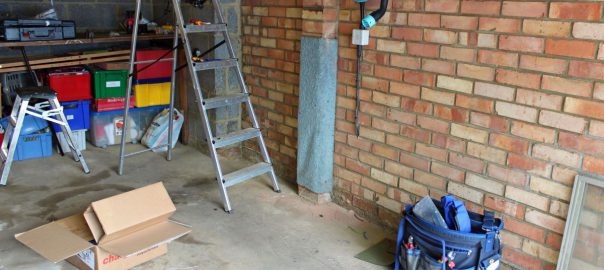
The Charge Point Being Installed for my First EV, a Renault ZOE (Image: T. Larkum)

Installing a Charge Point for your Electric Car

There can be a significant lead time in arranging the installation of a charge point so it is best if this gets underway as soon as possible after your new electric car is ordered.


If the car is a new Renault ZOE or Nissan Leaf on PCP (Personal Contract Purchase) then installation of the charge point will be organised by the manufacturer. As part of this deal the manufacturer will specify their preferred charge point.

In most other cases you will need to arrange the installation yourself. We can help you through the process with advice and guidance:

  1. We provide details of the main installation companies below.
  2. Our guide to selecting the most suitable charge point for you is here: Choosing a Charge Point.
  3. Our guide to check on your eligibility for a government grant for the charge point is here: Government Grant for Electric Car Home Charge Point.

If you are a Fuel Included customer then you can of course call or email us at any time for more detailed advice.

Note you may find that a charge point is occasionally referred to by its more technical name ‘Electric Vehicle Supply Equipment’ or EVSE.

Charge Point Installers

The biggest companies making and installing domestic charge points  – let’s call them the ‘Big 3’ – are the following (with links to their website and to our news feed with articles about them):

  1. Chargemaster PLC: Chargemaster website, Chargemaster news items.
  2. POD Point: POD Point order page, POD Point news items.
  3. Rolec EV (part of Rolec Services Ltd): Rolec website, Rolec news items.

However, there are many other smaller manufacturers and installers; here’s a brief (not definitive) list:

  1. Andersen order page, premium charge points.
  2. ChargedEV, nationwide installation partners for Rolec, based near Sheffield.
  3. Charging Solutions Ltd, partner with Chargemaster, based in Wales.
  4. The Phoenix Works, nationwide installers, based near Leeds.
  5. SOL Electrical, install POD Point and Rolec charge points in the South West of England.
  6. EV Charging Solutions, based in the Midlands.
  7. API Electrical Ltd, install in the North West of England.
  8. Armstrong Renewables Ltd, install in the North East of England.
  9. New Motion EVSE Ltd, based in London and part of a Dutch group, the largest provider in Europe.


Installation Process

In most cases the installation company is likely to contact you for information on your property, including asking for photographs of your main consumer unit (‘fuse box’) and the preferred location for the charge point. Usually a dedicated cable will be run from the consumer unit to the charge point so sometimes the installer may also ask for information on, and photographs of, the route between the two. Generally an isolator switch will be installed in this new circuit.

The Charge Point Being Installed for my First EV, a Renault ZOE (Image: T. Larkum)

Typically a standard installation will allow for cabling of up to 20m in length. If the distance is greater than this then there may be an additional cost to the customer (of perhaps £5 per metre). Similarly there may be additional costs if the installation is complex (e.g. passing a cable over a walkway or under a path); these issues are likely to be highlighted by the installer ahead of the installation visit. Sometimes the electrical system in the house will lack a mains isolator switch and this may need to be installed in advance by your electricity supplier; again the installer should flag this ahead of their visit.

The installation itself will take less than a day (it can be as little as an hour). You will need to be in attendance and the electricity supply will be turned off for much of the work.

After the installation is complete you will likely be asked to sign off on the work (and will be given a set of keys to the charge point if it is key protected). You should test the charge point as soon as possible by connecting your car, ideally while the engineer is still present in case it shows up any issues.

PS: I have previously described the installation of my charge point in detail here and here.

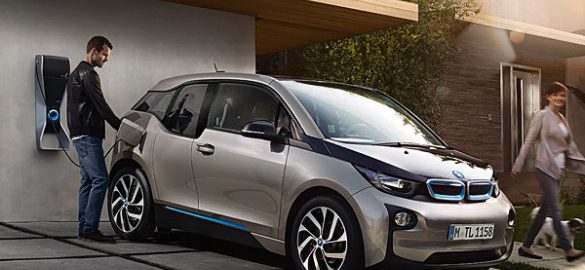
Charging a BMW i3 on the drive (Image: BMW)

Government Grant for Electric Car Home Charge Point

This is a summary of the UK Government’s scheme for subsidising home charge points for electric cars, known as the Electric Vehicle Homecharge Scheme (EVHS).

It has been kept relatively simple; if you need detailed guidance you should consult the original document (linked at the bottom).

1. Most plug-in vehicle owners carry out most charging at home.

2. Customers who are the registered keeper or have primary use of an eligible electric vehicle may receive up to 75% (capped at £500, inc VAT) off the total capital costs of the chargepoint and associated installation costs.

3. The key features of the Electric Vehicle Homecharge Scheme are as follows:

  • The grant is a 75% contribution towards the cost of one chargepoint and its
    installation up to a maximum of £500 (including VAT) per household/eligible
    vehicle.
  • Customers must provide evidence of being the primary user of an eligible electric vehicle or have a vehicle on order in order to be able to qualify for the grant.
  • The date of installation must not be more than 4 months ahead of the date
    of delivery or start date of vehicle use.

4. The grant covers up to 75% of the eligible costs of chargepoint installation, the
customer form requires confirmation of who is paying the balance of the
installation costs.

5. The grant for 75% must be claimed against an approved chargepoint and
made on your behalf by a chargepoint installer which has been authorised
by the Office for Low Emission Vehicles (OLEV).

6. You must have off street parking facilities suitable for chargepoint installation (a survey prior to installation should be conducted by your installer). If you do not have off street parking, your Local Authority may be able to help via a central Government grant.

7. The authorised chargepoint installer will claim the 75% (capped at £500) on your behalf. How the remaining cost is to be met should be agreed with your installer prior to installation. In any event, you should satisfy yourself whether you are expected to pay the remaining cost, and if not who will be paying for it, before the installation takes place. The grant will only be paid in arrears (i.e. once installation is complete).

8. No more than 2 chargepoints can be funded at one property irrespective of how many vehicles are registered there.

Source: EVHS – Guidance for Customers: November 2016

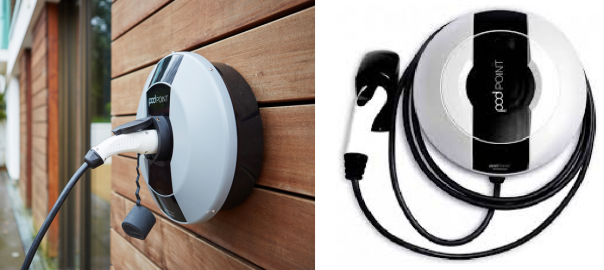
Untethered and Tethered Charge Points (Image: POD Point)

Choosing a Charge Point

When buying an electric car it is nearly always worthwhile to get a dedicated charge point installed at home.

It’s more convenient than an ‘occasional use’ or ‘granny’ (13 Amp) charge cable because you don’t need to reel it up and put it away each time.

Home Charging a Renault ZOE with a Dedicated Charge Point (Image: Charging Solutions)
Charging a Renault ZOE with a Home Charge Point (Image: Charging Solutions)

It will also be significantly faster because a dedicated charge point can provide more power without the risk of overheating. Also some electric cars, such as the Renault ZOE, don’t come with such a cable and buying one yourself can be very expensive (£500+).

The good news is that the installation of domestic charge points is subsidised by the UK government.

There are 3 decisions to be made when selecting the type of charge point for your car:

  • Tethered or Untethered
  • Connector Types
  • Power Level


Tethered or Untethered

There is usually the choice of a ‘tethered’ cable (it is fixed to the charge point) or an ‘untethered’ cable (it plugs into and can be removed from the charge point).

Untethered and tethered charge points (Image: Chargemaster)
Untethered and Tethered Charge Points (Image: Chargemaster)

Untethered has the advantage of allowing different cables to be connected (for example you can use the same charge point for a Nissan Leaf and a Renault ZOE). However, most people choose tethered because it avoids the inconvenience of connecting a cable whenever you need to charge (usually daily). It also reduces the risk of the cable being stolen.

A charge point with a tethered cable will usually cost more than an untethered one (typically about £50 more) because of the cost of its cable.

Untethered and Tethered Charge Points (Image: POD Point)
Untethered and Tethered Charge Points (Images: POD Point)

If you choose untethered you will need to use your own cable to connect to the car; it is the same cable that would be used to connect to a public charging point. It may come free with the car, for example the Renault ZOE or the Nissan Leaf with the 6.6kW charge option come with one. Otherwise you will need to buy one (we can advise you on suppliers).


Connector Types

All untethered domestic charge points supplied in the UK come with a Type 2 socket on the charge point, just as all public charge points now have (or at least officially should have) Type 2 sockets. Similarly all charge cables have a Type 2 plug at the charge point end.

Type 1 (5 pin) and Type 2 (7 pin) connectors

If the cable is tethered then you need to tell the installer the type of plug you want at the car end. This will depend on the car:

  • Type 1 socket: Nissan Leaf, Mitsubishi Outlander PHEV, Kia Soul EV
  • Type 2 socket: Renault ZOE, BMW i3, Tesla, VW e-Golf and Hyundai IONIQ

The Type 2 or ‘Mennekes’ connector is the official standard in Europe and should eventually replace the Type 1.


Power Level

A dedicated charge point can provide higher powers than a typical occasional use charging cable which will run at 10 Amps, equivalent at 230 Volts to 2.3 kilowatts. The charge will take place at the highest power that both the charge point can provide and the car can use.

There are two common power levels:

  • 16A = 3.5kW: This is the maximum charge level of the Nissan Leaf 3.3kW, the Mitsubishi Outlander and the VW e-Golf.
  • 30A/32A = 7kW: This is the maximum charge level of the Nissan Leaf 6.6kW, BMW i3, Kia Soul EV and Hyundai IONIQ. The standard Renault ZOE can use this level, in fact anything up to 22kW.

The higher power reduces the charge time so a typical EV battery will charge in about 8 hours at 16A but in about 4 hours at 32A.

It may be best to install the highest power charge point you can afford; even if your current car can’t use all the power, the next one almost certainly will be able to.