InstaVolt has said its electric vehicle (EV) charging hub in Banbury, Oxfordshire is now one of the UK’s largest following the installation of eight new 150kW chargers.
The Alpitronic chargers have been installed alongside an existing eight 125kW chargers at the site, with work on the new chargers beginning in January 2022.
InstaVolt said this is in response to increased demand for rapid, easy to use chargepoints across the country, with the company aiming to grow its network to 10,000 rapid chargers by 2032. By this summer, it is hoping to have 1,000 rapid chargers on its network.
Solar EV Charging Hub on Princes Street, Dundee (Image: eVolt)
The company said that in the 12 months to March 2022, it has grown its network by 45%, with deals for EV charging rollouts with companies such as Costa Coffee, McDonald’s, Bannatyne Health Clubs and Booths Supermarkets forming part of its “active efforts” to improve EV charging infrastructure.
Alongside the new chargers, the overall services at the hub have also been upgraded, with additional lighting, wider access spaces and two longer spaces to accommodate the increasing number of electric vans and fleet vehicles.
There are also plans for seating on site and a small wildflower meadow to increase biodiversity and create a habitat for pollinating insects.
If you would like to know more about Solar Panels and the PowerBanx range of home battery systems, and get a free instant quote, please complete our online form:
The Department for Transport (DfT) has published plans outlining how it seeks to significantly increase the UK’s electric vehicle charging capacity.
Funding for the £1.6 billion Electric Vehicle Infrastructure Strategy has previously been announced. The DfT has now detailed exactly how the allocated money will be used.
At its core is the aim to have 300,000 public charging devices available by 2030. This represents a tenfold increase from the 30,000 currently installed across the country.
Rapid-charging roll-out
Tackling electric vehicle charging for the millions without access to off-street parking is a key part of the strategy.
Some £450 million will be used by the Local Electric Vehicle Infrastructure fund. This allows for local authorities to apply for money to deliver EV hubs and innovative on-street charging solutions.
Solar EV Charging Hub on Princes Street, Dundee (Image: eVolt)
An existing £950 million Rapid Charging Fund is intended to support the installation of fast-charging devices at motorway services. It expects to deliver 2,500 rapid-charging points by 2030, and 6,000 by 2035.
Charging operators will be mandated to provide customers with real-time data about the status of charge points. A 99 percent reliability rate for charging devices will also be expected.
If you would like to know more about Solar Panels and the PowerBanx range of home battery systems, and get a free instant quote, please complete our online form:
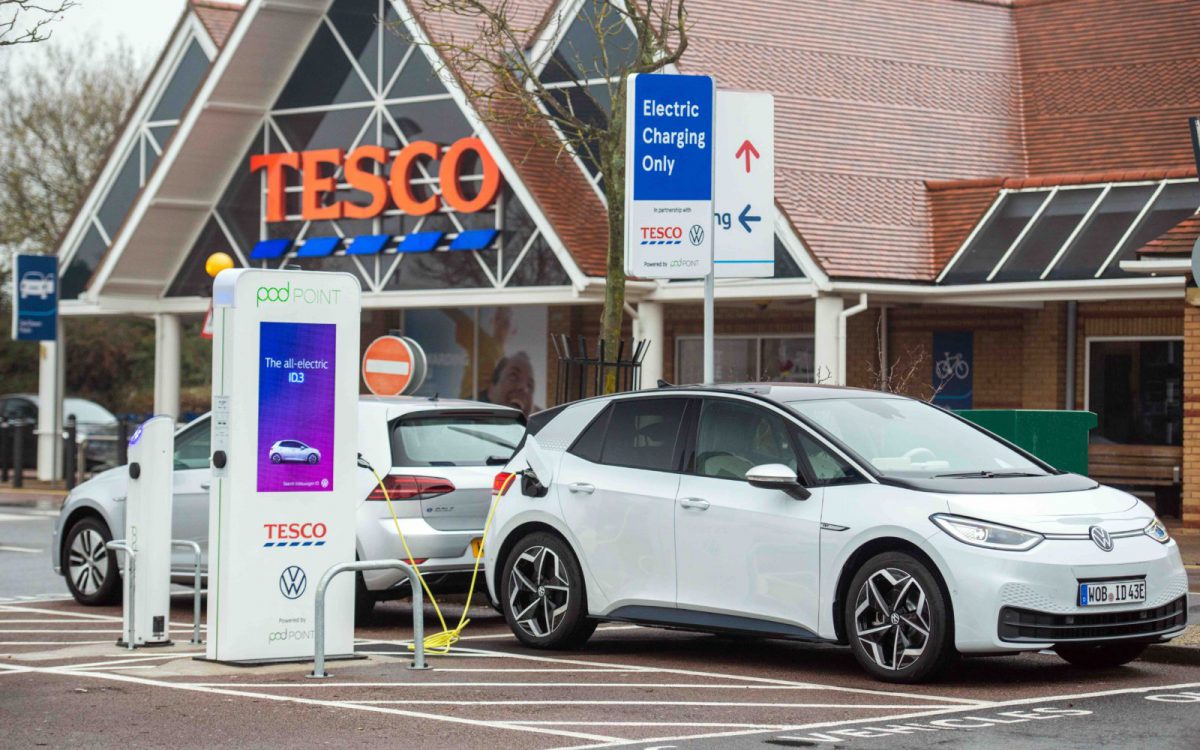
Supermarket giant Tesco has announced a ‘big change’ is coming to 500 stores across the United Kingdom. The retailer revealed plans to bring electric charging points to its branches.
The giant expanded the UK’s largest free electric vehicle charging network after usage of the points surged by 300% over the past year, reports the Echo. It unveiled its 500th charging point at Tesco Extra in Inverness.
POD Point Rollout at Tesco Stores (Image: Tesco/POD Point)
Other areas that have benefitted from improved charging access include Southend-on-Sea, Bolton, Wirral and Port Talbot. Since the network was launched in 2019 by Tesco, Volkswagen and Pod Point, the charging points have provided more than 41 million miles of free electric driving.
The network uses renewable energy and, since it launched, has saved 8,786 tonnes of CO2 compared with travelling the same distance in a typical car with an internal combustion engine. Designed to offer Tesco customers a secure, reliable and accessible way to top up their electric cars, the network of more than 1,000 chargers at 500 Tesco supermarkets in the UK also now includes 100 rapid chargers.
If you would like to know more about Solar Panels and the PowerBanx range of home battery systems, and get a free instant quote, please complete our online form:
Electric vehicle owners will have access to 300,000 public charge points by the end of the decade, the government has said.
Some £500m will be invested to hit the target, according to the Department for Transport, which represents a 10-fold increase on the current 30,000 public charge points across the UK.
The 2030 deadline is the same date the government aims to ban the sale of new petrol and diesel vehicles, as motorists are encouraged to go electric to help the UK hit net zero by 2050.
Helping drivers without access to off-street parking will be a focus when rolling out the new charge points.
The plan, part of the government’s wider Electric Vehicle Infrastructure Strategy, also highlights the need to ensure readily accessible fast charging for longer journeys.
At least 6,000 superfast charge points will be installed across England’s motorways by 2035 as part of an existing £950m commitment.
If you would like to know more about Solar Panels and the PowerBanx range of home battery systems, and get a free instant quote, please complete our online form:
On-street electric vehicle (EV) chargepoints are being rolled out across Wandsworth, with 35 sites set to see installations.
Wandsworth Council began the rollout of the infrastructure in 2021 across 26 sites, with 10 already live. The latest installations will take the total number of sites to 35, comprising 65 dual socket EV chargepoints able to charge 130 vehicles at any one time.
Liberty Charge is to own and operate the chargepoints, which are to be delivered by its sister company Virgin Media O2, with the council having chosen the company due to its ability to deliver fully-funded chargepoints for residents without the means to privately charge their EV.
Ubitricity Electric Avenue project lamppost charging (Image: Siemens)
Additionally, Liberty Charge’s chargepoints are 22kW, which the council said is faster than other street chargepoints.
Its creation followed an EV charging trial using Virgin Media’s infrastructure, the Virgin Media Park & Charge project, which aimed to deploy 1,200 charging sockets in towns and cities across the country by early 2021.
Liberty Charge is to own, operate and maintain the Wandsworth chargepoints without requiring local taxpayer support, while the council helps to identify locations and grants the necessary approvals, with the sites in Wandsworth agreed after consultation with residents throughout the technology rollout.
“We want to not only increase the number of available charge points but to ensure that a charge point is easily accessible to all our residents,” said Kim Caddy, deputy leader of the council and cabinet member for finance, resources and climate sustainability.
Over the past year, EV take up in the borough increased by just under 1,000 vehicles, with the new charging infrastructure to support and encourage EV adoption across the borough.
If you would like to know more about Solar Panels and the PowerBanx range of home battery systems, and get a free instant quote, please complete our online form:
Shell has replaced existing petrol and diesel pumps at its Fulham fuel station with ultra-fast chargers to open its first electric vehicle (EV) charging hub in the UK.
The hub features nine 175kW chargepoints, as well as a timber canopy with built-in solar panels. These chargers run on 100% certified renewable electricity, with this certified through the Renewable Energy Guarantee of Origin (REGO) scheme.
Charging Station in Sunderland (Image: Fastned)
István Kapitány, Shell’s global executive vice president for mobility, said: “EV drivers are looking for a charging experience that is as fast, convenient and comfortable as possible. This is exactly what Shell Fulham aims to offer.”
The site also features a seating area, free Wi-Fi, a Costa Coffee café and a Little Waitrose & partners.
In 2021, Shell announced that up to 800 Shell EV chargepoints would be installed in as many as 100 Waitrose sites across the UK by 2025.
If you would like to know more about Solar Panels and the PowerBanx range of home battery systems, and get a free instant quote, please complete our online form:
Osprey Charging’s first electric vehicle (EV) dynamic charging hub has opened in Wolverhampton today (30 November) .
The site has four high powered chargers, and is the first in the UK to use smart charging Kempower technology according to Osprey. These chargers are designed to optimise charging across multiple vehicles when more than one EV is plugged in.
This allows power to be distributed based on demand, helping to reduce waiting times by maximising the speed and availably of chargers for drivers. In doing so, consumer footfall is increased for the landowners hosting the hub. Osprey’s first site is located adjacent to the A463, and includes a Costa Coffee on-site.
Additionally, the Kempower chargers mean grid connections can be optimised, meaning multiple high-power chargers can be installed without the need for more grid power.
If you would like to know more about Solar Panels and the PowerBanx range of home battery systems, and get a free instant quote, please complete our online form:
The Government has allocated an additional £2.5 million to fund more than 1,000 new chargepoints on residential streets.
Announcing the additional cash today (Monday, August 12), transport secretary Grant Shapps says the funding will support the on-street residential chargepoint scheme, launched in 2017, which aims to help people access charging infrastructure near their homes when they don’t have off-street parking.
It will go towards helping local authorities to install these chargepoints, which can be built into existing structures like lamp-posts.
The scheme aims to encourage even more people to choose an electric vehicle (EV) by making it easier to charge their cars near home and has already seen 16 local authorities say they will install 1,200 chargepoints this year.
The Transport Secretary is now doubling funding for the scheme to meet demand and accelerate the take-up of electric vehicles as the UK moves towards net zero emissions by 2050 and further improve air quality.
Shapps said: “It’s fantastic that there are now more than 20,000 publicly accessible chargepoints and double the number of electric vehicle chargepoints than petrol stations, but we want to do much more.
“It’s vital that electric vehicle drivers feel confident about the availability of chargepoints near their homes, and that charging an electric car is seen as easy as plugging in a smartphone.
“That’s why we are now doubling the funding available for local authorities to continue building the infrastructure we need to super-charge the zero emission revolution – right across the country.”
The allocation of funding for on-street residential chargepoints is part of the £1.5 billion investment underpinned by the Road to Zero Strategy.
Milton Keynes has probably the greatest concentration of electric car charging points of any location in the world. This arguably makes it the best candidate destination city for electric car drivers anywhere in the world.
Electric cars charging in Milton Keynes (Image: T. Larkum)
Of course, those are difficult statements to confirm since there aren’t international league tables of such things. However, a look at international charge point maps like Plugshare certainly seems to indicate that it has as many standard power charge points (some 170) as other candidate ‘hot spots’ such as Los Angeles in the US and Oslo in Norway. If you look further into the density of high power rapid chargers (56) it appears to win hands down against all comers.
Charge Point Locations
More to the point, however, is that charge point locations are very well organised in Milton Keynes. While in other cities the growth and placement of charge points appears to be organic, i.e. nearly random, they are well placed in MK. Specifically the city centre is arranged in blocks on a grid (in the American style) and charge points are placed along at least one and usually both of the long sides of each block. One block can have as many as a dozen standard speed chargers.
The rapid chargers are arranged more strategically. In the city centre there is one rapid to every one or two blocks. Outside the centre, in the suburbs, there is one to every second or third housing estate.
Rapid Chargers next to Milton Keynes Central railway station (Image: T. Larkum)
The result of having so many charge points in Milton Keynes is that anyone can visit the city in an electric car and be confident of finding somewhere to charge for the return journey. With a typical EV range of 80 miles this means that MK can welcome visitors from as far afield as Southampton in the south, Gloucester in the west and Nottingham in the north – they won’t have to charge on the way in or back home.
Chargemaster / Polar Network
The charge points in MK are part of the Polar network operated by Chargemaster. Therefore to make use of them it’s necessary to use a Polar app or swipe card, either on subscription (Polar Network) or Pay As You Go (Polar Instant).
With that arranged, it is possible to find a charge point near almost anywhere in the city centre. Their locations can be seen on the council’s charge point map (PDF) and on the online Polar Live map.
This makes MK the perfect place for EV owners, whether visiting occasionally for shopping or commuting in daily for work.
If you want to charge your car away from home, and can’t get by with a 13 Amp ‘granny cable’, then you will need to join one or more of the national charging networks. That gives you access to the public charging points available around town centres and on the motorway and trunk road systems.
There are a number of sites where you can look up charging points, including:
In an occasional series I will cover the biggest networks: Electric Highway, Polar Network, POD Point and so on. Here we begin with the Electric Highway, created by Ecotricity and now owned and operated by Gridserve.
“Our low-cost, rapid and high power charging infrastructure is reaching every corner of the UK, covering 85% of the UK’s motorway network.
We provide rapid and high powered charging at some of the lowest rates in the UK. Our next generation chargers are supported by renewable energy from our solar farms.”
My BMW i3 on charge on an Ecotricity DBT rapid charger at Corley Services (Image: T. Larkum)
Our View
If you join just one network it probably has to be the Electric Highway (EH) as they have a virtual monopoly on charging at motorway service areas (the exception being Tesla with their Superchargers). The good news is that the majority of services now have at least one rapid charger, an increasing number have two and some have even more. So for long distance driving with your electric car you can pretty much get around most of England by charging at motorway services. Coverage outside England (in Scotland and Northern Ireland, and particularly in Wales) is however poor.
The reliability of Ecotricity charge points has historically been quite poor, but this has started to improve since the takeover by Gridserve.
Curiously, apart from at motorway services the majority of EH rapid chargers are in the car parks of IKEA superstores (due to a partnership deal between them – see IKEA Electric Vehicle Charging).
The majority of EH rapid chargers were large white units manufactured by DBT-CEV. These provide DC charging at 50kW for CCS (BMW i3 etc.) and Chademo (e.g. Nissan Leaf and Mitsubishi Outlander) connectors, and AC charging at 43kW (Renault ZOE). Typically the first ones installed were ‘single headed’ with just Chademo cables for the Leaf. Later they were ‘double headed’ with the addition of a Type 2 cable for the ZOE. Current installs are ‘triple headed’ with the addition of a CCS cable for the i3 and Hyundai IONIQ.
My Renault ZOE charging at an Ecotricity 22kW medium-fast charger (Image: T. Larkum)
Note that most EVs with a Type 2 connector (not the Leaf or Outlander) can be charged with any rapid through the Type 2 cable but only the ZOE can use it at full power (43kW or 22kW). Some can use it at reduced power (e.g. the i3 can use 11kW) but most will drop down to 7kW, like charging at home. You should use the CCS or Chademo connector for rapid charging, and only use the Type 2 if these aren’t working (it will be much slower).
Before using DBT rapids Ecotricity installed a small number of ‘medium’ chargers providing 22kW. Some of these are still in place and can be seen alongside the DBT ones; again, you should make sure that you understand which charger and cable/connector is most appropriate for your circumstances.