Category Archives: Sales

MINI Cooper Concept (Image: MINI)

How the UK is falling behind in the global electric car race

After a decades-long renaissance, worrying signs are emerging for Britain’s motor industry

In the global electric car race, Britain is struggling to keep up with its rivals. Fresh investment is dwindling as manufacturers prioritise their home markets..

A battery innovation centre, part-funded by £80m of government money, is planned in Coventry that will help businesses bring their electric technology from research phase to scalable production. Plans to open the site last week were delayed by Brexit. Even once open, however, the site will not be a manufacturing centre.

And the government’s industrial strategy, set out in 2017, proposed measures to attract a wave of electric investments — including £246m of funding to attract battery technology.

Weak demand and global consolidation hit UK

But demand for battery cars remains modest, with less than 1 per cent of global sales from pure electric models. Carmakers therefore want to consolidate all their expertise in one place to save costs, and this is often in their home market. The UK is feeling the effects.

MINI Cooper Concept (Image: MINI)

BMW has said that while it will assemble the electric version of its Mini in its Oxford plant, the batteries will be shipped from Germany.

Read more: FT
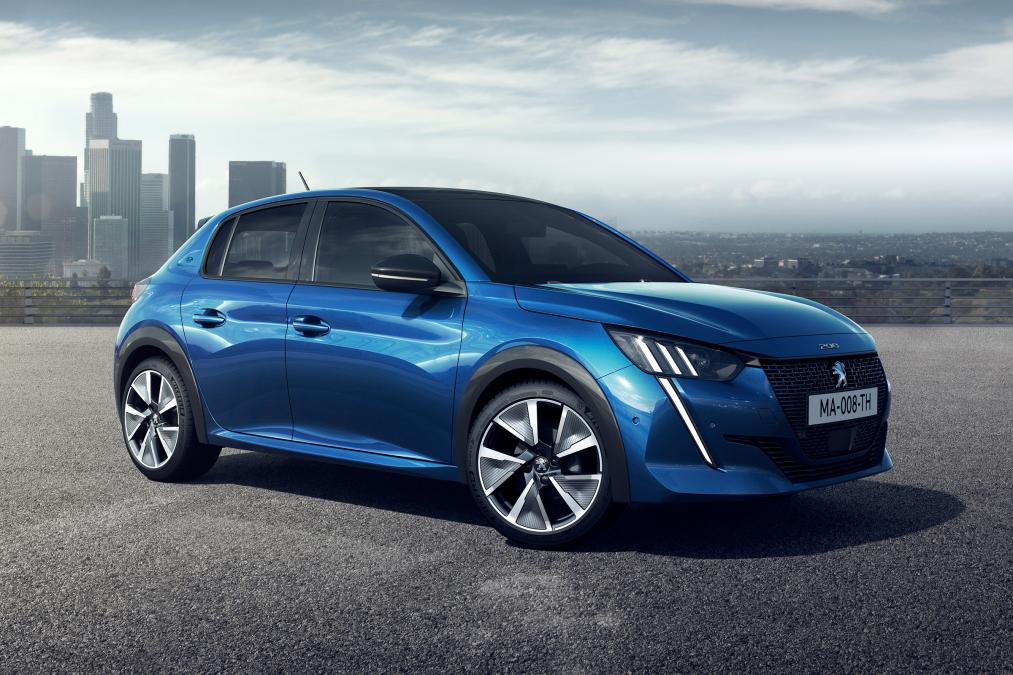
Peugeot e-208 (Image: Peugeot)

More new models, tougher CO2 rules poised to boost EVs, plug-in hybrids

A lack of choice has been one reason that buyers in Europe have not fully embraced full-electric and electrified plug-in hybrid cars.

But that is quickly changing as automakers prepare to launch more models to prepare for tougher CO2 emissions regulations that start to take effect in 2020.

The number of EVs on sale in Europe will increase to 24 this year from 18 last year as new vehicles such as the Audi e-tron, Tesla Model 3, Mercedes-Benz EQC, Mini EV and full-electric Volvo XC40 crossover hit the market, according to LMC Automotive data — which excludes very-low-volume niche models. The number of plug-in hybrids will nearly double to 53 this year from 27 in 2018, LMC says.

But the real jump will come in 2020, when the number of full-electric cars on sale doubles to 48 and plug-in-hybrid choice reaches almost 100, according to LMC data.

Peugeot e-208 (Image: Peugeot)

Next year battery-powered cars underpinned by Volkswagen Group’s flexible MEB electric-car platform and aimed at the mass-market will go on sale. VW brand’s Golf-sized I.D. hatchback will come first but it will soon be followed by MEB cars from the Audi, Skoda and Seat brands. They will have ranges of more than 550 km (342 miles), to ease range anxiety fears among car buyers.

It’s no coincidence that 2020 is also when the EU will start fining automakers if they miss their stricter CO2 reduction targets that are being implemented to help reduce greenhouse gas emissions blamed for contributing to climate change.

“We have only one target, which is to be compliant for CO2 targets for 2020, so 2019 will be the launch of all our electric and plug-in hybrid vehicles,” Maxime Picat, PSA Group’s operations director for Europe, told journalists in January.

Read more: Auto News

The Electric Car, Technological Disruption, and Climate Change

The key ingredients for decarbonization of the American economy are renewable energy and the electric car. Most of America’s use of fossil fuels is in transportation.

According to the U.S. EPA:

“The transportation sector generates the largest share of greenhouse gas emissions. Greenhouse gas emissions from transportation primarily come from burning fossil fuel for our cars, trucks, ships, trains, and planes. Over 90 percent of the fuel used for transportation is petroleum based, which includes gasoline and diesel.”

About 28.5 percent of America’s greenhouse gases come from transport. Close behind is electric power generation, with 28.4 percent of emissions. But as our electric system becomes more renewable, the proportion of greenhouse gases coming from transportation will increase if we don’t move toward electric vehicles. Transportation’s dominance of greenhouse gas pollution is a particularly American problem. This is because America’s development pattern of suburbs and sprawl cities like Los Angeles, Huston and Las Vegas requires personal transportation. In New York City, most of our greenhouse gases come from powering our buildings. Most of our transportation is shared ― it is mass transit, not personal transit. In the rest of the country, the car is king. America may re-urbanize, but its basic land use patterns will always require personal transport. Therefore, for America to decarbonize we need vehicles that do not use internal combustion engines. Fortunately, the era of electric vehicles seems to be upon us.

When the auto writer of the New York Times writes a piece on marketing electric cars, you know we have reached a tipping point. According to Times reporter Jack Ewing:

“After years of promising electric cars, established carmakers are actually starting to build them. But manufacturers are realizing that a shift to battery power also requires them to retool their sales machinery. The old come-ons are obsolete. Range is the new horsepower. Connectivity replaces cylinder count. And sustainability is the new status symbol.”

The automakers have begun to see the start of a new market. It’s not that they are in any way abandoning the old one, but the seriousness of their investment in the electric car demonstrates that this is not some form of greenwashing or public relations gimmick. I recognize that moving a huge industry like this will be gradual and that the investment in manufacturing and servicing current technology remains a major impediment to change. But it seems clear that change is coming. Not only are the automakers thinking about the marketing issues, they are beginning to get creative about the price structure of electric cars. Again, according to Ewing:

“…electric vehicle customers pay close attention to the same things as other car buyers, like the purchase price. Electric cars continue to cost thousands of dollars more than conventional vehicles. High price remains an obstacle, mostly because of the cost of the batteries. That may be less of a problem than it seems. Electric vehicles already on the road are holding on to their value well…that allows carmakers to offer attractive leasing terms because they know the cars will command a good resale price when the lease expires. And many buyers of electric cars won’t be individuals, but car-sharing services that buy them by the dozens and can spread the cost among more users. Those buyers tend to pay attention to the cost of a car over its life span rather than just the initial purchase price. Electric cars look better from that angle because they don’t require oil changes and electricity is cheaper per mile than gasoline.”

Read more: Columbia Blogs

VW e-Golf (Image: Volkswagen.co.uk)

Who’s Winning the Electric Vehicle Race?

Automakers are focused on developing models, but ad spending surge is sure to follow

Oil-rich Texas is an unlikely spot for an electric vehicle demand surge. But John Luciano, general manager of a Volkswagen dealership in Amarillo, says his customers are juiced about EVs, suggesting the market might finally emerge from niche status nationally.

“If there is interest in Amarillo, Texas—which is truck country—there is definitely interest,” he says.

Automakers are banking on it. Billions of dollars are flowing into the sector, with Ford, General Motors, Nissan, Honda and other big auto brands making grand pronouncements about their electric vehicle ambitions. Volkswagen Group, whose brands include Audi and Porsche, last week announced it will launch an estimated 70 new electric models in the next 10 years—up from its previous 50-model projection—accounting for 22 million vehicles globally. Audi last month ran a Super Bowl ad touting its claim that one-third of its new models will be electrified by 2025. “A thrilling future awaits. On Earth,” the ad boasted.

VW e-Golf (Image: Volkswagen.co.uk)

But there could be plenty of chills along with the thrills as brands look to overcome long-held consumer concerns about EVs. These include their relatively expensive pricetag when compared to similar gas-powered models, and so-called “range anxiety,” which refers to fears of being stranded, out of power, with no charging station in sight.

Technological advances, including investments in charging infrastructure, will quell some of the angst. But it will be up to marketing departments to get the word out with advertising that reaches beyond tree-hugging EV loyalists or wealthy, tech-obsessed buyers—all without overspending on a sector that remains unpredictable.

Read more: Adage

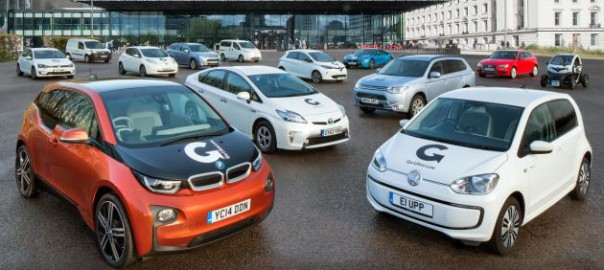
Ultra-low emission registrations up 386% on first quarter of 2014 (Image: OLEV)

Automakers Retool Marketing Machines as They Go Electric

Geneva — After years of promising electric cars, established carmakers are actually starting to build them.

But manufacturers are realizing that a shift to battery power also requires them to retool their sales machinery. The old come-ons are obsolete. Range is the new horsepower. Connectivity replaces cylinder count. And sustainability is the new status symbol. Volvo’s Polestar 2 electric car, unveiled last week, even comes with a leather-free “vegan” interior.

The need for carmakers to win over a public still hesitant about buying a car that needs half an hour or more to recharge is becoming more urgent as electric vehicles move closer to mass production.

Battery-powered rides like the BMW i3, Nissan Leaf and Tesla’s lineup have been available for years. But this once-niche category is now expanding at a breakneck pace.

Ultra-low emission registrations up 386% on first quarter of 2014 (Image: OLEV)
Electric cars (Image: OLEV)

There are dozens of new electric cars on display at the Geneva International Motor Show, which opened to the public on Thursday and continues through March 17. These are not concept cars that may never be for sale, as tended to be the case at previous shows. They are vehicles with familiar brand names that you will be able to buy this year or next.

An electric Porsche is coming at the end of this year. Volkswagen is refitting a German factory to build a battery-powered car that, beginning in 2020, will sell for about the same price as a Golf.

Audi, a unit of Volkswagen, showed nothing but battery-powered vehicles and hybrids at the Geneva show. Renault, one of the first companies to offer electric cars, is renewing its lineup. Volvo skipped the show in order to leave the stage to its all-electric Polestar.

“2019 will be a decisive year for electromobility,” Herbert Diess, the Volkswagen chief executive, said at a company event in Geneva.

Read more: NY Times

While the World Goes Electric, Some Germans Desperately Fight for their Diesel

Germany is divided about the future of its most important industry: while some automakers pursue electric vehicles, a noisy group of diesel-energy enthusiasts are expressing their frustration through protests.

These have gone on every weekend so far this year, since the first on January 11th.

The first protest took place in Stuttgart — the hometown of Daimler, Bosch, and Porsche — and was organized by Ioannis Sakkaros, who works as a mechatronics technician for Porsche. Since then, hundreds of protesters wearing yellow vests have gathered each weekend to rally against court-mandated driving bans for older diesel cars. The bans were put in place in response to excessive air pollution.

At a rally on February 9th in Munich, where BMW’s headquarters is located, dozens of people chanted a pro-diesel rhyme together, and cheered on speakers who accused “eco-fascists” and “green ideologists” of wanting to destroy the car industry. A man earned applause from the crowd for calling electric vehicles “hazardous waste.”

The debate about the future of cars — diesel or electric — is emotional for many Germans, as the auto industry and its dependent companies employ 1.8 million people, hundreds of thousands of whom work directly with internal combustion engines. But new carbon emission limits and pending bans on diesel and gasoline cars in major markets threaten their livelihoods. German cars are big business, bringing in almost $500 billion annually. And a successful switch to electromobility will cost 114,000 jobs in Germany by 2035, according to predictions from the Institute for Employment Research. After all, electric motors require significantly fewer components and less maintenance than internal combustion engines — which means an annual economic loss that will grow to reach $22 billion in 2035.

“The diesel is only the beginning,” Michael Haberland, who organized the protest in Munich, tells The Verge. “The gasoline engine is next.” Haberland is president of Mobil in Deutschland, a motor club. He feels the European emission limits for air pollution, which are responsible for driving bans, are nonsense. “Are we all supposed to drive electric vehicles now?” he asks. “They just don’t work. The diesel engine, on the other hand, has been a success story for more than 125 years.”

Read more: The Verge

First Ultra Low Emissions Zone drives up EV values at auction

The introduction of the UK’s first Ultra Low Emissions Zone in April is pushing up prices of EVs at auction.

Shoreham Vehicle Auctions (SVA) said it had seen a “significant rise” in demand for EVs in recent months with the market witnessing stronger residual values on both cars and vans.

Alex Wright, managing director of SVA, said: “The second half of 2018 saw a strong demand for used EVs and that has continued into 2019, which has resulted in ever stronger prices.

“For example, the Nissan e-NV200 van has appreciated in value year-on-year by around £1,000.

“Part of this rise in value is because of the increasing awareness across London and the south east of the pending introduction of the UK’s first Ultra Low Emissions Zone in April.”

SVA teamed up with the Energy Saving Trust to launch the first ever used electric vehicle training course for car and van dealer sales staff in May 2018. One of its main jobs was to dispel many of the myths surrounding EVs to help educate dealers on which customers will benefit most from buying and running an electric car.

“We have helped support an increase in knowledge of EVs within the market and many progressive dealers have a good understanding of EVs, customer suitability and battery types,” explained Wright.

Read more: Motor Trader

Electric Cars Are About To Absolutely Demolish Gasmobiles

We have other, much longer, much more detailed articles coming about this, and I have to recommend those over this one. But there’s also something useful about a short, simple message.

Kia Niro EVWhile editing Nicolas Zart’s review of the Kia Niro EV, one line jumped out at me and triggered this story.

“From Oct 2014 (first Soul EV launch) to Jan 2019, a little less than four years, the range has advanced from 93 miles to 239 miles (2.6×), and the battery energy density increased by +25%, while battery weight increased only 1.6x (640 lb to 1008 lb),” Steven Kosowski, Kia’s Long Range Strategy & Planning Manager, said.

This is something that those of us who have been following electric cars for years understand well, and understand is key to electric vehicles being disruptive tech, but we also get a little complacent to the progress and what is around the corner.

If you have a 71 mile BMW i3 (like we do), or a 84 mile Nissan LEAF, or a 62 mile Mitsubishi i-MiEV, you think about range quite a bit. You may not be plagued with range anxiety — that’s actually quite rare for people who actually own electric cars — but you plan a lot and are sure to charge often. Seeing range for the new versions of the i3, LEAF, and similar electric cars jump to 110 miles, 130 miles, 150 miles, etc. is a clear indicator the technology is improving fast and becoming much more acceptable for mainstream buyers.

Read more: Clean Technica

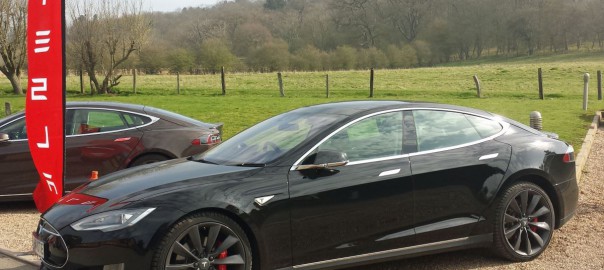
Our very own Tesla Model S – for a while anyway (Image: T. Larkum)

Electric Vehicles Benefit All Utility Ratepayers

As electric-vehicle sales mount, observers are finding benefits to society—especially to electric ratepayers—that sometimes surpass the benefits to the EV buyers.

Our very own Tesla Model S – for a while anyway (Image: T. Larkum)
Tesla Model S (Image: T. Larkum)

“These vehicles use a different kind of fuel and plug into our electricity system, and the good news about that is that there are a number of cost-benefit studies that are showing this can be really beneficial to all rate payers, not just the drivers of the vehicles,”

said Matt Stanberry, the managing director of the advanced transportation program for the trade group Advanced Energy Economy.

“As you increase electricity sales for charging the vehicles, it has the effect of driving down rates for all ratepayers because it spreads the fixed cost of the system out across a larger volume of sales.”

That sounds like the opposite of the scenario feared several years ago in which rooftop solar would enable homeowners to abandon the grid, concentrating fixed costs on the shrinking population that remains.

Recent studies have analyzed the impact of EVs in five Northeastern States and in California and found hundreds of dollars per car in annual benefits to three groups: to EV owners in saved fuel and maintenance costs, to electric ratepayers in reduced fixed costs, and to society in reduced carbon emissions.

Read more: Forbes

Tesla showroom in Milton Keynes (Image: T. Larkum)

Electric Vehicles and the Future of Oil

Just two percent of all auto sales today are electric. It is estimated that over 3.5 million electric cars are on the road today, and there may be as many as 36 million electric cars by 2025.

By 2040, 30 percent of all new car sales will be electric, according to analysts at IHS Markit. What does this massive increase of electric vehicles mean for the future of oil?

China Matters

The largest disrupter to the future of oil may be coming from China. Elon Musk has big plans in China where electric vehicle sales are three times higher than they are in the United States. Tesla (TSLA – Get Report) has just broken ground on a massive gigafactory that will have capacity to manufacture 500,000 cars per year.

Tesla showroom in Milton Keynes (Image: T. Larkum)
Tesla showroom (Image: T. Larkum)

Since tariffs have driven up the price of importing these vehicles, Tesla will now be able to build locally and bypass tariffs. In addition, BP Ventures just invested in the Chinese electric vehicle (EV) charging start-up PowerShare.

China is targeting sales of more than 7 million EVs by 2025, up from just 350,000 over the last 12 months. By 2030, China will overtake the United States as the largest consumer of oil with net imports reaching 13 million barrels per day, (the U.S. currently consumes about 20 million barrels per day).

Transportation Still Dominates Crude Demand

Global oil demand is forecast to stall within the next decade and the rise of EVs may accelerate the decreased demand. According to the Energy Information Administration, global oil demand is expected to average over 101 million barrels per day in 2019. But growth may have already peaked. The EIA’s estimate is a reduction of about 100,000 from its previous outlook.

The 101 million barrels consists of approximately 80 percent crude oil and 20 percent natural gas liquids. According to EIA, about 55 percent of the crude oil demand is for transportation while 35 percent is for industrial use and the remainder in other categories such as electricity. IHS also estimates that roughly a third of global oil demand is from cars: 40 percent of the growth since 2000 has come from cars. Again, the growth of EVs, especially in China, may greatly affect this number.

Read more: The Street