Category Archives: Pollution

EU Toughens CO2 Limits for Cars in Bid to Spur Electric Vehicles

  • New caps clear last political hurdle with EU Parliament vote
  • Reductions of 15% in 2025, 37.5% in 2030 versus 2021 limit

The European Union tightened caps on carbon dioxide from cars in a bid to accelerate the development of electric vehicles.

The European Parliament set a 37.5 percent CO2-reduction target for 2030 compared with the 2021 limit. In a vote on Wednesday in Strasbourg, France, the assembly also fixed an interim CO2-cut goal for autos of 15 percent for 2025.

The endorsement removes the final political hurdle for the new emission curbs meant to step up the European fight against climate change. EU governments have already signaled support for the new CO2 limits after striking a deal in December with the 751-seat Parliament, making their final approval due on April 15 a formality.

Read more: Bloomberg

Volkswagen e-Up charging outside the Experience Centre (Image: T. Larkum)

VW threatens to exit important automaker lobbying group over electric vehicle policies

Volkswagen is amongst the legacy automakers now most invested in electric vehicles and they now threaten to exit an important automaker lobbying group over their policies regarding electric vehicles.

Automakers have promoted policies to slow down the adoption of electric vehicles through lobbying groups for years.

Most recently, automakers associations have pushed against efforts to increase average fuel economy, which would have forced EVs to be built in higher volume.

Interestingly, several automakers were claiming to be ‘all-in on electric cars’ while indirectly supporting those lobbying efforts.

Now, Volkswagen appears to be recognizing this issue and is pressuring the Association of the German Automotive Industry (VDA), a powerful lobbying group in Germany, to promote electric vehicles.

Volkswagen e-Up charging outside the Experience Centre (Image: T. Larkum)

Germany’s Welt reported (Translated from German):

“The list of criticisms made at Volkswagen is long. Above all, the association must move away from the strategy of “technology openness” and ensure that all forces are focused exclusively on the enforcement of the battery-electric car. Development and promotion of vehicles with fuel cells and gas engines or other environmentally friendly variants would have to be stopped. This overburden the industry, says VW boss Herbert Diess.”

In short, VW wants the association to stop pushing “alternative fuel” vehicles and focus on battery-electric vehicles.

Read more: Electrek

O-M-G — Get Me Out Of This Gasmobile!

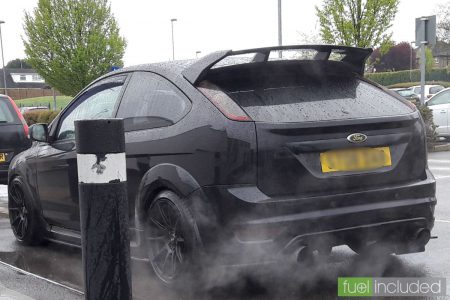
I’m renting a gas car for a few days. I won’t bother naming it, but it’s one of the 10 top selling cars in the USA. (Oh yeah, you can also see it above.) O–M–G, I cannot wait to get out of this car!

For people driving a Tesla, a BMW i3, a Nissan LEAF, a Chevy Bolt EV, or probably any other electric car for a while, I think the feelings they have when driving a gas or diesel car again are highly similar to mine below. Even knowing that, and even experiencing it years before,I couldn’t avoid the visceral shock of this experience.

Initially, I thought, “hey, it will be interesting to experience this car and maybe I’ll find some features I like about it.” Instead, I was quickly reminded of how “1910” gas car technology feels. The first sign (aside from the large grille on the front) was when I sat in the car and couldn’t find the “On” button. “Where the heck is the ‘On’ button in this thing? So many buttons and knobs and I can’t find it anywhere.” Okay, it didn’t take 10 minutes, but there were 30–60 seconds before I realized I had to insert the key into the car and turn it. It was a sign I wasn’t ready for what was about to come.

But the really annoying features are once the car is on. It starts rumbling and grumbling immediately. Like I said, it quickly feels like 1910 tech. It sounds like a monster. Putting the most positive spin on it that I can, it’s like a mild chair massager. 😛 But, yeah, it’s more annoying than relaxing.

Read more: Clean Technica

New Green NCAP highlights real-world emissions performance

Safety rating organisation Euro NCAP has launched a new green car assessment programme called Green NCAP in conjunction with European Governments, motoring clubs and other organisations.

It aims to promote cars that are less polluting and more fuel- and energy-efficient by providing consumers with independent information about cars’ performance in tests that go well beyond legislative requirements to uncover the differences between manufacturers’ emissions-control strategies.

With members and independent test laboratories in eight European countries, Green NCAP aims to motivate car manufacturers to develop cars that make the most efficient use of the energy they use and to minimise the pollutant and greenhouse gases they emit.

For now, Green NCAP considers only the energy used while driving (‘tank to wheel’), but in time, well-to-wheel and ultimately the whole life-cycle will be considered, including the energy used to produce the vehicle, the energy it consumes in its lifetime and the energy needed to scrap and recycle its parts.

Pierre Castaing, chairman of Euro NCAP, said,

“For years, there has been a mismatch between the way cars perform in regulatory tests and how they perform on the road. Consumers often don’t get the fuel economy officially claimed for their vehicles and end up paying for the difference in fuel. Now, legislation is tightening-up, but consumer testing can complement it and go a step further: it can really encourage car manufacturers to beat their competitors by innovating in the field of energy efficiency and emission reduction. We’re confident that they will respond to the challenge, to the benefit of car-buyers and the environment.”

In Green NCAP’s first round of tests, twelve cars have been rated: the Hyundai Ioniq and BMW i3, both electric vehicles, achieve a maximum five-star rating; the VW up! GTI gets a creditable four stars; BMW’s X1 2.0d and the Mercedes-Benz A200 are both awarded three stars; the Ford Fiesta 1.0 EcoBoost is rated as two stars in its latest guise, and a one-star rating is given to the Audi A7 50 TDI, the Volvo XC40 T5 and the Subaru Outback 2.5. Three cars – the VW Golf 1.6TDI, the FIAT Panda 1.0 and the previous level Ford Fiesta 1.0 EcoBoost – get zero-star ratings. All three of the zero-star cars are approved to Euro 6b emissions standards, still valid for models introduced before September 2017. However, from September 2019, all cars will have to meet the tougher standards of Euro 6d-temp and updated versions of these cars will be rated in the next round of tests.

Read more: Fleet News

While the World Goes Electric, Some Germans Desperately Fight for their Diesel

Germany is divided about the future of its most important industry: while some automakers pursue electric vehicles, a noisy group of diesel-energy enthusiasts are expressing their frustration through protests.

These have gone on every weekend so far this year, since the first on January 11th.

The first protest took place in Stuttgart — the hometown of Daimler, Bosch, and Porsche — and was organized by Ioannis Sakkaros, who works as a mechatronics technician for Porsche. Since then, hundreds of protesters wearing yellow vests have gathered each weekend to rally against court-mandated driving bans for older diesel cars. The bans were put in place in response to excessive air pollution.

At a rally on February 9th in Munich, where BMW’s headquarters is located, dozens of people chanted a pro-diesel rhyme together, and cheered on speakers who accused “eco-fascists” and “green ideologists” of wanting to destroy the car industry. A man earned applause from the crowd for calling electric vehicles “hazardous waste.”

The debate about the future of cars — diesel or electric — is emotional for many Germans, as the auto industry and its dependent companies employ 1.8 million people, hundreds of thousands of whom work directly with internal combustion engines. But new carbon emission limits and pending bans on diesel and gasoline cars in major markets threaten their livelihoods. German cars are big business, bringing in almost $500 billion annually. And a successful switch to electromobility will cost 114,000 jobs in Germany by 2035, according to predictions from the Institute for Employment Research. After all, electric motors require significantly fewer components and less maintenance than internal combustion engines — which means an annual economic loss that will grow to reach $22 billion in 2035.

“The diesel is only the beginning,” Michael Haberland, who organized the protest in Munich, tells The Verge. “The gasoline engine is next.” Haberland is president of Mobil in Deutschland, a motor club. He feels the European emission limits for air pollution, which are responsible for driving bans, are nonsense. “Are we all supposed to drive electric vehicles now?” he asks. “They just don’t work. The diesel engine, on the other hand, has been a success story for more than 125 years.”

Read more: The Verge

VW e-Golf (Image: Volkswagen.co.uk)

Volkswagen is pushing for CO2 neutral production of electric cars

The Volkswagen group is doing a 180-degree turn from their emission cheating days to pushing for CO2 neutral production of electric cars.

In a new presentation, VW shows how the I.D., its first next-generation electric vehicle, will be “CO2 neutral throughout the entire life cycle if the customer consistently charges with green power.”

They want to address CO2 emissions through the different phases including manufacturing.

VW e-Golf (Image: Volkswagen.co.uk)

In the manufacturing phase alone, VW says that “the carbon footprint of the ID. will be improved by more than 1 million tons of CO2 per year.”

They want to use green power throughout the entire supply chain and at their own factories.

Earlier this year, Volkswagen launched a new energy and charging unit to complete energy loop and help its future electric vehicle owners power their cars with green power.

Thomas Ulbrich, the Board Member responsible for e-mobility at the Volkswagen brand, commented on the effort:

“Climate change is the greatest challenge of our times. As the world’s largest car manufacturer, Volkswagen is assuming responsibility: The new ID. will be the Group’s first climate-neutrally produced electric car. To ensure that it remains emission free during its life cycle, we are working on many different ways to use green power. Truly sustainable mobility is feasible if we all want it and we all work on it.”

Read more: Electrek

The Mother Who Wants to Put Air Pollution on Her Daughter’s Death Certificate

Millions die each year from dirty air. The trauma of a 9-year-old London girl may bring the dangers home.

LONDON — Dirty air kills millions of people around the world every year, but it can be hard to put a face on a danger so vast. Rosamund Adoo-Kissi-Debrah is fighting to do just that. The face she has in mind is her daughter’s.

Ella Kissi-Debrah was 9 when she died in 2013, after three years of asthma attacks so bad, they sometimes triggered seizures. In photos, her smile is broad and bright, her hair braided. She loved music and swimming, and dreamed of becoming a pilot.

Ella lived with her family just off London’s South Circular Road, a major thoroughfare that is clouded by the diesel fumes that make London’s air — like much of Europe’s — thick and foul-smelling. A scientist’s analysis found that many of her hospitalizations coincided with local pollution spikes.
Now Ms. Adoo-Kissi-Debrah wants to put air pollution on Ella’s death certificate. On Jan. 11, the top legal adviser for England and Wales, Attorney General Geoffrey Cox, backed her application for a new inquest, and this week, her lawyer plans to petition the High Court to authorize it.

The coroner who originally investigated Ella’s death ruled she had died of acute respiratory failure, but made no mention of pollution. Ms. Adoo-Kissi-Debrah did not know then what diesel fumes can do to young lungs. It was more than a year after Ella’s death that she first learned dirty air is a known asthma trigger. “It was like putting a picture together” as it finally began to make sense, she told me.

Air pollution has never appeared on a British death certificate, said Ms. Adoo-Kissi-Debrah’s lawyer, Jocelyn Cockburn. If a new coroner amends Ella’s to note its role, he or she could also demand that the government take action to prevent future deaths. And the moral and political repercussions could be even wider.

This grieving mother’s fight holds a power far greater than its potential to clarify the cause of one family’s tragedy. It’s bigger than just London and Britain, too. In demanding that dirty air be written into the official record as having contributed to her loss, Ms. Adoo-Kissi-Debrah wants to force us all to recognize a danger that is all around us, but which we have long chosen to ignore.

Read more: NY Times

Putting Electric Vehicles on the Fast Track

Three years ago, the world’s largest car manufacturer made global headlines for deliberately evading emissions standards.

The Volkswagen Group spiraled into an unmitigated public relations crisis—now known as Dieselgate—once it became apparent that the company installed “defeat devices” in 11 million vehicles between 2009 and 2015. Those devices enabled VWs to pass emissions tests while emitting far more pollutants than allowed by law.

For years, transportation experts in the environmental community had shown that this practice was far more commonplace than official testing data might suggest. But it was thanks to the investigative prowess of the nonprofit International Council on Clean Transportation (ICCT), Volkswagen’s deceit was exposed—and from the depths of a $20+ billion corporate scandal rose a clarion call for action against unacceptably high emissions from vehicles. The dust has yet to fully settle from Dieselgate, but the fallout has already generated an urgent demand from corporations, cities and nations to embrace a new path that can provide significantly cleaner, more accessible and more affordable mobility for all.

A race has now emerged to determine the future of transportation and it is increasingly clear that those who invest in electric mobility will come out ahead. It is also clear that philanthropic funding proved instrumental in exposing Dieselgate and has helped amplify the call for increased ambition and action. In this new environment, philanthropy can continue to invest in accelerating innovation and ushering the world toward a zero-emission mobility future. Fast-tracking adoption of electric vehicles (EVs), however, requires tackling four challenges that could stand in the way of success.

The first is initial cost. While battery prices are falling rapidly and EVs are less expensive to operate and maintain than their combustion-engine competitors, the initial cost of EVs is still higher. Overcoming this challenge will require targeted fiscal and non-fiscal incentives that recognize the public benefits of EVs. The good news is that by taking innovation to scale, EVs will eventually become less expensive than combustion vehicles, providing significant economic savings in addition to environmental benefits.

The second challenge is convenience. Transitioning away from internal combustion engines toward EVs requires infrastructure building at scale. While early EV adopters were able to get by mostly charging at home, expanding the market further requires the installation of convenient public, apartment building and workplace charging stations. Once deployed, strategic management of vehicle charging can facilitate greater renewable energy integration and can make more efficient use of the grid, providing a double-win for clean power and transport.

Read more: Forbes

EVs cleaner than petrol or diesel cars, even when the electricity comes from coal

EVs emit less lifetime CO2 than cars with internal combustion engines, even in countries reliant on coal for electricity generation

Electric vehicles (EVs) are better for the environment than internal combustion engine (ICE) models even when charged up with electricity generated by coal-fired power stations, according to new research.

Data from BloombergNEF (BNEF) shows CO2 emissions from EVs were about 40 per cent lower than those from ICE models in 2018. Furthermore, the UK saw the biggest difference in emissions between the two categories of car due to its large renewable energy industry.

Even in countries like China, which are more reliant on coal-fired electricity, EVs were still found to be cleaner than ICE cars from the points of view of CO2 emissions.

The research helps clarify some of the details surrounding the lifetime emissions of EVs, which don’t pollute on the road but do consume electricity that’s often generated by fossil fuels.

As a result of the data, BNEF predicts EVs will become cleaner in the future as utilities companies ditch coal plants in favour of renewable energy sources, such as wind and solar farms.

Read more: Auto Express

It’s Plug-Ins Versus Pickups in Newest Culture Crash

Electric vehicle sales are on the rise all over the world. That doesn’t mean some traditionalists are taking it well.

2018 is shaping up to be a record year for electric vehicles. My Bloomberg NEF colleagues expect 1.9 million EVs will have been sold last year, up from 1.1 million the year before, with the bulk of those sales in Asia. Overall, China’s new passenger vehicle sales were in significant decline for the first time in more than 20 years.

Rapid growth requires the infrastructure to keep those electric vehicles charging on road trips, at offices or any time their owners aren’t plugging in at home. That infrastructure is being built in major auto markets — and some new behaviors are cropping up, too, as electric vehicle charging outlets are being built at retailers, apartment complexes and especially at gas stations.

There are currently about 50,000 fast-charging outlets in the U.S., and Germany and Japan have 30,000 to 40,000 each. However, as Bloomberg News’s Marie Mawad found out during her recent drive from Paris to Mannheim, Germany, there are still not enough charging outlets to set a road-tripping EV driver’s mind at ease.

China has … a few more. And for good reason: Very few drivers in China have personal garages in which to slow-charge overnight.

Meanwhile, by the end of last year, there were reports of U.S. drivers being “ICEd out”: drivers of internal combustion engine cars deliberately occupying dedicated charging spots, preventing EV drivers from using them. Besides being deliberate and hostile, it’s not an exaggeration to call such behavior the result of a culture clash between the environmentally minded and coal-rolling enthusiasts. More plainly, perhaps, it is new versus old.

Read more: Bloomberg