Category Archives: Oil

The sun sets on drilling (Image: Pexels)

Redefining Geopolitics in the Age of Electric Vehicles

Oil has played a pivotal role in shaping geopolitics for more than a century. But the rise of electric vehicles and shift toward cleaner fuels means that the world’s dependence on oil could begin to shrink, with both expected and unexpected consequences.

Most countries are not prepared for the consequences of this transition, according to E3G’s new report Rules of the Road: The Geopolitics of Electric Vehicles in Eurasia. The biggest sources of conflict will not come from the places security and foreign policy analysts instinctively look, like the struggle to control valuable mineral resources. Rather they will emerge from the need to navigate the social impacts of the energy transition, including supply chain disruption, employment impacts, and trade disputes.

The sun sets on drilling (Image: Pexels)

Fast-growing Electric Vehicle Market

Electric Vehicle (EV) sales have been growing at a rapid pace—between 40 percent and 50 percent per year, according to McKinsey. Even conservative forecasts show significant growth in EV adoption over the next several decades, with some projections showing EV penetration rising high enough to flatten oil demand from 2020 to 2030. Oil demand could fall steadily thereafter.

This shift could occur much faster than mid-range forecasts predict. The world’s largest independent energy trader has predicted peak oil demand in 15 years and signaled it intends to focus on clean fuels and power trading. Many of the international oil companies (IOCs) now are getting involved in EV markets or supply chains. Several of the world’s largest economies, including France and the UK, have set phase-out targets for internal combustion engine vehicles, and car companies collectively have announced that they are investing more than US$100 billion new EV models. It’s also worth noting that most forecasts have consistently underestimated EV deployment and other clean energy technology adoption rates.

Read more: New Security Beat

Big Oil wants to kill electric vehicles

Big Oil and its front groups want to kill electric vehicles (EVs) under the pretense of fairness.

It’s no secret why. The industry sees that the electric transportation future is coming fast, threatening their polluting profits, and they’re scared. We should double down on electrifying transportation and support an expansion of EV tax credits so we can stop pollution that is driving the climate crisis and making our air healthier for everyone.

Let’s get real about Big Oil: The industry receives over $26 billion in subsidies from American taxpayers and pays nothing for polluting the air we breathe and exacerbating the climate crisis. If there’s any group doesn’t need help from the government, it’s this industry.

Let’s also get real about who suffers the most from air pollution and climate: low-income families and communities of color. Pollution from fossil-fueled transportation is the largest single source of climate pollution in the United States. As we saw when Hurricane Harvey dumped 60 inches of rain on Houston or when Hurricane Maria pummeled Puerto Rico, it’s frontline communities who suffer the greatest losses and are left without the help they need.

The threat and disparate impacts go beyond climate. Transportation pollution is also making us sick. According to new research published in The Lancet Planetary Health, exhaust from cars is responsible for up to 4 million new cases of pediatric asthma each year. Another recent study by the Union of Concerned Scientists shows that African Americans and Latinos are exposed to roughly 40 percent more air pollution from vehicles than white people in California. The same study found that California households earning less than $20,000 per year are exposed to 25 percent more particulate matter pollution (PM 2.5) than California households earning more than $200,000 per year.

There’s a straightforward fix for a good part of this dangerous pollution: electrify the transportation sector. And thankfully, the sector is heading that way fast. For instance, electric vehicle (EV) and electric bus sales, while still a small percentage of overall sales, are growing precipitously. Between 2017 and 2018, EV sales almost doubled, and, in the latter half of last year, a zero-emissions vehicle was the fifth-best-selling passenger car in the United States. Bloomberg New Energy Finance projects that over 80 percent of all new bus sales globally will be electric buses by 2030. These increased sales are driving down costs and making electric transportation affordable for all.

Read more: The Hill

Global oil demand under growing threat from electric cars, cleaner fuel

LONDON (Reuters) – Electric vehicles and more efficient fuel technology will cut transportation demand for oil by 2040 more than previously expected, but the world may still face a supply crunch without enough investment in new production, the International Energy Agency (IEA) said on Tuesday.

Oil demand is not expected to peak before 2040, the Paris-based IEA said in its 2018 World Energy Outlook.

The IEA’s central scenario is for demand to grow by around 1 million barrels per day (bpd) on average every year to 2025, before settling at a steadier rate of 250,000 bpd to 2040 when it will peak at 106.3 million bpd.

“In the New Policies Scenario, demand in 2040 has been revised up by more than 1 million bpd compared with last year’s outlook largely because of faster near-term growth and changes to fuel efficiency policies in the United States,” the agency said.

The IEA believes there will be around 300 million electric vehicles on the road by 2040, no change on its estimate a year ago. But it now expects those vehicles will cut demand by 3.3 million bpd, up from a previous estimated loss of 2.5 million bpd in its last World Energy Outlook.

Read more: Reuters

Electric vehicles alone could cause peak oil demand within decade

In an aggressive scenario, electrified transportation could displace 8 million barrels of oil per day.

When Tesla announced that it had built 7,000 cars in a week, I got excited. Even though electric vehicles (EVs) make up only a small percentage of new car sales in most countries, those sales are growing rapidly.

But how long before they really start to take a bite out of oil demand?

Norway offers some clues, where years of generous—some would say unsustainable—incentives saw EVs and plug-in hybrid sales grow to 55% of the new car market in March. And the cumulative impact of those sales may have FINALLY translated into a drop in overall demand, with gasoline in particular seeing a 2.9% drop in sales.

Of course 2.9% is not exactly groundbreaking, but it’s important to remember that change is rarely linear. If it really is due to electric vehicles, then that figure should grow each year as adoption rates increase and older model gasoline cars retire from the fleet. And that, in turn, could lead to further drivers like gas stations closing, or lower resale value for fossil fueled vehicles.

Similar dynamics will be at play on a global scale, albeit many years behind. Now the carbon/finance geeks at Carbon Tracker have launched an interesting EV Demand Displacement Tool that allows users to explore how rates of EV adoption, mileage and efficiency gains in internal combustion engine (ICE) cars might interact to displace oil demand, and how that in turn could lead to major disruption for investors and volatility in oil pricing.

Read more: Treehugger

The sun sets on drilling (Image: Pexels)

Electric vehicle sales promise shock for Big Oil

If motor manufacturers are right about the prospects for electric vehicle sales, an oil price crash won’t be far behind.

LONDON, 5 July, 2018 – Oil and gas companies have underestimated probable electric vehicle sales and the effect they will have on their own businesses and profits, a new report says.

If the car manufacturers’ projections of future sales of electric cars are correct, then demand for oil will have peaked by 2027 or even earlier, sending the price of oil in a downward spiral as supply exceeds demand, says Carbon Tracker (CT), an independent financial think-tank carrying out in-depth analysis on the impact of the energy transition on capital markets.

The sun sets on drilling (Image: Pexels)

It says fossil fuel companies have taken into account some engine fuel efficiencies and the effect they would have on oil demand, but not the expected increase in electric vehicles themselves. There is a big mismatch between forecasts of EV market penetration from vehicle manufacturers and from oil majors, says Laurence Watson, a CT data scientist.

“The oil industry is underestimating the disruptive potential of electric vehicles, which could reduce oil demand by millions of barrels a day. Increases in fuel efficiency will also eat into oil demand and the industry’s profits. The oil majors’ myopic position presents a serious investor risk,” he told the Climate News Network.

Read more: Climate News Network

Big Oil, Utilities are Lining Up for an Electric Vehicle War

  • BP and Shell have bought electric-car charging companies
  • Power utilities are boosting sales to homes, chargers on roads

A red-hot electric vehicle market has triggered a face-off between Big Oil and utilities.

Oil majors, who’ve sold fossil fuels to cars for a century, are now moving into an electricity sector that’s preparing for exponential growth. The problem is that utilities, the primary power suppliers for a century, have the same idea.

BP Plc predicts electric vehicle sales will surge by an eye-watering 8,800 percent between 2017 and 2040, making it an attractive business for oil companies as demand for gasoline and diesel are forecast to slow. Big Oil will have to battle the traditional utilities for charging at people’s homes, on the road and even offices of green-car owners.

Read more: Bloomberg

Oil industry is ‘peddling misinformation’ about electric vehicles

  • Electric vehicles are cleaner and more efficient than conventional vehicles.
  • Reports against EVs are coming from oil-backed studies, leading to skewed public perceptions of battery-run autos.
  • Electricity powered transportation will cause less pollution and less asthma, cancer and other illnesses associated with pollution from the burning of fossil fuels.

When technological innovation threatens to upend the status quo, the status quo fights back. Every time. I try to keep that in mind when observing oil industry-backed efforts to discredit electric vehicles (EVs) and dismantle progress on transportation electrification by peddling misinformation through industry-funded studies.

To give you a sense of the absurdity of these efforts, imagine Bell Communication publishing a report suggesting cell phones are less convenient than landlines. Or Blockbusters paying for an analysis showing Netflix makes watching movies more difficult.

The vast majority of research institutions and environmental public interest groups support accelerated EV adoption because the science is clear that EVs are much cleaner than conventional vehicles.

Consider this: electric vehicles don’t have tailpipes. They run on electricity, and across the country, our electricity sources are getting cleaner. Even factoring in emissions from electricity used to power EVs today and pollution from battery manufacturing, electric vehicles are already significantly to vastly lower in emissions than conventional vehicles, depending on how the electricity is produced in different regions of the country.

Read more: CNBC

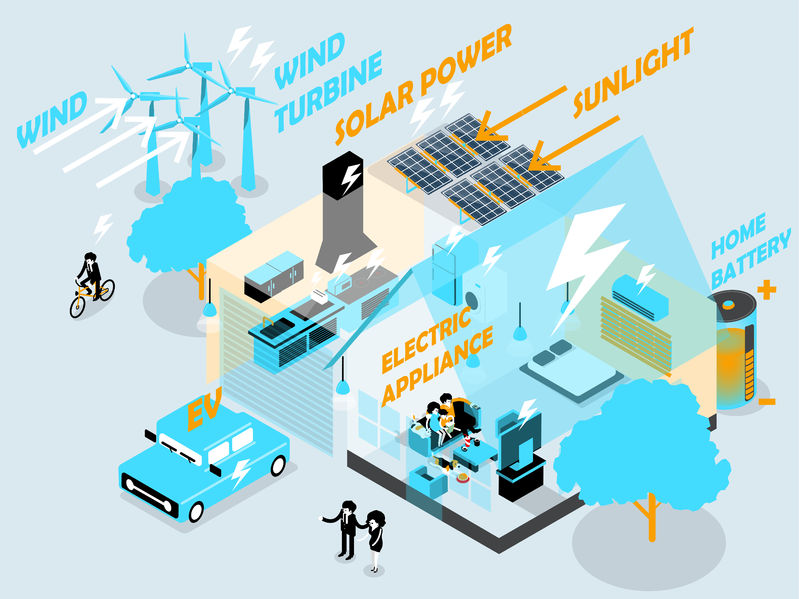
The Transition Trinity: Electric Car, Solar and Home Battery

Fuel Included was founded in 2014 in response to the threat of global warming. Our aim is to promote sustainable technologies at affordable prices, a mission that becomes ever more important as global climate changes accelerate.

59210374_EnergyHome_IsometricGraphic_123RF
Initially we concentrated on electric cars but as they become increasingly mainstream we are able to focus on other green technologies. We now offer our own home battery system, the PowerBanx, to go along with solar panel installs.

While the Global Energy Transition often seems to be about big infrastructure projects, like offshore windfarms and grid battery storage, what’s happening at the home level is arguably more important, in terms of the impact on the individual and on the future requirements for national grids.

For years we have seen the rise of solar power as it becomes cheaper and undercuts other forms of power generation. More recently, we have seen the spread of electric vehicles (EV), as the replacement of fossil fuel vehicles accelerates.

Finally we are seeing the widespread introduction of battery systems (such as our PowerBanx) into homes; all already have solar and many already have an EV.

Read more: LinkedIn


Electric cars charging in Milton Keynes (Image: T. Larkum)

Electric vehicle growth will start hurt tanker shipping by 2025

Come 2025 the switch to electric vehicles (EV) will start to impact the demand for gasoline, which will be bad news for shipping.

While charging infrastructure and range limits remain a concern for EVs the fact they are much cheaper to manufacture on a large scale than their petrol powered cousins will see a shift in the market by the middle of the next decade according to James Leake, an analyst at NS Lemos.

Electric cars charging in Milton Keynes (Image: T. Larkum)

Speaking at the Bimco Power Panel at Posidonia 2018 Leake said:

“EVs do represent a serious threat but not for the time being, if you ask me to put a date on it 2025 would be the point where it really starts to hurt.

“What is to me the killer fact is ultimately manufacturing an electric vehicle is much cheaper than manufacturing an internal combustion engine when you are producing them on scale.”

An electric powered car requires significant less components than one with an internal combustion engine making the structural production cost lower if the scale is large enough, and this why Leake said the likes of Volkswagen is investing $40bn into electric cars with an aim to be the world’s number one player in electric mobility by 2025.

With lower production costs car manufacturers will be much more keen to sell electric powered vehicles than petrol ones. “We will educated as customers to buy the product that will give them a higher profit.”

Read more: SeaTrade Maritime

The electric jolt that roused Big Oil

Identifying a tipping point is not always easy. But when one of the world’s most powerful oil bosses says he is in the market for an electric car, there can be little doubt.

The UK’s electric vehicle drive has put the energy sector on the road to change

Ben van Beurden, the Royal Dutch Shell boss, last week delivered the clearest indication yet that the burgeoning electric vehicle industry is already hastening the decline of global oil demand.

“When that will be is not certain. But that it will happen, we are certain,”

he told investors.

It was not so much a foil to the group trebling second quarter profits as a statement of intent: for “Big Oil” it is time to adapt or die, and Shell intends to adapt.

The Anglo-Dutch giant is already shifting its focus from drilling for oil to natural gas, but within the next year Shell will unveil early plans for a deeper presence in renewable energy and the electrical chain to tap the boom in electric vehicles.

“Everyone is repeatedly surprised at how fast electric cars are coming forward,”

Professor Dieter Helm told The Telegraph in April. The number of new registrations of plug-in cars has grown from 3,500 in 2013 to more than 100,000 at the end of May.

“But the political pressure to adopt this technology is increasing all the time. It’s not due to concerns over climate change – it’s city air pollution,”

he said.

Shell boss Ben van Beurden CREDIT: EPA/BART MAAT

And so it was in the UK last week when the Government’s bid to tackle the country’s worsening air pollution followed the example set by France two weeks earlier in pledging to halt the sale of combustion vehicles by 2040. At the same time, government put the battery boom front and centre in its industrial strategy with £246m of funding for research and development.

Read more: The Telegraph