Even though the Covid-19 pandemic hit the global automobile industry hard, causing it to contract 16%, electric vehicle sales grew strongly over the past year.
The findings come from a report by the International Energy Agency (IEA) which states that the number of electric cars, vans, trucks and buses on roads is forecast to grow from 11 million this year to 145 million by the end of the decade. If governments accelerate efforts to reach climate goals, that figure could grow to as high as 230 million by 2030.
The IEA found that a record three million electric cars were registered across the world last year, 41% higher than in 2019. That trend has remained resolute into 2021 with 2.5 times as many registrations recorded in the first quarter of the year as during the same period last year. That has been driven by strong sales in Europe and China of approximately 450,000 and 500,000 vehicles, respectively. The U.S. has also seen its sales double compared to the first quarter of 2020.
Renault ZOE 2020 (Image: Renault.com)
Consumers spent $120 billion on electric car purchases last year with governments providing $14 billion in subsidies to support sales, up 25% from 2019, primarily due to strong incentives in Europe. Those incentives have made a difference and 2020 was especially notable for the electric vehicle industry in that it saw Europe overtake China to become the world’s largest EV market for the first time.
The surging EV market is expected to wipe out demand for millions of barrels of oil. By 2030, existing policies could result in some two million barrels of petrol and diesel fewer per day with the equivalent of up to 120 million tonnes of carbon dioxide saved. If governments raise their goals in line with global climate targets, 3.5 million barrels per day could be removed from circulation with carbon savings nearly doubling.
If you would like to know more about Solar Panels and the PowerBanx range of home battery systems, and get a free instant quote, please complete our online form:
The EV Experience Centre, based in centre:mk, has gained a brand new partner; Vauxhall has officially joined the centre as of Wednesday (28/04). Get 20% off your test drive here…
The Vauxhall Corsa-e will be joining the experience fleet and will be available for flexible test drives from Friday 30th April 2021.
Natalie Reay, EV Experience Centre Manager, said: “We’re very excited to add the new Corsa-e to our fleet of vehicles. With our centre now back open, we are looking forward to welcoming customers behind the wheel of our new electric vehicles.”
Paul Willcox, Managing Director, Vauxhall, said: “The Electric Vehicle Experience Centre is a fantastic initiative to help educate British consumers about the benefits of switching to electric. Vauxhall has a range of affordable all-electric cars and vans and we are looking forward to be able to offer visitors to the centre test drives in our award-winning Corsa-e.”
Vauxhall Grandland X Hybrid4 (Image: Vauxhall.co.uk)
To let you in on what the new supermini is capable of, the Corsa-e has a 45kWh battery (useable) and a WLTP range of 209 miles. It can charge from 15% – 80% in just 30 minutes on a rapid charger and give you a full charge on a fast charger in roughly 7.5 hours. It also has great performance with a rated 0-60mph time of 7.6 seconds.
The EV Experience Centre will also be offering the Vauxhall Mokka-e for test drives mid-way through the year, keep an eye on their social media to find out more.
For more information or to book a test drive in the Vauxhall Corsa-e, Audi e-tron Sportback, Renault ZOE, VW ID.3, VW E-UP, VW E-GOLF, BMW I3 or MINI ELECTRIC and receive an additional 20% off your experience fill out the form below or quote promo code MKFM20 when enquiring with the Electric Vehicle Experience Centre directly.
If you would like to know more about Solar Panels and the PowerBanx range of home battery systems, and get a free instant quote, please complete our online form:
With the expectation that EVs and FCVs to account for 40% of vehicle sales by 2030.
Honda‘s new CEO, Toshihiro Mibe, has officially launched plans to increase its ratio of electric vehicles and fuel cell vehicles (FCVs) to 100 percent of all sales by 2040. The carmaker’s goal follows the company’s expectation that EVs and FCVs will account for at least 40 percent of vehicle sales in major markets by 2030 and 80 percent by 2035.
With the aim in mind, Honda is also set to produce more EVs and FCVs in the coming decades. The company also plans to roll out the first EVs it will build on e:Architecture, a new EV platform lead by Honda. Those vehicles are expected to make their debut in North America before expanding to regions across the pond. In the meantime, Honda and GM have introduced two jointly-developed EV models that will use GM’s Ultium batteries. The cars are expected to launch in 2024 in the North American Market.
Honda e Electric Car (Image: Honda.co.uk)
Reuters obtained a quote from Mibe stating, “I believe it is the responsibility of an automaker to achieve our carbon-free goal on a ‘tank-to-wheel’ basis.”
He continues to comment on the company reaching the goal in the Japanese market saying, “While the government’s target is extremely difficult, I believe it is a feasible target from the viewpoint of Japan becoming carbon neutral in 2050. As for Honda, we are in full support of this target – 46% -and we’d like to put all our efforts towards achieving the goal.”
Honda is expected to invest a total of $46.3 billion USD in R&D initiatives regarding electrification over the next six years, regardless of sales revenue fluctuations.
In other automotive news, Triumph updated its 900cc street scrambler for 2022.
THERE’s still a lot of suspicion around pure-electric vehicles (EVs), and for some car buyers they’re still not the answer. But the number of electric cars on sale is increasing rapidly, and so is their appeal, meaning many drivers are taking the plunge.
In March 2021, electric cars made up 8% of all new cars sold, up from 5% in the same month the year before. Improvements in battery technology are reducing cost and charging times, as well as increasing energy density (and therefore how far they can travel per charge).
So on Earth Day 2021, and ahead of the ban on the sale of new petrol and diesel cars in 2030, we ask: is now the right time to buy an electric car?
How much does an electric car cost?
Electric vehicles are still more costly to buy new than internal-combustion alternatives. A Vauxhall Corsa e, for example, is around £5,000 dearer than an equivalent Vauxhall Corsa with a petrol engine. This is because battery packs are costly to manufacturer, at present.
However, car makers are offering great deals on new electric cars (Vauxhall covers electricity costs for the first 30,000 miles, for example), and eventually there will be cost parity: according to Bloomberg, a battery pack today is responsible for 30% of an electric car’s cost, down from an estimated 57% in 2015.
A few years ago, buyers were also put off by the expected rapid depreciation of electric cars, with their value plummeting further in the first few years of ownership than internal combustion engine (ICE) cars. However, this has proved not to be the case because battery packs are not deteriorating as fast as expected, and because electric cars are still relatively scarce. By some estimates, electric cars now retain their value better than ICE cars, and premium models such as Teslas, which are some of the most popular electric cars, are holding their value extremely well.
2020 Renault Zoe (Image: Renault)
Some in the car industry believe incentives to encourage drivers to buy electric cars aren’t as strong as they could be. In order to end what a Whitehall source labelled the “Tesla subsidy”, the government last month reduced the scope of its Plug-in Car Grant (PiCG). The total that buyers are able to claim off the cost of a new electric car has been reduced from £3,000 to £2,500, while the grant is only applicable to cars costing under £35,000, rather than £50,000 as before.
However, there are still a number of vehicles covered by the grant, and they’re not just from quote-on-quote “budget” car makers — there are models from more premium car makers like BMW, DS and VW on which you can get a discount.
What are the running costs of an electric car?
Ownership of electric vehicles affords other benefits. Electricity costs vary depending on supplier and tariff but generally, if you charge up at home the cost per mile is much less than that of a petrol or diesel car.
In addition, electric cars don’t attract any Vehicle Excise Duty (VED, often referred to as “road tax”) for the first year of ownership, and if you live in London you’re exempt from fees in the Ultra Low Emissions Zone (ULEZ) and Congestion Charge zone.
If you’re considering getting an electric model as your company vehicle, it’s also worth bearing in mind that Benefit-in-Kind tax is just 1% on electric vehicles. That’s compared to at least 14% on cars with more than 50g/km of carbon emissions.
Maintenance costs should be significantly lower because an electric car is relatively simple. Aside from checking the brakes regularly and filling up the screen wash, most EVs don’t require much in the way of routine maintenance – there are no oils or filters to replace, no turbochargers to go wrong and no transmission to fail. So far, electric motors themselves seem to be very reliable — there’s effectively only one moving part.
It’s the cost of a replacement battery pack that puts off a lot of potential EV buyers, but there might be little to worry about on this front, too. Some EVs come with leased batteries, so they’ll just be replaced if necessary. When bought, most batteries have a warranty of around eight years years or 100,000 miles (whichever comes first).
What’s more, problems with battery packs might be traced to the failure of individual modules, which can be swapped out at minimal cost.
If you do need to fit a whole new battery pack you’ll potentially have to stump up some eye-watering amounts of cash. Manufacturing the 80.5kWh battery in a Tesla Model Y reportedly costs Tesla $9,250 (£6,670). Smaller batteries will obviously be cheaper to replace, but you’re still looking at £4,900 to replace the 40kWh battery in a Nissan Leaf hatchback.
But again, reliability after years of use seems to be pretty good and owners generally don’t complain of significant fade from older models.
How far can electric cars travel per charge?
There’s no escaping the fact that electric cars can be less convenient than internal combustion-engined alternatives. They often have a shorter range before they have to be refuelled (recharged), and that process takes significantly longer.
However, range is also improving significantly: the new Mercedes EQS can manage 479 miles on a single charge, while Tesla claims that the Model S Plaid can achieve a staggering 520 miles.
Those two are expensive electric cars but even the Peugeot e-208, which costs from £27,225, can manage more than 200 miles per charge.
Read more: DRIVING – The SUNDAY TIMES
It’s Time to Go Green!
If you would like to know more about Solar Panels and the PowerBanx range of home battery systems, and get a free instant quote, please complete our online form:
The SMMT has called out the government’s approach to EV funding in the wake of the recent cut to the plug-in car grant.
Speaking yesterday (Apr 20) at a talk on electric cars at the Goodwood Motor Circuit near Chichester, chief executive Mike Hawes said the cut in funding for new battery-powered models was counter-productive if the government wanted drivers to make the change.
‘It will become that much harder to get the allocation of [electric] vehicles into the country if we want to stimulate demand if we’re constantly on the back foot because we have a less competitive offering.
‘So we need to see a range of support measures and incentives in place.’
A ban on the sale of new petrol and diesel cars is coming into effect in 2030.
Hawes added: ‘We expect demand for EVs to rise pretty steeply, but even with that increase, when we get to 2030, we will not meet the total expectations that the government has to reach its climate change targets.’
He said the UK was ‘pursuing an entirely different path to the rest of Europe’ when it came to electric cars.
BMW iX3
Hawes highlighted countries such as Germany and France, where grants of up to £9,000 are available to help drivers make the switch to zero-emissions models.
Scrappage schemes are also available in several European nations to get motorists out of their older polluting models.
Last month, the government suddenly announced that the grant for EVs was being cut from £3,000 to £2,500 with immediate effect.
It also targeted new electric cars costing less than £35,000 – previously models available up to £50,000 were included.
Tesla Model 3 excluded as electric car grant to be cut to £2,500 – with experts branding move as ‘too soon’
With such little warning and previous consultation, it shocked many across the industry.
Neil McCue, chief operating officer at Snows Motor Group, told Car Dealer at the time: ‘We can’t understand why they’re trying to push electric vehicles but now coming out with this and not supporting them as they should be.’
With a number of electric models quickly getting more expensive without the grant, a range of manufacturers have cut prices to ensure they continue to be able to qualify for the grant.
Popular models such as the Nissan Leaf, BMW i3 and Kia e-Niro have all had their prices slashed.
If you would like to know more about Solar Panels and the PowerBanx range of home battery systems, and get a free instant quote, please complete our online form:
ELECTRIC cars are becoming increasingly popular around the world.
But how practical are they? Here’s everything you need to know if you’re thinking about getting one.
How much does it cost to charge an electric car at home?
According to EDF Energy, electricity costs 14p per kWh on average.
So, you’d pay £6 for a 13-hour charge on a 40kWh Nissan Leaf using a 3kW charger.
However, as electricity costs less off-peak (e.g. at night), the charge is more likely to be £4.
Home charging can be done using an existing plug socket or a wall-box home charging unit.
A typical wall-box home-charging unit can supply power between 3 and 22kW – and with a charge of 7KW, it can cut charge times in half.
You’ll need to pay to install one, but a government grant will fund up to 75 per cent of the cost of purchase, up to a maximum value of £350.
How much does it cost to charge an electric car at a charging station?
Running an electric car is less expensive than a petrol or diesel thanks to the cheap cost of charging up.
The cost depends on the type of vehicle you’re charging, what its battery capacity is, and where you’re topping it up – at home, work or via a public provider.
You’ll pay more at a public operator for a fast charger, for example, while slow 3kW chargers are the cheapest to use.
IONITY rapid charge points at Leeds Skelton Lake Services (Image: IONITY)
But it’s not simply a case of plugging in anywhere – you’ll need accounts with various operators like Chargemaster, Source London, Pod Point, and Ecotricity to make sure you can access different points.
Some of these come with a nominal yearly or monthly subscription fee and then a fixed usage rate depending on how long you charge for while others offer pay-as-you-go.
Most use an app to help you keep track of costs.
According to Pod Point, for a typical electric car with a 60kW battery, and up to 200 mile range:
Charging at home costs about £8.40 for a full charge
Work points should be free
Public location charging at supermarkets or car parks are often free for the duration of your visit
Rapid charging points, for example at motorway service stations, can cost about £6.50 for a half-hour charge
Where are the electric car charging stations in the UK?
Zap-Map is a useful app that shows you the location of charging points across the UK, and the type of charger available.
EVs currently account for around 3-4 per cent of the UK new car market, it says.
Although the charging infrastructure is expanding, there will be greater load on the grid than initially expected.
There are more than 7,000 locations with a public charging point installed, providing more than 20,000 connectors.
Many electric cars also have sat nav that recognises these locations and can direct you to those within range
Businesses can provide charging points, so check with your office.
And why not consider getting a home charger installed so you can plug it in overnight?
If you would like to know more about Solar Panels and the PowerBanx range of home battery systems, and get a free instant quote, please complete our online form:
ELECTRIC cars are becoming more and more popular as the UK public aims to be more environmentally conscious and cut back on their pollution emissions. But how far can an electric car go before it needs charging? These are the top 10 electric cars compared, including models from Tesla, Hyundai and Renault.
The UK will be banning the sale of new petrol and diesel cars from 2030, in a bid to improve the nation’s carbon footprint. That means manufacturers and the public will be forced into looking at electric vehicles – and there are plenty already on the market.
Electric cars are very similar to the modern day petrol or diesel vehicle – with one very big difference.
The engines aren’t powered directly by fossil fuels, and instead use everyday electricity to get people from A to B.
All you need to do is plug your car into your domestic electrical points, saving you a trip to the petrol station.
But some people may have heard horror stories about electric cars only managing to go 50 miles before having to recharge for a few hours – that simply isn’t the case.
Lexus UX 300e (Image: blog.lexus.co.uk)
How many miles can an electric car go?
The average modern-day electric car can drive anywhere between 200 and 350 miles before needing to charge.
That’s relatively similar to most full tanks of petrol or diesel.
In the early years of electric cars, up to 2016, vehicles were only capable of going about 100 miles before running out of power.
If you have a hybrid vehicle, you’re likely to get between 10 and 50 miles out of it before switching to petrol.
The University of California, Davis’s Plug-In Hybdrid & Electric Vehicle Research Center said: “All electric vehicles come with a standard 120V charging cord (like your laptop or mobile phone) that you can plug-in in your garage or carport.
“Electric vehicles that are equipped for fast-charging can receive an 80 percent charge in about 20 minutes.
“Current electric vehicles travel about 250 miles on a charge, though there are some, such as Teslas, that can do about 350 miles on a charge.
“Many automakers have announced plans to bring to market electric vehicles that promise longer range and even faster charging.”
Estimate ranges for different electric cars:
Tesla Model 3 LR – 348 miles
Hyundai IONIQ – 193 miles
Renault All-New Zoe – 338 miles
Nissan Leaf e+ – 239 miles
Jaguar I-Pace – 292 miles
Honda e – 125 miles
Kia e Niro – 281 miles
Vauxhall Corsa e – 209 miles
Audi E-tron – 249 miles
BMW i3 – 182 miles
Tesla vehicles provide drivers with one of the greatest ranges in a single charge, according to the Society of Motor Manufacturers and Traders (SMMT).
The car could take you from Brighton to Newcastle in a single journey without stopping.
If you would like to know more about Solar Panels and the PowerBanx range of home battery systems, and get a free instant quote, please complete our online form:
To steal a line from Jerry Seinfeld, what’s the deal with electric car names?
As the automotive landscape shifts towards EVs, car makers have come up with some creative names … and some downright odd ones.
For so long they relied on technical specifications like engine capacity to help create simple, easy-to-understand nameplates; like the BMW 318i was a 3 Series with a 1.8-litre fuel-injected engine or an Audi A4 2.0TDI was fitted with a 2.0-litre diesel engine.
But without engine capacities and cylinder counts, or even petrol or diesel to differentiate, the marketing and product planning departments have gone into overdrive. Luckily CarsGuide is here to help you make sense of all these new names.
Audi e-tron
The German brand began preparing for its electric switch long ago, introducing the ‘e-tron’ badge on early plug-in hybrid models and ditching engine capacities in favour of a more esoteric number designation – so an A4 2.0 TFSI became an A4 45 TFSI.
The problem is the company has now applied the ‘e-tron’ name to a single model, right on the cusp of a flood of similar EVs, such as the e-tron GT, Q4 e-tron and A6 e-tron. So how does it make sense?
Well, Audi sees the e-tron SUV (and Sportback variant) as the template for all new EVs, introducing the technology in the same way that the brand called its first four-wheel drive production car the ‘quattro’. It helped establish the system and then it was rolled out across the range.
BMW i
The Bavarian brand had a clear plan for its EV roll-out – a range of bespoke models designed from the ground-up and marketed under the new sub-brand BMW i. The first models were the i3 city car and i8 hybrid sports car, but neither managed to sell enough volume to justify all-new models, so BMW has opted to change course.
Now it will introduce electric versions of existing models, such as the new X3-based iX3 and 4-Series-sized i4, indicating that i is the new EV prefix. The catch is, they’ll also introduce a standalone model called the iX.
This X5-sized SUV is meant to be the flagship of this new range and will arrive to compete with the Audi e-tron, Mercedes-Benz EQC (more on that in a moment) and Tesla Model X. The name is bound to create confusion, with iX likely to be confused with the other models with numerical additions. It also becomes a mouthful when you add in the various model designations – iX xDrive40 and iX xDrive50.
In other words, get used to lots of ‘i’ and ‘X’ in future BMWs.
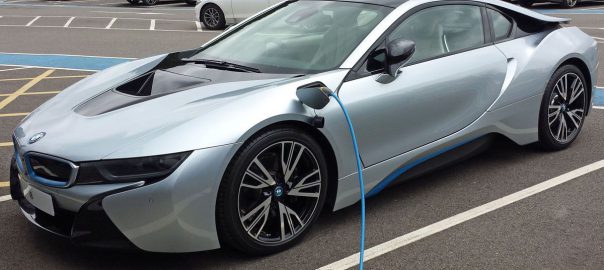
BMW i8 on charge (Image: T. Larkum)
Mercedes EQ
Mercedes has either telegraphed its intentions or perhaps not fully thought through the future and how many models it could have.
In some respects, the brand has done a good job by keeping things simple, creating the ‘EQ’ sub-brand for its initial run of EVs and basing them on its existing range. So, the GLC-based EV is called the EQC, the S-Class version called EQS and the Viano-based model the EQV.
But what happens when the brand wants to build a full-size electric SUV based on the GLS? EQLS? Or a Tesla Model 3 and BMW i4 rival the same size as the C-Class? The EQCC?
Surely, they have prepared a plan for this, but it does have potential to get messy for consumers down the road.
Toyota bZ4X
It’s not clear if Toyota meant to name its new EV SUV this or if someone just mashed the keyboard and liked the result.
But seriously, there is method behind the syntax-defying name, with ‘bZ’ standing for ‘beyond zero’ and signifying the start of a new range of models that will come over the next few years.
It hardly rolls off the tongue like RAV4 or LandCruiser, but it seems EVs can’t have traditional names.
If you would like to know more about Solar Panels and the PowerBanx range of home battery systems, and get a free instant quote, please complete our online form:
Electric cars have come a long way since the first mainstream models were introduced a decade or so ago.
Since the first truly modern fully electric cars were produced in 2009 and 2010 with the likes of the Mitsubishi i-MiEV, the Citroën C-Zero, the Peugeot iOn, and the Nissan Leaf, things have really come a long way. Back then, electric cars were little more than curiosities and seen as impractical by most people. Many would just discount them as being not ready for the market and unable to compete with normal gasoline and diesel-powered vehicles.
Now, that has all changed, and they are rapidly becoming mainstream and are proceeding to displace fossil-fueled cars – in Norway for example the sale of new gasoline and diesel cars will be banned in less than 4 years. General Motors has announced that it is intending to only sell electric vehicles after 2035, while many other car companies are echoing this too. EVs are now almost unrecognizable from what they were just 10 or so years ago. Here are eight ways the EVs have dramatically improved over the last decade.
Increased Range
The range of EVs has been growing dramatically. When the Nissan Leaf debuted in 2010 it came with an EPA range of only 73 miles, now in its second generation, it boasts 151 miles — a doubling in range in just ten years.
But its 151-mile range is dwarfed by some other ranges out there on the market with Tesla’s Model S reaching ranges of more than 400 miles and the upcoming Tesla Cybertruck Tri Motor and the Lucid Air expected to achieve EPA ranges of up to 500 miles.
Dacia Spring 2021 (Image: Dacia.co.uk)
Increased Speed
Tesla’s Roadster, expected to hit production within months, can reach dizzying speeds of up to 250 miles per hour while the Lucid Air is projected to be able to zip along at 168 miles per hour.
The electric vehicles of ten years ago were humble, sluggish affairs that could find themselves stuck in the slow lane of the Interstate Highway. But not anymore!
Charging Infrastructure
Back in 2010, one would be justifiably concerned about the distinct lack of charging infrastructure installed. But today that has changed dramatically – especially in states like California. The growth of charging infrastructure installed is explosive. Additionally, the ranges of the cars have also dramatically improved meaning that the constant need for charging is also less acute.
You can easily explore all corners of California with a Tesla now and while it’s possible some regions may still be very difficult to transverse with shorter ranged EVs – especially in the more mountainous regions that require more power, this is set to change in the near future.
Rapid Charging
The long time it takes to charge the vehicles has also been a significant stumbling block to adoption. But that too is now changing. Back in 2010, the charging times were so long that you basically had to let your vehicle charge in the garage overnight.
Today, superfast chargers like Tesla’s Model S can add 200 miles worth of charge in a mere 15 minutes, while the Lucid Air can add 300 miles worth of charge in 20 minutes. This is rapidly getting to the point of being a little less inconvenient than filling up with gas.
Price
Not only has the performance of the EVs gotten better and better, but the price of electric cars has also fallen precipitously. As economies of scale continue to kick in, that trend is set to continue.
If you would like to know more about Solar Panels and the PowerBanx range of home battery systems, and get a free instant quote, please complete our online form:
Good Energy is launching a new tariff that allows electric vehicle (EV) drivers to charge for free during periods of excess wind and solar generation.
Developed in partnership with Zap-Map – a company Good Energy owns a 50.1% stake in – the Zap Flash tariff includes ‘flash’ windows based on periods where Britain is generating an abundance of solar and wind. Drivers will then be alerted to a four-hour window when charging their vehicle comes at no extra cost and is backed by Good Energy’s 100% renewable electricity supply.
The flash period will vary in day each week, although the times will remain the same in the summer and winter months, with customers to receive at least 24 hours notice ahead of the period. The Summer Flash period will run from April to September between 11am and 3pm, while the Winter Flash Period is to run from October to March between 11pm and 3am.
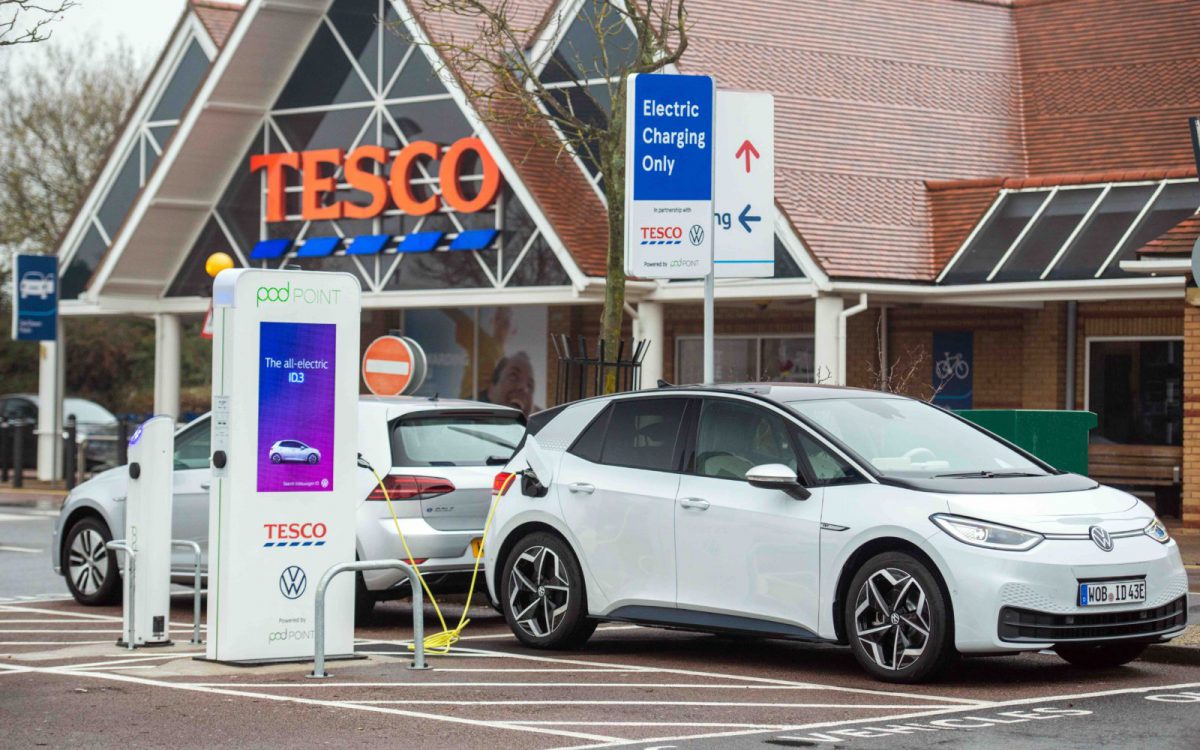
POD Point Rollout at Tesco Stores (Image: Tesco/POD Point)
The tariff will be enabled by smart metering, with Good Energy to rollout smart EV chargers and an updated app alongside the new product. It will initially be launched in beta phase, allowing for more sophisticated versions as the energy supplier learns from customers.
Good Energy’s CEO and founder, Juliet Davenport, said that with Britain generating “so much” renewable electricity, it only “makes sense for us to take advantage of this free resource”.
It was announced in February that Davenport is to step down as CEO, with Nigel Pocklington to takeover the role.
If you would like to know more about Solar Panels and the PowerBanx range of home battery systems, and get a free instant quote, please complete our online form: