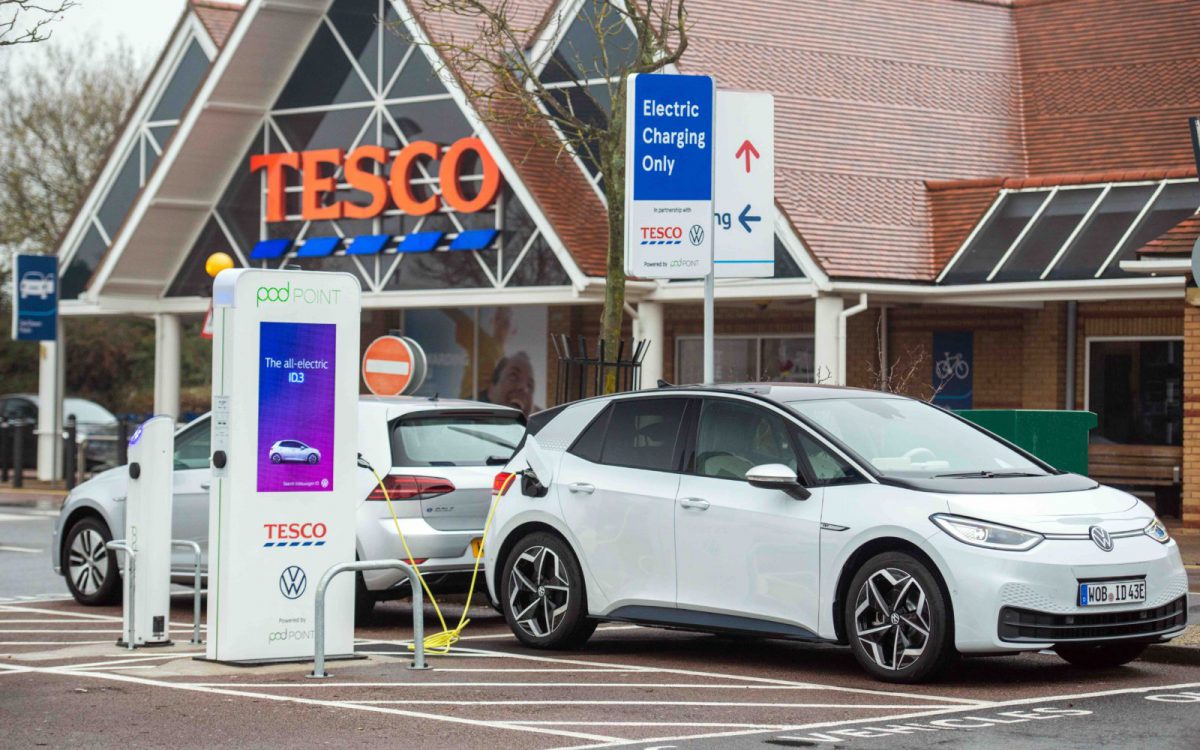
Electric vehicle (EV) charging company Pod Point has reached a new milestone in its rollout of chargers at Tesco stores.
Chargers have now been installed at 200 Tesco stores, with the latest – four 7kW charging bays – going in at the Chester Tesco Superstore. This takes the number of chargers installed as part of the rollout to 402, with at least two charging points installed at each location.
POD Point Rollout at Tesco Stores (Image: Tesco/POD Point)
The partnership is on track to install chargers at a further 200 stores by the end of the year, Pod Point said, with 12% of the total Tesco store footprint now having EV charging facilities.
This is set to rise to 36% following the rollout, which is being done as a partnership between Pod Point, Tesco and Volkswagen and was first announced in 2018.
It is aiming to install 2,400 charging points across 600 UK stores, with chargers first installed in 2019.
Since then, over 669MWh has been used to power customers’ vehicles, with the chargers – which are free to use – powered exclusively through renewables.
If you would like to know more about Solar Panels and the PowerBanx range of home battery systems, and get a free instant quote, please complete our online form:
The Nissan Ariya is a high-tech electric SUV with a 310-mile range and futuristic looks…
In order to explain why the new Nissan Ariya could represent a watershed moment for electric cars, we need to have a little history lesson, so pay attention at the back.
Nissan Ariya EV SUV (Image: Nissan)
In 2006, Nissan changed the game for SUVs with the launch of the Qashqai – the first mass-market family SUV which showed that you could have a high-set driving position and family friendly practicality without the sky-high running costs of a traditional off-roader. Then, in 2010, lightning struck twice with the Nissan Juke – a small SUV which took the Qashqai’s very successful formula, shrank it considerably, and lowered running costs yet again. Both cars, unsurprisingly, have sold like proverbial hot cakes ever since. The point is that Nissan has a habit of shaking up the market when it launches a new SUV, which is exactly why the new Ariya is such big news.
The Ariya is a fully electric large SUV, with styling that’s not changed dramatically from 2019’s concept car of the same name. Slim LED lights and a Nissan badge which lights up to welcome you to the car gives the Ariya a futuristic look, while its sloping rear roofline means this Nissan walks a fine line between traditional and coupe-styled SUV. Some of the concept’s frivolities, though, such as cameras replacing traditional door mirrors, haven’t made it to production. You can bet that the next Qashqai family SUV will take strong cues from the Ariya when it arrives later this year, too.
If you would like to know more about Solar Panels and the PowerBanx range of home battery systems, and get a free instant quote, please complete our online form:
Car buyers in Europe can now get their hands on a brand-new electric vehicle for less than the typical cost of a mobile-phone contract. Thanks to newly generous subsidies, some are even free.
Shoppers have swarmed virtual showrooms in Germany and France — the region’s two largest passenger-car markets — after their national governments boosted electric-vehicle incentives to stimulate demand. Their purchase subsidies are now among the most favorable in the world, according to BloombergNEF.
2020 Renault Zoe (Image: Renault)
The state support is allowing Autohaus Koenig, a dealership chain with more than 50 locations across Germany, to advertise a lease for the battery-powered Renault Zoe that is entirely covered by subsidies. In the 20 days since it put the offer online, roughly 3,000 people have inquired and about 300 have signed contracts.
“If we had more sales staff, we would have sold even more,” said Wolfgang Huber, head of electric-car sales for the dealer in Berlin, who published a Facebook post asking customers to be patient. “We did expect an increase in sales with the subsidies, but this run really struck us.”
Chancellor Angela Merkel and President Emmanuel Macron have sought to soften the coronavirus pandemic’s blow to the badly hit car sector. Sales in Europe have recovered more slowly in Europe than in China or North America, pressuring policy makers to support major sources of employment and economic activity.
In France, sales of Renault’s Zoe model are on track to double this year even as demand for gasoline vehicles has cratered. And in the Netherlands, where the city of Amsterdam is banning non-electric cars from 2030, a 10 million-euro ($11.4 million) fund to support EV purchases was used up in just eight days this month.
“There are a lot of attractive offers right now because of higher subsidies, and that’s boosting demand,” said Aleksandra O’Donovan, an analyst with BloombergNEF. “The EU is pushing toward decarbonizing transport, and the coronavirus crisis has allowed them to accelerate that.”
If you would like to know more about Solar Panels and the PowerBanx range of home battery systems, and get a free instant quote, please complete our online form:
Back in 2015, Kevin Booker and his wife wanted a quirky car few people owned – now they own two electric cars and wouldn’t look back. Here’s why…
You might say that my wife and I ‘get’ electric cars now: we started our journey with a Renault Zoe Q210 (22kwh battery) back in December 2015 for my wife’s small daily commute as a way to test the feasibility of an electric vehicle and have grown in confidence from there.
Hyundai IONIQ Electric 2020 (Image: Hyundai)
Over the past four and a half years we have covered more than 42,000 miles, and I’d say that our experiences have only been positive. What’s not to love? The ease of driving, the quietness, the power and instant torque and the cheap running costs all stand out.
We’ve had adventures all over England and Wales and always been surprised and delighted by the number of people that want to stop for a chat about the car, with lots of questions, around its range and how long it takes to charge.
If there are frustrations, they are not down to the car. We love driving the Zoe, but there are issues with the charging infrastructure, which lags behind what you would find in many other countries.
If you would like to know more about Solar Panels and the PowerBanx range of home battery systems, and get a free instant quote, please complete our online form:
The pandemic is likely to have lasting effects on traditional business models as we adapt to homeworking, social distancing and see aspects of a public policy shift away from globalisation, writes Mark Richards, partner and co-leader for Energy, Environmental & Infrastructure at Bryan Cave Leighton Paisner LLP.
The transport sector has been hit hard, as airline operators wrestle with record slumps in demand, airports underutilised and traditional mass transit systems operators deal with a fraction of usual daily commuter passengers.
The need to socially distance has led to an increase in commuters utilising their cars to get to and from their workplaces, especially those keyworkers who are unable to undertake their jobs remotely. But these keyworkers are only a fraction of the typical commuters heading into our big cities, most are currently home working.
Tesla Model 3 (Image: Tesla.com)
The combination of the lockdown imposed by the Government and continued homeworking has significantly reduced traffic volumes in our cities, which in turn has led to significant improvements in air quality and noise reduction.
Can these benefits be maintained and indeed accelerated through the adoption of zero-emission vehicles?
There are few industries enjoying double-digit growth in 2020, the EV sector is one of those – in July 2020 we have seen Tesla Inc. market capitalisation exceed Toyota, to become the largest car manufacturer in the world.
So in the UK with a push to net-zero by 2050, along with a ban on the sale of new petrol and diesel vans by 2035, is there more than can be done to accelerate the transition to zero-emission vehicles, especially if investment in industries supporting (and the adoption of) electrification of mobility is a COVID-19 recovery response?
The UK Government can already be commended for the recent tax incentives put in place to attract company car drivers to switch to electric vehicles, this comes after the UK Government’s commitment to the sector through its ‘Road to Zero’ strategy announced in July 2018, providing ambitious targets for a new car and van sales.
The Government continues to promote electric vehicle adoption and has enacted various pieces of legislation to promote the e-mobility transition including the Autonomous and Electric Vehicles Act 2018 and Alternative Fuels Directive/The Alternative Fuels Infrastructure Regulations 2017.
These pieces of legislation in most place focus on the conditions for creating electric vehicle charge points.
So, on balance, the current policies from the UK Government are creating a very positive ecosystem for the greater adoption of zero-emission vehicles, however, more can be done.
If you would like to know more about Solar Panels and the PowerBanx range of home battery systems, and get a free instant quote, please complete our online form:
The vast majority of emissions cuts from electric cars will be wiped out by new road-building, a report says.
The government says vehicle emissions per mile will fall as zero-emissions cars take over Britain’s roads.
But the report says the 80% of the CO2 savings from clean cars will be negated by the £27bn planned roads programme.
It adds that if ministers want a “green recovery” the cash would be better spent on public transport, walking, cycling, and remote-working hubs.
And they point out that the electric cars will continue to increase local air pollution through particles eroding from brakes and tyres.
The calculations have been made by an environmental consultancy, Transport for Quality of Life, using data collected by Highways England.
The paper estimates that a third of the predicted increase in emissions would come from construction – including energy for making steel, concrete and asphalt.
A third would be created by increased vehicle speeds on faster roads.
And a further third would be caused by extra traffic generated by new roads stimulating more car-dependent housing, retail parks and business parks.
If you would like to know more about Solar Panels and the PowerBanx range of home battery systems, and get a free instant quote, please complete our online form:
With car makers and legislators thrusting EVs out of their niche and into the mainstream, here’s our extensive buying guide for those tempted to take the plunge
The moment has come for electric cars. Lockdown is easing and, due to that, we’re seeing a rapid acceleration in demand for new cars – along with a determination in many a keen owner’s mind that this is a time to take a new view on life and concentrate on what really matters.
For a great number of us, that means making a well-informed and far-sighted decision about our next car. Do we stick with the same, safe, internal-combustion choices or embrace the future with an EV? We know it’s coming, so why not do it now?
Autocar believes it’s okay to think such things. Even before Covid-19, this was always going to be a major year for EV sales. The biggest European car makers must this year begin reducing their fleet-average CO2 emissions to 95g/km, and there’s no better way of offsetting the petrol cars that most of the market will still want by selling a decent number of zero-emissions ones. One reason EVs were so hard to buy last year is that firms were using 2019 to clear their less fuel-efficient stock, knowing 2020 would be the year of the EV push. Now, suddenly, they want to sell you battery cars.
There are other prime reasons for considering the change. The supply of enticing EVs has grown from a dozen to 40-plus in short order, and there’s now a viable second-hand EV market, reassuring for those considering the change. Company car economics have moved decisively in the favour of EVs, too. Road tax is eliminated, parking costs are low, fuelling costs are slashed and London’s congestion charge and ULEZ fees don’t apply.
What used to be a speculative topic has become a serious option. Now read on as we rate every EV on sale and answer the questions surrounding them.
If you would like to know more about Solar Panels and the PowerBanx range of home battery systems, and get a free instant quote, please complete our online form:
Electric car charging infrastructure is set to get a boost over the next five years according to the latest home charger data.
Research from charging point manufacturer Andersen has shown that by 2025 there could be 350,000 homes in the UK fitted with charging points, which would see a considerable shift in car buyers opting for a fully-electric or plug-in vehicle over the same period.
The latest new car registration figures from the Society of Motor Manufacturers and Traders (SMMT) have shown that while battery electric vehicles (BEVs) have a market share of only 4.7 per cent, they have seen the most growth in June and 2020 to date.
However, BEV and plug-in hybrid vehicles (PHEVs) combined now hold nearly eight per cent of new car registrations for 2020, up from 2.1 per cent in 2019.
Andersen quote in their research that it is expected there will be 1m EVs on UK roads by 2025 too, bringing with it this spike in home chargers.
The data has used statistics from the Department of Transport on home chargers installed between January 2015 to December 2019 to predict the next six years.
Andersen claims from its modelling that the rate of growth would suggest from 2021 more than 30,000 home chargers are installed a year reaching 67,480 in 2025.
If you would like to know more about Solar Panels and the PowerBanx range of home battery systems, and get a free instant quote, please complete our online form:
New research has found rush hour pollution levels have dropped considerably in London during the pandemic lockdown.
They fell up to a 50% during rush hour near Park Lane and double digit improvements in other commuter hotspots in London.
Borough High Street, at the base of London Bridge, saw a 37% reduction in the morning and 47% drop in the evening.
Cowcross Street, near Farringdon Train Station, saw a fall of 38% in the morning and 43% in the evening.
South Street, next to busy Park Lane, saw reductions of 32% and 50% for the morning and then the evening.
The research was carried out by Environmental Defence Fund Europe (EDFE) and Global Action Plan.
EDFE analysed pollution data from the Breathe London monitoring network during morning (8-11am) and evening (5-8pm) commuting hours in the first four weeks of lockdown.
These three sites were also in the top five of overall NO2 pollution reduction locations for the Breathe London network.
NO2 is a toxic pollutant produced when fossil fuels such as diesel, petrol or natural gas are burned.
In order to keep air pollution down, particularly during rush hour, Global Action Plan is calling on businesses to offer remote working to employees to ease pressure during peak travel times.
Additional research also shows that Londoners are more concerned about the air pollution since lockdown and are keen for it to stay low.
If you would like to know more about Solar Panels and the PowerBanx range of home battery systems, and get a free instant quote, please complete our online form:
A guide to the costs and options for charging your EV
2020 looks set to be a massive year for electric cars. Several major manufacturers have either already launched new EVs or have models due to go on sale later this year.
On top of that there are rumours of a Government-backed scrappage scheme that could offer incentives to switch to an electric car. There are also suggestions that the drop in traffic-related pollution during lockdown could encourage more drivers to switch to zero-emissions motoring.
Some of the biggest questions around EVs, besides how far they can travel, are around charging – how much it costs, how long it takes, and where you can charge your EV.
The answers to all these questions depend on a variety of things, including the size of a car’s battery, the type of charger it has, where you’re charging and even the brand of car.
How much does it cost to charge an EV?
How much it costs to charge an electric car is dependent on a number of factors.
The first is the car itself. Different cars have different battery capacities and in some cases, such as the Nissan Leaf and various Teslas, the same car can come with a choice of battery capacity. The larger the battery, the more electricity it will hold and the more it will cost to charge it but the further you’ll go on a single charge.
If you would like to know more about Solar Panels and the PowerBanx range of home battery systems, and get a free instant quote, please complete our online form: