Monthly Archives: September 2017

Electric cars charging in Milton Keynes (Image: T. Larkum)

UK government must raise the bar for electric vehicle adoption

British roads could stand on the verge of a revolution in personal transport, according to a new study.

Electric cars charging in Milton Keynes (Image: T. Larkum)

With the UK government becoming the latest to name 2040 as the cut-off point for petrol and diesel fuelled transport, manufacturers are finally beginning to prioritise the next generation of electronic vehicles (EVs), presenting new challenges for companies, governments, and drivers themselves.

With the EU collectively in danger of failing to meet various climate targets at present, a number of the community’s largest member states have announced measures aimed at weaning citizens off the direct consumption of petrol and diesel. Following a ban on petrol and diesel fuelled cars in France recently being scheduled for 2040, the United Kingdom has followed suit.

The governmental pushes away from petrol and diesel mean that large car producers like Volvo have an ultimatum to work toward – create electronic vehicles worth consumers’ whiles, or face becoming by-standers in the future automotive market. Change in public perception had previously pushed large manufacturers, most notably Toyota with their infamous Prius hybrid line, putting their money and brand influence behind partially electronic vehicles, however, with greater public awareness around the environmental impact of petrol and diesel, a growing variety of electric vehicles have come to the fore, enabling governments to put their trust in the industry to continue to profit in spite of their intervention.

However, while the market is moving steadily toward electrified transport, the uptake of electric vehicles could be double government estimates as early as 2020, according to new research by Baringa Partners. Researchers at the consulting firm, who called on policy makers to address issues around the integration of potentially soaring levels of EVs into the energy system, found that 18% of people said they would consider buying an electric vehicle for their next car, well above the governmental projection of a mere 9% of the UK’s road fleet by 2020.

Read more: Consultancy UK

The death of the internal combustion engine

It had a good run. But the end is in sight for the machine that changed the world

“HUMAN inventiveness…has still not found a mechanical process to replace horses as the propulsion for vehicles,”

lamented Le Petit Journal, a French newspaper, in December 1893. Its answer was to organise the Paris-Rouen race for horseless carriages, held the following July. The 102 entrants included vehicles powered by steam, petrol, electricity, compressed air and hydraulics.

Only 21 qualified for the 126km (78-mile) race, which attracted huge crowds. The clear winner was the internal combustion engine. Over the next century it would go on to power industry and change the world.

The big end

But its days are numbered. Rapid gains in battery technology favour electric motors instead (see Briefing). In Paris in 1894 not a single electric car made it to the starting line, partly because they needed battery-replacement stations every 30km or so. Today’s electric cars, powered by lithium-ion batteries, can do much better.

The Chevy Bolt has a range of 383km; Tesla fans recently drove a Model S more than 1,000km on a single charge. UBS, a bank, reckons the “total cost of ownership” of an electric car will reach parity with a petrol one next year—albeit at a loss to its manufacturer. It optimistically predicts electric vehicles will make up 14% of global car sales by 2025, up from 1% today. Others have more modest forecasts, but are hurriedly revising them upwards as batteries get cheaper and better—the cost per kilowatt-hour has fallen from $1,000 in 2010 to $130-200 today.

Regulations are tightening, too. Last month Britain joined a lengthening list of electric-only countries, saying that all new cars must be zero-emission by 2050.

Read more: The Economist

Getting Poisoned in my Electric Car

I’m on my way down the M1 from Northampton to Milton Keynes and the motorway has come to a halt. It’s not clear exactly what’s happened, but a bit of Googling on my phone indicates there’s an on going ‘police incident’. Apparently a suspicious object has been found under a bridge near Newport Pagnell. This started an explosive device incident. However, further investigation seems to have turned it into a chemical spillage incident. Anyway, the motorway is shut both ways between Junction 15 and J14. I joined the back of the queue about 8.30am and it’s now 11.30. People are milling around and chatting, and generally behaving well. However it’s shocking how many drivers keep their engines running. For the first couple of hours you couldn’t walk around without being assaulted by the noise, smell and fumes from three rows of diesel. Now, three hours in, most are off with just a few diehards keeping them on continuously.

Being in an electric car saves me from the noise, but unfortunately I can’t avoid breathing the fumes. I look forward to the day when we can all leave poisonous fumes in the past.

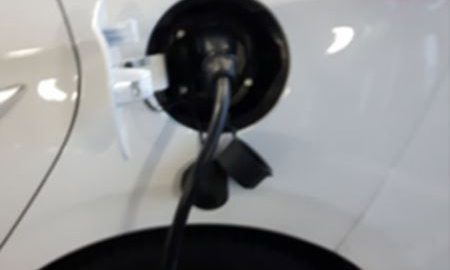
Charge Port Door (Image: T. Heale)

Green revolution: Oxford set to lead the world with its residential electric car charging point pilot

OXFORD is set to lead the world into a petrol-less future.

eMotor feeding (Image: T. Heale)

Electric vehicle charging points are being installed across the city this month and how motorists use them will be reported to the Government by Oxford University.

The trial, already thought to be the largest on-street charging pilot in the world, could see drivers in Oxford help shape international policy, with university chiefs saying the scheme had ‘global scientific significance’.

Oxford City Council, in a project alongside Oxfordshire County Council, has this month begun installing the 100 electric charging stations in residential streets across the city to encourage drivers to go electric.

It is starting with 30 stations which will come online in October and be available to use for 12 months.

Ten of these will be available for the general public, 10 for Oxford’s Co-wheels Car Club vehicles, and the remaining ten for individual households.

This first phase of the trial will be monitored by researchers from the University of Oxford’s Transport Studies Unit (TSU).

Two of the green guinea pigs are husband and wife Yousaf and Ruby Mehmood of Littlemore.

Mr Mehmood bought the couple’s first hybrid electric car – a Mitsubishi Outlander – last October.

He was partly influenced by the heavy pollution when he was growing up in Pakistan.

He said:

“People are causing these problems and I felt as an individual it was something I should do, and it might motivate other people as well.”

Read more: The Herald

Our Vision for Fuel Included

We want our customers to understand what we are about and where we are heading.

Our immediate goal is to transform how you find the right electric car for you. We want to make your experience more enjoyable, and ensure that we leave the world cleaner and greener than we find it. Our larger goals extend into the world of green energy, and, to help explain what we mean, I have recorded a short video message outlining our vision for this industry.

https://www.youtube.com/watch?v=pIvVajU82cI&list=PLEkXV5fvxEy9Tk54V9EBCru7_eh_XLjOg
Video Link

The full transcript is here:

“At Fuel Included we want to have an impact on climate change by changing the way people engage with cars and energy.
We use the internet to talk to our customers, and offer innovative ways for them to own green technologies.
Our goal is to make owning an electric car easy, fun and value for money. To do this, we sell electric cars with a unique offer; the cost of the fuel is included in the cost of the car giving fixed price motoring.
We are preparing to sell Solar Panels and Battery Storage solutions to give you energy security and independence.
Ultimately, our vision is to provide your car, your energy systems and your energy for both home and travel as a single package that saves you money and reduces your carbon footprint.
So please join us at Fuel Included and become part of the green energy revolution.”

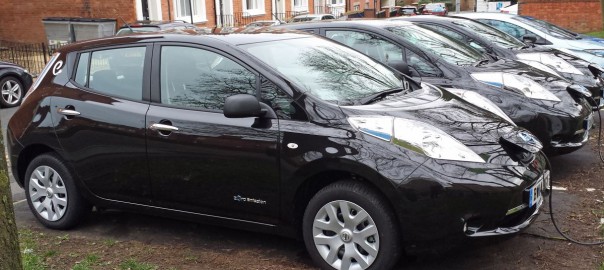
e-Car Club Nissan Leafs outside Northampton Derngate (Image: T. Larkum)

Going Backwards — Driving A Gas Car For 1 Day After 2 Years In A Nissan LEAF

It is nearly two years since I began my daily journeys in a clean, electrified vehicle — no particulates, zero emissions, human friendly, child friendly. I found myself driving in a light bubble that seemed to push the smell of gas to the periphery.

e-Car Club Nissan Leafs outside Northampton Derngate (Image: T. Larkum)

Becoming free dependence on oil/gas in my personal driving, it was initially easy to enjoy heightened optimism about air pollution and environmental concerns. I hoped that most drivers would to switch to electric vehicles — soon. If I could do it, many could.

Things have changed in an uncomfortable, challenging way within the history of those two years, though. EV range is the least of my worries.

I’m now accustomed to the ease and the smooth nature of the LEAF, and I sometimes take for granted what I fell in love with — the fluid ambiance and the sublime quietude that comes with a zero-emissions electric vehicle.
Remember the old saying,

“you don’t know what you have till it’s gone”?

I recently left the Nissan LEAF at the shop to get a tire changed. It was going to take a day, so Nissan offered me a nice new gasoline-powered loaner. Immediately, I felt the “rougher” feeling of an ICE car … just turning it on. No magical quiet jingles like the LEAF provides.

Taking off was fine, but not nearly as responsive as my LEAF, which moves like a silent airplane through time and space — without the smell of diesel or gasoline. I feel as if I am on a private plane in the LEAF. In the gas car, I was presented with a gravelly sound and feeling from under the car, a rumbling engine, and bad smells of gas. I felt I went backwards in time. It was similar to, but not nearly as deadly as, the day after the last election.

Read more: Clean Technica

New Nissan Leaf 2018 teaser – More pictures reveal latest electric car’s design

NISSAN has released yet more details of the forthcoming Leaf 2018 which will debut next month.

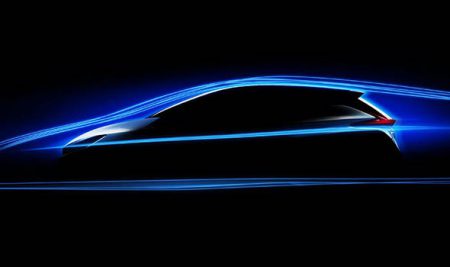
Image: Nissan

Nissan Leaf 2018 is just a few weeks away from being revealed.

Ahead of its September 6th debut there has been a lot of anticipation about the new EV.

Nissan has claimed that the new Leaf will be packed with their most advanced technologies and will ‘raise the bar’ for the electric vehicle market.

The zero-emissions vehicle has been the most popular EV in the UK for a number of years but with advancements in the market segment and more competition, the new car needs to deliver on more than style and technology.

Range anxiety is still the biggest problem for many would-be EV drivers as they don’t believe that an electric car can support their lifestyle.

Previous generation Leaf’s have not breached the 200 mile range and with the 24kW battery achieving a theoretical range of 124 miles of charge and the 30kW delivers 155 miles.

With the Model 3 producing around 220 miles with its standard battery and 310 miles with the long range battery pack then Nissan will need to produce a car with range closer to the 200 mark to compete.

In addition to this, with the lower price point they will be aiming to draw some potential customers away from Tesla.

From initial reports about the car’s specs and leaked pictures we know that the it sports a more conventional exterior design.

It looks heavily influenced by the new Nissan Micra which was unveiled earlier this year.

Read more: Express

How to buy an electric vehicle

Everything you need to know about EVs – and our top ten EV choices

Over 67,000 alternatively-fuelled vehicles – including full electric, hybrid and plug-in hybrid (PHEV) cars – have been sold in the UK so far in 2017. Not bad for what’s still regarded as a niche market.

Cars like the BMW i3, Nissan LEAF and Renault Zoe have shown that there are no space compromises demanded by electric cars. And, especially for drivers who spend most of their time in towns and cities, electrified cars save can save a great deal of money on fuel and road taxes relative to petrol and diesel rivals.

Charging an electric car is certainly much cheaper than filling up a petrol or diesel car. Based on an electricity cost of 10p per kWh, it will cost just £3 to fully power up a Nissan LEAF. A quick charge on the motorway will take the batteries up to 80% of their total capacity for about £6. Even ‘range anxiety’ is becoming less of a problem, with the latest-generation electric cars capable of some 150 real-world miles on a single charge.

Buying an electrified car

It’s a fact that electric and plug-in hybrid cars cost more new than conventionally-engined cars, but government grants will narrow that price gap. Cars emitting under 50g/km of CO2 and able to run for at least 70 miles just on electric power qualify for a £4500 grant. One that will do between 10 and 69 miles on electric power will get a £2500 grant. Then there are the incentives of around £2000 that car makers like BMW and Mercedes are offering for ‘scrappage’ trade-ins on older diesel cars.

But which type of electric car should you buy? A welter of jargon has sprung up to confuse buyers, so let’s try and untangle that.

Alternatively-fuelled vehicle: any car that doesn’t solely rely on a conventional petrol or diesel engine.

EV: full EVs (or electric vehicles) run only on electric power, like the Nissan LEAF. Rather than a ‘normal’ engine, they are driven by a battery-powered electric motor charged from a mains power source. These EVs escape road tax and the London congestion charge.

Read more: Evening Standard

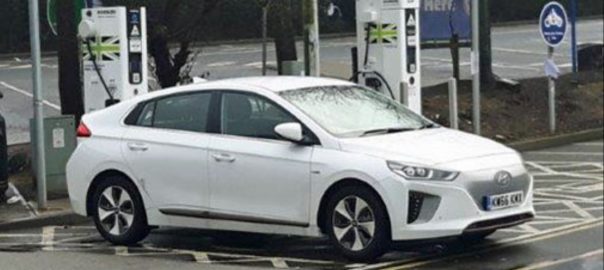
Charging at Cherwell (Image: T. Heale)

New Hyundai Ioniq Plug-in 2017 review

Hyundai isn’t the first manufacturer to offer pure-electric and hybrid technology, but there’s no denying the Korean brand is working hard to catch up.

Charging at Cherwell (Image: T. Heale)

Its Ioniq range of eco-focused cars includes a hybrid and a pure-electric version – but in the middle of the pack, there’s a plug-in model designed to offer the best of both worlds. We tried it in Italy back in April, but now we’ve had a chance to get behind the wheel of the car in the UK.

The PHEV version isn’t just a carbon copy of the regular Hybrid with an extra power socket. Although the normally aspirated 1.6-litre petrol engine has the same output as in the non-plug-in car, the electric motor gets a small boost. And while the maximum combined power figure is still 139bhp, it’s ever-so-slightly faster from 0-62mph – completing the sprint two tenths faster than the standard Hybrid car.

The ability to charge the larger battery at a wall socket (it takes about two and a half hours) really helps the Ioniq’s CO2 emissions, though; this car emits just 26g/km, compared with the conventional hybrid’s 79g/km.

As with most other PHEVs, the Ioniq is a car that is at its best when making relaxed progress. Treat the throttle with respect and it with gather speed smoothly and with little intrusion from the petrol motor. Stamp on the right pedal and things quickly deteriorate, though; the six-speed dual-clutch transmission isn’t the quickest or smoothest-shifting unit out there, and the petrol motor, while fluid enough, is pretty audible if its revs are sent rocketing.

You can run the plug-in Ioniq in a couple of modes. Most of the time will be spent in the car’s hybrid setting, where the system mixes electric and petrol power as it sees fit. It’s worth noting, though, that as with the Prius and Prius Plug-in, the Ioniq PHEV is keener to stick with pure-electric motoring than its conventional hybrid stablemate.

Read more: AutoExpress

Electric cars charging in Milton Keynes (Image: T. Larkum)

EV emissions fall by two-thirds as renewables kick in

Emissions from electric vehicles (EVs) have fallen by two-thirds as a result of electricity generation becoming greener.

Electric cars charging in Milton Keynes (Image: T. Larkum)

That’s according to a new report from researchers at Imperial College London in collaboration with Drax, who say power generation shifting from coal to renewables means electric transport is now cutting more carbon emissions than ever before.

It showed the power produced from April to June this year contained 199g of carbon dioxide (CO2) per kWh, 10% lower than last year.

Producing the electricity to charge a Tesla Model S back in 2012 would have created 124g CO2 per km driven – the same as a 180 horsepower Range Rover.

The researchers say that has now halved to 74g CO2 per km in winter and 41g CO2 per km in summer.

Smaller cars like the Nissan Leaf and BMW i3 can be charged for less than half the CO2 of the cleanest non-electric car on the market, the Toyota Prius hybrid.

Dr Iain Staffell from Imperial College London said:

“It is widely accepted that electric carsdramatically reduce air pollution in cities but there is still some debate about how clean they actually are – it varies depending on where the electricity to charge them with comes from.

“According to our analysis, looking at a few of the most popular models – they weren’t as green as you might think up until quite recently but now, thanks to the rapid decarbonisation of electricity generation in the UK, they are much better.”

Source: Energy Live News