Monthly Archives: July 2017

Refreshed Renault Kangoo ZE Now On Sale In Europe, With Improved Range

The newly refreshed Renault Kangoo ZE is now on sale in the European market, bringing with it an improved range and a number of other changes.
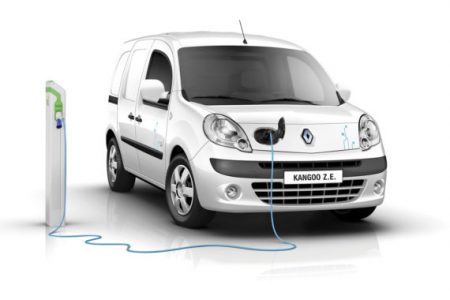
Reanault Kangoo ZE

The small electric van offering from Renault now features an official New European Driving Cycle (NEDC) range rating of 270 kilometers (167 miles). The company acknowledges that a real-world range of between 120 kilometers (74 miles) and 200 kilometers (124 miles) is probably more realistic, though.

That’s probably enough range to make the newly refreshed offering seem pretty attractive to many business operators, offering great potential to cut fuel and maintenance costs to a fair degree.

In addition to the improved range — courtesy of a new 33 kilowatt-hour (kWh) battery pack — the refreshed Renault Kangoo ZE also features an upgraded charging system and a heat pump that improves cold weather battery efficiency/range. The new battery pack was developed in partnership with LG Chem.

Green Car Reports provides more: “The new battery cells are denser but do not add additional weight to the Kangoo ZE, which means safety and payload are unchanged. Total power output from the electric battery and motor — shared with the Renault Zoe — is 45 kilowatts (60 horsepower).

“Additionally, Renault has added a dedicated heat pump to use less battery energy on climate control, which the brand says is a first for the light commercial vehicle segment. … In the coldest climates, the Kangoo ZE also benefits from an optional mini-heater for even more warmth.”

As far as the improved 7-kilowatt charging system, the Kangoo ZE can now be fully charged in 6 hours, rather than 7 hours, despite the much improved range.

Deliveries in Europe are expected to begin this summer.

Source: Clean Technica

Government puts up £20m for electric vehicle-to-grid tech development

Government has freed-up £20 million to help kickstart vehicle-to-grid (V2G) development. The aim is to work out how electric vehicles can help balance the electricity system.

Tesla Model 3

The Department for Business, Energy and Industrial Strategy (Beis) and the Office for Low Emission Vehicles (Olev) said money is available for three types of V2G projects:

  • feasibility studies – investigating the ways vehicle to grid technology can be used in the future
  • industrial research or experimental development – for example, to develop vehicle-to-grid charging equipment
  • demonstrator trials in the real-world environment – projects that trial vehicle to grid technology in different locations across the country.

There are currently around 100,000 EVs on UK roads. That number is expected to swell significantly over the coming years. Manufacturers such as Volvo have grabbed headlines in recent weeks with commitments to focus entirely on electric vehicles, Tesla is launching its first mass production model and even Rolls Royce, which produces some of the biggest and best combustion engines in the world, accepts that eventually, its future business will be electric. Meanwhile, France’s policymakers have outlined a goal to ban sales of petrol and diesel cars by 2040.

With battery costs continuing to fall, some analysts now believe the EV market is approaching a tipping point, and that battery powered cars will be “cheaper to buy than internal combustion engines in most countries by 2025-29”. That analysis does not take into account any fuel savings or subsidies that may be on offer.

In the UK, Beis is keen for carmakers and battery firms to collaborate on energy storage and services in order to help decarbonise both electricity and transport sectors. While the former sector has decarbonised significantly due to subsidy regimes, the latter appears to be in reverse gear.

“The ability to marry energy and automotive [goals] is a wonderful opportunity that would be crazy to separate and dilute,” secretary of state Greg Clark said recently.

“If you can create jobs in both sectors and simultaneously address problems that do not respect boundaries… that is a huge opportunity.”

Some carmakers are ahead of the curve. Nissan, second only to Jaguar Land Rover in the UK in terms of cars produced, told National Grid’s recent Power Responsive conference that it was becoming an energy services company.

Read more: The Energyst

Is a carmaker about to save the planet?

Volvo’s move to electric demonstrates the role ethical business can play in shaping our society for the better

think a lot about electric cars,” Tesla CEO Elon Musk famously said at a party at the very end of the 80s. “Do you think a lot about electric cars?” The problem with thinking a lot about electric cars is that certain things become impossible to unthink: powering a car with fossil fuels, meeting 21st-century challenges with 19th-century answers, become more than irresponsible. It becomes ridiculous.

You’ll never know when the tipping point is – it’s possibly as little as five minutes – but think enough about electric cars, especially if you’re a car manufacturer, and wham … you’re Volvo. They were rolling along perfectly happily until they thought too hard: about their business model and benefit to society; about climate change and their future customers; and so they made the decision that all their cars would be fully electric, or at least hybrid, by 2019. Not one car solely powered by internal combustion engine will come off a Volvo production line by 2020.

It is impossible to overstate the significance of this, and not because you are ever likely to buy a brand-new Volvo. If every branded car is a Veblen good – that is, something you want precisely because it is expensive, to flag to the world your ability to own it – then the Volvo is a peculiar inversion, the car you buy that looks less flash than it is, to show the world that you’re not the kind of person who shows off what they’ve bought. Nope, nobody here is buying a brand-new Volvo in 2019.

Yet this will instantly change the charging infrastructure for electric cars: there have already been pretty extraordinary advances in charge speed. You can fully charge an electric vehicle – one with a range of about 105 miles – in half an hour from a supercharger in a garage, which is the difference between being able to use an electric car in a normal way, and having to rebuild your life around it. However, there aren’t enough superchargers, in Europe or the US, and, maddeningly, a lot of the slower chargers – which take four to six hours – still call themselves “high speed” because that’s what they were when they were installed. Volvo will shunt progress forward worldwide on genuinely high-speed charging points, as well as battery production and research and development into battery storage.

Read more: The Guardian

Which are the best used electric and hybrid car buys?

As electric car sales rise, so does the number of them available on the used car market.

So the question is, which are the best used electric car buys available right now?

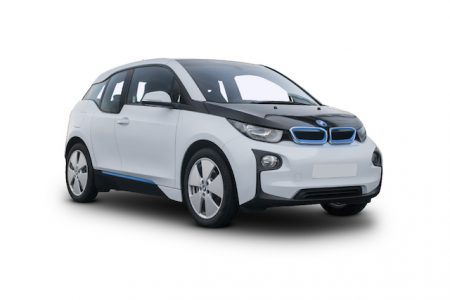
BMW i3

The first one is obvious – the BMW i3. This fantastically styled little hatchback is the embodiment of what we think of when someone says ‘electric car’. It has an exceptionally modern design that even four years on still looks futuristic, and the same can be said about the interior that is uber modern with its crisp design and light-coloured textiles and wood used throughout.

To buy one new today will set you back a minimum of £32,340 with a government grant of £4,500. However, search on the second-hand car market and you can pick yourself up a great deal.
According to research by valuation and provenance experts Cap HPI, a 2015 registration with just 20,000 miles on the clock can be bought for less than £14,650. Opt for the one with the range-extending three-cylinder petrol engine and you’ll pay from £18,400.

Another car on the list is the Nissan Leaf. This is an electric hatchback that has been with us for some years now but is still a very popular choice – much of which is down to its reliability and affordability.

A new top-spec Tekna variant of the Leaf will cost around the same as a BMW i3 with a few goodies, but second-hand and the savings are very impressive. A 2015 model can be had from £9,900, meaning electric cars can bought for an affordable price.

The third car on the list isn’t quite a fully electric vehicle, but the Toyota Prius is still a hybrid. Second-hand values are surprisingly strong, and have in fact risen slightly by 3.9 per cent.

The research shows that there are electric and hybrid models to suit most budgets out there, with used examples being excellent value for money when considering the savings on fuel over a 12-month period too.

Source: Aol. 

Severe Flooding, Against a Background of Wind Turbines: November 2012, Tyringham, Bucks. (Image: T. Larkum)

UK faces sharp rise in wind storms and higher bills as world warms

Data models show UK to be at mercy of fiercer winds and insurers call for action to reinforce buildings.

The UK is set to reap the whirlwind of climate change with the huge damage caused by wind storms expected to increase sharply, according to new analysis.

Even the minimum global warming now expected – just 1.5C – is projected to raise the cost of windstorm destruction by more than a third in parts of the country. If climate change heats the world even further, broken roofs and damaged buildings are likely to increase by over 50% across a swathe of the nation.

The research shows all of the UK is on track to see rises in high winds except the south and south-west, with the greatest impact across the Midlands, Yorkshire and Northern Ireland. This is because the main storms that barrel in off the Atlantic are expected to move their track northwards as the planet warms, a phenomenon linked to the rapid melting being seen in the Arctic.

Global warming is set to increase the destructiveness of wind storms in the UK

Severe Flooding, Against a Background of Wind Turbines: November 2012, Tyringham, Bucks. (Image: T. Larkum)

Flooding is the most high-profile impact of climate change on the UK. But the overall cost of wind storms is actually higher, as a result of a much larger number of smaller incidents, and currently runs at an average of about £1bn a year. Extreme wind storms can occur, though, and in 1990 the Burns’ Day storm resulted in 47 deaths, as well as more than £2bn of insured damage and many millions more in damage to roads, power lines and uninsured properties.

The new work was commissioned by the Association of British Insurers (ABI), which is concerned by the rising impacts of climate change on its customers, and was carried out by the consultancy Air Worldwide and the UK Met Office.

Read more: The Guardian

Drivers would switch to an EV if charge points mandated at fuel stations

The availability and accessibility of charge points could overcome one of the “biggest barriers” to the adoption of electric vehicles (EVs).

That’s according to the fleet industry and a Fleet News poll which revealed almost a third (29.2%) of drivers would make the switch to an EV if they were able to charge their car at the pumps.

A further one in five (22.2%) said they would consider choosing an EV, while one in 10 (9.9%) said they already drive a plug-in car.

The poll was conducted after the Government announced in the Queen’s Speech that it would introduce an Automated and Electric Vehicles Bill which will require the installation of charge points for EVs at motorway service areas and large fuel retailers.

The UK’s largest leasing company, Lex Autolease, welcomed the move.

“One of the biggest barriers to greater adoption of electric vehicles is range anxiety, so more charging points at petrol stations and motorway services will help to address that fear,”

said Chris Chandler, the firm’s principal consultant.

“The measures are a recognition of the need for pathway charging – essentially making it easier for electric vehicle drivers to get from one end of the country to the other, without worrying about their next charging point. This should broaden their appeal and open up the market for electric vehicles across the UK.”

Both Total and Shell had already confirmed their intention to install charge points at their stations, while earlier this year the head of BP Fuel Cards in the UK, Andy Allen, told Fleet News that charge points were a ‘logical step’ for the fuel giant.

Read more: Fleet News

Plug-In Vehicle Market Share In UK Hits New High Of 1.83% In June

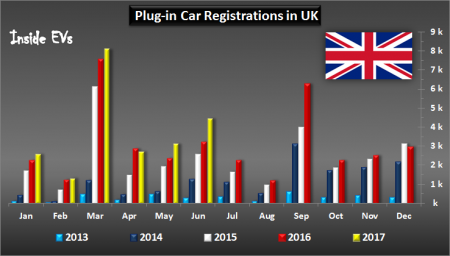
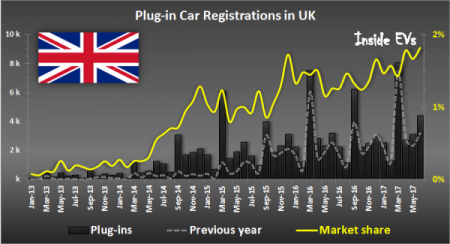
As we saw this month in the US, the overall British auto market shrink by nearly 5% in June, while plug-in sales continued to still rise at a decent pace; hitting a new record market share of 1.83%.

Plug-in Electric Car Registrations in UK – June 2017

The number of new plug-in registrations stood at 4,444 (up 38% year-over-year).

Interestingly, two thirds of the sales fell to plug-in hybrids, a relative anomaly to the rest of the world’s PHEV-to-BEV splits:

  • 1,466 BEVs (up 46 percent year-over-year)
  • 2,978 PHEVs (up 34 percent year-over-year)

In the first half of this year, around 22,350 new plug-ins have been registered (nearly 15% more than year ago), good for an average 1.6% market share.

Plug-in Electric Car Registrations in UK – June 2017

Source: Inside EVs

Gasoline Engines Emit More Particulates Than Diesels

For years, the conventional wisdom has been that pollution from diesel engines was far worse than from gasoline engines for two reasons: First, diesel exhaust fumes are known to contain nitrous oxide emissions. Second, they also contain particulates, small molecules that are too small to see. Both are believed to cause serious damage to human lungs.

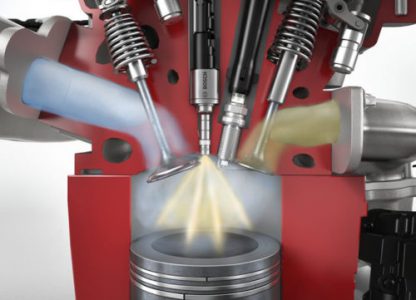
Particulate Emissions From Gasoline Engines

Now it turns out that conventional wisdom is wrong. A study by researchers at the Materials, Science, and Technology Laboratory in Switzerland claims that particulate emissions from gasoline engines can be far greater than those from diesel engines.

The laboratory studied the emissions of 7 gas engine vehicles equipped with direct-fuel-injection systems. The research found that they emit from 10 to 100 times more particulates than modern diesel engines. In fact, they have higher particulate emissions than older diesel without particulate filters.

Wait, did you read that right? Gasoline engines spew out up to one hundred times more particulates that a modern diesel engine equipped with a particulate filter? Yes, you read that right. Yikes. And people wonder why the incidence of asthma and other lung related diseases is on the rise!

Researchers Find Carcinogens In Gas Engine Exhaust

The researchers, led by Norbert Heeb, who has 25 years of experience analyzing emissions from diesel engines and designing filter systems, showed that the particles are the same size as those from older diesel engines. They measure between 10 and 20 nanometers and clump together into particles between 80 and 100 nanometers before they leave the exhaust system.

The gas engines were also found to discharge unburned hydrocarbons in the form of polycyclic aromatic hydrocarbons (PAHs), along with other liquid and solid toxins which accumulate on the surface of the emitted particles.

Particulates Penetrate The Lungs

Heeb says the particles are so small they penetrate lung tissue and pass into the bloodstream, bringing those toxins with them. Is this beginning to sound like the days when researchers first told the world about all the nasty stuff contained in cigarette smoke? It should, because it turns out there is a connection to smoking. The researchers also found that the exhaust gasses coming out ot the tailpipes of the cars with gas engines also contain benzo-α-pyrene, a carcinogenic produced when tobacco is burned.

Read more: GAS2

Home Refuelling: The Ultimate Guide to Charging an Electric Car at Home

The Government has just announced that Britain is to ban sale of all diesel and petrol cars and vans from 2040. The writing is on the wall, with some sources saying that most cars sold will be electric as soon as 2025. If you want to learn about what’s coming, and how owning an electric car is going to affect you, then this guide is for you.

I have been driving an electric car for four years; first a Renault ZOE (48,000 miles) and now a BMW i3. Through my blog sites at Fuel Included and My Renault ZOE I have answered tons of questions about home charging. I decided it was about time to put all the answers together in one place, in a downloadable eBook.

f

Click on the image, enter your name and email, and download your free guide.

If it leaves any questions unanswered, just get in touch (contact details here and in the eBook).

Dr Trevor Larkum
FuelIncluded.com
MyRenaultZOE.com

Tesla to build world’s biggest lithium ion battery in South Australia

Elon Musk’s company Tesla will partner with French utility Neoen to deliver the lithium ion battery designed to improve the security of electricity network.

Elon Musk, the billionaire founder of Tesla, will build the world’s largest lithium ion battery to store renewable energy in South Australia in partnership with French energy utility Neoen.

The 129MWh battery, which is paired with a wind farm, is designed to improve the security of electricity supplies across South Australia.

On Friday the state’s premier, Jay Weatherill, confirmed the deal, which forms a key part of the government’s $550m energy plan.
The state government said Musk had confirmed his pledge made on Twitter in March that he could deliver the battery within 100 days of signing the contract or it would be delivered free.

Romain Desrousseaux, the deputy chief executive of Neoen, said that at 129MWh the South Australian lithium ion battery would become the largest in the world. The battery will be built near Jamestown, in the state’s mid-north, and will be paired with Neoen’s Hornsdale windfarm to provide stability for renewable power being fed into the grid.

Musk told reporters in Adelaide on Friday the project was not without technical challenges, given it would be the largest battery installation in the world “by a significant margin”.

“When you make something three times as big, does it still work as well? We think it will, but there is some risk in that,” he said. “We’re confident in our techniques and the design of the system.”

He anticipated it would help stabilise the grid and help bring down prices for consumers.

Read more: The Guardian