Monthly Archives: May 2017

Plug-in electric does what you’d expect from a normal car, which is a good thing

“Electric cars are taking over! Autonomous cars will rule the road! The end of oil is nigh!”

Sigh. If you’re like me, you’re tired of all the rhetoric of how the auto industry is on the cusp of major change, like, any day now. Hell, I spent enough time reading my dad’s old copies of Popular Mechanics from the 1960s and ’70s. If you believed those stories, then today we should all be soaring over roads in flying cars, gently setting down in our suburbia-heaven driveways after a long day of work, your wife greeting you at the door in a dress and pearls with a martini in hand.
We all know how that worked out. As for autonomous cars, they are at least 10 to 15 years from being viable on a mass scale – there’s no way they could even get out of the driveway in Canadian winters with current technology. And electric vehicles (EVs), while having come a long way in the last 20 years, still make up less than 1 per cent of all vehicles sold in North America. Gasoline-guzzling trucks and SUVs are by far the biggest sellers here. So, considering all the facts, you’ll excuse me if I’m more than a little skeptical on how soon this sea of change will come.

Ah, not so fast: I just had a chance to drive “the future,” and I admit I was impressed. And what impresses me the most about it has nothing to do with sci-fi wizardry or space-age design; no, what impresses me is that it’s almost completely, well, normal.
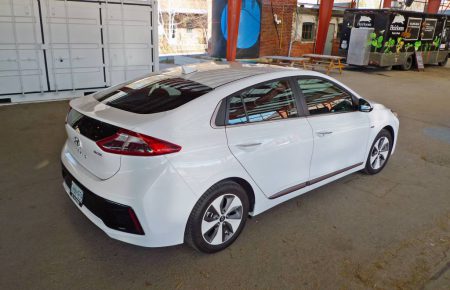
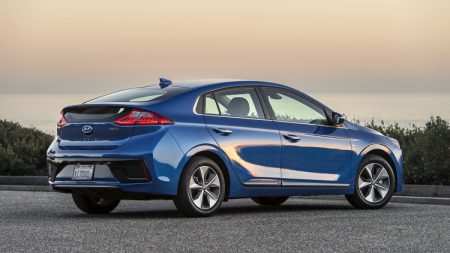
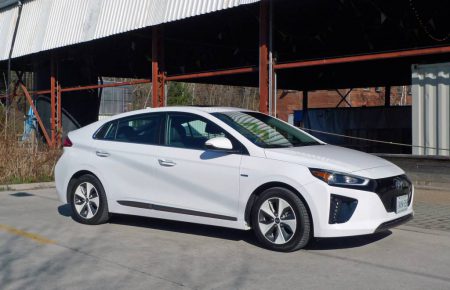
This is the new Hyundai Ioniq, a full-on, battery-powered electric vehicle. Only, you wouldn’t necessarily know it’s an EV if you saw it in someone’s driveway; the only giveaways being the word “electric” on the trunk lid (obvious) and the closed faux-grille at the front (not so obvious). No, this is not an overblown golf cart or futuristic science experiment; the Ioniq is a handsome car that fits in with the rest of Hyundai’s design language – not to mention any other car on the road. The front-wheel-drive hatchback has a wheelbase of 2,700 millimetres, about the size of the compact Elantra; LED lights fore and aft give this top-of-the-line Limited model a more upscale look, while the body-coloured wheels are a nice touch, too.

Inside, it’s more of that normal – no, don’t worry, that’s a good thing, especially as it continues the upscale feel. Nicely textured soft materials on the dash and doors, subtle bronze-coloured accents, simple, well laid-out controls, and a nifty TFT screen for the instrument cluster, which changes colours and details depending on the drive mode. In fact, this Ioniq Limited has an impressive list of features to coddle its passengers: adaptive cruise control, heated seats both front and rear, automatic climate control and a giant 8-inch infotainment screen, among many others.

The ride is comfortable, handling is competent for a sedate compact hatchback (though the steering is vague and over-boosted), the interior is roomy and relatively quiet and it looks sharp. Overall, the Ioniq would be a good choice for someone in the market for a compact hatch. In other words, this electric car is like a normal car.

Read more: Driving.ca

Survey Says: 85% Percent Of Electric Vehicle Owners Are Happy They Switched From Gas

EV-Box’s survey of over 850 electric drivers shows that 85% are happy having switched to electric driving. While insufficient charging infrastructure is raised as a concern by most (55%) of the EV drivers.

The main reason to initially purchase electric vehicles turns out to be a contribution to a more sustainable future (51%), although we still believe the “EV grin”, the smooth driving experience and advanced technology is something that will win over consumers in the long run.

Also interesting to note, is that 55% of those surveyed say they have never used a public DC fast charging station. Further to that, some 56% indicate that retail areas are the top locations to add charging facilities.

“A survey of over 850 electric drivers based in Europe and North America, as well as a “Manifesto for Electric Mobility”, was released publicly during rEVolution 2017, an annual gathering for e-mobility thought leaders that brought together 240 industry participants on the 14th of March in Amsterdam.

The e-mobility manifesto was created by a group of 12 thought leaders from EV-Box, ENGIE, EVConsult, Renault, Jaguar Land-Rover, E-Laad, The Municipality of Amsterdam, Urban Foresight, and Fastned, all of whom shared their vision on the future of e-mobility and what drivers, businesses, associations, and government can do to increase adoption of electric cars as well as improve the experience for the user.

Amongst many insights and recommendations, the manifesto clearly states that to increase the pace of transition towards sustainable mobility for electric vehicles, the following has to happen:

  • For the general e-mobility stakeholders: To cooperate and implement interoperability between different countries and EV charging providers;
  • For the charging providers and operators: To enable direct and mobile payments. Drivers should be able to pay for any charging session with any method, hassle-free;
  • For the semi-public charging facilities: To empower and support the expected rise of electric vehicle adoption by installing smart charging infrastructure at their parking sites;
  • For the automotive manufacturers: Create new services that allow drivers to charge their car in an easier way, and begin producing new batteries that can be charged faster
  • For the Governments: To assist the charging providers in standardizing their services and products by implementing more public charging stations, and create or continue financial incentives to motivate their citizens to acquire an electric vehicle.

The full manifesto has been shared publicly and can be accessed at www.ev-box.com/manifesto.

As per the survey, the insights are shared in the manifesto as well; the most notable findings are as follows:

  • 51% of electric drivers say that contributing to a sustainable future is the main reason to purchase an electric car
  • 55% of electric drivers are unhappy with the current availability of charging points
    47% of electric drivers want to have online connectivity on their home charging station to track and bill their charging sessions
  • 42% of electric drivers say that the main incentive to buy a charging station is to charge faster
  • 55% of electric drivers have never used a public fast (DC) charging station
  • 56% of all electric drivers rank retail areas as the top location to add charging facilities

The survey was answered by electric vehicle drivers, with the majority of respondent’s male (91%) and above 45 years old (58%). The respondents come from The Netherlands (40%), United States (35%) and 32 other European and North American countries, including United Kingdom, Canada, Norway, and Germany.”

Source: Inside EVs

Shell Joins CharIN Group, Will Add Chargers At Fuel Stations

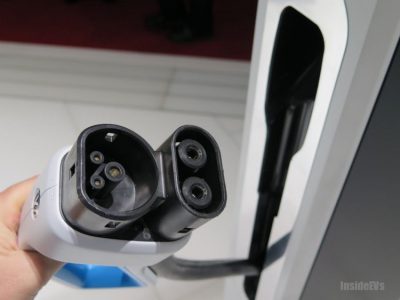
Shell, an integrated energy and petrochemicals company, has now become one of the core members of CharIN e. V. (aka the Charging Interface Initiative e. V.)…which we guess is a good thing?

The company of course is still mostly engaged in refueling conventional cars with petrol, but it would now also like to be best prepared for the future of transportation; and as such, participate in an industry collaboration in the development of a common standards for electric charging technology.

European CCS

“Shell is pleased to join CharIN as a Core member, and looks forward to being an active participant looking at charging infrastructure, communication and grid integration.”

This year, Shell intends to install charging stations primarily in the UK, followed by expansion into other countries.

At the same time, Shell also seems to be interested in smart home charging:

“Shell is already actively developing systems designed to serve the growing number of customers driving electric vehicles. From 2017, Shell will launch electric vehicle fast charging at a selection of Shell forecourts in the UK, with other countries to follow, to serve the ‘on the go’ charging needs of customers.

Shell is also in the early stage of launching an offer to customer fleets in Europe and the US, delivering more efficient charging for their electric vehicles via the use of Shell’s own smart charging technology. This technology can help to both reduce charging costs for customers and integrate this new demand effectively into the power grid. Smart charging technology also optimises the integration of renewable energy sources, by shifting the charge of electric vehicles to a period of the day when supply of electricity from those sources is high. Shell is also developing a R&D technology programme on electric vehicle charging and infrastructure.”

Matthew Tipper, Vice President Shell New Fuels said:

“A range of different fuels and vehicle technologies will be needed to meet growing demand for transport in a low carbon energy future. Electric vehicles are one of these solutions. We are pleased to join CharIN and take part in the efforts to develop common standards for the technology that will support the increasing number of electric vehicles on the roads wherever and however they charge”.

Source: Inside EVs

Fuel Included BMW i3 on static display (Image: T. Larkum)

Electric Car Day – Focus on BMW i3

The car that generated the most interest at our test drive event recently was undoubtedly the BMW i3. This is not surprising as the i3 is arguably the most advanced car in production at the moment, being both electric and constructed of carbon fibre. Certainly it was the car that was booked up fastest for test drives.

Fuel Included BMW i3 on static display (Image: T. Larkum)

As before we had our own i3 on static display so visitors could look around it. In addition we had an i3 available for taking on test drives. We took a couple of brief videos of this one, the first one is a walkaround.

The second video demonstrates how quiet the i3 is as it leaves on a test drive.

Our thanks go to Rick of Wollaston BMW for bringing the car along and conducting the test drives.

Cheap Motoring

EVs: Is the grass really greener with electric vehicles?

In the last decade the challenges faced by fleet managers have dramatically changed. From fuel price volatility to changes in technology that allow fleet managers to monitor vehicle usage and efficiencies – the job for a fleet manager is considerably different to ten years ago. One thing that has remained, however, is the strive towards greener fleet management.

Changes in corporate and social regulations which increase sustainability plus growing demand for cost reductions encourage fleet managers to source greener alternatives that aren’t too costly.

Despite everyone talking about it, there is a surprising lack of clarity to help managers make the right moves towards greener fleets. There are several hurdles to get over before the process can begin, staff buy-in and initial upfront costs, to name a few – however once these are addressed, there are so many benefits.

1. Electric Vehicles (EV)

Fleet managers wanting to make a conscious effort to be greener should look to switching their fleets to electric vehicles. EVs have often had a perception challenge surrounding battery range, with many citing this as a major reason for not investing in EV. Yet, in recent years, Plug-ins, Hybrid and EV technology and range has increased to up to 500km, bringing about a significant change.

As infrastructure improves, more public charge points are available and most EVs come with smart technology that allows you to locate the nearest charge point to your location.

‘Refuelling’ is minimal cost and once the actual foundations have been put in place e.g. installing dedicated equipment, charging can take place at home or work.

2. Cost reduction and savings

Reducing overall costs for any manager is a constant uphill battle. For a fleet manager, keeping an eye on costs is probably the number one challenge and the pressure to save money is persistent. Volatile fuel prices means it can be tricky to keep a handle on predicted costs and some fleet managers can find themselves trying to make cuts in other places, like maintenance.

The government has also put in place schemes to incentivise anyone thinking about making the switch; low or zero road tax and exemption from the London Congestion Charge are both benefits of moving to the renewable energy way of driving.

With low carbon dioxide emissions comes low tax. Businesses with low CO2 emissions benefit from corporation tax relief and allowances as well as lower national Insurance payments.

3. Hybrids and Plug-ins

Another consideration is to look at the use of Hybrid and plug-in hybrid vehicles. This option gives drivers the best of both worlds and is probably most chosen by those wanting to go green but aren’t entirely confident in full EVs yet.

As mentioned previously, one of the big hesitations among drivers when switching from fuel to EV is ‘what if I run out of charge and become stranded’. Fleet managers who face hesitation from nervous drivers worried about being stranded with no means of charging should take a look into hybrid vehicles as they could be just the solution they need.

4. Good brand reputation

Companies that are seen to be making greener decisions and moves are praised. Most organisations now have carbon reduction or corporate social responsibility targets and it’s very much seen as ‘the thing to do’.

Sustainability is the buzzword for many businesses and some big players are investing efforts and money into activity that is driving their social efforts into the public eye. But this shouldn’t be the only reason for adopting greener initiatives.

Read more: Fleet News

Copyright: convisum / 123RF Stock Photo

Total Cost of Ownership – Price Comparison of Electric Vs Petrol Cars

We are asked all the time to help people make sense of the Price to Value balance between Electric and petrol cars. The way the two types of cars work is quite different so it is not always straightforward.

To help, Fuel Included have today launched their Total Cost of Ownership calculator and information service to help you look at the actual costs associated with owning an electric car and comparing it to the actual costs associated with a petrol or diesel car.

This is available for both private and fleet enquirers

Copyright: convisum / 123RF Stock Photo

Our Total Cost of Ownership Calculator takes many factors into account, including the following:

  • Lease costs
  • Deposits
  • Comparison with petrol alternatives
  • Benefits (savings) of electric cars where you live i.e. congestion charge, parking
  • Different forms of charging (home vs public and rapid vs standard)

We know that cost is only part of the story, but now you can at least answer the cost part simply and clearly.

We provide access to a simple form on-line, that will provide a straightforward Total Cost of Ownership Report to help you make the right decision.

If you want a more detailed assessment, we will work directly with you to refine your circumstances.


Hyundai announces pricing for Ioniq Electric subscription service

When we first drove the Hyundai Ioniq Electric, we learned about a unique subscription program that would be available for Hyundai Ioniq Electric buyers in California.

Instead of a traditional purchase or lease, it would be a no-haggle program with unlimited mileage and service and wear items covered. At the time, though, Hyundai didn’t have pricing set for the program. Now it does.

It also has a name. It’s called Ioniq Unlimited+. The way it works is that after a consumer has their credit approved, they put down an initial $2,500 payment, and then pay a set monthly fee for the 36-month term. Pricing varies depending on the trim level of Ioniq Electric. The base model has a monthly fee of $275, the Limited goes for $305, and the Limited with the “Ultimate” package costs $365 per month. All of those prices are before tax.

The advantages to this program over a typical lease are in all the included goodies. The initial tax, title, license and fees are covered with the down payment, drivers have no mileage caps, and charging, service, and wear items are all covered for 50,000 miles. If you’re interested, hopefully you live in California, since that’s the only state in which the program is offered. But, if the program is successful, there may be a chance it expands to other models and regions.

Source: autoblog

VW e-Golf 2017 First Drive

The e-Golf has long been a very good EV in terms of driving experience, but it has significantly lacked the range to truly compete with the big players in the electric car market.

It started out with a below average electric range, and almost all of its rivals have upped their game since the e-Golf’s launch. Now though it’s Volkswagen’s turn to bring out an improved model. NGC went to the car’s launch in Majorca to try out the new VW e-Golf.

What’s new

Volkswagen has given its entire Golf line-up a refresh, with sharper styling front and rear, and improved equipment levels inside. The e-Golf is no different and benefits from these changes, though more importantly, the all-electric model has also had more done to it than any other Golf.

On top of the Golf line-up’s updates, the e-Golf also now benefits from a more powerful electric motor and significantly larger battery capacity. The upshot is a slightly more stylish car, with more tech and improved value for money; and an EV with around 50% more range and a little extra performance to go with it. That means an increase in battery capacity from 24.2 kWh to 35.8 kWh, and power jumps from 85 kW (115 hp) to 100 kW (136 hp). It all sounds great on paper, but how does it come together on the road?

What’s it like to drive

Something that was a positive with the first-generation e-Golf for some was that it was similar to a ‘normal Golf’. Unlike rivals such as the Nissan Leaf and BMW i3, VW didn’t create a new and edgier car, but used it’s tried, tested, and very popular Golf as a foundation. Climbing from a conventional petrol or diesel Golf and into an e-Golf sees very few changes presented to the driver, instantly putting many at ease behind the wheel.

From there, the driving experience does change but actually becomes easier in many respects. The instant torque from the electric motor, the single gear transmission, and regenerative braking create a very digital driving experience, and one that is both enjoyable and convenient. An EV’s most natural habitat is in built up areas, with the low speeds and stop-start traffic minimising the restrictions of the relatively limited range of an EV compared to a conventionally powered car. Here the e-Golf excels, helped by the low centre of gravity created by the battery pack being placed in the car’s floor. It’s nimble, very nippy in short bursts of acceleration, and fun to drive.

Read more: Next Green Car