Monthly Archives: April 2017

Severe Flooding, Against a Background of Wind Turbines: November 2012, Tyringham, Bucks. (Image: T. Larkum)

Northern hemisphere sees in early spring due to global warming

Spring is arriving ever earlier in the northern hemisphere. One sedge species in Greenland is springing to growth 26 days earlier than it did a decade ago. And in the US, spring arrived 22 days early this year in Washington DC.

The evidence comes from those silent witnesses, the natural things that respond to climate signals. The relatively new science of phenology – the calendar record of first bud, first flower, first nesting behaviour and first migrant arrivals – has over the last three decades repeatedly confirmed meteorological fears of global warming as a consequence of the combustion of fossil fuels.

Severe Flooding, Against a Background of Wind Turbines: November 2012, Tyringham, Bucks. (Image: T. Larkum)

Researchers say the evidence from the plant world is consistent with the instrumental record: 2016 was the hottest year ever recorded, and it was the third record-breaking year in succession. Sixteen of the hottest years ever recorded have happened in the 21st century.

The most dramatic changes are observed in the high Arctic, the fastest-warming place on the planet, according to a study in Biology Letters. As the polar sea ice retreats, the growing season gets ever longer and arrives earlier.

The pattern is not consistent: grey willow sticks to its original timetable, and dwarf birch growth has advanced about five days earlier for each decade. But the sedge, almost four weeks ahead of its timetable in a decade, holds the record, according to a study that observed one plot at a field site in west Greenland, 150 miles inland, for 12 years.

“When we started studying this, I never would have imagined we’d be talking about a 26-day per decade rate of advance,”

says Eric Post, a polar ecologist at the University of California, Davis, department of wildlife, fish and conservation biology, who has been studying the Arctic for 27 years.

“That’s almost an entire growing season. That’s an eye-opening rate of change.”

Read More: The Guardian
85% of drivers ‘more seriously’ considering EV thanks to Government investment

The majority (85%) of respondents to a survey by Venson Automotive Solutions say they are now ‘more seriously’ considering buying an electric vehicle (EV) or choosing one as a company car in light of investment from the motor industry, Government and major oil companies.

The Government recently announced that it is putting in place new measures to improve provision of EV charge points as part of the Vehicle Technology and Aviation Bill, and oil supermajors Total and Shell have said that they will be making charging points a standard feature at fuel stations.

Although the commitment by industry and Government to remove purchasing barriers is having a positive influence, the survey also highlights that a focus on educating motorists on the ownership benefits – over and above the environmental benefits – is still needed.

Around two-fifths (41%) of the 100 drivers that responded to the survey said their general lack of knowledge about the total cost or convenience of owning such a vehicle impacted their decision making so Venson is urging fleet managers to arm employees with the tools needed to make an informed company car ownership choice.

Venson’s survey findings reported that the lack of charge points across the UK has been the biggest deterrents for motorists (69%), when it comes to buying or choosing an electric vehicle. Limited mileage range came second (61%), with the cost of charging the vehicle (42%) in third place.

Women (31%) were more reluctant than men (15%) to consider buying or leasing an EV because of the lack of opportunity to ‘try before you buy’.  The cost of insuring an EV is one of the lowest concerns, with only 19% of motorists seeing this as a deterrent and battery safety fears the least of motorists’ EV worries.

Alison Bell, marketing director of Venson Automotive Solutions, said:

“It’s really encouraging to see that public attitudes to electric vehicles are significantly shifting, as the industry invests in the necessary infrastructure. Clearly, Total and Shell’s move to install more charging points is critical in giving motorists the confidence when it comes to choosing EV or hybrid.”

Source: FleetLeasing


eVolt charge points support new fleet of EVs at Taxi Central

eVolt, the Electric Vehicle (EV) charge point supplier, has completed the installation of three chargers to assist a Kirkcaldy-based taxi business in achieving its environmental ambitions and support its five new private hire Nissan Leaf EVs, which are now fully operational.

Taxi Central has installed one of eVolt’s Rapid Chargers, which can charge the 30kWh Nissan Leafs to 80% battery life in 30 minutes, to provide on-shift EVs with essential charging capability; and two eVolt AC 7kW Wall-mount Chargers that fully charge the EVs in around 5 hours.

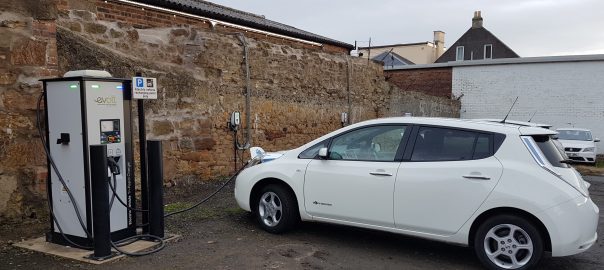
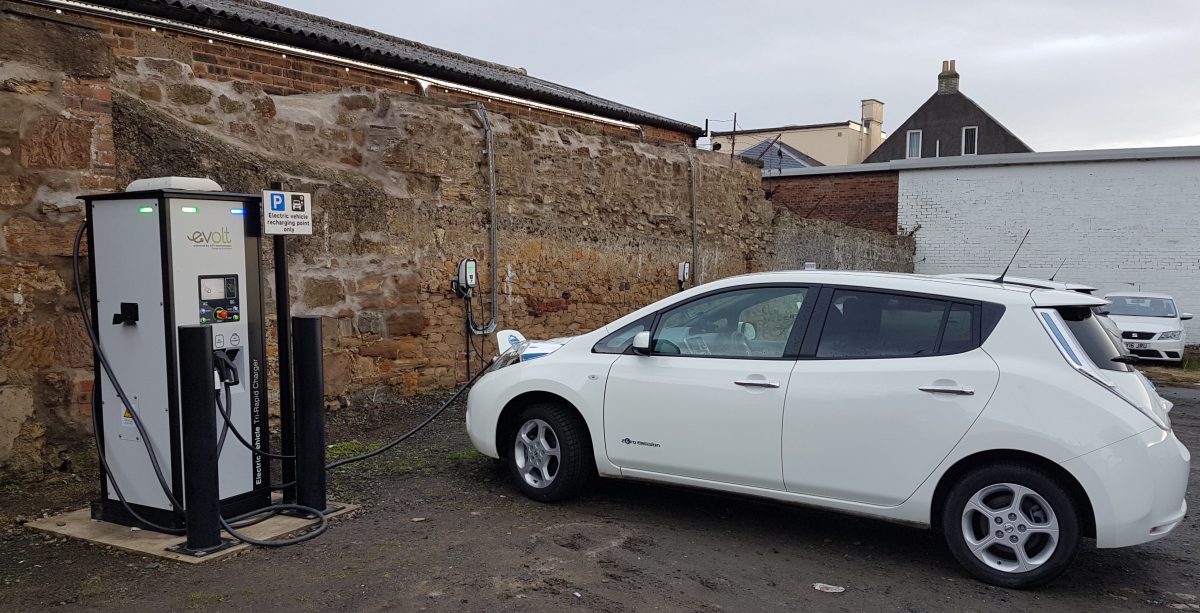
Nissan Leaf charging at an Evolt Charge Point (image: Evolt)

“This charging structure is working excellently, and ensures that our new EVs are well-supported,”

says Mike Brown, Owner of Taxi Central. “We are a 24-hour business and conscious of our environmental foot print. EVs are cheaper to run in the long-term and have a lower maintenance cost, particularly since our taxis travel over 1,000 miles a week.

“eVolt’s chargers are high quality and very reliable, the installation was efficient, and its support network of local engineers gives me peace of mind that should there be a problem, it will be quickly resolved,”

he adds.

The funding for the charge points came through the Energy Saving Trust (EST) and Transport Scotland, and eVolt achieved its status on the latest EST Scotland-wide charge point framework in 2016.

Matthew Eastwood, Head of Transport – Scotland at EST, says EST is pleased to have provided grant funding on behalf of Transport Scotland to support this installation:

“By facilitating the introduction of EVs into the Taxi Central fleet, these charge points will help Kirkcaldy’s residents experience the benefits of EVs, reduce their exposure to harmful emissions and support the Scottish Government’s aim of decarbonising Scotland’s road transport.”

Stephen Rennie, Business Development Manager – Scotland at eVolt, says the Private Hire and Taxi market is one in which eVolt is enjoying considerable success: “More and more businesses are bringing EVs into their fleets as they are seeing its benefits in affordability and sustainability.

“Firms like Taxi Central understand and appreciate that eVolt chargers perform reliably and quickly when used multiple times, and help protect the environment as well as revenues.”

Source: Plug-in Magazine 

Will the diesel car you are driving be worthless in five years’ time?

Is this the nightmare future for owners of today’s diesel cars? It’s 2020 and you are already taxed out of driving into the city centre. At the pumps the price of diesel has soared. The low-emission zone has extended to your suburb. Do you carry on paying extra, or sell for a small fraction of what you paid?

The mayor of London has effectively banned older diesel cars from central London from next October, and the same drivers face a wider ban from a larger area, possibly as soon as 2019. Meanwhile, a report this week by the mayor’s office proposed higher parking charges for diesel owners across the capital.

Things could also be even worse after next week’s budget. After years of pro-diesel policies, chancellor Philip Hammond could be selecting reverse, announcing a major shift in the way both diesel fuel, and the cars, are taxed.

The Society of Motor Manufacturers and Traders this week issued a plea to the government not to come down hard on diesel, as it revealed figures suggesting Britain’s love affair with such cars is already slowing. In January registrations were 4.3% lower than the year before, while those of petrol cars grew 8.9% – unthinkable two or three years ago. British Car Auctions, meanwhile, says the traditional price premium commanded by used diesel cars has narrowed considerably in the past 12 months.

Steve Gooding, director of the RAC Foundation, predicts price falls.

“Will all diesels be worthless in five years? Most unlikely. Will some of them be worth significantly less than they otherwise might have been? Almost certainly.”

He says that while the sale of new diesels in the UK has barely been dented, the market for new and secondhand vehicles looks “a lot less certain”, and in continental cities that have seen restraints on diesel use, older car values have fallen.

“It could be a bonus for high-mileage, bargain-seeking motorists who mostly drive out of town, but that will be scant comfort to the out-of-pocket urban vendor who probably thought they were doing the environmentally correct thing in choosing diesel.”

There is a precedent of sorts for price falls. Back in 2012, drivers of older diesel-engined campervans and a host of other older vehicles, including minibuses, saw values plummet after their use was included in London’s Low Emission Zone covering most roads inside the M25. Owners had to either install new exhaust systems, or sell to avoid paying a £100 or £200 charge for every day the vehicle was driven.

Read more: The Guardian

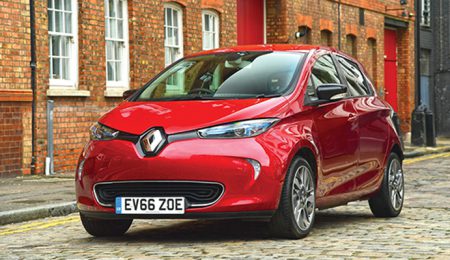
The Engineer drives: going electric with the Renault Zoe Z.E. 40

Renault has almost doubled the battery capacity of its electric supermini, the Zoe. Chris Pickering puts it to the test

Could it be that the electric car has finally come of age? Stepping into the new Renault Zoe Z.E. 40 I would be inclined to argue it has. In some respects, this unassuming little car might seem like an underwhelming choice to back up that claim. After all, it takes more than four times as long to crack the 0-to-60mph sprint as the Tesla Model X we featured last month.

If you look at what‘s kept drivers from going electric in the past, though, the Zoe now ticks an awful lot of boxes. Renault has virtually doubled its range with the launch of this new 41kWh version, which is good for 250 miles on the NEDC test cycle. That’s said to equate to around 186 miles of real-world driving in good conditions – nearly 20 times the length of the average British commute.

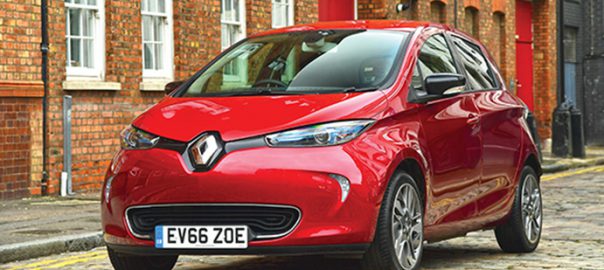
The 41kWh version of the Zoe is comparable to a well-specified Ford Focus

This extended range has been achieved without changing the physical dimensions of the battery and with only a 15kg weight increase. It still contains 192 cells arranged in 12 modules, but battery developer LG Chem has managed to pack more active materials into each one. Meanwhile, the surface area of the electrodes has been increased by some 10 per cent and a new cooling system aims to ensure more consistent performance across the temperature range.

The next obstacle has traditionally been cost, but while the Zoe is somewhat pricier than a conventional supermini it’s an order of magnitude cheaper than offerings from companies such as Tesla. Starting at £23,445 (including the government’s Plug-in Car Grant) the 41kWh version is comparable to a well-specified Ford Focus.

That said, over 90 per cent of buyers choose to lease the battery separately (priced at between £59 and £110 a month, depending on the mileage), which drops the purchase price to £17,845. Opt for the entry-level 22kWh version and that figure falls to just £13,995.

The Zoe comes with a clever onboard charging system, dubbed the Chameleon

Finally, the Zoe comes with a clever onboard charging system, dubbed the Chameleon. This means it can draw the maximum power from virtually any charging point, including the 43kW fast chargers that are increasingly found in motorway service stations. As a result, the Q90 version – more on that in a minute – can fill 80 per cent of its battery in just over an hour. Renault even includes a fully installed 7kW Chargemaster home-charging system with each car.

Read more: The Engineer


New fleet of electric cars contribute to energy efficiency at Portsmouth Naval Base

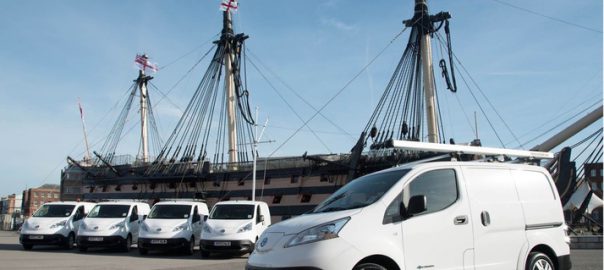
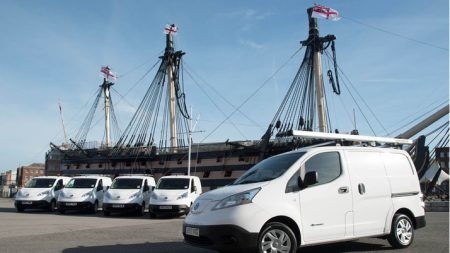
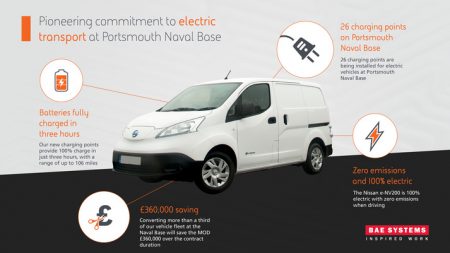
Portsmouth Naval Base will be welcoming a fleet of a different kind this week with the arrival of the first batch of 48 electric Nissan e-NV200 vans to support the Royal Navy’s operations at the base.

The electric vehicles have been ordered by BAE Systems on behalf of the Naval Base Commander as part of his commitment to investing in green energy on the naval base. The vehicles will be used by BAE Systems’ personnel to transfer stores, engineering and load-lifting equipment from warehouses within the Naval Base.

Nissan e-NV200 at Portsmouth Naval Base (image: BAE Systems)

The all-electric Nissan vans will reduce carbon dioxide emissions from the naval base’s vehicle fleet by around 40 per cent.

The agreement, which also includes 59 standard diesel vehicles, will save the Ministry of Defence (MOD) an estimated £360,000 in fuel and other costs over the duration of the contract, which runs for two years with an option to extend into a third.

To support the new electric fleet and as part of BAE Systems’ commitment to reduce emissions and increase energy efficiency across the naval base, 26 charging points and 28 designated parking bays for electric vehicles are being installed.

BAE Systems’ agreement with Nissan and fleet management specialists Lex Autolease reiterates the company’s commitment to delivering value for money. It also supports the MOD’s drive to create a more modern and energy-efficient naval base, equipped with innovative technology, fit for the 21st century.

Nissan, e-NV200. Company guide (image BAE systems)

Portsmouth Naval Base Commander, Commodore Jeremy Rigby, said:

“I am very pleased to welcome the addition of these 48 electrical cars to our fleet in the naval base. It’s great for the Royal Navy, great for Portsmouth and great for the environment.”

Read more: BAE Systems

Climate Change Impact in Africa (Image: iPhoto)

Record-breaking climate change pushes world into ‘uncharted territory’

Earth is a planet in upheaval, say scientists, as the World Meteorological Organisation publishes analysis of recent heat highs and ice lows

The record-breaking heat that made 2016 the hottest year ever recorded has continued into 2017, pushing the world into

“truly uncharted territory”,

according to the World Meteorological Organisation.

The WMO’s assessment of the climate in 2016, published on Tuesday, reports unprecedented heat across the globe, exceptionally low ice at both poles and surging sea-level rise.

Climate Change Impact in Africa (Image: iPhoto)

Global warming is largely being driven by emissions from human activities, but a strong El Niño – a natural climate cycle – added to the heat in 2016. The El Niño is now waning, but the extremes continue to be seen, with temperature records tumbling in the US in February and polar heatwaves pushing ice cover to new lows.

“Even without a strong El Niño in 2017, we are seeing other remarkable changes across the planet that are challenging the limits of our understanding of the climate system. We are now in truly uncharted territory,”

said David Carlson, director of the WMO’s world climate research programme.

“Earth is a planet in upheaval due to human-caused changes in the atmosphere,” said Jeffrey Kargel, a glaciologist at the University of Arizona in the US. “In general, drastically changing conditions do not help civilisation, which thrives on stability.”

The WMO report was “startling”, said Prof David Reay, an emissions expert at the University of Edinburgh:

“The need for concerted action on climate change has never been so stark nor the stakes so high.”

The new WMO assessment also prompted some scientists to criticise Donald Trump.

“While the data show an ever increasing impact of human activities on the climate system, the Trump administration and senior Republicans in Congress continue to bury their heads in the sand,”

said Prof Sir Robert Watson, a distinguished climate scientist at the UK’s University of East Anglia and a former head of the UN’s climate science panel.

Read more: The Guardian

Spring has sprung and it’s not just my Renault ZOE that’s smiling

Summer is on its way, the sun is shining and I’m full of energy, much like my Renault ZOE.

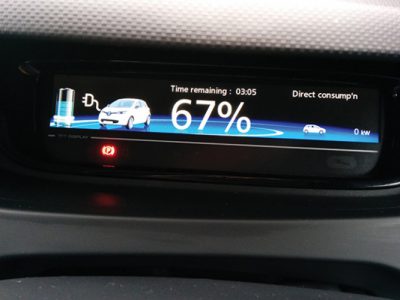
On a beautiful sunny day last week, I returned to my fully charged electric car, did my usual reset of ‘Trip B’ on the right hand stalk and looked at my estimated range – it gave me a lovely reading of 89 miles (22kWh ZOE).

Although winter range isn’t a big problem (us eco warriors are made of sterner stuff), there is something quite satisfying when you see the estimated range increase by about 15 miles, simply because it’s warm and sunny outside, and it’s still only spring.

I’m told the range increases because chemical reactions work better at higher temperatures, and obviously a chemical reaction must take place to create energy. But I quite like to imagine my Renault ZOE as a true sun worshipper, rejoicing in the change of season ?

Increase to Milton Keynes Parking Permits, Ultra-Low Vehicles remain FREE

From 1st April, and ‘only when you renew your permit’, Milton Keynes council will be increasing permit costs; but not for Ultra-Low emission Vehicles (ULEVs).

The decision was made following a public consultation on the matter that was first proposed back in December 2016.  The reason for the increase is being stated as ‘unprecedented budget cuts’, with revenue from parking permits along with parking charges and parking meters being used in other areas of the highways and transport services.

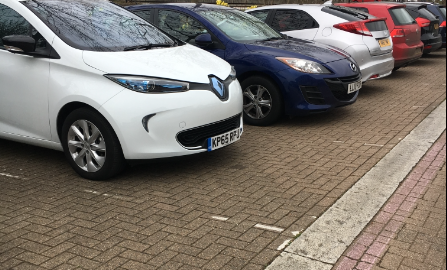
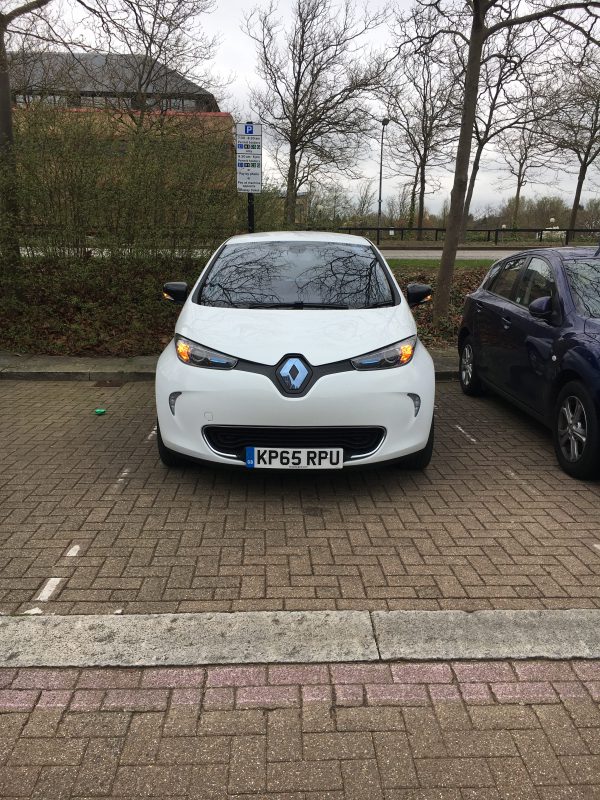
Renault Zoe, with ULEV Green Parking Permit in Milton Keynes

The good news is that all Ultra-Low Emission Vehicles (under 75g CO2 per km driven), will continue to benefit from a ‘Green Permit’ allowing Free Parking in specified areas of the city centre.

However, Low Emission Vehicles will see an increase in their ‘Green Permit’ from £0/ Free to £195 per year. Still much lower than fully fossil-fuelled cars, which will see permits costing up to £1,688 per year.

The City’s ambition to become a Go Ultra Low City is evolving. With these changes to permit costs, and the ‘EV Experience Centre’ due to open this spring, I anticipate the city will see an uptake of more electric vehicles in the city centre for regular commuters.

Milton Keynes Parking Permits can be applied for online at: Milton Keynes Council

Read about:  The Milton Keynes, Electric Vehicle (EV) Experience Centre

f

In Praise of the Ecotricity Charging Network

Last week I took a bunch of friends to a concert by the progressive rock band Haken. The round trip distance from Northampton to Nottingham was 150 miles. So, even in the new i3, I knew I would need a charge or be constrained to keep my speed low.

With a bit of Googling I settled on parking at the Victoria shopping centre as it had a charge point. On arriving we plugged in and I started a charge using an old Plugged in Midlands card.

The concert was great and Haken were in fine form. However afterwards we returned to the car to find the charge had failed. Unfortunately I hadn’t been able to monitor its progress on my smartphone as the location had no signal.

So we went to Plan B and stopped off on the way back at Donnington Services to top up on the Ecotricity rapid charger. Although we might have gotten away with just a ten minute charge, there were signs saying the M1 was closed further south so I gave it a  good 20 minutes instead.

After a coffee and a Danish we were on our way. It turned out that it wasn’t just the M1 that was shut but also the main alternative, the A5, so we had to divert a long way out via Rugby.

The i3’s range was more than up to it though and we got home with charge to spare. The trip took place after going to work earlier in the day so the i3 had done 200 miles in a day without trouble. And all for £8.70 in fuel costs (the daytime charging at work in Milton Keynes).