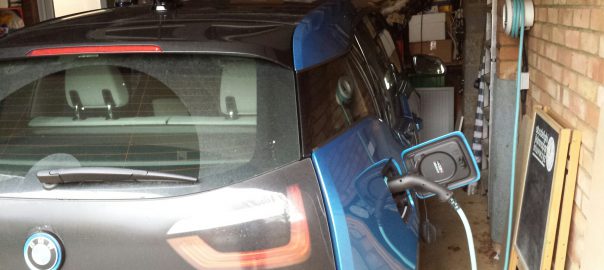
One feature of the i3 that wasn’t available on my previous Renault ZOE is the ability to change at very low powers. Of course that means charging can be very slow.
The benefit of this option, which may not be obvious, is that it means the current draw is a good match for solar panels. In other words the car can be entirely charged by solar with nothing being drawn from the grid. Free fuel!
Klaus Jacob, a German professor affiliated with Columbia’s University’s Lamont-Doherty Earth Observatory, is a geophysicist by profession and a doomsayer by disposition.
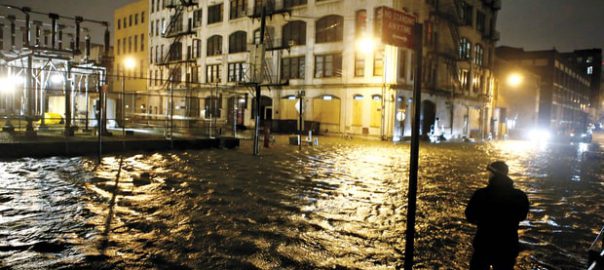
Hurricane Sandy flooded huge parts of Lower Manhattan and downtown Brooklyn (Image: J. Countess/Redux)
I’ve gotten to know him over the past few years, as I’ve sought to understand the greatest threat to life in New York as we know it. Jacob has a white beard and a ponderous accent: Imagine if Werner Herzog happened to be a renowned expert on disaster risk. Jacob believes most people live in an irrational state of “risk denial,” and he takes delight in dispelling their blissful ignorance. “If you want to survive an earthquake, don’t buy a brownstone,” he once cautioned me, citing the catastrophic potential of a long-dormant fault line that runs under the city. When Mayor Bloomberg announced nine years ago an initiative to plant a million trees, Jacob thought, That’s nice — but what about tornadoes?
For the past 15 years or so, Jacob has been primarily preoccupied with a more existential danger: the rising sea. The latest scientific findings suggest that a child born today in this island metropolis may live to see the waters around it swell by six feet, as the previously hypothetical consequences of global warming take on an escalating — and unstoppable — force. “I have made it my mission,” Jacob says, “to think long term.” The life span of a city is measured in centuries, and New York, which is approaching its fifth, probably doesn’t have another five to go, at least in any presently recognizable form. Instead, Jacob has said, the city will become a
“gradual Atlantis.”
The deluge will begin slowly, and irregularly, and so it will confound human perceptions of change. Areas that never had flash floods will start to experience them, in part because global warming will also increase precipitation. High tides will spill over old bulkheads when there is a full moon. People will start carrying galoshes to work. All the commercial skyscrapers, housing, cultural institutions that currently sit near the waterline will be forced to contend with routine inundation. And cataclysmic floods will become more common, because, to put it simply, if the baseline water level is higher, every storm surge will be that much stronger. Now, a surge of six feet has a one percent chance of happening each year — it’s what climatologists call a “100 year” storm. By 2050, if sea-level rise happens as rapidly as many scientists think it will, today’s hundred-year floods will become five times more likely, making mass destruction a once-a-generation occurrence. Like a stumbling boxer, the city will try to keep its guard up, but the sea will only gain strength.
The new BMW i3 94Ah adds more electric range to what’s arguably the most distinctive everyday electric vehicle
A battery upgrade for the BMW i3 sees range almost doubled
The BMW i3 94Ah has just had its first major upgrade since this radical all-electric model was launched two and a half years ago.
The unusual 94Ah name refers to the car’s brand new lithium ion battery pack, which allows the i3 to travel longer distances between charges. Mounted under the cabin floor, the new battery is the same physical size as the original i3’s battery, which means there’s no reduction in boot space, but the energy density of the unit has been improved by 50% to 33kWh.
What’s the 2016 BMW i3 94Ah like to drive?
The biggest change you’ll notice when driving the new i3 is the extra range. Although the official EU testing regime rates the new i3 as having a 195-mile range, even BMW acknowledges this is not indicative of its real-world capability.
Instead, it claims the 94Ah has a realistic range of 124 miles, a figure that can even be achieved in more extreme weather conditions. Electric vehicles usually suffer a range reduction in cold, winter weather, when the car’s heating and headlights are in use. Summer range can also suffer if the energy-hungry air-con is being used. However, BMW promises the i3 will deliver that 124-mile range whatever the weather.
Evolt, the SWARCO Group’s eMobility brand, has been selected to provide its smart electric vehicle (EV) chargers for Electric Nation, a nationwide trial that is seeking to better understand the demand and impact that ‘at-home charging’ places on the local power distribution networks.
Greater demand is being placed on power networks as the take up of EVs widens, EV battery sizes increase, and charging times get faster. This demand is particularly noticeable when EVs in the same local network are charging simultaneously.
The Electric Nation project aims to implement a prototype smart charging solution that will better manage power distribution at a local level at peak times.
Evolt, which is a brand of the SWARCO Group, is providing its smart charging unit to 50% of the 500 – 700 members of the public that are being recruited for Electric Nation.
Its units will be subsidised by OLEV* and Western Power Distribution (WPD), which is funding the project. Initially, the project will take place within the bounds of WPD (the South West, South Wales, and the Midlands), but has the ability to be rolled out nationally.
A previous project, My Electric Avenue (which was smaller in scale and used only one type of EV and charger), found that 32% of the UK’s supply cables would require upgrading when 40% – 70% of a network’s customers have EVs. This is estimated to cost £2.2 billion. Electric Nation is now trialling a smart charging solution that monitors the level of power going to many different makes and models of EV via a variety of charge points; in effect managing the distribution of power at a local level.
“Electric Nation’s scope is far broader than the previous My Electric Avenue project, and is the world’s largest trial of its kind,”
says Gill Nowell, Senior Consultant – Smart Interventions at EA Technology, which is responsible for developing the demand control technology, as well as the customer research, marketing and learning dissemination for the project.
“Evolt’s capability to provide smart chargers that stream information via the cloud was key to its selection,” she adds. “It also provides well-known, easy to use and reliable products that are installed throughout the length and breadth of the UK. Having proven systems that are trustworthy was also a central aspect to its selection.”
Justin Meyer, General Manager of Evolt, says the EV industry is constantly adapting:
“We need to ensure that our local power distribution networks can cope with the increasing demands of EV charging,” he says. “We know that when everyone charges at the same time there is increased pressure on the grid. But by working together we can find the right way of optimising the grid’s availability and protect the future of EV charging as demand continues to rise.”
Electric Nation is the customer-facing brand of CarConnect, a WPD and Network Innovation Allowance funded project. WPD’s collaboration partners in the project are EA Technology, DriveElectric, Lucy Electric GridKey and TRL.
Scientists’ warnings that the rise of the sea would eventually imperil the United States’ coastline are no longer theoretical
NORFOLK, Va. — Huge vertical rulers are sprouting beside low spots in the streets here, so people can judge if the tidal floods that increasingly inundate their roads are too deep to drive through.
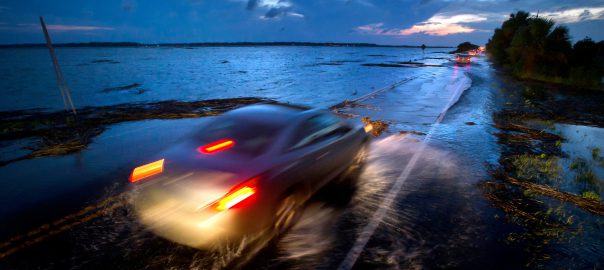
Highway 80, the only road to Tybee Island, Ga., in June. High tides are forcing the road to close several times a year (Image: S. Morton/New York Times)
Five hundred miles down the Atlantic Coast, the only road to Tybee Island, Ga., is disappearing beneath the sea several times a year, cutting the town off from the mainland.
And another 500 miles on, in Fort Lauderdale, Fla., increased tidal flooding is forcing the city to spend millions fixing battered roads and drains — and, at times, to send out giant vacuum trucks to suck saltwater off the streets.
For decades, as the global warming created by human emissions caused land ice to melt and ocean water to expand, scientists warned that the accelerating rise of the sea would eventually imperil the United States’ coastline.
Now, those warnings are no longer theoretical: The inundation of the coast has begun. The sea has crept up to the point that a high tide and a brisk wind are all it takes to send water pouring into streets and homes.
Federal scientists have documented a sharp jump in this nuisance flooding — often called “sunny-day flooding” — along both the East Coast and the Gulf Coast in recent years. The sea is now so near the brim in many places that they believe the problem is likely to worsen quickly. Shifts in the Pacific Ocean mean that the West Coast, partly spared over the past two decades, may be hit hard, too.
These tidal floods are often just a foot or two deep, but they can stop traffic, swamp basements, damage cars, kill lawns and forests, and poison wells with salt. Moreover, the high seas interfere with the drainage of storm water.
In coastal regions, that compounds the damage from the increasingly heavy rains plaguing the country, like those that recently caused extensive flooding in Louisiana. Scientists say these rains are also a consequence of human greenhouse emissions.
“Once impacts become noticeable, they’re going to be upon you quickly,”
said William V. Sweet, a scientist with the National Oceanic and Atmospheric Administration in Silver Spring, Md., who is among the leaders in research on coastal inundation.
MPs warn that the uptake of ultra-low emission vehicles is too low to meet national climate change targets
The government target is for electric cars to make up 9% of the fleet by 2020 (Image: S. Lee/Guardian)
The government is falling behind on its commitments to switch a proportion of Britain’s car fleet to electric vehicles, an influential committee of MPs said on Thursday.
Take-up of electric vehicles has been slower than hoped in the UK, but the technology is essential to reducing greenhouse gas emissions from transport, and tackling the air pollution produced by the increased number of diesel cars on the road.
According to the guideline target recommended by the government’s climate advisors, ultra-low emission vehicles such as electric cars should make up 9% of the fleet by 2020, but current forecasts by the Department for Transport (DfT) show the figure by the end of the decade is likely to be about half that. Ministers have not said what should happen if the target is not met, nor produced a plan for beyond 2020.
Parliament’s environmental audit committee said ministers were failing to put forward the incentives and infrastructure needed to encourage drivers into electric cars, while air pollution was breaching regulations, with 38 of 43 clean air zones exceeding acceptable levels of nitrogen oxides.
In addition, the committee said the lessons of the Volkswagen emissions scandal, in which the manufacturer was found to have cheated on tests to make vehicles seem greener than they really were, had not been learned. Affected models were only starting to be withdrawn from the market, the MPs were told.
Mary Creagh, chairwoman of the committee, said:
“The uptake of ultra-low emission vehicles is too low to meet the UK’s climate change targets at the lowest cost to the public. Air quality targets that were supposed to be met in 2010 won’t be hit until 2020 at the earliest. And it’s been almost a year since we discovered VW had fitted cars with cheat devices, but the government has still to decide what action to take against the company.”
Evolt, the Electric Vehicle (EV) charge point supplier, has assisted Comhairle nan Eilean Siar (Western Isles Council) in creating a north-south EV charging network throughout the islands of the Outer Hebrides.
A total of 11 charge points have been strategically positioned on the Isles of Lewis and Harris, North Uist, South Uist and Barra, which make up the majority of the Council’s remit. The new network adds to the existing Evolt charge points procured and installed at the ferry ports throughout the Western Isles.
The news also follows Evolt’s selection as one of the Energy Saving Trust’s EV charge point suppliers on a Scotland-wide framework agreement.
A Spokesperson at Comhairle nan Eilean Siar explains the charge point infrastructure project was completed in three phases, and Evolt were appointed the successful tenderer to supply its equipment:
“It has proven to be an good and reliable supplier, and we have had minimal operational issues with the equipment, which bearing in mind our extreme weather conditions and harsh environment, is impressive.”
Three top-of-the-range Rapid chargers that can efficiently charge two EVs to 80% of their battery life within 30 minutes through a 50Kw AC and 43Kw DC outlet have been installed at key locations throughout the region. These are supplemented by three 22kW Fast chargers that are ideal for quick ‘top ups’, have AC and DC capability, and take one hour to simultaneously charge two EVs; and five 7kW Street chargers that complete the Islands’ north-south network.
“The charging infrastructure has contributed to our environmental agenda and is an enabler of sustainable tourism,” the Spokesperson adds. “A car club is also being set up by an independent enterprise for residents and businesses to hire EVs.
“Further strategically placed charging units are proposed for the future to increase accessibility to some of our prime tourist locations, however there can be limitations to installations based on the capacity of the electricity network in the area,” the Spokesperson concludes.
Justin Meyer, General Manager for Evolt, emphasises EVs and charge points appeal to both rural and urban environments:
“It’s a testament to the reliability and durability of our systems that they continue to effectively charge EVs even in the most testing conditions.”
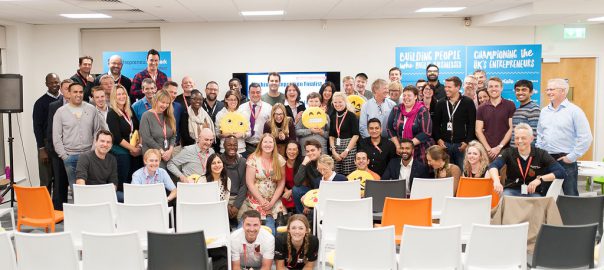
We are now halfway through the Entrepreneurial Spark programme for start-ups that we embarked on in August. Fuel Included is in the ‘Hatchery’ in Milton Keynes.
Entrepreneurial Spark #GoDoAcceler8 event in Millton Keynes (Image: CO Photo Design)
This week saw the halfway point marked by a series of programs known as #GoDoAcceler8. We had presentations during the day on skills for start-up entrepreneurs, followed by an awards evening. A good time was had by all!
Hard not to put this at the top of the list for new elecrtric cars. An excellent machine, very sophisticated and cheaper than a 30kWh Nissan Leaf.
Hopefully this time I’ve put a lot of information in the episode. Enjoy.