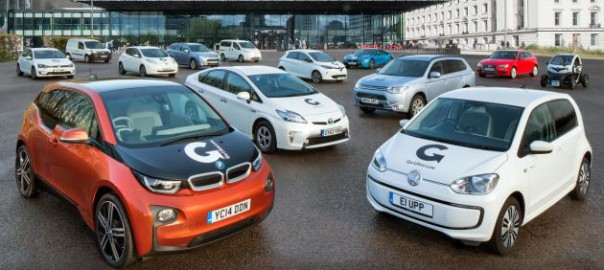
Alex L. Dykes from the Alex on Autos channel released an in-depth review of Volkswagen e-Golf.
If you’re considering the e-Golf among other EVs and have a spare 25 minutes, this is the review you should check out.
Presentation includes exterior, engine motor, charging options, seats, interior, infotainment, cargo area capacity, drive including regenerative braking, comfort and price. The detailed review will appeal especially to the customers new to the EV world.
In the summary, Alex compares some of the features and prices of the e-Golf to the Nissan LEAF and Kia Soul EV. As always, every car has its strong and weak points, so you must decide which needs are most important for you.
A record number of UK car buyers are opting to reduce their fuel bills by choosing ultra-low emission vehicles (ULEVs), according to research by Go Ultra Low.
The latest registration figures from the Society of Motor Manufacturers and Traders (SMMT) reveal that more than 41% of all alternatively-fuelled cars registered in the first quarter of 2015 qualified for the government’s plug-in car grant, up from 13% over the same period in 2014.
Ultra-low emission registrations up 386% on first quarter of 2014 (Image: OLEV)
In the first quarter of 2015, 8,573 passenger vehicles with CO2 emissions lower than 75g/km were registered, a year-on-year increase of 386%, as more drivers saw ULEVs as great alternatives to traditionally-fuelled cars. The most popular choice was the Mitsubishi Outlander PHEV, followed by the Nissan LEAF and BMW i3.
Business operators are benefiting too, with those seeking lower maintenance fees and tax rates, plus the potential for reduced whole-life running costs, contributing to a 421% increase in fleet and business ULEV volumes in the quarter.
Businesses running commercial vehicles also showed signs of increasing adoption of electric vans, with volumes up 263 units on January-March 2014 – a growth rate of 353%.
Hetal Shah, Head of Go Ultra Low, said: “The latest plug-in vehicle uptake figures prove that ultra-low emission cars and vans make sense for both private and business users, especially with the potential for fuel costs as low as 2p a mile and reduced whole life running costs.”
Thanks to CO2 emissions of less than 75g/km, all ULEVs are exempt from car tax. Other advantages such as typical annual fuel savings of £660 per vehicle, a nationwide network of recharging points and no congestion charge to pay in London have helped accelerate uptake over the past five years.
The latest registration figures show that car buyers in the South are most likely to opt for an ultra-low emission vehicle, followed by Londoners and the east of the country.
Yorkshire and the North West complete the list of top five regions. The figures also show that car buyers in East Yorkshire are least likely to choose an ultra-low emission option.
With an increasing choice of models qualifying for the £5,000 plug-in grant, the government is well on the way to hitting its aim for ULEVs to make up 5% of all new registrations by 2020.
Most popular ultra-low emissions vehicles
1. Mitsubishi Outlander PHEV
2. Nissan LEAF
3. BMW i3
4. Renault ZOE
5. BMW i8
Regions where ultra-low emissions vehicles are most popular
1. South
2. London
3. East
4. West Midlands
5. North West
Regions where ultra-low emissions vehicles are least popular
1. East Yorkshire / Lincolnshire
2. Northern Ireland
3. West
4. South East
5. East Midlands
The concern: EV’s take a long time to charge don’t they?
When I meet someone new to electric vehicles, the first two questions about them are usually “How far can EVs go?” quickly followed by “How long does it take to charge?” The response most want to hear is “1000 miles” and “Blink and it’s done”.
Concerns with charging time are the product of a mind-set that comes from driving cars with internal combustion engines; you drive around until near empty, de-tour to a petrol station, swiftly slake your vehicle’s unyielding thirst for explosive hydrocarbon and continue onwards. It’s because of this that people can be a little sceptical when it comes to matters of re-charging. To make my point I usually offer the sceptic the worst case scenario; “a Nissan LEAF has a real world range of about 80 miles and could take up to 10 hours to charge from a 13A socket” and watch them fall about laughing. For a bit anyway…
When trying to convince a sceptic some might try and point out that faster charge times are possible with rapid chargers but not only is this still not as fast and thus “good” as a petrol pump, it is fighting the wrong fight.
Why it doesn’t matter: Your car can charge when it’s stopped, which is most of the time.
BP’s shareholders overwhelmingly supported a resolution on Thursday that would force the company to disclose some of its climate change-related risks. The shareholder vote was extraordinarily lopsided, with about 98% of shareholders approving the resolution, which had the backing of BP’s chairman, Carl-Henric Svanberg.
The embrace of the climate change resolution is being called a watershed event in the history of climate-related shareholder resolutions, which investors large and small have been pursuing since 1999 to try to encourage oil, coal and gas companies to inform shareholders of their climate change-related risks and shift their investments into renewable sources of energy.
Previously, companies from Exxon to BP have spurned such resolutions.
Climate March poster on the London Underground (Image: T. Larkum)
The risks that global warming poses to the business models of companies like BP are clearer now than ever before. Scientists are warning that in order to avoid the worst consequences of global warming, much of big oil’s fuel reserves, which these companies value so highly, would need to be left in the ground, rather than burned to create energy.
The BP vote and support of a similar resolution at Shell show that climate change has moved beyond the world of socially-responsible investing and into the mainstream, says Shanna Cleveland, a senior manager at Ceres, which advocates for more sustainable business practices and open disclosure of climate-related risks to investors, among other goals.
In an interview with Mashable, Cleveland called the BP vote:
“A sea change in the type of support and voting that we’ve ever seen in a climate-related resolution.”
“That is unprecedented… to have a fossil fuel company to actually come out and support a climate-related resolution has not happened before to have a fossil fuel company to actually come out and support a climate-related resolution has not happened before,” she said.
The resolution was filed by a coalition of shareowners in the U.S. and the UK, including the California Public Employees’ Retirement System (CalPERS). It asks BP to report on the risks and opportunities associated with climate change through routine annual disclosures, including ongoing emissions management at company facilities, preparation for the effects of global warming and low carbon research and development strategies and investments.
“What happened today I would classify it as historic, not only passing but getting that number of votes,” Cleveland said.
On Friday, a separate coalition of investors coordinated through Ceres is planning to ask the SEC to strengthen disclosure requirements from U.S.-based fossil fuel companies.
In the past few weeks, there’s been a battery of new studies on batteries. Not the kind in your cellphone, but a much more revolutionary make – the kind that is already powering many cars, and that might someday help power your home.
A recent study in Energy Policy, for instance, found that the cost of batteries for home systems (to store the energy collected by rooftop solar panels) is starting to decline – although even with these systems, it probably won’t be economically optimal for most people to ditch the grid entirely. Another report by the Rocky Mountain Institute similarly found that within 10 to 15 years in some places, the most economical choice for home energy could be a solar plus battery system, meaning that there could be a great deal of “load defection” from the traditional electricity grid.
Finally, a new study in Nature Climate Change documented that there has been a steep decline in the cost of lithium ion batteries for electric vehicles like Teslas – 14 percent per year plunge since 2007.
All of which is being hailed as pretty revolutionary. “Solar-plus-batteries is set to begin a dramatic transformation of human civilization,” wrote Bloomberg commentator Noah Smith recently, commenting not only on the declining price of batteries for electric vehicles, but also the potential for more batteries in homes.
Construction on the Tesla Motors Gigafactory east of Reno, Nev., March 25, 2015 (Image: D Calvert/Washington Post)
But there’s a need for caution. People with home battery systems paired with solar panels certainly exist, but are quite rare for the moment. One problem is that right now, there just aren’t many ways to make a home energy storage system investment pay off.
So why do some analysts nonetheless think that solar plus battery systems could become quite prevalent in homes, and maybe sooner than we think?