A large cargo vessel carrying cars has sunk in the Atlantic Ocean, thirteen days after a fire broke out on board.
The ship’s manager and Portuguese navy confirmed on Tuesday that the Felicity Ace sank around 400 kilometres off the Azores.
The Panama-flagged vessel was being towed after a salvage team had extinguished the fire, MOL Ship Management in Singapore said in a statement.
The view from our hotel window in Falmouth, ZOE in foreground (Image: T. Larkum)
The 200-metre-long vessel had been sailing from Germany to the United States before it caught fire last month. Portugal’s Air Force had evacuated the 22 crew members, before letting the ship drift for several days in the mid-Atlantic.
Ocean-going tugboats with firefighting equipment had been hosing down the ship’s hull to cool it.
It was not clear how many luxury cars were onboard, but vessels of the Felicity Ace’s size can carry at least 4,000 vehicles.The ship was transporting electric and non-electric vehicles, according to Portuguese authorities.
Authorities suspect the fire may have broken out due to the lithium batteries used in electric vehicles, but an investigation into the cause of the blaze is still underway.
The Portuguese navy confirmed the sinking of the Felicity Ace, saying it occurred outside Portuguese waters.
There were also concerns that the sunken vessel could pollute the ocean, given that it had been carrying 2,000 metric tons of both fuel and oil.
The Portuguese navy said in a statement that only a few pieces of wreckage and a small patch of oil was visible where the ship went down. The tugboats were breaking up the patch with hoses, it added.
A Portuguese Air Force plane and a Portuguese navy vessel will remain at the scene on the lookout for signs of pollution.
If you would like to know more about Solar Panels and the PowerBanx range of home battery systems, and get a free instant quote, please complete our online form:
Renault’s new 100%-electric Mégane E-Tech is the French company’s non-hedged bet it can convince drivers they’ve nothing to lose in swapping their traditional ICE rides for modern a EV – and gain considerable performance, cost, and flair advantages in the bargain. A day test driving the car on the roads of southern Spain suggests the company stands a good chance of winning that wager and setting some standards for European EV development as it does.
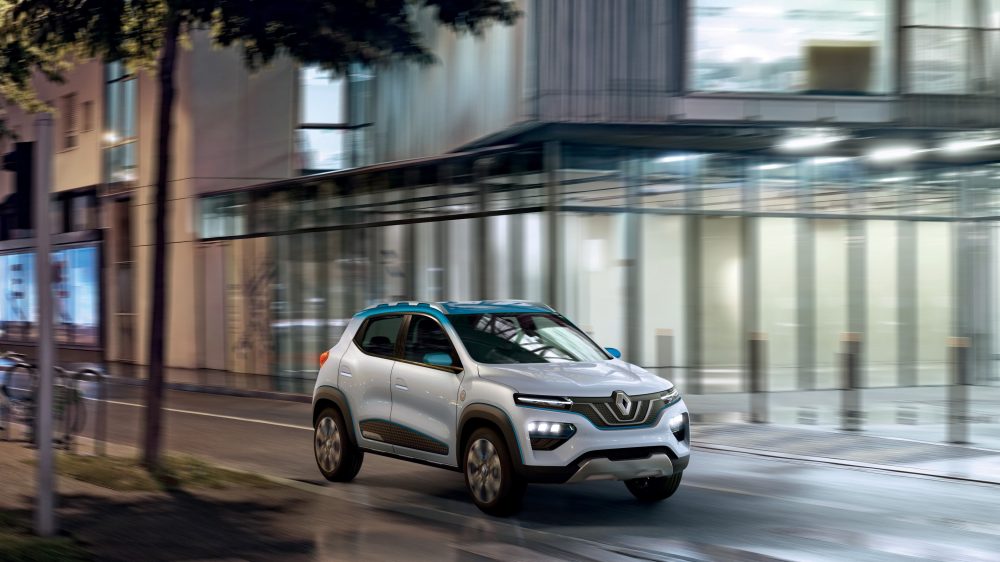
Renault electric SUV (Image: Auto Express/Playback)
Renault is in no way a newcomer to electric vehicles, having sold over 400,000 EVs since the 2012 rollout of its Zoe e-compact. Yet the Mégane E-Tech represents a veritable milestone in several ways. For starters, it’s the first battery-powered vehicle built using the firm’s common module family (CMF) platform, meaning it will inevitably influence later models. And while Renault is adamant the car is positioned to enter Europe’s C-segment at the top of the family hatchback class, its design, spaciousness, and operating chops may well convince some cross-over and the occasional SUV shoppers to reconsider their plans.
Indeed, as Renault staffers acknowledged when asked, the Mégane E-Tech is playing to several kinds of drivers and expectations at once. Conceived to provide the sound, solid, and powerful performance of a German-engineered car – rival Volkswagen ID.4, for example – Renault’s showcase EV is also an unabashed demonstration of French seductive flair. Its innovative design, stylish flourishes, myriad creature comforts, and various features play as much to the eye and heart as its emissions-free, sustainable, efficiently manufactured hardware and tech appeal to pragmatic buyer demands.
And it does so under the name of Renault’s most popular and recognizable Mégane model – but with everything in, on, or about it completely new and different.
If you would like to know more about Solar Panels and the PowerBanx range of home battery systems, and get a free instant quote, please complete our online form:
We purchased it secondhand just over five years ago. It’s a Nissan Leaf. All electric.
We purchased it in the days when people used to say ‘we haven’t got the infrastructure’ or ‘where are we going to get all the energy from?’ or ‘they don’t have the range’.
I let the wife conduct the research, just so she could build up her range anxiety until we saw an affordable great little car on sale from Stebbings on Hardwick Narrows.
Since we have had the car we have never used a public charge point, of which there are six times as many as there are petrol pumps in the UK and growing by around 200 a week on top of the hundreds of home chargers installed daily. No, we just use the ‘granny charger’ which is basically a three-pin plug charger, like your mobile phone. It uses about half the energy a kettle uses and stays on for an hour here and an hour there to keep us topped up.
A showroom tour of a Nissan Leaf (Image: T. Larkum)
Go out, come home, plug in. That’s all there is to it and for over five years, that’s my knowledge of electric cars.
Oh, you need to put washer fluid in for the windscreen and air in the tyres every now and then, but that’s it.
If you would like to know more about Solar Panels and the PowerBanx range of home battery systems, and get a free instant quote, please complete our online form:
GRIDSERVE and Moto have opened a first high-powered electric vehicle charging hub in Wales, the first in the country according to the companies, as they continue their UK wide rollout of sites.
The Electric Hub is located in Swansea and features six 350kW electric vehicle (EV) chargers with contactless payment. It forms part of the GRIDSERVE Electric Highway, and has the possibility to add six more EV chargers when requested and GRIDSERVE said all chargers will be powered with clean energy, through their own solar farms.
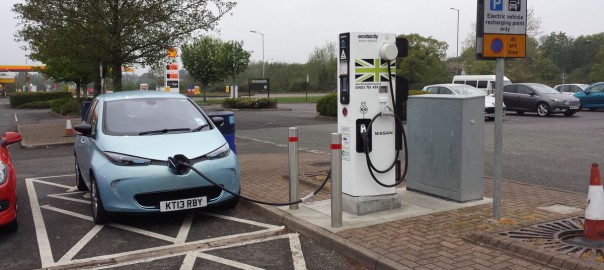
Charging Station in Sunderland (Image: Fastned)
“This is a landmark project for GRIDSERVE and Moto and the first high-power charging facility of its kind for Wales. We’re really excited to be demonstrating that all parts of the UK should be able to embrace the EV revolution,” said Toddington Harper, CEO of GRIDSERVE.
“We cannot let a lack of infrastructure prevent drivers from realising the myriad of benefits that come with driving an electric vehicle. This project will help deliver the confidence for more people to make the switch to EVs, as well as support the growing number of people who already have.”
Harper added that Swansea’s Electric Hub is the first of many projects they are considering across Wales. Last year GRIDSERVE’s announced over 20 Electric Hubs, which are due to open across UK’s motorway services by the end of Q2 2022.
If you would like to know more about Solar Panels and the PowerBanx range of home battery systems, and get a free instant quote, please complete our online form:
With much of the UK today being battered by Storm Eunice, sparking the strongest wind on record in the south to massive snowfall in the north, a number of households are already experiencing power cuts, with more predicted for the weekend.
For those suffering this unfortunately consequence, if they have one of the latest Korean electric cars on their driveway they will be able to keep their home appliances running for days.
That’s because the £37,500 Hyundai Ioniq 5 and £41,000 Kia EV6 boast a feature that turns the vehicles into mobile power stations that can charge laptops, power a fridge or even watch TV for hours on end.
Charging at Cherwell (Image: T. Heale)
The electric SUVs both have something called ‘Vehicle-to-load’ (V2L) technology, which consists of a three-pin adapter that plugs into the cars’ charging sockets to take electricity directly from the lithium-ion battery so you can boil a kettle even when your house has no power.
While electric cars are undeniably expensive to buy and certainly not to all tastes, they offer one big benefit to owners if there are power cuts and blackouts for prolonged periods.
The sister Korean brands have developed ‘built-in bi-directional chargers’ that can take electricity away from the lithium-ion batteries as well as send it to them – tech that’s expected to feature on most new electric models.
Bi-directional systems are designed to allow plug-in vehicles to send electricity stored in their batteries back to the grid (vehicle-to-grid, or V2G), which can be financially lucrative for owners who charge at the cheapest off-peak times and sell that electricity back to the network during the most expensive in-demand hours.
If you would like to know more about Solar Panels and the PowerBanx range of home battery systems, and get a free instant quote, please complete our online form:
Though only 12% of new sales were zero-exhaust electric vehicles, emissions fell by 11.2% in 2021
Topping up at Tiverton (Image: T. Larkum)
The carbon dioxide emissions of new cars sold in the UK dropped to the lowest level ever in 2021 thanks to the unprecedented surge in electric vehicle sales, industry data suggests.
Average new car CO2 emissions fell by 11.2%, to 119.7g for every kilometre driven, according to the Society of Motor Manufacturers and Traders (SMMT), a lobby group.
Battery electric vehicles accounted for only 12% of UK sales during 2021, but they rapidly drag down the figures because they produce zero exhaust emissions. Increased sales of hybrids, which include a battery alongside an internal combustion engine, also contributed to the fall in emissions, which was previously stymied in recent years by the rise of sales in higher-emission sports utility vehicles (SUVs).
In 2021, the SMMT reported a 38% drop in average new car emissions since 2000, although those data were produced under a different test methodology so are not directly comparable.
Car sales data for January, also published on Friday, showed that the number of battery electric cars more than doubled year on year to 14,400, accounting for 12.5% of cars sold
‘Ambitious’ UK plans for electric vehicles welcomed – with reservations
Read more
Total new car sales rose by 27.5% year on year in January, although that was compared with January 2021 when the UK was in a strict lockdown and car showrooms were closed. The industry reported that sales were still limited by the months-long shortage of computer chips that has forced carmakers to favour key vehicles, including electric cars – which are vital for meeting emissions legislation.
Mike Hawes, the SMMT’s chief executive, said: “Once again it is electrified vehicles that are driving the growth, despite the ongoing headwinds of chip shortages, rising inflation and the cost-of-living squeeze.
If you would like to know more about Solar Panels and the PowerBanx range of home battery systems, and get a free instant quote, please complete our online form:
Being named overall What Car? Car of the Year is the highest honour a new model can receive…
Choose any of our 2022 award winners and you’ll be getting an absolutely fantastic car that’s better than all of its direct rivals. However, the overall Car of the Year award is reserved for the model that has moved things on the farthest in the past 12 months. And this year, that’s the Kia EV6.
The electric car market is a particularly exciting one at the moment; sales are booming, prompting all of the major manufacturers to respond by launching new models. But the great news for car buyers is that the heat of competition has inspired car makers to really up their games, and none has done more so than Kia.
or starters, the EV6 combines a huge real-world range with the ability to charge at speeds that even some Teslas can’t keep up with, addressing two of the biggest concerns that people still have about electric cars.
Kia Ceed Sportwagon PHEV and XCeed PHEV (Image: Kia)
What’s more, by basing the EV6 on bespoke electric underpinnings rather than a set that’s shared by petrol and diesel models, Kia has been able to take advantage of the compact size of electric motors and produce a car that’s hugely spacious and practical.
If you would like to know more about Solar Panels and the PowerBanx range of home battery systems, and get a free instant quote, please complete our online form:
The all-electric Renault Zoe hatchback is only the third car in history to receive zero stars from Euro NCAP, despite the previous model scoring top marks
The Renault Zoe has become only the third car in Euro NCAP history to be awarded zero stars for crash safety. The previous version of the popular electric hatchback received a five-star rating in 2013, but thanks to more stringent safety tests and the omission of certain safety features, the latest model scored poorly.
2020 Renault Zoe (Image: Renault)
The Zoe didn’t fare well in the frontal offset crash test, with Euro NCAP citing poor protection of the driver’s chest area. It performed worse in the side pole test, however, which simulates hitting a tree or lamppost side-on. According to Euro NCAP, a third of these accidents are serious or fatal, and the pole struck the test dummy’s head when testing the Zoe.
A key factor in the Zoe’s poor performance is the removal of a head airbag, which protects occupants from side impacts. Renault introduced this type of airbag in 2001 with the Laguna 2, which became the first car to achieve a five-star Euro NCAP rating. The Zoe’s 43% adult occupant safety score is the lowest in the past 11 years of testing.
If you would like to know more about Solar Panels and the PowerBanx range of home battery systems, and get a free instant quote, please complete our online form:
West Sussex County Council takes delivery of four 100 percent electric Renault ZOE
Vehicles will be used as pool cars and form part of the council’s drive to reduce emissions
Local authority was convinced by the ZOE’s class-leading real-world range of 174 miles
All-electric Renault ZOE priced from £18,420 OTR (after PiCG, plus battery rental)
Renault continues to be the best-selling manufacturer of all-electric vehicles in Europe
West Sussex County Council has become the latest in a long line of public sector organisations to take its first steps into electric motoring with the 100 per cent electric Renault ZOE.
The local authority has added four ZOE Q90 Dynamique Nav models with the Z.E.40 battery to its 530-strong fleet – its first pure EV cars – after being convinced by the model’s 174-mile estimated real world range.
West Sussex Council Fleet Goes Electric With Renault ZOE (Image: Renault)
Based at County Hall in Chichester, the models are already in service as pool cars, helping the council reduce emissions by tackling grey fleet car use and cut costs by offering staff an alternative to using their own vehicles.
Already, the vehicles are proving extremely popular and are booked out everyday. Between them, the vehicles will complete several thousand journeys per year, allowing users to travel from council HQ to points as far afield as Crawley and Shoreham and back on a single charge.
Loretta Haddow, Team Leader – Fleet Resource and Support, at West Sussex County Council, said:
“We have had electric vehicles on trial and extended demos before and must have looked at every model out there but they have never been quite right for us.
“But the latest ZOE was the game changer for us and the extended range made it a viable option for the first time.
“We are really pleased that the ZOE is able to get across the county and back and we wanted to give everyone who’s going to take one of these cars the confidence to know that wherever they’re going to go they’re going to get back again.
“Since going into service we’ve been really impressed with how easy and relaxing they are to drive. The team love them. They’re really popular.”
Haddow added:
“While range and emissions were the biggest factors for us, as a public sector organisation we still have to present a compelling business case before adding new vehicles to our fleet. In this case, the ZOE ticked all the boxes in terms of whole life costs.”
Ben Fletcher, Head of Z.E., Renault UK said:
“We are delighted to have supplied four Renault ZOE to West Sussex County Council. The ZOE provides low running costs with no emissions as well as a relaxing environment. This is proof of another public sector body recognising the business and environmental benefits of adopting the Renault ZOE.”
ZOE is the best-selling electric car in Europe with more than 100,000 ZOE sold since launching in 2013 with over 6,000 in the UK. ZOE is one of three models in Renault’s diverse electric vehicle range which also includes the Twizy quadricycle, the Kangoo Van Z.E., Europe’s best selling electric van, and the forthcoming Master Z.E. large panel van.
The Renault ZOE is available in a choice of two trim levels, Dynamique Nav and Signature Nav, both of which come with the new R110 electric motor, combining extra power with driving enjoyment and the Z.E 40 battery that provides a 174-mile real world range. For customers more likely to use public rapid chargers whilst travelling longer distances, the Q90 option is available with both trim levels. This charges the ZOE from 0-80 per cent full in just over an hour when using a 43kW charge point. The MY18 ZOE Q90 with Z.E.40 battery provides an estimated real-world range of 174 miles.
The Dynamique Nav offers a comprehensive specification, which combines comfort with convenience, safety and security. Standard features include Hands Free keycard, automatic lights and wipers, rear parking sensors, cruise control, climate control, 7-inch R-Link infotainment system with voice-controlled TomTom sat nav, electric windows and LED Daytime Running Lights. The top-of-the-range Signature Nav adds further luxury with features such as supple premium leather upholstery, BOSE® audio system, heated front seats, electrically folding door mirrors and a rear parking camera. Renault’s Range OptimiZer technology ensures ZOE is highly efficient with its heat pump, a bi-modal braking system and Michelin ENERGY E-V tyres.
ZOE continues to be available to purchase in two ways. First, under a battery hire scheme, where ZOE pricing starts at £18,420 (OTR) after the Government Plug-in Car Grant, with battery leasing from £59 per month. It is easy to purchase a used ZOE with a battery lease – the new owner simply chooses which leasing option suits their needs the best and starts monthly payments based on their lease plan. You can also buy the ZOE outright. ZOE i ‘full purchase’ models start from £24,020 (OTR) after the Government Plug-in Car Grant, giving the buyer full ownership of the battery with no monthly battery lease payments.
A new real-world test for diesel vehicles will begin later this week to more accurately measure emissions of vehicles sold in Britain.
Starting from 1 September, tested cars will be driven on urban and rural roads as well as motorways, with measuring equipment placed on their exhaust system.
The evaluation, which replaces current lab-based tests, will last 90 minutes and focus on cars due to reach market in Britain in the coming months. From 1 September 2019, all existing cars on sale will also be retested with this new system.
Government estimates suggest the stricter tests, rolled out as part of European-wide reforms following the Volkswagen Dieselgate scandal, will help to cut nitrogen oxide emissions from new diesel vehicles by two-thirds.
The Government claims that this reduction will be possible because where some cars were shown to have performed better in the lab than in real life, now they will have to conform to emissions limits in public – something that will force manufacturers to produce even cleaner powertrains.
A diesel-testing programme last year found that several Euro 6 diesel cars were emitting around six times more nitrogen dioxide in the real world than in the lab.
Certain models, such as those caught up in Dieselgate, were engineered to perform better in lab conditions, therefore deliberately skewing their CO2 and NOx outputs in order to be categorised as lower-emitting vehicles. Others saw rises in emissions after 20 minutes – the duration of the lab test process.
Transport Minister Paul Maynard said the new testing structure came as part of broader ambitions to improve air quality in Britain. From 2020, councils will be given power to enforce tougher restrictions on the highest polluters of nitrogen oxide.
“We are taking strong action to clean up our air and these tough new emissions standards will reduce dangerous pollutants,” he said. “This will ensure all vehicles meet rigorous standards when driven on our roads – and we are going even further by tightening requirements again in 2020.”
Earlier this year, the UK Government revealed plans to ban the sale of pure combustion engine cars from 2040. Some critics, including Aston Martin CEO Andy Palmer, believe the legislation will have little impact, because the market is naturally heading in this direction.