
With the UK planning to ban petrol and diesel cars and vans in 2040 we asked you what it’s like to drive the vehicle of the future.
Amid fears that rising levels of nitrogen oxides pose a major risk to public health, Britain plans to ban all new petrol and diesel cars and vans from 2040. As part of the government’s much-anticipated clean air plan it has said the move is needed because of the unnecessary and avoidable impact that poor air quality was having on people’s health.
With the inevitable demise of diesel and petrol vehicles we asked electric car drivers to tell us what it’s like to drive one, and why they are the future.
Christine Burns, 64, retired, Manchester: ‘The UK government’s policy isn’t really a policy – the market will get there before’
Drives a Nissan Leaf

In an electric car you glide around in virtual silence like a limousine, but it can also out-accelerate the boy racers at the traffic lights! A scheme where I live in Manchester, means I only have to pay £20 a year to have free access to chargers across the city. There are almost a dozen kerbside and car park chargers inside a 1-2 mile radius of my home, plus I can charge from empty to full in around four hours for less than £3 on domestic electricity.
Benefits of electric cars include a low-cost mileage, no road tax, no congestion charge and low servicing costs. They’re also easy to drive with just one pedal, and there’s no smelly flammable refuelling involved. People tend to be curious when they find out I have an electric car and want to know more especially as there are a lot of myths like low acceleration. However, charging infrastructure could definitely be improved in the UK.
The UK government’s policy isn’t really a policy. Saying you’ll ban internal combustion engine car sales in 23 years from now doesn’t make sense, as the market will get there long before that. Norway plan the same by 2025 so why can’t we?
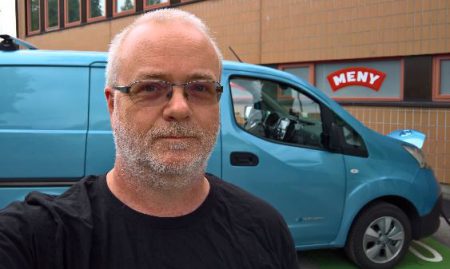
Øivind Johansen, 52, craftsman, Vestfold, Norway: ‘Electricity is much cheaper’
Drives a Nissan Leaf and e-NV200

It’s beautiful to drive. And with just forward and reverse they are not difficult to drive. There is no clutch or shifting of gears. They are peaceful, without any noise and there are no stinking fuels. I just plug it in at home. It’s pre-warmed in the winter and pre-cooled in the summer which is wonderful when going to work. They’re fun. I’ll never go back to fossil fuel cars.
Where I live in Norway, most people have their own houses which makes it easy to install chargers outside. There are normally charging stations every 50km with most places having at least two. What it comes down to though is money. It’s expensive to pay for diesel and electricity is much cheaper. I can drive 10km for around 10p. They’re also so much cheaper, both in parts and repair. We save around £6,000-7,000 a year by not using a diesel car.
I think the UK government’s plan is too little too late. It’s crazy when you think about how much oil is burnt every day by internal combustion engine cars. I’m just glad to be able to do my bit for the environment.
Read more: The Guardian












Yet this will instantly change the charging infrastructure for electric cars: there have already been pretty extraordinary advances in charge speed. You can fully charge an electric vehicle – one with a range of about 105 miles – in half an hour from a supercharger in a garage, which is the difference between being able to use an electric car in a normal way, and having to rebuild your life around it. However, there aren’t enough superchargers, in Europe or the US, and, maddeningly, a lot of the slower chargers – which take four to six hours – still call themselves “high speed” because that’s what they were when they were installed. Volvo will shunt progress forward worldwide on genuinely high-speed charging points, as well as battery production and research and development into battery storage.
Read more: The Guardian