Category Archives: Opinion

Seven Reasons Why The Internal Combustion Engine Is A Dead Man Walking

The age of the Internal Combustion Engine (ICE) is over. Electric cars are the future. The transition has just begun, but the move from ICE vehicles to Electric will happen sooner and more quickly than most people suspect.

What are the factors that lead me to say this with such confidence?

1 China says so!

China is now the world’s largest car market (of the 86m cars sold in 2017, 30% (25.8m) were sold in China, compared to 20% (17.2m) in the US, and 18% (15.6m) in the EU).

Unsurprisingly, car manufacturers want to have access to this market. However, China has passed a law which requires any vehicle maker to obtain a new energy vehicle score of at least 10% by 2019, which rises to 12% by 2020, and on up to 20% of sales by 2025.

As a result of this announcement, all the major OEM’s have suddenly found EV religion. A slew of announcements has followed about the 10’s of billions of dollars or Euros they are investing in their EV development programs and the partnerships or huge investments they are creating to secure their battery supply chain. The CEO of Porsche has even gone on record as saying that after 2030 all Porsche cars will be 100% electric.

So, China has spoken, and the car manufacturers have listened. In the next 18 months, expect the number of electric vehicle models available to purchase, to increase significantly.

2 Battery Costs are falling

The main cost of an electric vehicle is the cost of the battery. These price of these batteries is falling significantly.

Lithium-Ion batteries cost $1,000 per kWh in 2010. By 2017 that cost had fallen to $200 per kWh, and it won’t stop there. At the Tesla shareholder meeting on June 5th of this year, Elon Musk stated that Tesla would be at $100 per kWh within 2 years. $100 per kWh is widely agreed to be the figure where EVs and ICE vehicles will have a comparable upfront purchase price.

So, by 2020 the cost of batteries will have fallen 90% in 10 years, and the price will continue to drop.

3 Battery capacity is increasing

Lithium-Ion batteries are increasing in energy density at a rate of 5-8% per annum. Mercedes has said that their fully electric Mercedes EQC, which will come to market in 2019, will have an expected range of 500km. While the Tesla Roadster, which launches in 2020, has a stated range of 1,000km. When Electric Vehicles have a range of 1,000km, it is the ICE vehicles which start to have a range problem.

Moreover, other battery technologies like solid-state batteries will come on stream giving us batteries that are cheaper, faster charging, and with even greater range still.

4 Electric car batteries have a very long life

Contrary to what many believe, the batteries in electric vehicles don’t degrade over time (or over miles/kilometers driven either).

Read more: Forbes
Cheap Motoring

‘If you don’t believe in the electric car yet, you soon will’

Electric cars are the future of motoring, and they’ll soon be impossible for consumers to ignore, says Steve Fowler…

This is when the electric car starts to get really serious. This week Mercedes has revealed its first, bespoke, all-electric car to the world and later this month, Audi does the same. Rest assured, it’s not stopping there.

It all comes hot on the heels of Jaguar getting its I-Pace to customers before its rivals – and winning our Car of the Year prize in the process – and Hyundai launching an affordable all-electric small SUV with a real-world range of 300 miles.

Cheap Motoring

Of course, cars like the Nissan Leaf, Renault Zoe and Tesla Models S and X have been with us for a while, but it’s going to take more mainstream and premium brands to come to the party to make wary buyers really sit up and take notice.

The biggest barrier to EV ownership remains range – unfairly so, these days. The perception of ‘under 100 miles’ will soon change as closer to 300 miles becomes the new norm, while interest will increase as more and more appealing (if not particular attractive) cars like the EQC are launched.

Mercedes is going at it with real gusto – EQ is set to become a Mercedes brand in the same way AMG and Maybach are. EQ stands for ‘electric intelligence’ (yes, that’s what I thought, too). It also stands for a range of electrified models that’ll line up against rivals from every other maker in the coming years.

Read more: Auto Express

Red Tesla Model S (Image: T. Larkum)

The Latest Challenges For Automotive Batteries

There’s no questioning the fact that electric cars are the new ‘it’ thing, especially with major players like Tesla and Formula E in the scene. But this is also why recently the debates have been shifting more and more towards their environmental impact.

There are definitely many challenges that need to be addressed before electric cars can be declared as a completely green alternative to fossil fuels. For now, some of the major concerns for environmentalists have been the manufacturing process of the vehicles and the processes through which their batteries are charged. In fact, the batteries themselves are a greater cause of concern, mainly because of a key ingredient that lets the Li-ions battery generate electricity, i.e. cobalt.

Red Tesla Model S (Image: T. Larkum)

Discovering Cobalt

If you are just hearing about cobalt for the first time then you should be surprised to know how often it is used. Cobalt is the name of a chemical element that was discovered in 1739 by a Swedish chemist, Georg Brandt. This metal is silvery-white in appearance and it’s mostly produced as a by-product of nickel and copper mining.

Cobalt is used in a number of everyday products such as paints, medicines, powerful magnets, cutting tools, smartphones and even in some very basic items such as pottery. But  the use that concerns us here is its use in car batteries. Cobalt, combined with other elements produces cathodes, which are then used in lithium-ion batteries – a major component of electric vehicles.


The Challenges

In recent years, cobalt has actually been a major cause of speed bumps on the road to developing the ideal electric vehicle. There are numerous economic and ethical issues that have surfaced regarding the use of cobalt.

The price of cobalt is set to rise as its supplies are dwindling. They are predicted to hit critically low levels  by 2050, according to the the Helmholtz Institute Ulm (HIU) in Germany. Hopefully, this will lead to an increased need for manufacturers to replace its use with a new technology.

From an ethical, political and environmental stance, it’s seen as an ingredient that needs replacing, fast. The unearthing process is infamous for being  unhealthy for miners, with the U.S. Centers for Disease Control and Prevention reporting that “chronic exposure to cobalt-containing hard metal (dust or fume) can result in a serious lung disease called ‘hard metal lung disease’”.


Positive Advancements

With so many things going against its use, it’s pretty clear that battery manufacturers have to look for alternative sources to power their car batteries. A lot of advancements have already been made and many positive signs for the future have been observed.

For instance, Tesla has been working with its battery cell suppliers, Panasonic, to produce batteries that would work with significantly lower levels of Cobalt and their ultimate aim is to completely eliminate its use.


How Practical is This?

While they’ve announced their goal, Panasonic and Tesla have not exactly made it clear how they plan on achieving it. However, there are a number of promising technologies around that they may choose from.

One option could be the use of lithium-manganese spinel or lithium-iron phosphate that might work without cobalt. However, certain concerns regarding the feasibility of these alternatives and their cost-effectiveness when it comes to using them for commercial vehicles still exist. There are also some other alternatives like solid-state lithium batteries, which are very promising, but their production processes are still in the testing phase.

The only thing that seems clear right now is that cobalt is not a sustainable element and thus it is not a viable option for future production of electrical vehicles. The success of both the ordinary and autonomous car industry is based heavily on sustainability, which rules out the use of an element that is likely to run out in future. It’s important for investors like Tesla to continue their research and experiments to produce greener car batteries in order to make the common use of electric cars a possibility.

Giles Kirkland

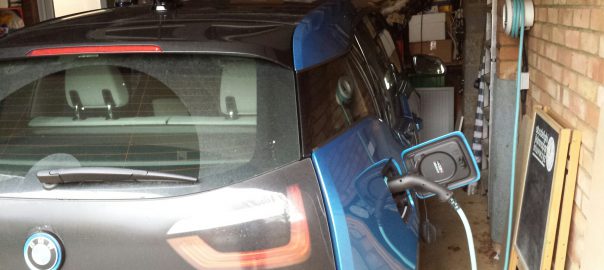
BMW i3 All-Electric (Image: BMW)

The Three Horsemen of the Apocalypse

By the middle of the next decade, the world as we know it will end. This end is not written in stone, it was not predicted by the Mayans, and it was not foretold by UFO religions.

This end has been sung in the past few years in press releases, statements and interviews. It is the prophesied end of the internal combustion engine. And its killers, the three horsemen of the apocalypse, are finally here, waiting for the fourth to join them.

Until September 2018, the electric car segment has been one of marginal delight, laughter, and discord. Caught between the flamboyant statements showing the impressive sale figures for the Nissan Leaf, the pot-smelling tweets of Elon Musk, and promises made from all over the industry to go all electric, the world watched in amusement and amazement what until now amounted to nothing more than good television.

But no more. The big boys came out to play this month, and their way of playing the game will change the industry. As Turkish used to say, Ze Germans are here. And they are here because they saw something they like.

The three heralds of doom are Daimler, BMW, and Volkswagen. All three, be it in their own name or that of some of their subbrands, revealed in the past two weeks the three horsemen that will shape the future: the EQC, the Vision iNext, and the e-tron SUV.

BMW i3 All-Electric (Image: BMW)

How will they end the ICE world? Through sheer strength, numbers, and services.

Strength. The three are the biggest players in the automotive industry, period. Combined, their power – read sales numbers, financial figures, pretty much everything – dwarfs any competition.

And it is power that gets noticed. Try as it might, Tesla is incapable of single-handedly change centuries of habits and patterns, of changing rules and regulations, of getting enough government support. But when the likes of Daimler, BMW and Volkswagen step into the room, everything changes.

Numbers. Daimler plans to have on the roads ten different all-electric cars by 2022. BMW has 12 of them in the works, all to be released by 2025. Volkswagen shames both of them with plans to launch 80 new models across its brands by the same year.

Read more: Auto Evolution

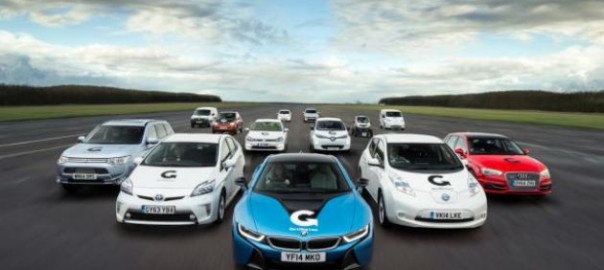
Go Ultra Low members boast 15 ULEVs across a range of segments (Image: OLEV)

Automakers Try Hard To NOT Sell Electric Cars

Automaker executives from Ford, GM, Nissan, and Toyota are fond of saying that not very many consumers want electric cars. They sometimes claim they could produce many more electric cars, but customers are not asking for them. (The execs somehow ignore the hundreds of thousands of orders Tesla has pulled in for the Model 3.)

Aside from giving me wicked cognitive dissonance via the completely incorrect claim that consumers don’t want electric cars, the insidious thing is that these automakers have hardly used traditional means of drumming up demand — aka advertising — to try to persuade buyers to want their electric cars.

Go Ultra Low members boast 15 ULEVs across a range of segments (Image: OLEV)
ULEVs across a range of segments (Image: OLEV)

Automakers have huge advertising budgets. Last I heard, the industry spends more money on advertising than any other industry in the US or worldwide. The automakers push SUVs and pickup trucks on you incessantly. They want to convince you to buy non-electric gas guzzlers. Yet, a new study from the Northeast States for Coordinated Air Use Management (NESCAUM) (NESCAUM) indicates that “six major automakers in the U.S. (General Motors, Ford, Toyota, Nissan, Volkswagen, and FiatChrysler) are spending almost nothing to advertise their electric vehicles,” as the Sierra Club summarizes it.

Normally, I wouldn’t say the automakers are trying to not sell electric cars. I’d just say that they aren’t trying very hard to sell the EVs. However, when you look at EV advertising compared to non-EV advertising from these firms, it becomes more visually obvious — the companies are trying hard to sell gasmobiles while not encouraging people to buy their electric cars. That essentially means they are trying to not sell electric cars.

Furthermore, it’s clear that it’s not just one company that’s lagging. Across the board, traditional automakers spend almost nothing to shape the values and product interests of consumers in a positive way.

Read more: Clean Technica

Myths And Shibboleths About Electric Vehicles: The Long Tailpipe Theory

One of the most frequent comments spouted by critics of electric vehicles is “the electricity they use is produced by fossil fuels, so actually they’re more polluting than petrol or diesel vehicles.” The long tailpipe theory, repeatedly trashed by science, is still the fallback argument for the ill-informed.

Where does it come from? The two main sources of air pollution are vehicles with diesel or gasoline engines and electricity generated by coal or diesel oil. Since many countries still generate electricity in this way, the argument goes that electric vehicles are simply transferring the pollution from our exhaust pipe to the chimney of a power station.

Is that true? No. The first reason is obvious: not all electricity is produced by coal and diesel power plants. More and more countries are using sustainable generation such as hydroelectric, wind, solar or other renewables, while at the same time, we are seeing an increase in distributed generation infrastructures such as solar panels in homes. Therefore, even if all we were doing was transferring pollution from one point to another, in the vast majority of countries a certain part of that electricity would come from clean sources.

In fossil fuel vehicles, this is not the case: everything it produces comes from where it comes from, and anybody with a minimum of environmental awareness should be ashamed every time they get behind the wheel.

Read more: Forbes

Union Of Concerned Scientists’ President: Electric Cars Rock

But he also identifies why electric vehicle ownership remains out of reach for many.

Earlier this year Ken Kimmell, President of the Union of Concerned Scientists, purchased a Chevrolet Bolt EV. After about 6 months, he has found electric vehicle ownership to be everything he had hoped. The car is fun to drive, has a low cost of ownership, and far more efficient than a gasoline car.

Mr. Kimmell has uncovered what many EV owners have already come to realize. For a home owner with a garage, an EV is more convenient (not less) than a gasoline-powered vehicle.

“I charge the car once or twice a week overnight. Plugging it in takes about five seconds, and the charging takes between 4-8 hours. When I wake up, the battery is full. No more trips to the gas station. (…) Because of the long range, I rarely need to use public charging stations while on the road. I’ve used them five times since I leased the car, typically to add about fifty miles of range.”

Owning an EV like a Chevy Bolt, Tesla Model 3 or Nissan Leaf is also much more affordable than it appears at first blush. In addition to taking advantage of the $7,500 federal tax credit, $2,500 of his down payment was paid back by the MA rebate program. Similar programs are available in many other states. That is just the upfront savings:

“At the same time, I am saving about $60/month in fueling costs, as electricity cost per mile is less than half of gasoline, even in a state like Massachusetts that has relatively high electricity costs and relatively low gas prices. And not paying for oil changes, air filters, belts, brake pads and many other maintenance expenses for a gas-fired car also saves money.”

Read more: Inside EVs

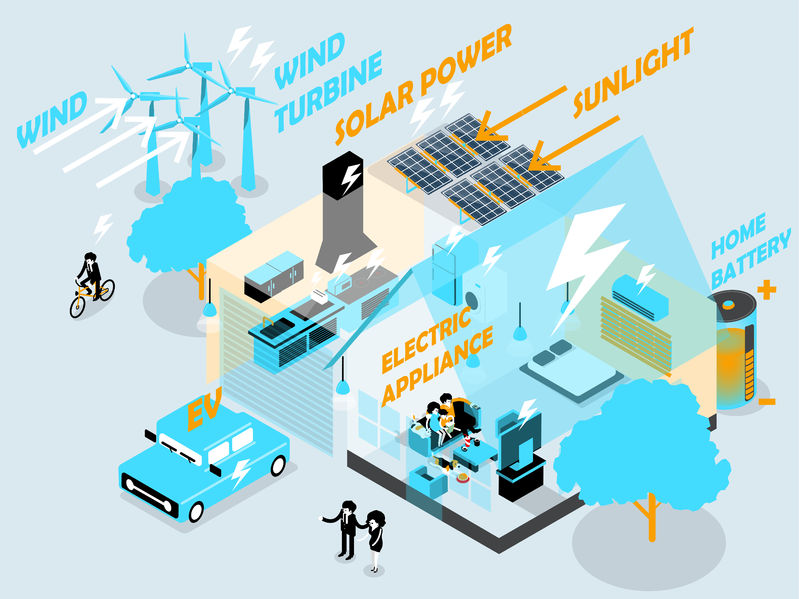
The Transition Trinity: Electric Car, Solar and Home Battery

Fuel Included was founded in 2014 in response to the threat of global warming. Our aim is to promote sustainable technologies at affordable prices, a mission that becomes ever more important as global climate changes accelerate.

59210374_EnergyHome_IsometricGraphic_123RF
Initially we concentrated on electric cars but as they become increasingly mainstream we are able to focus on other green technologies. We now offer our own home battery system, the PowerBanx, to go along with solar panel installs.

While the Global Energy Transition often seems to be about big infrastructure projects, like offshore windfarms and grid battery storage, what’s happening at the home level is arguably more important, in terms of the impact on the individual and on the future requirements for national grids.

For years we have seen the rise of solar power as it becomes cheaper and undercuts other forms of power generation. More recently, we have seen the spread of electric vehicles (EV), as the replacement of fossil fuel vehicles accelerates.

Finally we are seeing the widespread introduction of battery systems (such as our PowerBanx) into homes; all already have solar and many already have an EV.

Read more: LinkedIn


Red Tesla Model S (Image: T. Larkum)

5 Reasons EVs Will Displace ICEs

My grandfather was quite intrigued with those horseless carriages. Here he is, with a big grin on his face, testing out a Model T back in 1913.

A few years earlier, Henry Ford had debuted his Detroit assembly line and began cranking out Model Ts – the world’s first mass-produced automobile. The rest is history.

Then, a hundred years later in 2010, Nissan (OTCPK:NSANY) became the first company to mass-produce EVs (cars powered only by electricity), the Nissan Leaf. Motortrend at the time noted that the Leaf “could be the most significant vehicle of the century.”

Red Tesla Model S (Image: T. Larkum)

Did the 2010 Leaf and does today’s Tesla (NASDAQ:TSLA) Model 3 indeed herald a transportation revolution into EVs, much as Henry Ford’s Model T did into “horseless carriages” a century earlier?

Well, EV sales have soared from practically nothing in 2010 to an estimated 1.6 million in 2018 and are up 68% over 2017.

The surge in EV sales (growing 50-100% each year now) is primarily due to better and more affordable batteries and today virtually every major automaker plans on introducing electric cars, if they haven’t already, both hybrids and EVs.

Read more: Seeking Alpha

Electric Cars

I live a short drive away from the birthplace of the shale oil revolution. It was 2006 that we started to get an inkling that something big might be happening.
I’m referring to the Bakken boom…

My business has always been finance, so I wasn’t directly involved. However, the people around me very much were.

I watched twenty-five year olds blow through hefty six-figure salaries as fast as the money came in. Then I watched them scramble to keep their houses when oil prices crashed in 2014.

For years now I’ve been surrounded by oil industry families wherever I go.

My gym, the grocery store, at my kid’s school. Everywhere I go, interacting regularly with oil patch workers is part of my daily life.

Nice people for the most part, if a little rough around the edges. It has been hard to watch them go through the bust that followed the really good times that were driven by $100 oil.

What I’ve learned through my interactions is that these oil industry folks share some very passionate opinions. Not surprisingly those opinions are directly aligned with what is in the best interests of their industry.

If you are wondering what I mean, let’s just say that the strong majority of them drive giant gas guzzling trucks or SUVs, don’t own a copy of Al Gore’s Inconvenient Truth, and probably don’t live in a neighborhood with solar panel rooftops.

And it’s my familiarity with the loyalty these people have to their industry that made the remarks from the mouth of Royal Dutch Shell’s CEO even more surprising.

In fact, I’d say that his words were like a splash of cold water in my face that provided me with a much needed wake-up call as an investor…

His exact words were…

“The next car I buy will be electric.”

Our Wake Up Moment – The Inflection Point For Electric Cars Is At Hand

I’m pretty sure that when I look back on today ten years from now, those words from Shell’s CEO Ben Van Beurden will be a critical point in time that I remember.

That will be the moment when I realized that the electric car revolution is truly underway.

The talking points about electric cars for an oil man are supposed to be about all the reasons they aren’t even close to being ready for mainstream acceptance:

  • The lack of range
  • The prohibitive up front cost
  • The lack of charging station infrastructure
  • Inability of an owner to self-service
  • The fact that they still require lots of energy to charge them, likely including coal

Shell’s CEO said none of those things. What he said told me that the age of the electric car is underway.

That means that the growth curve for electric car use is about to go parabolic. Seriously, I mean parabolic.

I want you to fully appreciate how crazy the numbers here really are.

The chart below from International Energy Agency data shows the impressive growth that the electric car has had since 2010. We have gone from virtually zero electric cars on the road to just over 2 million in 2016.

Read more: Daily Reckoning