If the ongoing bushfire crisis has taught Australians one thing, it is that the use of petrol and diesel vehicles will have to be minimised in the future in order to avoid pumping more carbon into the atmosphere and making the problem worse.
And that means electric vehicles will have to start becoming the rule, not the exception as they are now.
Prior to the 2019 May election, the Australian Labor Party offered as one of its policies a subsidy on electric vehicles. But the government that was elected had no such policy and as a result any Australian who has to buy an electric vehicle today will have to fork out from his/her own pocket.
Electric vehicles are not cheap. I recently had a test drive in the Nissan LEAF, one of the three EVs that is available for sale locally – the others are from BMW and Hyundai – and the price is something that a medium-level petrol vehicle will cost.
There are some pluses: services are only required once every 20,000 kms, there is a five-year warranty, the drive is very smooth and the handling is exceptional. But the cost is still a big factor; the LEAF costs about $50,000.
If you would like to know more about Solar Panels and the PowerBanx range of home battery systems, and get a free instant quote, please complete our online form:
If you’re concerned about climate change, the next car you buy really should be electric.
Why? Because the average car, SUV or light truck in the United States is on the road for 11.8 years. So vehicles bought this coming year will be part of the shift away from fossil fuels that climate scientists say needs to be well underway within 10 years.
“By 2030 we need to be really well into this transition. Which means people need to be buying these cars now,” said Lewis Fulton, director of the Sustainable Transportation Energy Pathways program at the University of California, Davis.
The message is getting out there. In May, 16% of Americans said they were likely to buy an electric vehicle the next time they were in the market for a new or used car. Their leading reasons were concern for the environment and lower long-term costs of EVs, according to a AAA survey.
The good news, say owners, is that today’s electric cars are cost-effective, reliable, fun to drive and get upward of 200 miles to the charge so it’s not a hardship.
If you would like to know more about Solar Panels and the PowerBanx range of home battery systems, and get a free instant quote, please complete our online form:
This fall for only the second time in my life, I bought a new car.
It’s an emission-free Nissan Leaf. I named it “Greta.” Last night, I ran into a friend who has a Tesla all-electric vehicle (AEV) also named “Greta.” I’m now wondering how many AEVs there are in the world bearing the name of Swedish teenager Greta Thunberg.
I’m comfortable saying it was the extraordinary courage of this young woman who could be my granddaughter that drove my decision to go all-electric. “OK boomer,” I said to myself, “it’s your turn to help leave a habitable world for the next generation.
Nissan Leaf (Image: Qurren/Wikipedia)
When Green Mountain Power held a get-acquainted session on AEVs for its customers, my wife and I drove up. They had most current models available there for customers to test drive and dealers to answer questions. I chose the Leaf and, thrilled that I fit in it, took it for a spin. It was a distinctly different experience … silence, no auto-shifting clunks. I learned that by using the eco-pedal, I didn’t need the brake pedal and could extend Greta’s range. I was hooked!
I’ve traveled 1,200 miles with Greta and my early experience with the car sent me searching for the encyclopedic instruction manual in the glove compartment. Like most consumers, I had read the FAQs and thought I knew it all. At the time of purchase, my key question was driving range between charges, a deciding factor for most potential buyers. The range is nominally 150 miles. My benchmark was the 88-mile round trip between my home in Hinesburg and Montpelier.
I set out on my first excursion with a full 152 miles on the meter. When I got to Montpelier, I expected to find it down 44 miles, but it was, in fact, down twice that — about 66 miles left to go before I needed a charge. This didn’t register, so before heading home, I pulled out the manual and read what I’d neglected to read before committing to the AEV.
Like all living things, her capacity is temperature-dependent. It was 10 above zero when I left the house and I had turned on the heat to make it worse as both heat and lights reduce Greta’s range. I risked the straight shot home and made it with 12 miles to go by turning off the heat and arrived home in a near cadaverous chill, scraping my frozen breath from the inside of the windshield with a credit card. Did this mean driving at night with no lights and no heat? Should I buy a flashlight and a wool blanket?
I also learned Greta’s batteries can be severely damaged by exposure to temperatures below minus 13. I’ve lived in Vermont for 70 years and have yet to experience a winter where it didn’t get colder than that. I remember a sunny, dry winter day in Lincoln at 38 below. Could the car even survive here, much less provide frigid transportation beyond a few miles from home? I began to worry.
But I’ve learned that by monitoring the temperature and my energy usage as I drive, using the eco-pedal to recharge as I drive, charging every night at home during off-peak hours, I can manage quite well and I haven’t eaten in a gas station in two months. I’m finding more and more charging stations, all searchable on my cellphone. Besides if it’s freezing cold and I have a round trip to Montpelier, a stop at Red Hen Bakery in Middlesex for a quick charge, a latte and a croissant isn’t much of a price to pay for doing my part. Sometimes, slowing life down enhances it.
If you would like to know more about Solar Panels and the PowerBanx range of home battery systems, and get a free instant quote, please complete our online form:
Could climate change get so bad that it leads to our extinction? A few researchers are trying to answer that question.
Simon Beard has a career that most people would consider depressing and terrifying. He is part of a team of researchers trying to figure out if, how, and when climate change could cause the human species to go extinct. The stakes of his research—a potential annihilation of 7.7 billion humans and all the unborn people who come after them—couldn’t be any higher.
The idea that a heating planet will doom humanity is the subject of a lot of public speculation and anxiety, yet there are very few experts studying the existential impacts of climate change with any sort of academic rigor. Beard, who does this work at the Cambridge Center for the Study of Existential Risk, described it as “a field with next to no data” and a lot of unsupported hypotheses. “Under what circumstances could climate change cause a collapse of global civilization?” he said. “When you start asking that question, then your already quite-limited literature gets even more scarce.”
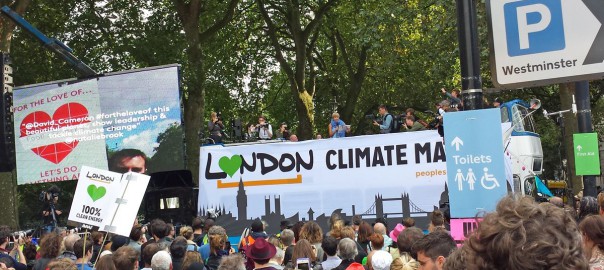
London Climate March – the Rally (Image: T. Larkum)
By bringing scientific precision to the doomsday scenario that wipes us off the planet, Beard hopes to convince world leaders to actually do something about it. “That’s really what we’re aiming for at the moment,” he said. “I think this could be genuinely transformative—firstly for the science but also by implication for the policy and the way that these things are discussed in society.”
The starting point for Beard’s research is that humans are incredibly resilient: We have found a way to survive in tropical rainforests, blistering deserts, icy tundra, and even for a brief time on the moon. But that says more about our collective strength than our skills as individuals. Shut down the grocery stores, turn off the taps, disband the government and very few of us, perhaps apart from a small number of rugged survivalists, would be able to stay alive for long.
“And so every one of us as an individual, I think, is very vulnerable, and relies upon these massive global systems that we’ve set up, these massive global institutions, to provide this support and to make us this wonderfully adaptable generalist species,” Beard recalled earlier this year on the Future of Life Institute podcast,
Those systems—the ones that put broccoli and frozen pizzas in our fridges and keep our streets from becoming Mad Max war zones—are themselves way more vulnerable and interconnected than we appreciate. The greenhouse gas emissions that humans are pumping into the atmosphere at record levels are changing the climate in ways that make it harder for us to grow and distribute food. This also increases pressure on our political system—as we saw with drought and crop failures in the lead-up to the Syrian civil war.
If you would like to know more about Solar Panels and the PowerBanx range of home battery systems, and get a free instant quote, please complete our online form:
A couple of weeks ago, Mercedes-Benz quietly announced the price for its all-electric EQC sports-utility vehicle.
A $67,900 starting price for a luxurious, 200-mile, 402-horsepower luxury crossover is a good start for the EQC brand. But the announcement got completely lost in the shuffle in a week filled with buzz about Tesla’s bulletproof, stainless-steel Cybertruck. Even the deserved attention given to Ford’s Mustang-inspired electric SUV was cut short. So where does that leave the play-it-safe luxury electric SUVs from Mercedes-Benz, Audi, and BMW?
Mercedes-Benz EQC (Image: Mercedes-Benz)
As we reported a week ago, the $75,000 Audi e-tron has not been a big hit. Don’t get me wrong. Audi loyalists and traditional luxury car buyers appreciate the e-tron’s smooth, comfortable, and safe ride. But relatively low sales numbers suggest that the e-tron is not energy-efficient enough. And it doesn’t have enough range at 204 miles. Or it’s being produced in low numbers. Or there aren’t other stand-out attributes besides being a well-made automobile. Who knows?
Audi e-tron (Image: Audi)
But whatever the reason, the first of four all-electric e-tron variants did not stir a big response. Not when it’s facing competition for mindshare from the Cybertruck or an electric Mustang.
If you would like to know more about Solar Panels and the PowerBanx range of home battery systems, and get a free instant quote, please complete our online form:
Transforming the way we travel is an essential part of tackling the climate crisis.
The transport sector contributes about 20% of global carbon emissions. In the UK the figure is 33%, and the country has made virtually no progress in reducing emissions from transport. In many countries, they’re actually increasing.
Electric vehicles are often hailed as the solution to this quandary, but some question their environmental credentials. With much of the world’s electricity still produced from fossil fuels, the criticism goes that EVs may actually be responsible for more carbon emissions over their lifetime than combustion engine vehicles.
As German economics professor Hans-Werner Sinn put it in a recent controversial article, all we are doing is transferring carbon emissions “from the exhaust pipe to the power plant”.
The assumptions underlying these claims are questionable. But even if true, this line of argument misses a key point. The car we choose to buy today directly influences the future of our energy system. Choose a combustion-powered vehicle and we lock in ongoing fossil fuel use. Choose an electric vehicle and we support the switch to a zero carbon society.
Due in large part to the high carbon-cost of EV batteries, the manufacturing process for an electric vehicle causes more carbon emissions than for a combustion engine vehicle. This means that the source of electricity used during the life of an EV is critical in determining how eco-friendly they are.
While two thirds of the world’s electricity is generated from fossil fuels, this proportion is decreasing rapidly. At least four countries are already at or close to being powered entirely by renewable electricity: Iceland, Paraguay, Costa Rica and Norway. Brazil is one of the ten largest economies in the world and they are at 75% renewable electricity. In the UK, the proportion of electricity provided by fossil fuels has halved over the last decade and is currently about 40%.
As the transition towards renewable electricity progresses, so too will the carbon footprint of EVs keep decreasing in step. This means that the superiority in carbon cost that electric vehicles already have over combustion vehicles, even if narrow now, will widen in the years to come.
If you would like to know more about Solar Panels and the PowerBanx range of home battery systems, and get a free instant quote, please complete our online form:
In a victory for sustainability, UK restrictions on the use of electric car chargers are to be lifted under plans to increase the use of green vehicles in the UK.
Practically, this means only one subscription will be required to use charging points. Additionally, the transport secretary is allocating £2.5 million of funding for more than 1,000 new electric car charging points.
All signs point to the British government readying itself for the next wave of innovation in the auto-industry. Just as our streets were once emptied of the horse and cart, in the not-so-distant future our roads could be free of petrol and diesel powered vehicles – transforming how we drive in the process.
I recently bought an electric car, a BMW i3s. I did so for environmental reasons but I didn’t fully appreciate just how radically different the driving experience would be. Among many innovations, the experience embraces connected technology, reduced running costs, outstandingly fast performance and virtual silence. A measure of moral smugness is thrown in as an emotional extra.
BMW i3 and i3S 120Ah (Image: BMW Group)
Driving experience aside, we are on the brink of a design revolution for the auto industry thanks to e-cars. In a way, the clock is being turned back so auto designers can free their imagination.
There is evidence that the classic car market is heading for fast decline: the value of such cars at auction dropped dramatically over the summer, driven by concerns over the availability of fuel. Yet many of the vehicles of the 1950s, 60s and 70s remain iconic symbols of design at its wonderful best. They were symbols of freedom, opportunity and progress, and they were magnificent to behold.
But as competition and market demand increased, the distinctive beauty of car design eroded away. The dominant voices around the automotive industry table became those of engineers and economists who sought to compromise the work of the designer in the name of efficient manufacturing process and, ultimately, lower prices. The democratisation of the automobile happened at the expense of elite design.
But now, the possibilities for a design-led approach are once again coming to the fore and are endless. Electric vehicles do not require a cooling system, oil, a transmission, nor so much else of the mechanics of a fossil-fuelled car. As battery and electric motor technology improves, the design challenge shifts from “how do I fit it all in?”, to, “what on earth am I going to do with all this space?”. As a consequence, we are about to witness a transformation on the scale of how Apple transformed the PC or the mobile phone.
Oil consumption continues to rise in the U.S. and around the world, but as electric vehicles keep growing as a percentage of vehicle sales, there will ultimately be a tipping point on multiple fronts.
The first will be manufacturers investing in more EVs to ultimately overtake internal combustion engines, which is happening today from Tesla (NASDAQ: TSLA) to General Motors (NYSE: GM) to Porsche.
The bigger tipping point will be a peak in oil consumption that the world will (likely) never look back from. We don’t know when peak oil will happen, but given the cost reduction of EVs and the focus on reducing emissions around the world, it’s only a matter of time.
EV sales are still booming
There’s no question that Tesla has led the EV revolution the last decade, and it’s helping drive the industry’s growth. According to the website Inside EVs, Tesla has already sold 99,525 Model 3, S, and X vehicles in the U.S. through July 2019, and total U.S. EV sales across all manufacturers were 176,174 thru seven months of 2018, a 14.5% increase from 153,854 a year ago.
Global electric vehicle sales were 1,105,405 in the first six months of this year, a 46.9% jump from 752,690 a year ago. It’s this growth on a global level that’s going to lead to that tipping point.
No matter where you look, EV sales are going up. And in 2020 and 2021, there will be even more options coming to the market from Porsche, Ford, Kia, Mini, and many more.
The future is not looking bright for oil, according to a new report that claims the commodity would have to be priced at $10-$20 a barrel to remain competitive as a transport fuel.
The new research, from BNP Paribas, says that the economics of renewable energy make it impossible for oil to compete at current prices. The author of the report, global head of sustainability Mark Lewis, says that “renewable electricity has a short-run marginal cost of zero, is cleaner environmentally, much easier to transport and could readily replace up to 40% of global oil demand”.
The oil industry faces a disruption on the same scale as that which has hit the European utilities sector over the last decade, he adds.
The sun sets on drilling (Image: Pexels)
The report, Wells, Wires, And Wheels… Eroci And The Tough Road Ahead For Oil, introduces the concept of the Energy Return on Capital Invested (EROCI), focusing on the energy return on a $100bn outlay on oil and renewables where the energy is being used to power cars and other light-duty vehicles (LDVs).
“For a given capital outlay on oil and renewables, how much useful energy at the wheel do we get? Our analysis indicates that for the same capital outlay today, new wind and solar-energy projects in tandem with battery electric vehicles will produce six to seven times more useful energy at the wheels than will oil at $60 per barrel for gasoline powered light-duty vehicles, and three to four times more than will oil at $60 per barrel for light-duty vehicles running on diesel,” says Lewis.
Mark Lewis is global head of sustainability research at BNP Paribas Asset Management.
The number of electric cars may be increasing, but there are challenges for charging infrastructure and energy storage.
Oil prices will need to fall to between $10 and $20 per barrel if it is to remain competitive in the mobility sector, according to a recent report from BNP Paribas Asset Management.
The report’s author, Mark Lewis, told CNBC’s Squawk Box Europe Friday that such a view reflected how the economics of renewables were changing “very dramatically” and the way in which electric vehicles were becoming more competitive.
The sun sets on drilling (Image: Pexels)
“We have to be very clear here,” Lewis, who is global head of sustainability research at BNP Paribas Asset Management, added.
“What we’re saying is if you’re comparing investing money in renewable energy in tandem with electric vehicles, you can get six to seven times the energy yield at the wheels – useful energy, mobility – for the same capital outlay as you can spending on oil at the current market price of $60 a barrel, and then refining it into gasoline and using it in an internal combustion engine, which loses 80% of the energy as heat.”