The government has cut the Plug-in Car Grant for electric cars by another £1,000, meaning motorists will save even less on affordable EVs
The Plug-in Car Grant to help make electric cars more affordable has been cut by further £1,000 in a surprise announcement that will infuriate electric car buyers and manufacturers alike.
Previously £2,500, the Plug-in Car Grant is now just £1,500 as of 7am today (15 December 2021).
Zappi 2018 EV Charge Point (Image: myEnergi)
What’s more, the qualifying maximum price of an electric car has been reduced, from under £35,000 down to less than £32,000.
Both cuts are effective immediately.
The government argues that its approach to Plug-in Car Grant cuts “is clearly working – whilst the grant has slowly reduced over time, the sales of electric vehicles has soared”.
Transport minister Trudy Harrison said the government is “refocusing our vehicle grants on the most affordable vehicles and reducing grant rates to allow more people to benefit, and enable taxpayers’ money to go further”.
If you would like to know more about Solar Panels and the PowerBanx range of home battery systems, and get a free instant quote, please complete our online form:
Osprey Charging’s first electric vehicle (EV) dynamic charging hub has opened in Wolverhampton today (30 November) .
The site has four high powered chargers, and is the first in the UK to use smart charging Kempower technology according to Osprey. These chargers are designed to optimise charging across multiple vehicles when more than one EV is plugged in.
This allows power to be distributed based on demand, helping to reduce waiting times by maximising the speed and availably of chargers for drivers. In doing so, consumer footfall is increased for the landowners hosting the hub. Osprey’s first site is located adjacent to the A463, and includes a Costa Coffee on-site.
Additionally, the Kempower chargers mean grid connections can be optimised, meaning multiple high-power chargers can be installed without the need for more grid power.
If you would like to know more about Solar Panels and the PowerBanx range of home battery systems, and get a free instant quote, please complete our online form:
The Government has allocated an additional £2.5 million to fund more than 1,000 new chargepoints on residential streets.
Announcing the additional cash today (Monday, August 12), transport secretary Grant Shapps says the funding will support the on-street residential chargepoint scheme, launched in 2017, which aims to help people access charging infrastructure near their homes when they don’t have off-street parking.
It will go towards helping local authorities to install these chargepoints, which can be built into existing structures like lamp-posts.
The scheme aims to encourage even more people to choose an electric vehicle (EV) by making it easier to charge their cars near home and has already seen 16 local authorities say they will install 1,200 chargepoints this year.
The Transport Secretary is now doubling funding for the scheme to meet demand and accelerate the take-up of electric vehicles as the UK moves towards net zero emissions by 2050 and further improve air quality.
Shapps said: “It’s fantastic that there are now more than 20,000 publicly accessible chargepoints and double the number of electric vehicle chargepoints than petrol stations, but we want to do much more.
“It’s vital that electric vehicle drivers feel confident about the availability of chargepoints near their homes, and that charging an electric car is seen as easy as plugging in a smartphone.
“That’s why we are now doubling the funding available for local authorities to continue building the infrastructure we need to super-charge the zero emission revolution – right across the country.”
The allocation of funding for on-street residential chargepoints is part of the £1.5 billion investment underpinned by the Road to Zero Strategy.
The Electric Nation project ran from 2016 to 2019 in the UK, describing itself as “the largest smart charging project in the world”. GreenFlux has now published the results.
A total of 673 “smart” chargers were installed in participants’ homes as part of the project researching the controlled charging of electric vehicles. More than 40 different electric vehicles were involved in the project – from plug-in hybrids to vehicles with range extenders, as well as purely electric cars.
EV Charge Point (Image: myEnergi)
GreenFlux’s intelligent charging system was used to collect charging data and control charging sessions. Among other things, the project recorded the times of plugging in and unplugging, the duration of the actual charging process and the amount of electricity consumed. In this way, the system monitored the overall demand and was able to instruct individuals charging that they should reduce their charging capacity if necessary.
GreenFlux concludes, according to a company statement, that thanks to controlled charging, there is no need to upgrade the existing grid capacity. This will eliminate the need for costly investments in the electricity grid. In Germany, EnBW also came to similar conclusions when they conducted field tests near Stuttgart.
In the Electric Nation project, most vehicles were connected to the home charging station between 5 pm and 7 pm as one would expect. While PHEV drivers had an average of 0.76 charging sessions per day, BEVs were generally only plugged into the wallbox every third day. In January and February in particular, however, there were more charging operations than in August – due to the shorter range in the winter months.
Milton Keynes has probably the greatest concentration of electric car charging points of any location in the world. This arguably makes it the best candidate destination city for electric car drivers anywhere in the world.
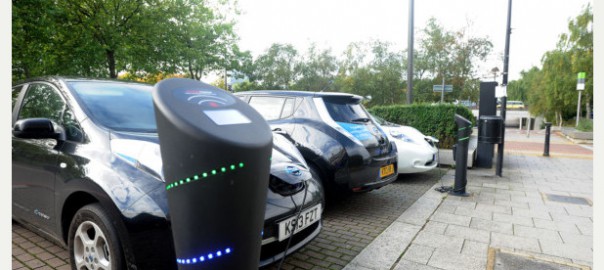
Electric cars charging in Milton Keynes (Image: T. Larkum)
Of course, those are difficult statements to confirm since there aren’t international league tables of such things. However, a look at international charge point maps like Plugshare certainly seems to indicate that it has as many standard power charge points (some 170) as other candidate ‘hot spots’ such as Los Angeles in the US and Oslo in Norway. If you look further into the density of high power rapid chargers (56) it appears to win hands down against all comers.
Charge Point Locations
More to the point, however, is that charge point locations are very well organised in Milton Keynes. While in other cities the growth and placement of charge points appears to be organic, i.e. nearly random, they are well placed in MK. Specifically the city centre is arranged in blocks on a grid (in the American style) and charge points are placed along at least one and usually both of the long sides of each block. One block can have as many as a dozen standard speed chargers.
The rapid chargers are arranged more strategically. In the city centre there is one rapid to every one or two blocks. Outside the centre, in the suburbs, there is one to every second or third housing estate.
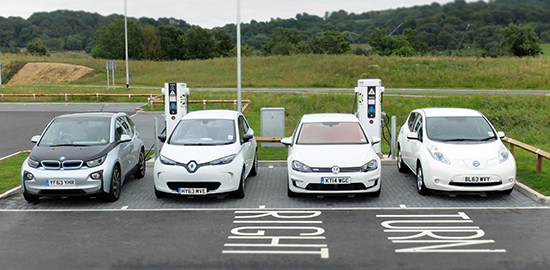
Rapid Chargers next to Milton Keynes Central railway station (Image: T. Larkum)
The result of having so many charge points in Milton Keynes is that anyone can visit the city in an electric car and be confident of finding somewhere to charge for the return journey. With a typical EV range of 80 miles this means that MK can welcome visitors from as far afield as Southampton in the south, Gloucester in the west and Nottingham in the north – they won’t have to charge on the way in or back home.
Chargemaster / Polar Network
The charge points in MK are part of the Polar network operated by Chargemaster. Therefore to make use of them it’s necessary to use a Polar app or swipe card, either on subscription (Polar Network) or Pay As You Go (Polar Instant).
With that arranged, it is possible to find a charge point near almost anywhere in the city centre. Their locations can be seen on the council’s charge point map (PDF) and on the online Polar Live map.
This makes MK the perfect place for EV owners, whether visiting occasionally for shopping or commuting in daily for work.
If you want to charge your car away from home, and can’t get by with a 13 Amp ‘granny cable’, then you will need to join one or more of the national charging networks. That gives you access to the public charging points available around town centres and on the motorway and trunk road systems.
There are a number of sites where you can look up charging points, including:
In an occasional series I will cover the biggest networks: Electric Highway, Polar Network, POD Point and so on. Here we begin with the Electric Highway, created by Ecotricity and now owned and operated by Gridserve.
“Our low-cost, rapid and high power charging infrastructure is reaching every corner of the UK, covering 85% of the UK’s motorway network.
We provide rapid and high powered charging at some of the lowest rates in the UK. Our next generation chargers are supported by renewable energy from our solar farms.”
My BMW i3 on charge on an Ecotricity DBT rapid charger at Corley Services (Image: T. Larkum)
Our View
If you join just one network it probably has to be the Electric Highway (EH) as they have a virtual monopoly on charging at motorway service areas (the exception being Tesla with their Superchargers). The good news is that the majority of services now have at least one rapid charger, an increasing number have two and some have even more. So for long distance driving with your electric car you can pretty much get around most of England by charging at motorway services. Coverage outside England (in Scotland and Northern Ireland, and particularly in Wales) is however poor.
The reliability of Ecotricity charge points has historically been quite poor, but this has started to improve since the takeover by Gridserve.
Curiously, apart from at motorway services the majority of EH rapid chargers are in the car parks of IKEA superstores (due to a partnership deal between them – see IKEA Electric Vehicle Charging).
The majority of EH rapid chargers were large white units manufactured by DBT-CEV. These provide DC charging at 50kW for CCS (BMW i3 etc.) and Chademo (e.g. Nissan Leaf and Mitsubishi Outlander) connectors, and AC charging at 43kW (Renault ZOE). Typically the first ones installed were ‘single headed’ with just Chademo cables for the Leaf. Later they were ‘double headed’ with the addition of a Type 2 cable for the ZOE. Current installs are ‘triple headed’ with the addition of a CCS cable for the i3 and Hyundai IONIQ.
My Renault ZOE charging at an Ecotricity 22kW medium-fast charger (Image: T. Larkum)
Note that most EVs with a Type 2 connector (not the Leaf or Outlander) can be charged with any rapid through the Type 2 cable but only the ZOE can use it at full power (43kW or 22kW). Some can use it at reduced power (e.g. the i3 can use 11kW) but most will drop down to 7kW, like charging at home. You should use the CCS or Chademo connector for rapid charging, and only use the Type 2 if these aren’t working (it will be much slower).
Before using DBT rapids Ecotricity installed a small number of ‘medium’ chargers providing 22kW. Some of these are still in place and can be seen alongside the DBT ones; again, you should make sure that you understand which charger and cable/connector is most appropriate for your circumstances.
Rapid Charging on the Motorway – Completing the Charge
Ecotricity rapid charger with LCD status display (Image: T. Larkum)
I previously described the process for initialising a charge at an Ecotricity rapid charger, as found at most motorway services. Here I’ll cover the process for monitoring and ending the charge session.
Step-by-Step Guide
12. While the car is charging you will want to monitor it regularly to confirm it is continuing successfully and to see when it has completed. The charge status, the time taken, the amount of electricity used and usually (depending on the car) also the charge level will be shown on the charge point screen.
Rapid charger status screen during charging (Image: T. Larkum)
13. There will also be visual indications on the car, for example the Nissan Leaf has blue lights on the dashboard, the Renault ZOE shows an icon on the driver’s screen, the BMW i3 has an indicator light around the charge socket, etc. However the most convenient monitoring method is via smarthphone, using an app provided by the car manufacturer. You can use this remotely, for example while eating in a services restaurant. Each app functions differently, but they all provide a display of the current charge level. The BMW one can generally be updated on demand (though sometimes requires the app to be killed to achieve this). The Renault one, rather inconveniently, will only update every 30 minutes.
BMW ‘i Remote’ app display during charging (Image: T. Larkum)
14. When you wish to end the charge session you do so first in the Ecotricity app, then follow its instructions.
Ecotricity app display after ending session (Image: T. Larkum)
15. You remove the charge cable from the car and hang it back up on the charge point. Then you notify the Ecotricity app. The app will display the cost of the session (zero if you’re an Ecotricity customer) and the session identification number. You will also usually receive this information soon after by email to your registered address.
Ecotricity app display at end of session (Image: T. Larkum)
16. The session is ended and the rapid charger display will return to its welcome screen.
Ecotricity rapid charger welcome screen (Image: T. Larkum)
People who have never owned an electric car don’t understand how different charging one is compared to fuelling a petrol or diesel car. Therefore I’m going to explain what charging an electric car is like so that potential owners can understand it better.
Home charging a Nissan Leaf (Image: Nissan)
The point I want to get across is that charging an electric car is much easier and more convenient than filling a fossil-fuelled car. That’s an idea that can be difficult to grasp. Now that I’ve upgraded to electric (I’m on my second all-electric car) I could never go back, any more than I’d give up my smartphone and make do with a landline.
Here I’ll concentrate on the ins and outs of home refuelling, and cover charging away from home another time.
Charging System
Most electric cars come with a charging cable (fitted with a 13 Amp plug) that can be used to charge the car; such cables can be bought separately where they are not supplied with the car. One name given to these items is ‘granny cable’ as they can also be used to charge up while visiting relatives.
BMW i3 ‘occasional use’ charging cable (Image: BMW)
Another name they are given is ‘occasional use cable’ as they are not intended to be used frequently. They will also be slow to charge the car (12 hours or more) as a standard home socket is not capable of providing as much power as the car can potentially take.
Instead most car owners will have a special charge point installed at home to charge their car. This often comes free with a new car. It is typically wired straight into the main house consumer unit. It will be capable of passing higher power than a standard socket – usually either 16 or 32 Amps – and will be designed for frequent use.
Using a third-party ZOE granny cable while visiting my brother (Image: T. Larkum)
These charge points can be installed either inside a garage, or on a garage or other outside wall. Sometimes they’re just put on a post beside the driveway. They are all waterproofed and can be used in all weathers (including heavy rain). They usually come fitted with a tethered cable to match the car but sometimes just have a socket to which the owner can connect different cables, for example if the unit has to charge electric cars with different types of connector. The pros and cons of having a tethered versus untethered charge point are covered elsewhere.
Charging an Electric Car: Frequency
How often does an electric car need to be charged? This is an important question, and is key to why charging is more convenient than conventional refuelling.
The obvious answer, at least to someone used to a conventional car, would be “when it’s empty”. That’s because most people let their cars run low on fuel before refilling. There is no good reason for this; it simply reflects the fact that conventional refuelling is so inconvenient that it is to be avoided whenever possible. It takes time, and usually also involves a diversion from where you actually want to go.
With an electric car you could choose to do the same thing, relying on public charge points, and that can work if you can’t do home charging. However for the majority of electric car owners with a home charge point the easiest thing is simply to charge at home overnight every night.
Charging a Renault ZOE on the drive (Image: Fraunhofer ISE)
Electric cars use Lithium-Ion batteries, similar to those found in mobile phones (though they have significantly more sophisticated charge management systems than phones and so last longer). Lithium-Ion likes to be kept charged unlike previous technologies (e.g. Nickel-Cadmium batteries) that you were supposed to run down before recharging. Therefore it does no harm to plug in every night and so have the car battery fully charged every morning ready to go.
Using a dedicated high power charge point allows a typical electric car to be charged in about 4 hours. It’s also fine to only partly refill it. Therefore it can be perfectly practical to drive, say 100 miles during the day for work, then go home and – those evenings when it’s useful – top it up for an hour or two and go out again for, say, another 50 miles.
Charging an Electric Car: Process
It’s very easy to charge an electric car once you have a dedicated charge point. If you are lazy, like me, then you have a tethered one with its cable permanently attached so you don’t have to unpack a cable each time. Similarly, I choose to leave mine switched on permanently for convenience.
In this case, charging is as simple as the following:
Open the charge point door on the car
Uncurl just enough of the charge cable to insert its connector into the car’s charge socket
The car will automatically start to charge when it sees the electrical connection made. It will control the charge and finish it automatically.
On my original Renault ZOE the charge point door was unlocked using a button on the key fob or a switch inside the car. The charge socket was in the nose and so required walking around to it to insert the connector. The total time taken was about 15 seconds; this would also be typical for the Nissan Leaf.
Charging a Nissan Leaf in the garage (Image: Chargemasterplc.com)
On my current BMW i3 the charge point door is always unlocked if the car is unlocked, and the charge socket is on the driver’s side. Therefore I can insert the connector after I have parked the car and as I walk out of the garage; there is literally no additional time taken to set the car for charging. The Hyundai IONIQ Electric also has the socket on the rear quarter, though on the passenger side.
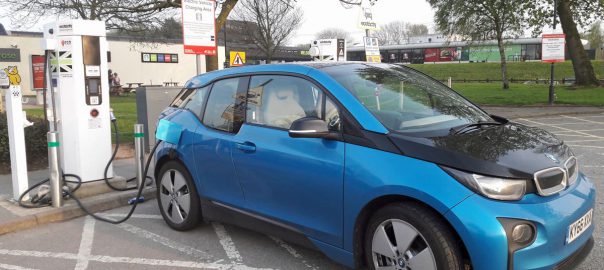
Charging a BMW i3 on the drive (Image: BMW)
People sometimes ask me how long it takes to charge my car. They probably expect to hear me say ‘4 hours’ or whatever, but actually it takes me personally no time at all, not a single minute. That’s because I don’t care how long it takes for the battery to fill up while I’m in the house (and probably asleep).
Charging a Hyundai IONIQ Electric on the drive (Image: T. Heale)
With my i3 having a range of about 120 miles, and my commute being 45 miles, it’s not even a problem if I forget to charge for a day or two. However, like with your smartphone, making charging it a daily routine is generally the best option.
Summary
One of the great things I love about a car that’s electric is no longer having to spend time fuelling it. It’s just 100% full every morning when I get in, as if by magic. I certainly don’t miss having to travel to petrol stations, often standing in the dark and rain, to hand over large amounts of money.
Now instead I fuel the car myself using renewable energy. During the week I charge it from wind (courtesy of our renewable electricity supplier) and a fill-up costs about £2.50. At the weekend I can charge it from our solar panels for free.
I Have my New Car Ordered – Now I Need a Charge Point
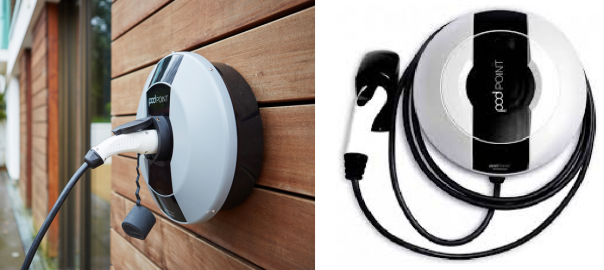
Untethered and Tethered Charge Points (Image: POD Point)
With my new Leaf, I get a new, FREE, POD Point charge point.
Thanks to a Nissan discount of £264 and the government OLEV scheme discount of £500, there is no charge for me at all for the entry level unit, although there are a couple of upgrade options you can choose.
Here is a quick guide to what to expect when you are ready to get your system installed. This blog covers the on-line application, with a separate blog that covers the installation.
Ordering my New Charge Point
The process starts with an email from POD Point to start the application. It was pretty straightforward and the pictures below step through the choices offered. The three choices I made of most significance to me were the following:
1) Upgrade to a 7kW charger. This cost £95. This seemed good value and future proofs me for longer range cars in the future.
2) Upgrade to a key so that I can lock the charger if necessary. This cost £30. I am not sure if electric thieving is likely.
3) I chose to have an un-tethered system with a type 2 socket so that it could work with any car. This was no charge. POD-Point tell me there is no difference in charge between a tethered and un-tethered system.
1 – The initial email from POD Point
2 – website starting point
3 – charge power choice
4 – tethered/untethered choice
5 – extras: key, cable, freestand
6 – Order summary showing total price less the nissan discount
7 – A statement that I have bought/leased a new car and have suitable off-street parking for a chargepoint to qualify for the OLEV grant
8 – 2nd Order summary including the OLEV grant
9 – payment for my extras
10 – payment summary
11 – address for installation
12 – installation specific questions
13 – statement of whether I do or don’t want the OLEV grant
14 – formal grant application. This needed a form downloaded, filled in and uploaded. Not particularly difficult and definitely worth it to save £500.
Our BMW i3 on charge at Corley Services (Image: T. Larkum)
Once you’ve had an electric car for a short while you’ll want to venture beyond its initial range and you can only do that by charging away from home. The most popular method is to use one of the network of Ecotricity rapid chargers, their ‘Electric Highway‘; there is at least one located at virtually all service stations on the UK motorway network.
In advance you need to have installed the Electric Highway smartphone app (available for Apple and Android devices) and set up an account with Ecotricity to allow you to use it. Ecotricity home customers get 52 free uses per year, otherwise the charge is £6 per half hour charge.
Step-by-Step Guide
Here is your guide to charging your electric car at an Ecotricity rapid charger:
1. On arrival, park up so the required cable can reach the charge socket on your car. Typically that means facing forward if your car has the charge point in the nose (e.g. the Nissan Leaf, Renault ZOE or Kia Soul) but reversing in if the charge point is near the rear (e.g. BMW i3, Mitsubishi Outlander, Hyundai IONIQ or Tesla Model S).
Rapid Charging Step 1: Access the Rapid Charger (Image: T. Larkum)
2. Get out of the car and check the screen on the rapid charger to confirm it’s working. Assuming the charge point is not already in use, the rapid charger will show a screen saying ‘Welcome! To charge your car, use the Electric Highway smartphone app’ or ‘Welcome! Select the correct charger for your vehicle’.
Rapid Charging Step 2: Welcome Screen (Image: T. Larkum)
3. Start the Electric Highway app on your phone. If it has been correctly setup it will show your car type at the top. The screen will say ‘What would you like to do?’ with two big green buttons labelled ‘Charge: charge your vehicle now’ and ‘Find pumps: find compatible pumps’.
Rapid Charging Step 3: Choose to Charge (Image: T. Larkum)
4. Press the ‘Charge’ button. The screen will change to say ‘Charging your car’. Press the ‘Get Started’ button.
Rapid Charging Step 4: Get Started (Image: T. Larkum)
5. The screen will change to say ‘To start, scan the pump’s QR code or enter the pump ID’. Here ‘pump’ is Ecotricity’s term for a rapid charge point. For simplicity we’ll choose the latter – press the ‘Enter pump ID manually’ button.
Rapid Charging Step 5: Identify the ‘Pump’ (Image: T. Larkum)
6. This will bring up a box to enter the pump identification number; selecting in this box will bring up your ’phone keyboard. Type in the four digit number as written below the screen on the charge point.
Rapid Charging Step 6: Enter the Pump Number (Image: T. Larkum)
7. The app will look this up and specify the location of the rapid charger with that number. If the number matches your location press ‘YES’.
Rapid Charging Step 7: Identify the Pump Location (Image: T. Larkum)
8. The screen will change to allow you to select the appropriate cable and connector for rapid charging your car. This is essentially straightforward: the Renault ZOE uses AC rapid, the Leaf, Outlander and Kia Soul use CHAdeMO and most others use CCS. You should know the connector type for your car, and the app will also exclude the ones it believes are incompatible. However, you should be aware that most cars can use the AC at low speeds as well as the DC at high speeds and so you may accidentally use AC but find your car charges only very slowly. In other words, use CCS and CHAdeMO in preference to AC unless you have a ZOE.
Rapid Charging Step 8: Select the Connector (Image: T. Larkum)
9. At this point control of the charging moves from the app to the charge point itself. Once initialised the charge point screen will show ‘Connection: connect your vehicle’.
Rapid Charging Step 9: Connect to the Car (Image: T. Larkum)
10. Plug the connector into the car, remembering to remove the secondary dust cover if you have a CCS socket. So long as the car is set to charge (i.e. you don’t have the charge timing override set) the car and charge point will ‘negotiate’ the fast charge they can both support, and charging can begin. The screen will show ‘Initialization: Please wait whilst your vehicle connects to the charge point’ and will highlight the charge point going through a number of check steps: Start communication, Isolation check, Precharging, Charging.
Rapid Charging Step 10: Initialization (Image: T. Larkum)
11. At this point charging starts, and you can usually hear the distinctive high pitched whine of rapid charging underway.
Rapid Charging Step 11: Car is Charging (Image: T. Larkum)
Monitoring the charge progress, and ending the charging session, are covered in Part 2.