Category Archives: Tesla

News and reviews of Tesla electric cars (including plug-in hybrids).

Tesla in Bitcoin’s driver’s seat, sending the crypto’s prices to the roof, literally

Elon Musk is powering electric cars, homes and now he’s trying to give homeowners the chance to mine Bitcoin using his solar panels. He’s got vested interests

Your home can allow you to generate actual Bitcoins with the surplus energy your solar system makes
Musk is now tied to the bitcoin story in the eyes of the Street
Tesla could have made more in profits from its recent bitcoin investment than it has made selling EVs

Tesla made a substantial investment in Bitcoin and allowed the cryptocurrency to be used for car purchases in the future perhaps as a way of differentiating Tesla from other auto manufacturers.

But besides cars, Tesla’s other significant business involves solar panels, solar roofs, and batteries. The batteries are used in their cars and provide power storage for their residential solar systems, sold as the Tesla Powerwall.

Powerwalls can store that surplus energy and power various things in your home, including air conditioners, and charge your Tesla EV.

Tesla Powerwall

But Tesla added a capability to its on-premises solar energy/battery energy management computer that would give it GPUs for mining cryptocurrencies.

These are already connected to home Wi-Fi. They have a management app, so upgrading it with Wi-Fi 6 and attaching it to a cryptocurrency network and an easy-to-use mobile app for cryptocurrency account management would be an achievable systems integration effort for Tesla, given the company’s considerable engineering resources.

It would then be possible for your home to become the ultimate idle money-producing game allowing you would generate actual Bitcoins with the surplus energy your solar system makes.

How smart is that? And just how many birds can Musk hit with one stone?

The key is you need areas with plenty of sun and fewer high-rises and plenty of those exist around the world.

A Tesla solar-paneled roof, on average, will cost $50,000 (to $75,000) or just about the cost of one Bitcoin today. A good mining machine will set you back another $5000 and voila! You’re all set.

Of course, not that simple and there’s plenty of technical issues to be solved before any of this happens, but what a way to sell solar panels and drive Musk’s beloved Bitcoin prices to the roof, quite literally.

Talking about power…
As Texas continues to struggle with major blackouts, some of its residents are finding innovative ways to provide power to their homes, using their cars’ battery packs, including Tesla’s.

Local Tesla owners have used the Tesla Powerwall to provide backup power during the outages and many such owners have taken to Twitter and Reddit to share the wonders of their savior Powerwalls, or simply their seemingly heroic Teslas.

EV adoption is skyrocketing globally, led by China, and Tesla is well-positioned to capitalize on this $5 trillion market over the next decade.

Tesla and Bitcoin share a destiny
Tesla’s share price is now directly linked to the price of bitcoin after Elon Musk’s company invested $1.5 billion into it, according to Daniel Ives, an analyst at Wedbush.

Read more: AMEinfo

It’s Time to Go Green!

If you would like to know more about Solar Panels and the PowerBanx range of home battery systems, and get a free instant quote, please complete our online form:

Tesla showroom in Milton Keynes (Image: T. Larkum)

Tesla refreshes Model S with 520-mile range, goofy steering wheel

Tesla unveiled the first major refresh of its flagship Model S electric performance sedan on Wednesday, and it was not an over-the-air update. The interior gets a major overhaul with an airplane-inspired steering wheel and the powertrain adds a third motor in some versions. Top-performance versions will be capable of a 520-mile range and a 0-60 mph time in less than 2.0 seconds, Tesla announced on a quarterly call with shareholders and the media.

Launched for 2012, the Tesla Model S electric sedan supercharged the electric vehicle revolution with an 85-kwh battery pack that provided an EPA-confirmed 265 miles of range. At the time, the Nissan Leaf, which was its main competitor with nationwide availability, had a 73-mile range.

The Model S presaged the reality that blistering performance and high-tech luxury could be packaged in a vehicle with no tailpipe emissions. Tesla juiced performance and range capability along the way, and the 2020 Model S can accelerate to 60 mph in just 2.4 seconds.

Now, as traditional automakers play catch-up to Tesla with dozens of electric vehicles coming to market within the next year, Tesla has reset the bar once again.

Tesla showroom in Milton Keynes (Image: T. Larkum)

The latest Model S range improves from a peak of 387 miles of range in the 2020 Model S Performance model to more than 520 miles in the Plaid+ version, but that estimate hasn’t been confirmed by the EPA. Tesla claims the range-topping Plaid and Plaid+ will have three motors, two on the rear axle and one on the front, generating more than 1,100 hp. That could rocket the Model S to 60 mph in less than 1.99 seconds and a quarter-mile in less than nine seconds, making it the quickest production sedan on the market.

Its estimated range of 520 miles would make the Model S the longest-range electric vehicle, narrowly edging out the 517-mile range on the forthcoming Lucid Air.

The Model S Plaid+ undercuts the Lucid Air’s top version at just below $140,000, and it won’t be available until late 2021. There are two less expensive options for the new model year expected in the first quarter of this year. The American-made electric vehicle maker has been characteristically reluctant to share key details such as the battery pack size and even the model year. The tamer 1,020-hp Plaid model, which itself follows the cheeky naming of hyperspeed modes from the Mel Brook’s spoof masterpiece, “Spaceballs,” has the same “Tri Motor” all-wheel drive setup with a 390-mile range, a 0-60 mph time in 1.99 seconds, and the same 200 mph top speed as the Plaid+. It costs just under $120,000.

The entry-level Model S Long Range is quicker than most other performance sedans out there, for a similar price. For under $80,000, it has a dual-motor setup with one motor on either axle for all-wheel drive that hits 60 mph in 3.1 seconds, and has an estimated 412-mile range and a top speed of 155 mph.

The Model X three-row SUV adopts the same changes as the Long Range and Plaid versions of the Model S.

The most jolting difference in the new Model S might come from inside the cabin, not the propulsion sources that bookend it. Tesla reoriented its large 17-inch touchscreen that serves as a hub for all vehicle functions, from navigation and climate settings to adjusting the side mirrors, from a portrait orientation to a landscape orientation same as in the Model 3 compact sedan.

Read more: The Car Connection

It’s Time to Go Green!

If you would like to know more about Solar Panels and the PowerBanx range of home battery systems, and get a free instant quote, please complete our online form:

White Tesla Model S (Image: T. Larkum)

Tesla’s Dominance Could Be Under Threat Sooner Than You Think

Tesla currently has a very clear technological lead over its competitors. One teardown in 2020 estimated it to be six years ahead of Toyota and VW. There seems no stopping the share price of the company either. In fact, Tesla doesn’t just have a higher market cap than Toyota, it’s nearly four times as much now and recently passed Facebook to become the fifth most valuable US company. But although Tesla is awash with investor cash and producing cars that have significantly more range and performance than other vendors, there are signs already that its market lead is eroding, and competitors are starting to catch up.

One of the first indications is just how well Volkswagen is already doing with its new ID.3 compact car in Europe. It was the best-selling EV in Europe in October. The Tesla Model 3 is still way ahead as the best-selling EV globally and has now sold more units than the Nissan Leaf, despite the latter just reaching its tenth anniversary where the Model 3 isn’t even four yet. But in Europe in November 2020 the Renault Zoe came top, with the ID.3 second and the Hyundai Kona Electric third. The Tesla Model 3 was fourth, and the Model S and X weren’t even in the top 20, whereas the technically inferior Audi e-tron was. This is causing some concern with European investors.

Part of the problem is that Tesla is still targeting a relatively premium end of the EV market, with its cheapest vehicles in the USA still around the $40k mark, and more expensive in Europe. To hit much higher volumes, it sorely needs a smaller, cheaper car for greater mass market appeal. The Model Y is in the crossover / SUV format, which is more popular than “mid-sized sedans” like the Model 3. But it’s no cheaper and still won’t compete in the same segment as the Renault Zoe, VW ID.3 or Hyundai Kona.

Tesla is rumored to be gearing up to build a new car in China already, which some have mooted could be the much-anticipated $25,000 Model 2. But where a $25,000 car sounds like decent value in the West, there are already plenty of cars on sale in China for less than this, and not just tiny urban-only vehicles like the infamous Wuling Hong Guang Mini EV. The BYD e2 is close to $20,000 before any subsidies, yet still offers a very respectable 190 miles of NEDC range.

White Tesla Model S (Image: T. Larkum)

Last week, I highlighted some of the Chinese cars that we are likely to be seeing come out of China into the US and European markets in 2021 – a couple of which have arrived already like the Polestar 2 and MG5 EV. These will not only be competitively priced but extremely well specified as well. There’s a good reason for Chinese EVs to be looked upon as the biggest competitor in the market, too. The huge range of increasingly capable EV models is there to fulfil a local need. A big explosion in the size of the Chinese EV market is expected in 2021, which will become larger than the rest of the world put together by unit volume, if not value.

Whatever the value of Tesla as a company, it could have had its day in the sun already as biggest EV gorilla in the room. Green and high technology hedge fund Snow Bull Capital has made some very telling predictions about the future of EV sales. In 2020, Tesla just fell short of selling its target of half a million cars, which is incredible considering the youth of the company. Snow Bull expects its sales to peak at just under 7 million cars by 2031. But then it will decline, and more tellingly, the estimate is that Tesla’s market share of EVs has already peaked in 2020 at around 23% and will reduce to 8% by 2040, as other vendors pick up volume.

I already argued a month ago that 2020 was the year EVs came of age, and lots of big players are taking notice. Apple appears to have resuscitated its plans for an autonomous EV, Sony has teased some more details and videos of its Vision-S concept, and NIO recently launched its ET7, which could really take the battle to Tesla thanks to a 150kWh solid-state battery that allegedly will provide over 1,000km (620 miles) of NEDC range. Then there’s the Lucid Air, due to arrive this year, which could be a Tesla Model S killer, particularly as its CTO was formerly the chief engineer at Tesla behind the Model S.

One of the many areas where Tesla currently has a very clear lead over the competition is battery technology and the efficiency it can extract from its power packs. As an example, the Tesla Model 3 Standard Range Plus manages 267 miles out of a 54kWh battery, whereas the VW ID.3 requires 58kWh to go 263 miles – and the ID.3 is over 100kg lighter, too. At Tesla’s Battery Day last year, the company announced a host of technological developments, but in particular a new cell type called 4680, which will see limited initial delivery in the Tesla Model S Plaid this year.

Although batteries are becoming inexorably cheaper, the 4680 will accelerate that greatly once it enters mass production. The battery cost of $100 per kWh has long been considered the magical point where EVs start being cheaper than internal combustion engines. Tesla’s current Panasonic 2170 cell technology isn’t expected to hit that point until 2022/23, and being new tech, the 4680 will take a bit longer. By 2024 it will significantly undercut the 2170 per kWh.

Read more: Forbes

It’s Time to Go Green!

If you would like to know more about Solar Panels and the PowerBanx range of home battery systems, and get a free instant quote, please complete our online form:

Electric Vehicle Launches To Watch Out For In 2021

The last year has been surprisingly positive for EVs. But a lot of cars that were due to be released in 2020 have slipped to next year. There are also new technologies looming in 2021 that will shift the EV market still further in the right direction. Here are some of the most significant things to watch out for in the world of electric cars in 2021.

Tesla Berlin Gigafactory And European Model Y
Just when it looked like the Model 3 would be the car that took Tesla into the mainstream, the Model Y arrived, with even greater success. But we still can’t get our hands on it in Europe, and it’s not likely to arrive until the end of 2021 or even 2022. A key factor in its delivery will be the Tesla Gigafactory in Berlin, which is due to come online in July 2021. This development has encountered numerous hiccups along the way, including some about its effect on wildlife, unexploded WWII bombs, and soil composition requiring a change of foundation type with new planning permission.

But when Giga Berlin comes online it will aim to build a quarter million cars a year in its first phase, and then onwards to three times that. The factory will produce batteries, battery packs and Tesla Model Y final assembly. According to announcements made at the Tesla Battery Day in September, the Model Y will be built a bit differently in Berlin, too. It will be made from a small number of very large metal cast parts – maybe just two for the main frame – and will have batteries that are structurally integrated to save on excess structure while increasing chassis stiffness. So the European Model Y, when it does arrive, could be even better than the one now on sale in the USA.

Rimac C_Two
There are several electric hypercars imminent – the Lotus Evija and Pininfarina Battista both look amazing, and there’s Tesla’s new Roadster too. But the Croatian Rimac C_Two, if it delivers on its promises, will be the one to beat. Rimac is boasting a top speed of 258mph and 0-60mph in 1.85 seconds from the C_Two’s 1,900hp motor. These figures are ahead of the competition and could mean the C_Two will even give fossil-fueled hypercars like the Bugatti Chiron something to think about, particularly in a drag race.

Tesla Model S Plaid
The Rimac C_Two will show just what is possible now with EVs, but at a starting price of €2 million ($2.45 million), few will have the chance to try it. More mainstream – if you call $132,990 affordable – will be the Tesla Model S Plaid, slated for late 2021. Slotting in above the Performance version of the S, the Plaid promises astonishing acceleration of less than two seconds to 60mph, a top speed of 200mph, and perhaps even more significantly, a range of over 520 miles on a single charge. The latter is likely to be the result of a larger 120kWh battery (the current model has 100kWh) allied with some of the new technologies announced at Battery Day 2020. Once the Plaid arrives, it should be the fastest accelerating production car on the market. And it’s still a hatchback with plenty of room for four adults.

Solid State Batteries
As Tesla’s emphasis on battery announcements above other areas indicates, this is the technology that is most significant for EV development. One of the cornerstones of Tesla’s success has been its battery production deals, particularly with Panasonic, and now the company is aiming to be a big manufacturer itself. But Toyota and VW might have an answer waiting in the wings in the shape of solid-state technology. Because it doesn’t use liquid electrolytes, solid-state battery technology is safer, charges faster, holds more power and lasts longer than traditional lithium ion battery designs.

Read more: Forbes

It’s Time to Go Green!

If you would like to know more about Solar Panels and the PowerBanx range of home battery systems, and get a free instant quote, please complete our online form:

2020 Renault Zoe (Image: Renault)

The Internal Combustion Engine Apocalypse Is On The European Horizon

Morgan Stanley analyst Adam Jonas wrote in a note to clients on Friday that global EV sales will grow 50% or more next year, while sales of internal combustion engine vehicles are expected to grow 2% to 5%. He also predicted that global EV penetration will rise from 4% to 31% by 2030.

Those predictions may or may not come true, but one thing is certain and that is 2021 is shaping up to be a critical year for EV adoption. Mercedes-Benz just announced its Tuscaloosa plant will build large, electric SUVs starting from 2022 as part of what it calls its electric-vehicle “fireworks display”. Aiming to take the lead in premium EVs from Tesla Inc (NASDAQ: TSLA), Mercedes-Benz announced plans to deliver eight new all-electric models starting from early 2022.

But near-term, Europe remains the most fertile EV ground. Stricter emission regulations and government subsidies that make these vehicles much more affordable are speeding up the de-adoption of internal combustion engine (ICE) vehicles. Here are six electric vehicles that could bring on the “ICEpocalypse” to European roads.

Volkswagen’s ID.3 And ID.4

Volkswagen’s (Pink: VWAGY) ID3 was the top-selling EV in Europe only one month after being launched. But Europe has been shifting toward larger vehicles, so the ID.4 should grow in popularity quickly and, with its highly competitive price considering the range and specs, it should give the ID.3 a run for its money.

Renault ZOE

ZOE (Pink: RNLSY) has been the top-selling electric vehicle on the continent in most of the last decade. As it continues to improve and range increases, the ZOE should replace the Clio, which sold 230,000 units in Europe during the first 10 months of the year. Although the ZOE, which was the top-selling EV in Europe until the ID3 came along and took its throne in October, was at 73,403 units, it’s only a matter of time before it reaches 100,000 in European sales per year. But it needs to fend off the competition and grow a backbone.

2020 Renault Zoe (Image: Renault)
The improved Renault Zoe has a longer range and posher interior (Image: Renault)

Tesla’s Model 3 and Model Y

Tesla’s Model 3 is the top selling EV in the world. In Europe, it is second on the top-selling list. It’s not exactly on track to beat 100,000 sales in 2020, but Tesla is determined to win over Europe considering its ambitious developments at its upcoming Berlin factory. However, it has been ordered again to suspend its preparations due to a successful court injunction by environmentalists. This time round, Tesla was stopped by snakes and lizards. But its Model Y will arrive to Europe eventually and it is probably going to sell considerably better than the Model 3, due to its features and an overall preference for its class of vehicle.

Peugeot e-208

Peugeot’s (Pink: PUGOY) 208 was the 7th best-selling vehicles in the first 10 months of the year. So, while the e-208 had only about 25,000 sales in that time period, it could gradually rise up the rankings as tech improves, range increases, and cost drops in the coming year. It is considered by many as one of the best European EV offerings on the market, a testament to Peugeot’s upswing.

Read more: yahoo!finance

It’s Time to Go Green!

If you would like to know more about Solar Panels and the PowerBanx range of home battery systems, and get a free instant quote, please complete our online form:

2020: When electric vehicle excitement kicked into high gear

Washington, DC (CNN)Tesla’s fortunes have made quite a journey since April 2018, when CEO Elon Musk posted a photo on Twitter of himself apparently asleep, lying on a Model 3, holding a ragged cardboard sign that read “Bankwupt!”

“There are many chapters of bankruptcy and, as critics so rightly pointed out, Tesla has them *all*” Musk tweeted, in an apparent April Fools Joke.

But at the time, Tesla’s finances were nothing to laugh about. Tesla came within about a month of bankruptcy when bringing the Model 3 to mass production, Musk said last month.

Tesla persevered through the dark stretch and begin reporting a string of profitable quarters in 2019, even ending the year with a slight profit. Tesla’s 2020 on its own has been a roller coaster. Its stock began to surge in early 2020, before plummeting to its low for the year on March 18, as the pandemic hit and the world’s economy unraveled.

On the same day that Tesla’s stock bottomed in March, Nio, a Chinese electric vehicle company, warned for the second time in three months that it was running out of cash to operate in the future. It had just lost $1.6 billion in 2019.

Tesla Model S

But those low moments appear to be forgotten as the stock prices of Tesla and Nio have sky-rocketed. Tesla became the world’s most valuable automaker this summer, and is now worth more than Toyota, VW, Daimler, Ford, GM and Honda combined. Tesla’s stock has surged more than 600% this year even as it sold about 1% of the vehicles those automakers sold in 2019.

And Nio’s stock rallied this summer, too. It’s grown roughly 1200% this year, and it is now worth nearly as much as General Motors.

Electric vehicle experts say that excitement and energy around the industry hit a new peak in 2020. The stock prices and fundraising fortunes of electric vehicle companies worldwide have thrived in stark contrast to businesses that have generally stumbled through 2020’s pandemic.

“People are betting that this is a new soda pop market, and Tesla represents Coca-Cola, the dominant name brand,” said Reilly Brennan, a venture capitalist at Trucks VC, which invests in transportation startups.

Some view the electric vehicle excitement as overzealous and resembling a mania, as unproven and unprofitable companies have enjoyed soaring stock prices and raised huge sums of cash.
Electric vehicle companies have raised more than $10 billion this year in fundraising rounds, initial public offerings, and special purpose acquisition companies (SPACs), which offer companies an alternative way to go public by merging with an existing company, and which some investors say is an easy way for flawed companies to go public and avoid the scrutiny of a traditional initial public offering.

Read more: CNN BUSINESS

It’s Time to Go Green!

If you would like to know more about Solar Panels and the PowerBanx range of home battery systems, and get a free instant quote, please complete our online form:

Volvo Polestar 2 (Image: Volvocars.com)

Top 5 EV Trends Of 2020: The Year Electric Cars Came Of Age

Although 2020 will be primarily remembered for the pandemic, it has also been a watershed moment for electric vehicles. The rest of the car industry has seen massive drops in sales every month during the worst months of COVID-19, but the EV market has continued to grow. In the UK, by November, 162% more battery electric vehicles had been sold over the year compared to 2019. This was echoed across Europe, with EVs (including hybrids) outselling diesels in September and every month since. Here are the important events that have helped to make 2020 the year EVs came of age.

VW Takes The EV Market Seriously
After Dieselgate, Volkswagen has clearly felt the need to make amends, and is now the German carmaker with the most mainstream EV plans. The ID.4 SUV sold out overnight on launch in the USA, and in Europe the ID.3 compact was already the bestselling EV in October, just a few months after launch, surpassing the ever-popular Renault Zoe and leaving Tesla’s Model 3 in its dust. Considering VW’s heritage of taking cars to the masses – “people’s car” is what the word Volkswagen means, after all – the fact that the Teutonic giant is now going for the mainstream electric market really means something. VW is aiming to sell 28 million electric cars by 2028. Putting that in perspective, that would be three quarters of all cars currently on UK roads, and around 10% of current US motor vehicle registrations. It’s highly ambitious, but the ID.3 is great start despite software glitches in early vehicles. Volkswagen clearly sees how big EVs are going to be, very soon.

Tesla Promises $25,000 Car
Tesla hasn’t actually released a $25,000 car in 2020, but the company’s Battery Day 2020 showed in great detail how it was about to enter the battery business in a big way, potentially more than halving costs by 2023/24. Batteries are the most expensive component of an EV, costing as much as a third of the entire sticker price. Halving the costs of these would mean electric cars hit cost parity with fossil fuel ones, and then start becoming cheaper. This led Musk to promise a “fully autonomous $25,000 small Tesla” around 2023/24, which would mean from then on that fossil fuel cars would become the more expensive option. But VW is already discounting the ID.3 to this kind of level in some countries, MG has an SUV and a station wagon around the equivalent of this price, and in France the Renault Zoe can be had for as little as 20,000 Euros ($24,000) with all the discounts available. So the $25,000 Tesla by 2023/24 is no pipe dream. It may even be cheaper than that, and there will certainly be even less expensive options by then too.

Volvo Polestar 2 (Image: Volvocars.com)

Polestar 2 Challenges Tesla Model 3
Tesla has a huge technological lead over its competitors, and a teardown of one of the company’s cars in February by Nikkei Business Publications put it six years ahead. It’s no surprise, therefore, that most other companies entering the EV market have chosen to target sectors Tesla isn’t currently in. Even the luxury electric SUVs from Mercedes, Jaguar and Audi aren’t directly competing with the Model X, and VW has clearly aimed its ID.3 at a European mass market that Tesla won’t be entering until it releases the much-vaunted $25,000 “Model 2” mentioned above. But one company has had the courage to go head-to-head with Tesla: Polestar. The Polestar 2 is priced and specified to go directly against the Tesla Model 3 Long Range. In fact, in the UK, it’s £90 ($120) cheaper. It doesn’t have the latest 2021 Model 3 Long Range’s massive 360 miles of WLTP range, and it’s not quite so fast either. But its 292-mile WLTP range and some great design features show that there will be some serious competition for the American giant, and likely sooner than in six years. Most telling of all is the fact that Polestar is part of Geely – a Chinese company that also owns Volvo, the LEVC taxi company, Malaysian carmaker Proton, and Lotus. So the Polestar 2 is just the beginning of the EVs we will see coming out of China very soon.

Read more: Forbes

It’s Time to Go Green!

If you would like to know more about Solar Panels and the PowerBanx range of home battery systems, and get a free instant quote, please complete our online form:
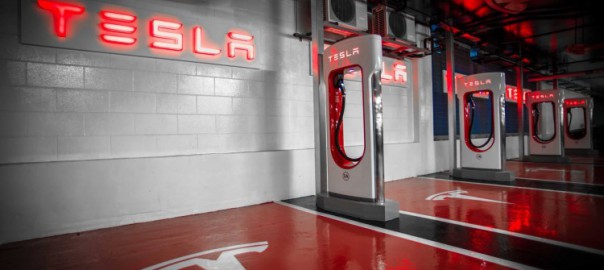
Tesla Supercharging Station at Westfield, London (Image: Tesla)

Tesla opens its largest EV super-charging station with 56 points

Tesla has opened its largest supercharging station in California, to the public with a massive capacity of 56 V3 rated slots to charge the electric vehicle up to 250kW for fast charging.

Standard Tesla vehicles with 85 kWh batteries can fully charge on Firebaugh’s Supercharger station for under an hour only using the solar heat as power. The station is equipped with solar roofs that can significantly block out the Sun’s heat, preventing the car’s interior from rising in temperature and, at the same time, gather those to generate and store power.

Tesla Supercharging Station at Westfield, London (Image: Tesla)

Analyst comment: The massive supercharger with 56 V3 charging points appears to be the largest charging station compared to its previously installed supercharging stations in China, with 50 charging points in 2017. However, this will not hold longer because another massive supercharging station is in line with 64 points in its Gigafactory Shanghai. The 64 charging points would be V3 is not clear yet and will be used for fresh lineup out from Gigafactory production. Tesla will make its 56 V3 supercharging stations available for an electric vehicle from other carmakers such as BMW, Hyundai, Porsche, Renault, and Volkswagen. The solar roof would also ensure that there would be an alternative source of power other than Tesla’s reliance on the existing power lines from the county’s grid.

Read more: FutureBridge

It’s Time to Go Green!

If you would like to know more about Solar Panels and the PowerBanx range of home battery systems, and get a free instant quote, please complete our online form:

Tesla Model 3 (Image: Tesla.com)

BEST 10 PURE-ELECTRIC CARS WITH A RANGE OF 300 MILES OR MORE TO BUY FROM 2021

WHICH ELECTRIC cars can be driven 300 miles or more between charges? When buying a new battery-electric vehicle, a long range is one of the first things a customer will look for.

At the time of the original Nissan Leaf’s launch 10 years ago, the car makers dabbling with pure-electric models were trying to convince us that its official range of 109 miles between charges (less than that in the real world) was more than enough for most drivers.

In a way, it was true — research from 2008, published in the Society of Motor Manufacturers and Traders’ 2011 Electric Car Guide, showed that the average individual journey length in the UK was 8.6 miles and the average total daily distance travelled was 25 miles, while more than 80% of motorists across Europe drove less than 63 miles in a typical day.

And yet “range anxiety” (the fear of running out of charge) was still a major talking point, with many commentators asking, “But what happens if I want to drive from London to Scotland”. Although journeys of that distance aren’t common, a long road trip — say for a family holiday — once or twice a year isn’t out of the question for many households — especially with the coronavirus pandemic forcing us away from air travel.

Elon Musk, the founder of Tesla, was one of the few pure-electric car advocates arguing that drivers shouldn’t just put up with a range of 100 miles or less. He knew that if the tech was going to take off, drivers would need electric cars capable of travelling at least three times as far as the Leaf. He had introduced the Roadster in 2008, which could travel 244 miles according to the American test cycle, and then the Model S (more than 300 miles) in 2012.

Now it seems, the rest of the car industry is catching up. Cars that can go at least 300 miles per charge are becoming the norm rather than the exception, and they’re becoming more affordable, too.

Tesla Model 3 (Image: Tesla.com)

Here are 10 of longest-range electric cars available to buy in 2020/2021.

1. Long range electric cars: Tesla Model S Plaid — 520 miles
The most powerful and quickest-accelerating Model S yet certainly packs some impressive stats, ahead of its production beginning in late 2021.
A teaser video released by Tesla as part of its Battery Day celebrations in September claimed 0-62mph in under two seconds, a 200mph top speed, the ability to cover a quarter mile in nine seconds and 1100hp (1085bhp), intermingled with shots of the much-awaited model sprinting around the Laguna Seca racetrack in 1:30.3 minutes, 6 seconds quicker than a model that the car maker sent round in 2019.
In the era of electric hypercars like the Lotus Evija or the Pininfarina Battista, however, stats like this are nothing new. What is, is an estimated range of 520 miles, which leaves even the Tesla Model S Long Range, second in this list, in its dust. At a price of £130,980 it’s not what you’d call cheap, but it’s a fraction of the price of an Evija or Battista.

2. Long range electric cars: Tesla Model S Long Range Plus — 405 miles
This version of the Model S is already available to buy. It’s the cheapest version of the electric saloon — although, at £74,980, “cheap” might not be an apt descriptor — meaning the Model S is still the standard-bearer when it comes to how far an electric car can go on a single charge.

3. BMW iX — 373 miles
The announcement of the BMW iX was overshadowed somewhat by the red-blooded anger about its looks, which have proved, to put it mildly, polarising. However, beneath the skin is a seriously impressive drivetrain, packing what BMW claims will be a range of 373 miles.
That’s considerably more than any of the electric SUV’s current competitors, including the Jaguar I-Pace, Mercedes EQC and Tesla Model X. How far ahead of its rivals it will be when it goes into production at the end of next year remains to be seen.

4. BMW i4 — 373 miles
The i4 electric coupé represents another step in BMW’s desire to diversify the drivetrain options in its current lineup, as part of what it is calling its “power of choice” mantra. It will share the same electric setup as the aforementioned iX, with the same range.

Read more: The Sunday Times: Driving

It’s Time to Go Green!

If you would like to know more about Solar Panels and the PowerBanx range of home battery systems, and get a free instant quote, please complete our online form:

Tesla Model 3 (Image: Tesla.com)

Electric vehicle acronym guide: Know your BEVs from FCEVs from PHEVs from ULEVs

When it comes to more sustainable driving, there is a whole host of options now and it can be confusing knowing what’s what. In the olden days you pretty much had the choice of diesel or petrol, but with the ever-evolving market of low-emission vehicles, there’s more choice than ever.

When it comes to “EVs,” you can choose from BEVs, PHEVs, HEVs, or FCEVS, all of which are classed as ULEVs. But what do all these acronyms actually mean?

If you need some quick pointers on what all these acronyms stand for and what they refer to specifically, look no further.

BEV
Let’s start with the most common type of EV, and the type of vehicle we usually refer to when we’re talking about EVs: the battery electric vehicle, or BEV.

As the name suggests, a BEV is an electric vehicle that uses batteries to store and deploy power which powers electric motors to drive the wheels. It’s also common to see words like “pure electric,” or “all-electric” when you read about battery electric vehicles.

Popular BEVs include cars like the Nissan Leaf, the whole range of Teslas, the Polestar 2, the BMW i3, Hyundai Kona Electric, Kia Soul EV, VW’s ID.3 and e-Golf, the Jaguar i-Pace — you get the idea.

Tesla Model 3 (Image: Tesla.com)

PHEV and HEV
Plug-in hybrid (PHEV) and hybrid electric vehicles (HEV) are perhaps the most confusing of the partially-electric vehicle world. There’s one key difference, though: plug-in hybrids can be charged up like a battery electric vehicle by plugging-in to an EV charge point, regular hybrids cannot.

It gives you the flexibility to drive and use your PHEV like it was a BEV and not rely on the combustion engine, for very short journeys at least. They typically have very small batteries and are only capable of driving between 30 and 50 miles on all-electric mode.

Popular PHEVs include the Mitsubishi Outlander, Hyundai Ioniq, MINI Countryman PHEV, and the Volvo XC60 T8.

Regular hybrid vehicles (HEVs), like the original Toyota Prius, can’t be plugged in and the only way to charge their batteries is from regenerative braking or by using the engine like a generator.

Some companies have even referred to these vehicles as “self-charging hybrids,” as if not having to plug them in is a benefit. That phrase has been branded as misleading, and Toyota and Lexus ads in EV loving Norway using the tag line have been banned for being misleading. In reality, to charge them, you need to fuel them with gasoline.

FCEV
FCEV stands for, Fuel Cell Electric Vehicle. These are a small offshoot of EVs that use hydrogen fuel cells to create an electrical charge that’s used to power motors that drive the wheels.

Most FCEVs use a small battery or super capacitor to act as a buffer between the fuel cell and the motors to ensure power delivery is consistent and reliable.

Some tout fuel cell vehicles as a better option than batteries for the future of sustainable transport. They can be filled up in the same way as a combustion engine vehicle, hydrogen is the most abundant element in the world, and their only waste product is water vapor.

Read more: TheNextWeb

It’s Time to Go Green!

If you would like to know more about Solar Panels and the PowerBanx range of home battery systems, and get a free instant quote, please complete our online form: