Category Archives: Model S

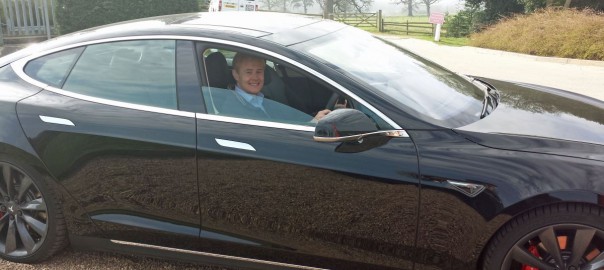
A classic Tesla grin (Image: T. Larkum)

‘Laughing in the face of the congestion charge’ – Zoe Williams meets the Tesla

As more drivers opt for electric, Zoe Williams takes the Tesla Model S for a spin

This is the most unscientific analogy to use about the most incredibly scientific car, but you know when you’ve been out with, say, three Sagittariuses (Sagittarii?) in a row.

You think, each of those was very delightful in their own way, exciting, adventurous, yada yada, but I would not do a Sagittarius again because they’re just too unreliable.

That’s what I always felt about the electric car. Watching the mileage vanish in a BMW i8, 16 miles of charge left one minute, wham, 50 yards later, you’re down to your last four, with a boot full of shopping and no charger in sight; stranded in a service station, halfway between Oxford and Manchester in a Hyundair Ioniq, staring down the barrel of spending three hours next to a plug, smiling half-heartedly at the people checking their tyre pressure.

A classic Tesla grin (Image: T. Larkum)

It just isn’t worth it. This may be the future, but thanks, the future isn’t for me.

And then I met the Tesla; and oh my God, I’d fallen for another archer, except this time, it was also Brad Pitt.

Obviously, this car is the brainchild of Elon Musk, and though there are faults to find in Musk’s temperament and these might predispose you against his invention, forget it. Surrender is inevitable.

Read more: Standard
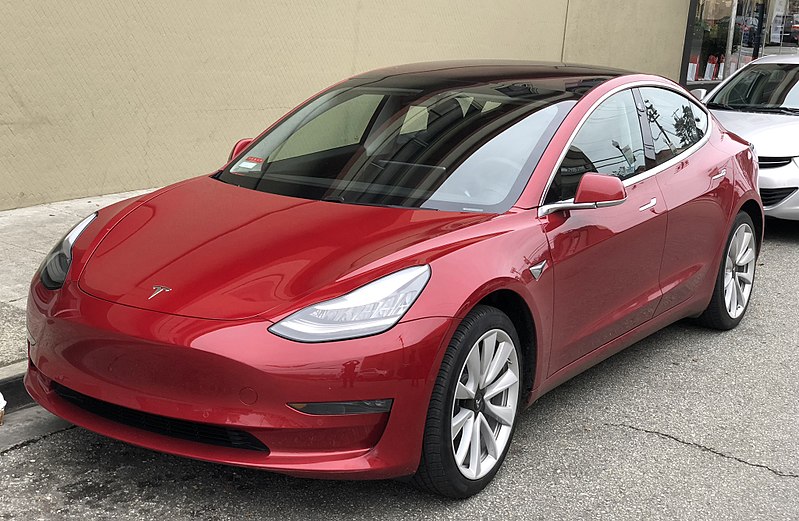
Tesla Model3 (Image: Wikimedia/Carlquinn)

Tesla to open up CCS fast charging for European Model 3, Model S and Model X

Third-party CCS fast charging available to all Tesla Model 3 owners with adaptors coming for Model S and Model X owners

European Tesla Model 3s will come with a CCS (Combined Charging System) fast charging compatible port when they arrive in the early part of 2019. That means that, as well as using Tesla’s own Supercharger and Destination networks, the Model 3 will be able to fast charge on third-party networks such as Polar/BP Chargemaster and Ionity.

Owners of Model X and Model S cars will also be able to use third-party CCS chargers by buying an adaptor that can be plugged into their cars’ existing on-board Type 2 sockets. The new adaptors are expected to be priced similarly to existing CHAdeMO fast-charging adaptors, which cost around €500 (£435), yet will be slightly smaller in form.

Tesla Model3 (Image: Wikimedia/Carlquinn)

Speaking exclusively to Auto Express, Tesla’s head of global charging infrastructure, Drew Bennett, said: “There’s a lot of excitement about Model 3 coming to Europe and charging is always part of that conversation.

“We’ll be continuing to invest in our network – that’s a huge part of the ownership experience. But we’ll be enabling our owners to have access to the CCS networks that are starting to grow in Europe, so the Model 3 will have a charge port for the CCS standard and we’ll also have an adaptor for Model S and X.

“All existing Tesla customers will be able to use the Supercharger network still, but these changes will allow people to venture outside the network – this is something that could really help our owners and is really exciting for us to be able to say that about the infrastructure in Europe.

“We’re all about accelerating the advent of sustainable energy and transportation and this is another way to help everybody scale.”

Read more: AutoExpress

Electric vehicles will be allowed to drive at higher speed limits than gas cars, says Austrian government

A new initiative from the Austrian government is set to reward electric car owners with a unique incentive.

On October 25, the Austrian ministerial cabinet announced that it would be adjusting the speed restrictions for electric vehicles traveling in the country’s IG-L-Hundred zone, which covers a total area of 440 kilometers (273 miles). With the updated rules in place, owners of Teslas and other electric vehicles will be allowed to travel up to 130 km/h (80 mph) on the highway, 30 km/h (20 mph) faster than their fossil fuel-powered counterparts.

Austrian Minister of Sustainability Elisabeth Köstinger noted that the speed limit exception for electric vehicles is part of the country’s initiative to encourage the adoption of sustainable transportation. Together with the adjusted speed limits, the Austrian government is also pushing to open bus lanes for zero-emissions cars, and promote free parking programs for electrified vehicles.

“The exception for electric vehicles in the IG-L-Hundred is an advantage that we want to give owners of e-vehicles to internal combustion engines,” Köstinger said.

While the specifics of the speed limit incentive are yet to be fully announced, the Austrian government’s wording on the program suggests that the exception would be tailor-fit for battery-powered vehicles like Tesla’s electric cars. Köstinger, for one, noted that the top speed advantage would be given to EV drivers over drivers in vehicles with internal combustion engines. With this statement in mind, it appears that hybrid vehicles such as the BMW i8, which are equipped with a internal combustion engines and electric motors, would not be awarded the same top speed incentive.

The country’s EV community would likely appreciate a speed limit incentive for electric cars, and if it proves effective in Austria, there is a good chance that the program would be adopted in other regions as well. Electric cars, after all, emit no emissions regardless of their speed, and with the advent of high-performance vehicles like the Tesla Model S, Model X, and Model 3, EVs are now more than capable of maintaining high speeds for long periods of time. With batteries getting cheaper and better, electric cars will soon be able to travel even farther than before as well. With this in mind, even simple perks like a higher speed limit would likely encourage even more drivers to join the growing electric car movement.

Read more: Teslarati

Demand for used electric vehicles continues to rise

Strong demand for electric vehicles (EVs) saw values rise 0.9% in September, while average used values remained static, says Cap HPI.

Particular strength has been seen for pure battery electric cars with values increasing for as diverse models like the Renault Zoe, BMW i3 and Tesla Models S and X.

At three years and 60,000 miles, average used values didn’t move in September, while newer cars have increased by a negligible 0.1% at the six month and one-year points. Older cars have dropped slightly, but the 0.3% decrease at five-years-old is again negligible.

Read more: Fleet News

Ultra-low emission registrations up 386% on first quarter of 2014 (Image: OLEV)

185,000 Plug-In Cars Were Sold In Europe In First Half Of 2018

June was the second-best month all time for plug-in electric car sales in Europe with more than 38,000 units put on the road.

With year-over-year growth of 37% in June, market share jumped to 2.4% (2.2% for the first half of the year).

The total sales in the first six months nearly hit 185,000 (43% more than a year ago) and it’s expected that more than 400,000 is possible in all of 2018.

Ultra-low emission registrations up 386% on first quarter of 2014 (Image: OLEV)
Ultra-low emission registrations up (Image: OLEV)

The top five best selling models in Europe – for the year are:

  • Nissan LEAF – 3,377 and 17,944 YTD
  • Renault ZOE – 3,425 and 17,016 YTD
  • BMW i3 – 2,002 and 11,301 YTD
  • Volkswagen e-Golf – 1,447 and 9,796 YTD
  • Mitsubishi Outlander PHEV – 2,174 and 9,662 YTD

Renault ZOE this time managed to beat Nissan LEAF and close the gap a little bit in the race for the best selling model.

As usual, the last month of the quarter brings some decent numbers from Tesla – 2,105 Model S and 1,829 Model X in June and 7,699 and 5,600, respectively for the year-to-date.

Read more: Inside EVs

Europe Electric Car Sales Up 37% In June

The European passenger plug-in market continues pushing forward. In June, the continent registered some 38,000 plug-in electric vehicles (PEV), up 37% relative to the same period last year and the continent’s second best performance ever.

That showing pulled the year-to-date (YTD) count to some 185,000 deliveries (+43% year over year, or YoY). In total, the 2018 PEV market share of the overall car market there is up to 2.2% (2.4% in June).

This time, fully electric cars (BEVs) grew slower (+20%) than PHEVs (+55%). Will we see all-electrics bounce back in the second half of the year?

Looking at Europe’s fuel mix, diesel continues to drop significantly (-16% YoY) in a growing market (+5.2%), while all other fuels (including CNG, LPG, …) are on the rise, profiting from the diesel-fleeing stampede. At this pace, the new registrations of diesel-powered vehicles will be virtually dead by 2025.

June saw the Renault Zoe beat the Nissan Leaf for the first time since February, with BEVs continuing to own the top positions. The Tesla Model S, meanwhile, profited from the usual last-month-of-quarter peak to join the top 5. It landed in the #4 position.

The Mitsubishi Outlander PHEV managed to score another top 5 presence as well, winning at the same time the bestselling PHEV award.

Among models that landed in 2018, the best selling one is the Land Rover Range Rover Sport PHEV, which registered 235 units in June, adding to the current 498 registrations made this year.

Read more: Clean Technica

White Tesla Model S (Image: T. Larkum)

Tesla Showroom Opens in Central Milton Keynes

Milton Keynes is probably the leading city in the UK for its support for electric vehicles (EVs). Today I went into the main shopping centre to have a look at the progress on the forthcoming EV Experience Centre.

The new Tesla showroom in the Intu shopping centre (Image: T. Larkum)

On the way I checked out the new Tesla showroom (in the Intu centre) which I hadn’t visited before.

Red Tesla Model S in the new MK showroom (Image: T. Larkum)

I was impressed to see that in the fairly small space they had fitted in a red and a white Model S, and further in a black Model X.

White Tesla Model S (Image: T. Larkum)

Also there was a display of the Powerwall home battery energy storage system, a technology that we are very keen to promote.

Tesla Powerwall display (Image: T. Larkum)

f

What IS ‘one-pedal driving’ in an electric car?

One-pedal driving is rather like the experience of owning an electric car: it can be hard to appreciate until you’ve spend time doing it.

The phrase “one-pedal driving” refers to the ability of some electric cars to be driven almost entirely with the accelerator pedal alone.

It’s a feature much prized by owners of Teslas, BMW i3s, and most recently the Chevy Bolt EV.

And it’s something that everyone should know about, even if you don’t own an electric car. Even if perhaps you won’t completely understand why it would be appealing until you experience it.

One-pedal driving combines conventional acceleration, using the right-hand pedal, with a much higher degree of deceleration than in a conventional car.

That means that when a driver lifts off the pedal, the car slows down more quickly than an internal-combustion-powered car would.

It’s not found in every electric car. Some makers give their electric cars an identical driving experience to conventional vehicles, meaning they drive like an automatic-transmission car that never actually shifts.

Once you’ve acclimatized, the only times you hit the brakes is for emergency situations.

It may sound a little strange, but trust us: once you try it, you’ll never go back.

And then you’ll start to wonder why all cars don’t work that way.

Full article: Green Car Reports

Red Tesla Model S (Image: T. Larkum)

Motorists are moving away from diesel cars and opting for alternatively fuelled cars

Tesla Model S – why its diesel–powered rivals should be very afraid: motorists are moving away from diesel cars and opting for alternatively fuelled cars such as electric or hybrid, suggests new research

New car registrations in the UK achieved a 12-year high in January with 174,564 cars being registered – a 2.9 per cent increase on January 2016.

Figures collected by the Society of Motor Manufacturers and traders show that diesel car sales were down by 4.3 per cent in January.

The reason for the dip in interest for car buyers purchasing diesel cars could be due to the recent emissions scandals that have embroiled companies such as Volkswagen.

The government is now planning a diesel scrappage scheme to encourage motorists to ditch cars that are heavy polluters.

In total there were 78,778 diesel cars registered in January.

It is good news for electric car companies however as the alternatively fuelled vehicle segment grew 19.9 per cent to take a record 4.2 per cent market share.

Red Tesla Model S in the new MK showroom (Image: T. Larkum)
Tesla Model S is one of the cars spearheading the electric car boom (Image: T. Larkum)

Electric cars are becoming increasingly popular as car companies are looking to vehicles powered by alternative and sustainable fuel sources.

Figures show that 7,270 AFVs including hybrids, were sold in January.

Read more: Express