Both the Renault ZOE and the Kangoo Z.E. sell like hot cakes
Renault noted a very strong electric car sales results in June 2019, delivering some 6,418 cars (excluding Twizy), which is 45% more than a year ago.
After six months, sales amounted to 30,659 YTD (up 43%):
Renault ZOE (passenger and commercial versions) – 5,309 (up 49%) and 25,686 YTD (up 44%)
Renault Kangoo Z.E. – 1,036 (up 22%) and 4,759 YTD (up 31%)
Renault Master Z.E. – 73 (up 3,550%) and 214 YTD (up 1,845%)
A great June (the third-best month ever) means that the unveiling of the all-new Renault ZOE Z.E. 50 in mid-June didn’t decrease demand for the outgoing generation of ZOE – at least not immediately.
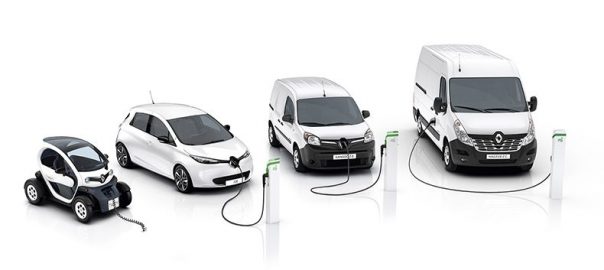
Renault lineup – from left Twizy, ZOE, Kangoo Z.E., Master Z.E.
This past month BEVs accounted for close to 2.4% of all cars sold by Renault globally and 3.9% in Europe (where almost all Renault EVs are sold).
These are interesting times we live in. Electric cars walk the world, and some even make advances in professional motorsports.
The Renault Zoe has new ice to break in this field, though.
The Andros Trophy is an off-season racing series held in France and so far attended exclusively by traditional, fossil fuel-burning cars. The DA Racing team intends to break from that tradition, however. Their experienced driver, Jean-Baptiste Dubourg, will join the next championship behind the wheel of a modded Renault Zoe.
2020 Renault Zoe (Image: Renault)
Modded how exactly? We don’t have the answers yet, but the production car is obviously looking forward to major tweaks and design alterations, especially since freezing weather is known to have an utterly devastating effect on traction battery capacity and performance. So far, finding a workaround is at the top of the priority list.
Typically, when I review a new car, in addition to telling you how it looks, who its competitors are, and how much tech it holds, the main value that I bring to the table (or so I hope) is letting you know how it drives – basically what it feels like from the driver’s seat.
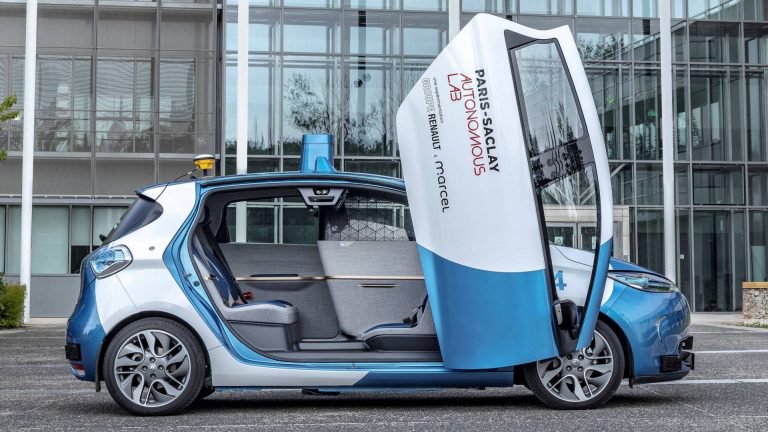
ZOE Cab autonomous vehicle (Image: Renault)
Well, I was rendered largely redundant on this occasion because all I can tell you is what it felt like to be driven around in this vehicle. You see, the car that you see here is Renault’s autonomous Zoe prototype. And I mean fully autonomous – well, sort of. After all, the autonomous Renault Zoe isn’t exactly ready for the chaotic traffic at the Arc de Triomphe roundabout in the heart of Paris as yet. For the moment, it’s restricted to the campus of the University of Paris-Saclay on the outskirts of the French capital. This is part of a pilot project being run by automaker Renault, a public transport multinational, the Transdev Group, technology companies IRT SystemX & VEDECOM and, of course, the University of Paris-Saclay.
…
Where does it operate?
For the moment, the autonomous Zoe will operate within the campus of the University of Paris-Saclay. It’s meant to provide an autonomous shuttle service within the campus for a select group of students and faculty who opt into the program and allow their fate to be determined by this vehicle that has a mind of its own – literally! At present, French law prohibits companies from charging patrons for a service such as this, so it’s voluntary and free of cost.
A plug-in hybrid version of the new Renault Captur SUV will be available when the car goes on sale next year
Details of the all-new Renault Captur plug-in hybrid have been released, with the company confirming a pure-electric range of up to 28 miles.
Due to go on sale in early 2020, the Captur E-Tech Plug-in will use a 1.6-litre petrol engine and two electric motors, complete with a 9.8kWh lithium-ion battery pack.
Captur E-TECH Plug-in (Image: Renault)
It will be capable of doing 83mph in pure-electric mode, and also features advanced brake regeneration that the company says “always retains enough charge to move away and run at low speeds in electric mode”.
The Captur will also have a single-pedal driving mode – similar to the Nissan Leaf’s e-Pedal system – for low-speed traffic, which is designed to maximise efficiency and ease of driving.
Today’s Renault Zoe is one of the most affordable electric cars on sale, but its replacement brings additional tech, a more sophisticated interior and a 236-mile range…
On sale August Price from Around £22,000 (before gov’t grant)
When the current Renault Zoe was launched, it addressed two of the most common complaints about electric cars: the paltry range and high price. But with competition now a lot stiffer, this new version has to push up the former again while keeping down the latter.
Sure enough, while the battery is no larger to ensure it doesn’t eat into passenger space, its energy capacity is up from 41kWh to 52kWh. That results in a 20% improvement in official range, to 236 miles.
2020 Renault Zoe (Image: Renault)
Putting that into perspective, the long-range, e+ version of Nissan’s Leaf can travel just three miles farther, despite costing almost £40k. And the upcoming Peugeot e-208 and Vauxhall Corsa-e both manage only 211 miles.
A full charge of the new Zoe from a 7kW home wallbox takes nine hours and 25 minutes. Or if you’re out and about, 30 minutes plugged into a 50kW public charger gives enough juice for about 90 miles of driving.
Revised model will feature similar styling but a range of interior and tech upgrades
The upcoming facelifted Renault ZOE has been caught testing by spy photographers. It’s likely to be revealed later this year, and will sport a similar look to the current model but is expected to be refreshed revised styling, and interior and tech updates.
2018 – Renault ZOE
Underneath the camouflage wrap, there appears to be a lot of design details carried over from the current ZOE, like the slim headlights, diamond-shaped tail-lights and the overall body shape. However, there are a few minor changes including a redesigned grille, new plastic mouldings that look like air intakes and a restyled rear windscreen. We would expect the ZOE to keep its kinked rear windows, but the camouflage hides these areas. A more aerodynamic shark-fin aerial will also be fitted to the roof.
No pictures of the interior have surfaced yet, but it’s expected that the revised model will offer a very different cabin to the current car. It’s likely to follow the new Clio by having a large touchscreen in the centre of the dashboard. This would be adapted to show driving range and charging information, and the locations of nearby charging points. Other features carried over from the new Clio should include LED headlights, a digital instrument cluster and wireless smartphone charging.
The new Renault EZ-FLEX concept showcased at Viva Tech 2019, was first revealed in April, as an experimental, electric and connected LCV that is compact and easy to handle and features a modular rear design.
Groupe Renault has unveiled an all-new electric light commercial vehicle (LCV) concept, Renault EZ-FLEX, at the recently concluded Viva Tech 2019, in Paris. Designed to be an improved and efficient mobility solution for urban delivery system, the new Renault EZ-FLEX concept was revealed in April 2019, as an experimental, electric and connected LCV that is compact and easy to handle and features a modular rear design, for different applications. In fact, Renault has partnered with La Poste Group, the postal service company in France, for an experimental run and they will work together to develop and further improve this urban delivery ecosystem.
EZ-FLEX Electric LCV (Image: Renault)
Talking about Renault EZ-FLEX, Denis Le Vot, Alliance Director of the Renault-Nissan Commercial Vehicles Division, said,
“With traffic congestion in cities and the rise of e-commerce, urban deliveries are transforming. As a European leader in vans and light commercial vehicles, Groupe Renault is duty bound to continue proposing disruptive solutions. Renault EZ-FLEX, an experimental light commercial vehicle, gives us the opportunity to join forces with La Poste Group, through an innovative and collaborative approach designed to develop and anticipate future practices in urban deliveries.”
Vehicle emissions regulations are meant to promote clean air and reduce carbon dioxide in order to combat climate change.
In Europe, aggressive new rules are also a direct response to a massive diesel-emissions scandal, accelerating the shift to electric vehicles, said Renault CEO Thierry Bolloré.
The tightening of emissions limits has created huge tension in the automotive industry, Bolloré said in Paris at Viva Technology, a flagship European tech conference this week. In 2017, the European Commission proposed reducing CO2 emissions for new cars and vans by 30% in 2030, compared with levels in 2021. The aggressive rules are seen, in part, as an attempt to regain credibility after regulators failed to prevent Volkswagen and other automakers from cheating existing standards.
Bolloré said he was surprised by the backlash on emissions rules following the “dieselgate” scandal: Volkswagen admitted in 2015 that software was used to cheat on pollution tests for as many as 11 million of its diesel vehicles. Later, a host of other automakers, including Renault, were reported to have made diesel vehicles that produced more pollution than tests seemed to indicate.
“It’s not fully rational,” Bolloré said of the regulatory response, which is reshaping the industry. He added that it’s giving a boost to electric vehicle development, and that the French car giant he runs is already making a “modest” amount of money from its electric-vehicle business. (Bolloré also credited Tesla’s efforts to build mass-market electric cars as a kind of revolution for the industry, but noted that the company is having a hard time making money.)
Renault and several partners have started “The Paris-Saclay Autonomous Lab” project which aims to make self-driving transportation a reality in France.
The project aims to develop new mobility services using dedicated lane and public and campus streets to supplement the existing Saclay Plateau transportation systems.
Made possible by Renault’s collaboration with the Transdev Group, IRT SystemX, Institut VEDECOM and the University of Paris-Saclay, the trial program uses three Renault Zoe Cab self-driving prototypes and a Transdev-Lohr i-Cristal autonomous shuttle.
The latter will provide collective transportation service for up to 16 passengers at a time during the night when the regular transportation systems are not functioning. As for the three Zoe Cab vehicles, they will be used for a daytime on-demand car service for the Paris-Saclay urban campus.
ZOE Cab autonomous vehicle (Image: Renault)
People can hail a car or book one ahead of time using a dedicated Marcel smartphone app. A prototype autonomous electric Renault Zoe Cab vehicle will then come to pick up the user and then drop them off at the destination. The service is designed to provide a large number of pick-up and drop-off points, which do not interfere with other traffic and are located near the most frequented campus areas.
The all-electric Renault Zoe Cab and Transdev-Lohr i-Cristal shuttle autonomous vehicles are equipped with GPS-type sensors, Lidar, cameras, inertial units, and self-driving software. The technology enables them to detect other vehicles and pedestrians, safely pass through intersections and roundabouts, detect deceleration and recognize traffic lights. In the specified areas they operate they provide full autonomy, although a “safety operator” is present at all times inside the vehicle.
Renault does not provide additional details about the Zoe Cab autonomous prototype but it’s easy to spot the changes compared to the regular production model. Those include the massive Lambo-style door on the right-hand side which eases access to the cabin thanks to the elimination of the B-pillar. The interior features three passenger seats, two facing forward and one facing rearward, as well as a “driver’s seat” that is isolated from the passenger compartment, presumably for safety reasons.
The China-only Renault K-ZE has the potential to be the Dacia of the electric age, offering a 150-mile range for less than £13,000
Verdict: 4* Decent electric range, reasonable performance and impressive quality standards – all at an affordable price. If Renault could add ESP and bring the K-ZE to the UK for less than £13,000, it could repeat the success it found with Dacia in the early 2000s. In fact, the K-ZE has the ability to surpass all other petrol-powered city cars, which due to upcoming emission standards, won’t be quite so affordable any more.
Solid build quality at “shockingly affordable” prices: that’s how Renault made Dacia such a huge success around the world. Now, Renault is getting ready to repeat this coup with an all-new electric vehicle. In China, the French car maker has just presented the K-ZE, which will be built and sold in the world’s largest EV market this summer – before being rolled out globally at a later date.
Groupe Renault CEO Thierry Bolloré told us: ”This is not a Chinese project. It is a global project”. And even if he won’t mention specific regions, there is no doubt Europe is near to the top of the firm’s list. Especially when conventional cars like the Clio will struggle to meet exacting emissions standards due in the coming years.
Renault K-ZE electric supermini (Image: Autocar)
While most of the industry takes its aim at Tesla, the cheap and cheerful K-ZE is a breath of fresh air. At 3.73m-long, with four proper seats (with a fifth as a spare) and a 300-litre boot, this is a small car with big aspirations. Renault claims a reasonable 150-mile real-world electric range and all for a price of around £13,000 before the usual government subsidies.