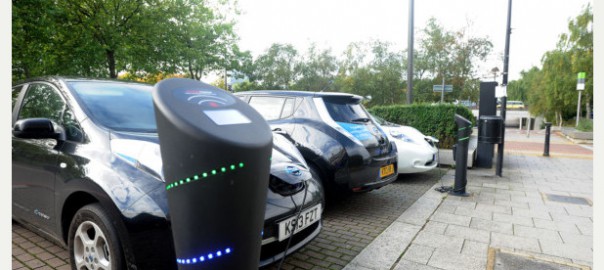
Milton Keynes has probably the greatest concentration of electric car charging points of any location in the world. This arguably makes it the best candidate destination city for electric car drivers anywhere in the world.
Electric cars charging in Milton Keynes (Image: T. Larkum)
Of course, those are difficult statements to confirm since there aren’t international league tables of such things. However, a look at international charge point maps like Plugshare certainly seems to indicate that it has as many standard power charge points (some 170) as other candidate ‘hot spots’ such as Los Angeles in the US and Oslo in Norway. If you look further into the density of high power rapid chargers (56) it appears to win hands down against all comers.
Charge Point Locations
More to the point, however, is that charge point locations are very well organised in Milton Keynes. While in other cities the growth and placement of charge points appears to be organic, i.e. nearly random, they are well placed in MK. Specifically the city centre is arranged in blocks on a grid (in the American style) and charge points are placed along at least one and usually both of the long sides of each block. One block can have as many as a dozen standard speed chargers.
The rapid chargers are arranged more strategically. In the city centre there is one rapid to every one or two blocks. Outside the centre, in the suburbs, there is one to every second or third housing estate.
Rapid Chargers next to Milton Keynes Central railway station (Image: T. Larkum)
The result of having so many charge points in Milton Keynes is that anyone can visit the city in an electric car and be confident of finding somewhere to charge for the return journey. With a typical EV range of 80 miles this means that MK can welcome visitors from as far afield as Southampton in the south, Gloucester in the west and Nottingham in the north – they won’t have to charge on the way in or back home.
Chargemaster / Polar Network
The charge points in MK are part of the Polar network operated by Chargemaster. Therefore to make use of them it’s necessary to use a Polar app or swipe card, either on subscription (Polar Network) or Pay As You Go (Polar Instant).
With that arranged, it is possible to find a charge point near almost anywhere in the city centre. Their locations can be seen on the council’s charge point map (PDF) and on the online Polar Live map.
This makes MK the perfect place for EV owners, whether visiting occasionally for shopping or commuting in daily for work.
Our solar panels occupy only a third of our roof area. Even so, on a summer day they produce about the same power our Volkswagen electric car draws as it charges from a plug in the garage.
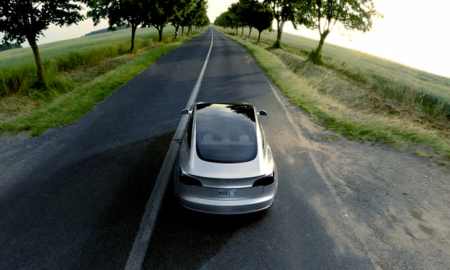
Electric car on the road. ‘We are literally driving on sunshine,’ write James and Lesley Willis. Photograph: EPA
So, to the extent that we top up during the day, we are literally driving on sunshine: nil use of resources, nil pollution, and, in the context of your article (Battery cars may eat up more than Hinkley Point’s capacity by 2030, 13 July), nil load on national power generation infrastructure. Going for a drive in serene, effortless near-silence, knowing that it hasn’t cost anybody anything, is quite simply wonderful.
The rapid increase in the number of distributed solar power installations is producing an unmanageable peak on sunny days. But our experience illustrates that there is an excellent match between renewable energy and electric vehicles. Electric cars are big batteries on wheels, storing far more power than they need for journeys. They could be made to play a dynamic part in balancing the uneven generation inherent in many forms of renewable energy.
James and Lesley Willis
Alton, Hampshire
Zoe Williams suggests (Is a car maker about to save the planet? 10 July) that “the goal has to be an electric car powered by renewable energy”. A seemingly admirable aim but one that implies that the only problem is atmospheric pollution. Unfortunately, the motor car also encourages sprawl, making our cities less compact and sustainable and resulting in healthy travel alternatives (walking, cycling, public transport) becoming more difficult. It divides communities, both by splitting them with transport corridors and by isolating users in their car bubbles. It maims and kills, which may become more of an issue, as electric cars are quieter. It requires road space that is increasingly not available, causing issues from congestion and excessive travel time to access and pavement parking. And, given that a high percentage of pollution in the life-cycle of a car is in its production, how much is actually avoided?
A shift of emphasis to electric cars will raise supply challenges for both components suppliers and talent managers.
Last orders’ has been called for the internal combustion engine.
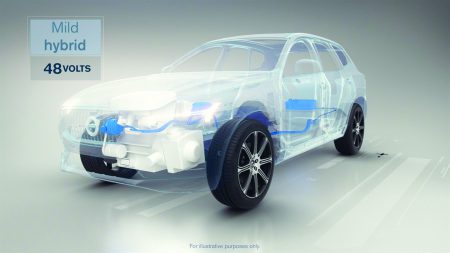
Volvo hybrid car concept
Just a day after Volvo announced plans to include an electric motor element in all its cars, the new French government said it will legislate to phase out non-electric vehicles.
This will not be an overnight transformation. Volvo has said that all new cars from 2019 will be either fully electric, hybrid or what it calls “mild hybrid”.
The French government’s 2040 deadline is sensibly long-term, given that in France only 1.1% of new car registrations last year were for fully electric vehicles and in the whole of the EU the number was just 0.6%.
But make no mistake – this is a big shift. Other countries will follow France’s lead; other car makers will follow Volvo in the footsteps of Toyota, Tesla and others.
Manufacturers of electric cars seek talent
For the electronics sector, it’s a big deal too. The automotive industry is already a major employer for electronics engineers as in-car electronics become increasingly sophisticated.
Jaguar Land Rover’s recent campaign to recruit 1,000 engineers is testament to how hard they have to work to recruit already, but as the market shifts more to electric vehicles it will surely soak up even more of the talent pool.
Growing demand for components from tier one automotive firms has been mooted as one cause of strong sales and extending lead times in the market. This is before the shift to electric really takes hold, so expect massive changes as the market adapts.
How stakeholders in the electronics supply chain adapt to the challenge will be a defining factor in our attempts to break our addiction to oil.
There are many incentives available to encourage drivers to move from polluting petrol and diesel cars to electric cars. They come from national and local government, car manufacturers, suppliers and independent organisations.
Electric Car Line-up (Image: Go Ultra Low)
Here we provide a brief summary of the main incentives currently provided to electric car drivers by the national government.
UK Government
Plug-in Grants
The UK government provides a grant off the cost of a new electric car as follows:
£4500 off cars with ‘CO2 emissions of less than 50g/km and can travel at least 112km (70 miles) without any CO2 emissions at all’. Examples include the Nissan Leaf, Renault ZOE, BMW i3 and Hyundai IONIQ Electric.
£8000 off vans with ‘CO2 emissions of less than 75g/km and can travel at least 16km (10 miles) without any CO2 emissions at all’. Examples include the Mitsubishi Outlander Commercial, Nissan e-NV200 and Renault Kangoo ZE.
Note that the grants are capped at 35% of the purchase price for cars and 20% for vans. Plugin Hybrids (PHEVs) with a retail price above £60,000 are not eligible (including the BMW i8 and Porsche Panamera).
There are three grant schemes available to help fund the cost of installing charge points:
The Electric Vehicle Homecharge Scheme (EVHS) provides grant funding of up to 75% towards the cost of installing electric vehicle chargepoints at domestic properties across the UK.
The Workplace Charging Scheme (WCS) is a voucher-based scheme that provides support towards the up-front costs of the purchase and installation of electric vehicle charge-points, for eligible businesses, charities and public sector organisations.
The On-street Residential Chargepoint Scheme (ORCS) provides grant funding for local authorities towards the cost of installing on-street residential chargepoints for plug-in electric vehicles.
The Homecharge Scheme is the one that’s relevant for most electric car owners. Essentially it means that you can get a charge point installed at home for a few hundred pounds rather than at the full price of nearer £1000. For more details see Government Grant for Electric Car Home Charge Point.
Vehicle Excise Duty (‘Road Tax’)
Vehicle Excise Duty (VED), also known colloquially as ‘road tax’, is a tax levied by the government on every vehicle on British public roads, and collected by the Driver and Vehicle Licensing Agency (DVLA). Major changes have been introduced for vehicles registered after 1st April 2017.
The current situation can be summarised as follows:
All-electric cars are exempt from VED (they pay at a rate of £0 per year) if they have a list price of less than £40,000.
Conventional cars and plugin hybrids are charged in the first year at a rate that depends on their emissions. Plugin hybrids are charged £10 less than conventional cars.
Thereafter conventional cars are charged £140 per year while plugin hybrids are charged £130 per year.
All vehicles with a list price of more than £40,000 pay an additional £310 per year for 5 years from the second year. For electric cars this mostly affects the Tesla Model S and Model X, but could impact high end versions of the BMW i3 and Mitsubishi Outlander, for example.
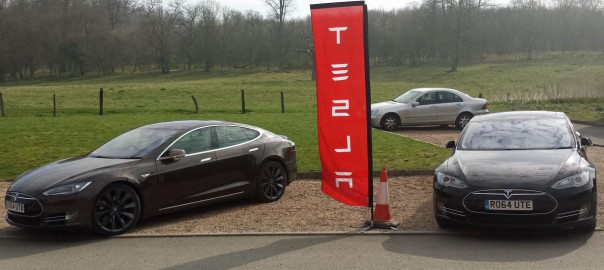
Tesla Model S – tax is boring but electric cars are not (Image: T. Larkum)
Company Car Tax (‘Benefit in Kind’)
If you have use of a car for personal transport, and that car has been supplied by your employer, it will be considered a taxable perk by HMRC – a ‘benefit in kind’ (BIK). The Benefit-in-Kind (BIK) is then taxed at your appropriate personal tax rate (usually collected through PAYE).
Petrol and diesel BIK rates depend on the car’s CO2 emissions, and there is a large matrix of rates covering different emission categories up until the scheme changes again in 2020. In summary:
Petrol cars are in the range 13% (technically 9% but see below) for low emissions to 37% for high emissions in 2017 (but starting at 16% in 2018 and 19% in 2019).
Diesel cars are in the range 20% to 37% in 2017 (but starting at 22% in 2018 and 25% in 2019).
All-electric cars are at 9% in 2017 (13% in 2018 and 16% in 2020)
From this we can see that all-electric cars are effectively taxed the same as a very low emission petrol car. However, in practice there are no conventional petrol cars that have such low emissions – they are all plugin hybrids – so in effect all-electrics and most PHEVs are taxed at the same rate of 9%, and the smallest petrol car and biggest PHEVs (e.g. Mercedes C350e) will start at 13%. A typical petrol car like a Ford Focus will be taxed at something more like 30%.
Note that proposed tax changes for 2020-21 are generally even more favourable for EVs, with the BIK being determined by the electric range. It could be as low as 2% for EVs with a range greater than 130 miles (and 5% for a range greater than 70 miles).
Of course, tax is always a complex issue and you should take advice on your personal situation.
Update: We’ve added a blog post about capital allowances for businesses here.
It seems like most major car retailers are jumping into the electric vehicle game.
Let’s talk about one of our favourite things: cars. And more specifically, how the internal combustion engine is on the verge of extinction.
Not only that, but we’re also being told that in five years we’re going to be driving self-driving cars. OK, that’s not accurate. They will be driving us — or at least a lot of us.
Unless you were at the beach and had your head buried in the sand because of worries about Russia’s determination to wipe out democracy on the planet, you undoubtedly heard that Volvo will stop making cars that run solely on gasoline.
Volvo announced that starting in 2019 all new models it introduces will be either hybrids or vehicles powered solely by batteries. While the new electric cars will initially be made in China, where air pollution is critically dangerous, a new plant is being built near Charleston, S.C., and some will be built in Europe.
Tesla, the posh electric car maker, plans to sell hundreds of thousands of new electric models priced at “only” $35,000, which is substantially less expensive than most of the flashy vehicles it currently sells. The new cars will be serviced at 250 centers that don’t charge service fees! If you live too far from a service center, Tesla will send one of its 350 special vans to your home or office to repair your vehicle on site! The vans will have toys for children, espresso machines and, you won’t believe this, replacement parts. I know. I know. Except for the sticker shock, it seems like heaven.
Tesla, which makes nowhere near the number of cars that Ford and General Motors produce, earlier this year beat the two auto behemoths in stock market value because investors think the future is in electric vehicles. Part of this is urban congestion and part of it is climate change — carbon dioxide from burning gasoline depletes the ozone layer, playing havoc with climate patterns around the globe.
We have recently seen several projections about the adoption of electric vehicles from different companies and research groups, like Morgan Stanley, Bloomberg, and even OPEC. Most of them predict that about half of new vehicle production will be electric at some point between 2035 and 2040.
Now Tesla CEO Elon Musk jumps in with his own prediction, which is unsurprisingly much more aggressive.
At the National Governors Association today, Musk said that he expects “more than half of new vehicles” will be electric in the US within the next 10 years or roughly 10 to 15 years ahead of most predictions. He said:
“I think things are going to grow exponentially. There’s a big difference between 5 and 10 years. My guess is probably in 10 years more than half of new vehicle production is electric in the United States.”
We gave a similar prediction back in May when Morgan Stanley projected that electric vehicle sales will surpass gas-powered cars by 2040. We suggested that due to rapidly falling battery costs, there will be a point between 2020 and 2025 when all-electric powertrains reach cost parity with internal combustion engines before accounting for the cost of operation (gas and maintenance savings).
At that point, there will be virtually no reason for buyers to want gas-powered cars over battery-powered cars and automakers will divert all their investments to electric vehicles.
Musk specifically referred to new vehicles coming to market in the US – stating that it will take a few more years until all production is electric and then a few more to replace the existing fleet.
Interestingly, Tesla’s CEO added that it will likely happen even sooner in China, where they have been more aggressive with their regulations. He even referenced the fact that virtually all automakers (except for Tesla) are asking the Chinese government to slow down their electric car mandate.
Furthermore, while he expects over 50% of new vehicles to be electric in the US within 10 years, he thinks that “almost all” new vehicles will be autonomous within the same timeframe. Add another 10 years and he thinks that all vehicles will not even feature a steering wheel anymore.
For months, politicians and fossil fuel industry have lied about the viability of renewables. Now Tesla’s big battery in South Australia will prove them wrong
Elon Musk’s agreement to build the world’s largest battery for South Australia isn’t just an extraordinary technological breakthrough that signs coal’s death warrant. It’s potentially a game changer in the way we do politics, reinserting the importance of basic reality into a debate which has been bereft of it for too long.
There’s been a lot written in recent years on the idea that we are living in a “post-truth” world. Climate writer David Roberts brought it to my attention around 2010, when I was grappling with the idea that dinosaur politicians and rent-seeking corporates not only weren’t telling the truth about climate change and energy: they were actively dismissive and destructive of the very idea of truth.
While we got a taste for it in Australia under Tony
“don’t believe anything I haven’t written down”
Abbott’s government, the idea sprang into the global mainstream last year with Donald Trump’s election campaign and the Brexit bus.
It seemed that truth no longer mattered. Facts were not just unimportant, but barriers to be smashed through with rhetoric. Demonstrating beyond reasonable doubt that a politician was lying no longer had any impact. Even when people agreed that he (usually) was lying, they still supported him, because he activated a frame or a value that drove their political decision-making.
OPEC quintupled forecast for battery powered cars in last year
Oil majors and automakers diverge on outlook for EVs
The world’s biggest oil producers are starting to take electric vehicles seriously as a long-term threat.
OPEC quintupled its forecast for sales of plug-in EVs, and oil producers from Exxon Mobil Corp. to BP Plc also revised up their outlooks in the past year, according to a study by Bloomberg New Energy Finance released on Friday. The London-based researcher expects those cars to reduce oil demand 8 million barrels by 2040, more than the current combined production of Iran and Iraq.
Growing popularity of EVs increases the risk that oil demand will stagnate in the decades ahead, raising questions about the more than $700 billion a year that’s flowing into fossil-fuel industries. While the oil producers’ outlook isn’t nearly as aggressive as BNEF’s, the numbers indicate an acceleration in the number of EVs likely to be in the global fleet.
“The number of EVs on the road will have major implications for automakers, oil companies, electric utilities and others,”
Colin McKerracher, head of advanced-transport analysis at BNEF in London, wrote in a note to clients.
“There is significant disagreement on how fast adoption will be, and views are changing quickly.”
BNEF expects electric cars to outsell gasoline and diesel models by 2040, reflecting a rapid decline in the cost of lithium-ion battery units that store power for the vehicles. It expects 530 million plug-in cars on the road by 2040, a third of worldwide total number of cars.
More battery-powered vehicles would mean cleaner air and quieter streets – but also a drain on the National Grid and less fuel duty to the Treasury
Streets will be quieter, the air will be cleaner, people will spend less time at petrol stations and car factories might even return to Britain’s shores if the country switches to electric cars in a dramatic, widespread fashion.
But widespread adoption of battery-powered vehicles would not be without challenges too. A large-scale switchover to electric cars could create problems for power grids, could mean roads lined with charging poles and it could also leave a big hole in public coffers as fuel duty dries up.
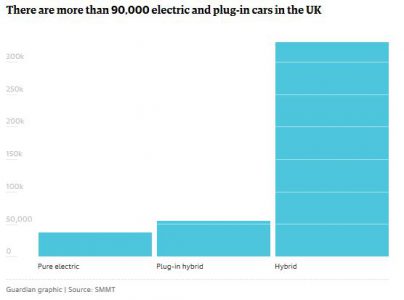
With just over 90,000 fully electric and plug-in hybrid cars now on UK roads, such risks and benefits might look a way off.
But this week big changes have been announced. On Wednesday Volvo said it will only launch electric or hybrid cars from 2019 and just a day later Emmanuel Macron’s new government pledged that France will ban diesel and petrol cars by 2040. Battery-powered travel could be coming far sooner than previously thought.
According to research published this week by Bloomberg New Energy Finance the proportion of fully electric new cars sold in the UK will be one in 12 by 2030 – up from one in every 200 today.
The surge in electric cars will have to be accompanied by thousands of new charging points to plug them all in.
Today there are around 4,000 publicly accessible locations with 13,000 plug sockets. Of the 13,000, a fifth are so-called rapid charging connections that will top up a Nissan Leaf, the UK’s best-selling pure electric car, in half an hour.
More electric and plug-in hybrid cars were registered during the first half of 2017 than in any previous six-monthly period.
More than 22,400 plug-in models were registered between January and June 2017, a rise of 14.3% on 2016 and 53.8% up on the same period in 2015.
June exceeded all previous non-plate-change months with 4,405 new plug-in models sold during the month (33% up on June 2016). Demand from private buyers has driven growth with 44.9% more consumers opting for plug-in hybrid and electric power between January and June 2017, compared to the same period last year.
Transport minister Jesse Norman said: “It is great to see that electric and plug-in hybrid cars are helping more UK motorists to cut fuel costs and emissions.
“The total number of plug-in cars on our roads is at record levels, with the latest figures showing that there are now over 100,000 plug-in cars and vans registered in the UK.
“The UK is a world leader in tackling climate change and the Government is committed to supporting the transition to a low carbon economy and improving air quality. Our aim is that nearly all cars and vans on our roads are zero emission by 2050.”
The Nissan Leaf was the UK’s best selling plug-in car in the first six months of 2017, while BMW’s plug-in hybrid 3-Series saloon was one of the year’s biggest growers, rising 79.9% following its launch last year.
Poppy Welch, head of Go Ultra Low, said:
“Month after month we’re seeing record levels of registrations, demonstrating that the public awareness and appetite for electric and plug-in vehicles is growing.
“They are fast becoming a serious consideration for an increasing number of motorists who are switching on to the cost-saving and environmental benefits of driving an electric car.”