Category Archives: Electric Cars

News and reviews of the latest electric cars (full electrics and plug-in hybrids).

MINI Cooper Concept (Image: MINI)

BMW unveils electric Mini as it charges into new era

New model will have list price of £24,400, with first deliveries expected in early 2020

Six decades after the original Mini first rolled off the production line in Oxford, its owner BMW has unveiled a new electric version it hopes will herald a new era – and help the German carmaker meet looming EU emissions targets.

BMW said it had 15,000 expressions of interest before order books open on Tuesday. The first deliveries to customers are expected in the first quarter of 2020, with a list price of £24,400, after the government’s plug-in car grant of £3,500 has been applied.

MINI Cooper Concept (Image: MINI)

The investment in the new Mini will preserve the jobs of about 5,000 workers at the Oxford plant at an uncertain time for an industry awaiting Brexit clarity. The plant produced 234,501 Mini and Mini Clubman cars in 2018, an increase of 4.8% year on year.

While the original Mini was built by the British Motor Corporation in response to fuel rationing following the Suez crisis of 1956, the latest version will help BMW, which relaunched the Mini brand in 2000, reduce the average emissions of the cars it sells to meet EU carbon dioxide emissions limits.

Oliver Zipse, the BMW board member in charge of production, said: “We are entering an era in which electric cars will become a normal choice for our customers.

“The Mini Electric will kick off our new model offensive for fully electric vehicles.”

Read more: The Guardian
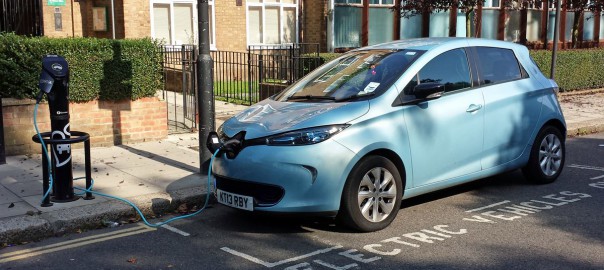
Slow Charging the ZOE at Highgate (Image: T. Larkum)

On-street charging gets £37m boost from Government

Department for Transport announces funding for 12 projects to help drivers charge on streets

The Government is to invest £37 million in a series of schemes designed to help drivers with no off-street parking charge their electric vehicles.

It’s thought that up to 45% of people in the UK don’t have access to their own driveway or private parking, but 90% of ‘charging events’ are estimated to take place at home.

Meanwhile, only households with private parking currently qualify for the Office for Low Emissions Vehicles’ wallbox grant, which contributes up to £500 towards the total cost of installation.

Slow Charging the ZOE at Highgate (Image: T. Larkum)

A dozen projects will share the £37 million fund, with each having passed a three-month feasibility study as part of the Government’s Future of Mobility Grand Challenge.

Char.gy – which opened the first lamp post chargers in London last year – has been given £2.3 million to develop wireless chargers for residential streets.

Consultants Urban Foresight secured £3 million to deploy pop-up chargers that rise up from the kerbside, a project that’ll see Virgin Media helping to monitor usage.

Other projects include the installation of multiple chargers in car parks in order to enable “mass charging” of electric cars at night, while “solar forecourts” – which use solar panels to power charging facilities – will also benefit from funding.

Read more: Driving Electric

Figure 4: Charging on Christmas Day (Image: T. Larkum)

More than 1.5 million UK households could go electric without compromise

Millions of buyers are in the perfect position to buy an electric car, research by What Car? has found…

Electric car ownership is the right choice for at least 1.5 million UK households today, according to new research by What Car?. That’s the number of multi-car homes in the UK with a sweet-spot combination of off-street parking for home-charging and at least one vehicle that never does more than 100 miles in a single journey.

What Car? approached 2310 current electric vehicle owners and a further 23,500 non-EV owners to understand how they used their cars on an everyday basis.

The research found that 17% of multi-car households have at least one vehicle that never makes a journey of more than 100 miles. Overlaying these numbers with the percentage that have a driveway for home-charging (88%), What Car? calculated that 1.56m households – of the 27m in the UK – could convert to a pure electric vehicle without any compromises today. This figure is set to increase as charging infrastructure and electric vehicle range increases in future years.

Figure 4: Charging on Christmas Day (Image: T. Larkum)

To further support the arguments for purchasing an electric car, a surprising two-thirds of households that already have one, as well as a traditional petrol or diesel vehicle, say they now use the EV as their main vehicle.

2019 has been labelled the year of the electric vehicle, with no fewer than 19 different pure battery powered cars hitting the showrooms. The latest is the Oxford-built all-electric Mini Electric, which launches this week. It is being revealed just months after What Car? awarded its coveted Car of the Year accolade to the all-electric Kia e-Niro – the first time that an electric car has won the award.

Read more: What Car

Ubitricity charging post demonstrator at CENEX show (Image: T. Larkum)

£37 million in government funding earmarked for EV charging innovation

Twelve electric vehicle (EV) charging projects, including wireless charging and solar powered forecourts, are set to receive a share of government funding totalling £37 million.

Over £2.3 million has been awarded to Char.gy for the development and deployment of wireless charging on residential streets in Milton Keynes, the London Borough of Redbridge and Buckinghamshire County.

The project is in collaboration with the Open University and The University of Warwick’s Warwick Manufacturing Group. Char.gy has previously worked with Southwark Council to install a network of 50 lamppost chargers.

Ubitricity charging post demonstrator at CENEX show (Image: T. Larkum)
Lamp post charging demonstrator at CENEX show (Image: T. Larkum)

Richard Stobart, Char.gy CEO, said the company is “excited” to help accelerate the uptake of EVs through its ability to retrofit to existing vehicles and enable several parking bays per lamp column “without the need for cables”.

Over £3 million has been awarded to a project for the roll out of ‘pop up’ chargers built into pavements in Plymouth and Dundee, with the aim to provide a solution for drivers without access to off-street parking. Urban Electric, along with partners Urban Foresight, Co-wheels, Duku and Appy parking, is to conduct the project.

Read more: Current News

Charging with an Ohme smart charging cable

Octopus Energy and Ohme launch smart EV charging cable

Octopus Energy and Ohme have collaborated to offer smart EV charging to customers, with the energy company’s time-of-use tariff and the new Ohme cable reducing charging costs.

The cable will manage a customer’s charging depending on requirements, and optimising the process to make the most of the Agile Octopus tariff. Customer’s open Octopus’ app, set their requirements – such as ‘On weekdays, charge my car battery to 100% by 7am’ – and Ohme then uses the energy company’s API to automatically draw the right amount of electricity when it is cheapest.

Charging with an Ohme smart charging cable

Estimated cost savings could see those using the Ohme cable and Agile Octopus tariff reduced by £300 per year, compared to charging on a typical standard energy tariff. This not only reduces costs for customers on the smart time-of-use tariff, but also reduces load on the grid.

The cable manages to turn any home or public untethered EV charge point effectively into a smart unit, and costs £399. The first 1,000 Octopus Energy customers will get a special launch price of £199.

The cable can feed back a Green Score to drivers, calculating CO2 consumption per mile, and also a cost per mile summary. It can manage an EV driver’s energy usage and sets charging preferences such as daily commutes or regular trips.

Read more: Zap-map

The sun sets on drilling (Image: Pexels)

Redefining Geopolitics in the Age of Electric Vehicles

Oil has played a pivotal role in shaping geopolitics for more than a century. But the rise of electric vehicles and shift toward cleaner fuels means that the world’s dependence on oil could begin to shrink, with both expected and unexpected consequences.

Most countries are not prepared for the consequences of this transition, according to E3G’s new report Rules of the Road: The Geopolitics of Electric Vehicles in Eurasia. The biggest sources of conflict will not come from the places security and foreign policy analysts instinctively look, like the struggle to control valuable mineral resources. Rather they will emerge from the need to navigate the social impacts of the energy transition, including supply chain disruption, employment impacts, and trade disputes.

The sun sets on drilling (Image: Pexels)

Fast-growing Electric Vehicle Market

Electric Vehicle (EV) sales have been growing at a rapid pace—between 40 percent and 50 percent per year, according to McKinsey. Even conservative forecasts show significant growth in EV adoption over the next several decades, with some projections showing EV penetration rising high enough to flatten oil demand from 2020 to 2030. Oil demand could fall steadily thereafter.

This shift could occur much faster than mid-range forecasts predict. The world’s largest independent energy trader has predicted peak oil demand in 15 years and signaled it intends to focus on clean fuels and power trading. Many of the international oil companies (IOCs) now are getting involved in EV markets or supply chains. Several of the world’s largest economies, including France and the UK, have set phase-out targets for internal combustion engine vehicles, and car companies collectively have announced that they are investing more than US$100 billion new EV models. It’s also worth noting that most forecasts have consistently underestimated EV deployment and other clean energy technology adoption rates.

Read more: New Security Beat

Sales of EVs soar by 61% amidst charging expansions

Sales of battery electric vehicles (BEV) in the UK have soared by 61%, according to new figures released by the Society of Motor Manufacturers and Traders (SMMT).

Last month 2,461 BEVs were registered, going up from the 1,522 registered in the June of 2018.

Overall sale of vehicles dropped by 4.9%, with the worst hit being plug-in hybrid electric vehicles (PHEV), which fell by 50.4%. This places BEVs and PHEVs almost level, with BEVs now making up 1.1% of the market, up on the 0.6% of 2018, and PHEVs making up 1.0%, falling from 1.9%.

This comes at a time when EV charging in the UK is undergoing rapid expansion, with the number of charging sites overtaking petrol stations in May. Ultra-rapid 150kW chargers are also finding their way onto the market, with Shell claiming the first UK install of a 150kW charger and BP Chargemaster revealing plans to install 150kW chargers across its Polar network.

Read more: Current News

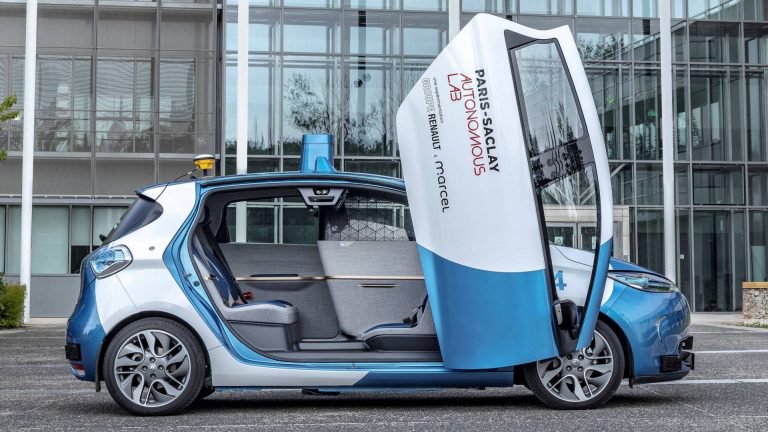
ZOE Cab autonomous vehicle (Image: Renault)

Renault Zoe Autonomous Review: First Drive

How far is your car from driving itself?

Typically, when I review a new car, in addition to telling you how it looks, who its competitors are, and how much tech it holds, the main value that I bring to the table (or so I hope) is letting you know how it drives – basically what it feels like from the driver’s seat.

ZOE Cab autonomous vehicle (Image: Renault)

Well, I was rendered largely redundant on this occasion because all I can tell you is what it felt like to be driven around in this vehicle. You see, the car that you see here is Renault’s autonomous Zoe prototype. And I mean fully autonomous – well, sort of. After all, the autonomous Renault Zoe isn’t exactly ready for the chaotic traffic at the Arc de Triomphe roundabout in the heart of Paris as yet. For the moment, it’s restricted to the campus of the University of Paris-Saclay on the outskirts of the French capital. This is part of a pilot project being run by automaker Renault, a public transport multinational, the Transdev Group, technology companies IRT SystemX & VEDECOM and, of course, the University of Paris-Saclay.

Where does it operate?

For the moment, the autonomous Zoe will operate within the campus of the University of Paris-Saclay. It’s meant to provide an autonomous shuttle service within the campus for a select group of students and faculty who opt into the program and allow their fate to be determined by this vehicle that has a mind of its own – literally! At present, French law prohibits companies from charging patrons for a service such as this, so it’s voluntary and free of cost.

Read more: AutoX

Volkswagen ID.R breaks 20-year-old Goodwood hillclimb record set by V10 F1 car

Volkswagen has been racking up EV records with its ID.R all-electric racecar, and today the VW ID.R piloted by Romain Dumas managed to beat a record which has been held for 20 years — Nick Heidfeld’s record run of the Goodwood hillclimb in the 10-cylinder McLaren MP4/13 which dominated the 1998 Formula 1 season.

Nico Rosberg Formula E Gen2 car at 2018 Berlin E-Prix (Image: Wikimedia/KAgamemnon

The previous record was 41.6 seconds for the 1.86km (1.16mi) hillclimb course. Volkswagen managed to bring that record down to 41.18. They have more runs to go this weekend, so it’s entirely possible that the record might be lowered again.

VW brought their ID.R to the hillclimb last year in an attempt to set the record, and they managed to set an EV record with a 43.05-second run but fell short of the overall record. This year, after taking the ID.R to Nurburgring and setting an EV record there, VW modified their package a little and managed to make the car quicker. In the last year VW also managed to set an all-time record at Pikes Peak with the ID.R.

Read more: Electrek

Electric cars exempt from company car tax next year

UK’s million or so company car users will escape Benefit-in-Kind tax if they have an electric car in the 2020/21 financial year

Company car users who drive an electric car will not have to pay any Benefit-in-Kind (BiK) tax during the next financial year, after the Treasury reviewed tax rules.

The change follows the introduction of the WLTP (Worldwide Harmonised Light Vehicle Test Procedure) emissions regulations, which are more stringent than the NEDC regime they replaced. Because BiK rates are based on CO2 outputs, and WLTP sees higher on-paper emissions recorded, company car users faced a potentially significant hike in the BiK rates they faced.

To offset that rise, the Treasury has replaced previously published BiK rates for the 2020/21 financial year with new tables that see most BiK percentage bands reduced by two points.

Electric cars were due to get a two per cent BiK rate in 2020/21, so the changes will mean drivers choosing an EV as their company car will pay no Benefit-in-Kind rate whatsoever for that financial year. The tax exemption applies to EVs registered from 6 April 2020, and those registered before that date.

Read more: Auto Express