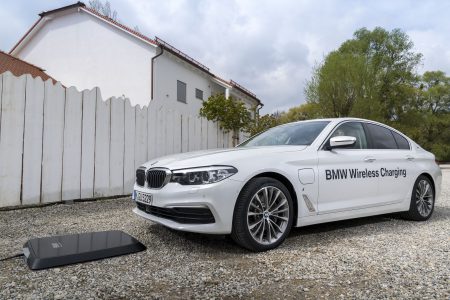
BMW has announced wireless charging will be added as an option for the 2018 model year 530e iPerformance plug-in hybrid.
BMW 530e iPerformance – wireless charging
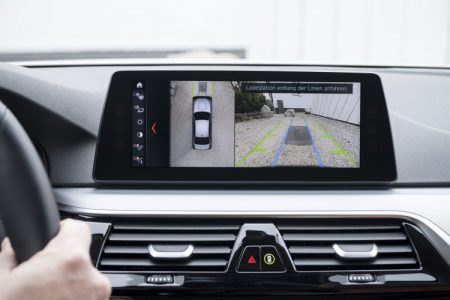
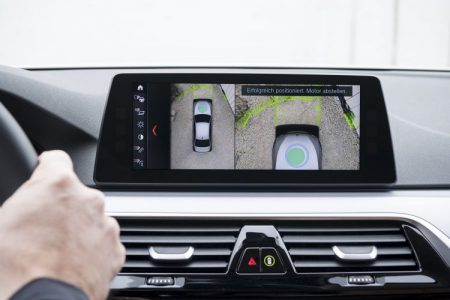
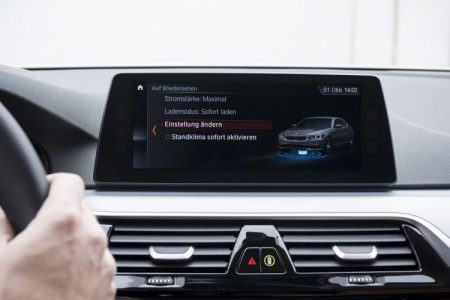
The 3.2 kW wireless system will be integrated with the 530e’s on-board infotainment system to show the charger’s alignment on the screen.
The conventional system of charging for the 530e (ie-plugging it in yourself) is rated at 3.7 kW, that can replenish the BMW’s 9.2 kWh battery in less than three hours using a wall box.
From electric socket, while charging power is limited due safety reasons/output limits, charging takes about five hours.
The 3.2 kW wireless system would take a little over three hours to charge the battery.
“In addition, BMW Wireless Charging for the high-voltage battery will be made available as an option for the BMW 530e iPerformance from 2018. This technology allows energy transfer to take place without the use of cables.
Presented by BMW in prototype form, the system consists of a base pad with integrated primary coil – which can be installed in a garage, for example, but also in the open – and a secondary coil integrated in the underside of the vehicle. An alternating magnetic field is generated between the two coils, through which electricity is transmitted without cables or contacts at a charge rate of up to 3.2 kW.
This form of power supply to the high-voltage battery is extremely convenient for customers and involves a charging time of around three-and-a-half hours.”
The growing popularity of electric vehicles makes it difficult to remember when the environmentally friendly automobiles were considered appropriate solely for short local trips.
Today, an increasing awareness of the connection between cars and climate change, coupled with a growing number of electric car charging stations is inspiring a surge in electric car use around the world.
Europe is the current frontrunner in the global race to increase electric car use, with Norway leading the charge. Having stated that they plan to eliminate using all fossil fuel powered vehicles by 2025, the Scandinavian country offers residents an array of incentives designed to make the switch to electric vehicles easy.
While Europe is embracing electric vehicles, the current world leader for electric car use is China. With their sights set on the future, China is focused on achieving their reported goal of deploying 5 million electric vehicles by 2020. To date, there are approximately 600,000 electric vehicles on the road in China.
The surge in electric car use has prompted the rapid installation of electric car charging stations worldwide. Once limited to a radius of approximately 100 miles per charge, some new generations of electric vehicles are promising that a full charge will last for approximately 200 miles.
In addition to the increased power of electric vehicle charges, electric car charging stations are also improving. A full charge, which can take approximately eight hours, can now be accomplished in little over 15 minutes by using quick charging stations.
While there are still challenges, such as under supported power grids, obvious next steps will be for countries to enhance their power grid to prevent brownouts due to the high volume of people charging vehicles.
It is still early days for electric vehicles (EV), but with more motorists reaping the benefits of electric driving, the market is growing.
Total plug-in car registrations for 2016 passed the sector’s 2015 total, while the Government’s pledge to invest £35m in the ultra-low emission vehicle sector will help ensure that development of the UK’s EV charging infrastructure keeps pace.
Improvements in battery technology mean that pure EVs can now travel around 100 miles on a full charge, while plug-in hybrids (PHEVs) and range extenders enable vehicles to travel several hundred miles.
Phil Gilbert, director of energy solutions at E.ON, says:
“We’re seeing huge growth in the number of new electric vehicles on the road, including hybrid technologies and pure electric vehicles from manufacturers such as Tesla, BMW and Mitsubishi.
“As this growth continues, we want to offer our business customers the ability to take full advantage of the financial and environmental benefits of charging their fleets or their employees’ cars at work, or offering a charging service to their customers.”
To do that, the company (which has a well-established network of charging points across Europe), is launching a range of charge-point solutions. It’s part of a wider drive from E.ON to work with clients to help maximise the benefits of investment in EV infrastructure.
InstaVolt has signed a multi-million-pound deal with the world’s largest electric vehicle (EV) charging network.
The Basingstoke firm has signed an agreement with Silicon Valley giant ChargePoint to purchase more than 200 of its electric vehicle rapid charging solutions. They will be installed later this year, marking the first time the rapid charging systems will be deployed in the UK.
InstaVolt, which installs and maintains electric vehicle charging points at places such as forecourts and service stations, will begin installing the first of the ChargePoint ‘Express Plus’ rapid charge systems this summer. They will be strategically placed close to popular routes across the country, enabling drivers to easily charge their vehicles during long journeys.
The Express Plus charging systems, which can add hundreds of miles of range in as quick as 15 minutes, have been designed to be future-proof. The modular charging platform is built to scale as demand grows.
The deal between InstaVolt and ChargePoint comes after the American company secured $82 million in investments as part of its latest funding round to help it break into Europe.
More charging points could be made available across South West Wales to cater for an increase in electric cars
An electric car show in Swansea has prompted calls for electric car chargers to be placed over Wales
More charging points could be made available across South West Wales to cater for an increase in the use of electric cars.
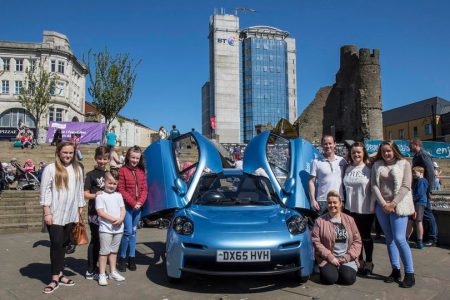
A Clean Air Roadshow organised by Swansea Council took place in Castle Square on Saturday to showcase electric and hydrogen vehicle technology.
Electric cars owned by the authority and Swansea University were on display, as well as a battery-powered one-man from the 1980s car known as the Sinclair C5, while there were also live shows from Titan the friendly robot.
Following the event Swansea Council announced it is exploring the concept of introducing more charging points in collaboration other public bodies in South West Wales.
Martin Nicholls, director of place at Swansea Council, said:
“The Clean Air Roadshow was a great success, with many thousands of visitors coming along to Castle Square from across South Wales and beyond on the day to discover electric and hydrogen vehicle technology.
“With the profile of this type of technology being raised, it’s important we explore how we can help in terms of ensuring the right infrastructure is in place to support it.
“That’s why we’re working closely alongside our local authority, university and health board partners across the region on a study that could see more electric vehicle charging points in place in future all the way from Neath Port Talbot and through the Swansea Bay City Region to Pembrokeshire.
“We support technology of this kind because it’s sustainable and helps Swansea cut its carbon footprint as we look to become a greener, more environmentally aware city.
“We already have a number of electric vehicles in our council fleet, which are used by staff in departments including recycling and corporate building and property services. These numbers are due to grow over coming months.
“This builds on the work that’s already on-going to promote and improve other forms of sustainable transport in Swansea, including cycling.”
An electric car show in Swansea has prompted calls for electric car chargers to be placed over Wales
Shell, an integrated energy and petrochemicals company, has now become one of the core members of CharIN e. V. (aka the Charging Interface Initiative e. V.)…which we guess is a good thing?
The company of course is still mostly engaged in refueling conventional cars with petrol, but it would now also like to be best prepared for the future of transportation; and as such, participate in an industry collaboration in the development of a common standards for electric charging technology.
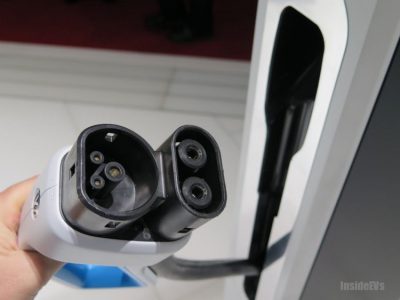
European CCS
“Shell is pleased to join CharIN as a Core member, and looks forward to being an active participant looking at charging infrastructure, communication and grid integration.”
This year, Shell intends to install charging stations primarily in the UK, followed by expansion into other countries.
At the same time, Shell also seems to be interested in smart home charging:
“Shell is already actively developing systems designed to serve the growing number of customers driving electric vehicles. From 2017, Shell will launch electric vehicle fast charging at a selection of Shell forecourts in the UK, with other countries to follow, to serve the ‘on the go’ charging needs of customers.
Shell is also in the early stage of launching an offer to customer fleets in Europe and the US, delivering more efficient charging for their electric vehicles via the use of Shell’s own smart charging technology. This technology can help to both reduce charging costs for customers and integrate this new demand effectively into the power grid. Smart charging technology also optimises the integration of renewable energy sources, by shifting the charge of electric vehicles to a period of the day when supply of electricity from those sources is high. Shell is also developing a R&D technology programme on electric vehicle charging and infrastructure.”
Matthew Tipper, Vice President Shell New Fuels said:
“A range of different fuels and vehicle technologies will be needed to meet growing demand for transport in a low carbon energy future. Electric vehicles are one of these solutions. We are pleased to join CharIN and take part in the efforts to develop common standards for the technology that will support the increasing number of electric vehicles on the roads wherever and however they charge”.
We are asked all the time to help people make sense of the Price to Value balance between Electric and petrol cars. The way the two types of cars work is quite different so it is not always straightforward.
To help, Fuel Included have today launched their Total Cost of Ownership calculator and information service to help you look at the actual costs associated with owning an electric car and comparing it to the actual costs associated with a petrol or diesel car.
This is available for both private and fleet enquirers
Our Total Cost of Ownership Calculator takes many factors into account, including the following:
Lease costs
Deposits
Comparison with petrol alternatives
Benefits (savings) of electric cars where you live i.e. congestion charge, parking
Different forms of charging (home vs public and rapid vs standard)
We know that cost is only part of the story, but now you can at least answer the cost part simply and clearly.
We provide access to a simple form on-line, that will provide a straightforward Total Cost of Ownership Report to help you make the right decision.
If you want a more detailed assessment, we will work directly with you to refine your circumstances.
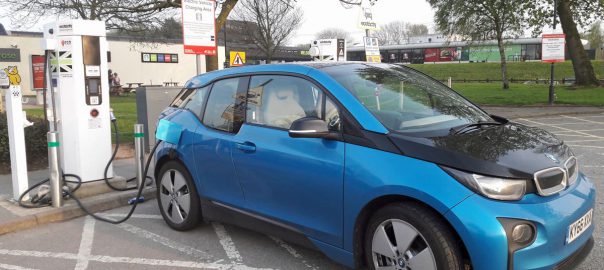
Our BMW i3 on charge at Corley Services (Image: T. Larkum)
Once you’ve had an electric car for a short while you’ll want to venture beyond its initial range and you can only do that by charging away from home. The most popular method is to use one of the network of Ecotricity rapid chargers, their ‘Electric Highway‘; there is at least one located at virtually all service stations on the UK motorway network.
In advance you need to have installed the Electric Highway smartphone app (available for Apple and Android devices) and set up an account with Ecotricity to allow you to use it. Ecotricity home customers get 52 free uses per year, otherwise the charge is £6 per half hour charge.
Step-by-Step Guide
Here is your guide to charging your electric car at an Ecotricity rapid charger:
1. On arrival, park up so the required cable can reach the charge socket on your car. Typically that means facing forward if your car has the charge point in the nose (e.g. the Nissan Leaf, Renault ZOE or Kia Soul) but reversing in if the charge point is near the rear (e.g. BMW i3, Mitsubishi Outlander, Hyundai IONIQ or Tesla Model S).
Rapid Charging Step 1: Access the Rapid Charger (Image: T. Larkum)
2. Get out of the car and check the screen on the rapid charger to confirm it’s working. Assuming the charge point is not already in use, the rapid charger will show a screen saying ‘Welcome! To charge your car, use the Electric Highway smartphone app’ or ‘Welcome! Select the correct charger for your vehicle’.
Rapid Charging Step 2: Welcome Screen (Image: T. Larkum)
3. Start the Electric Highway app on your phone. If it has been correctly setup it will show your car type at the top. The screen will say ‘What would you like to do?’ with two big green buttons labelled ‘Charge: charge your vehicle now’ and ‘Find pumps: find compatible pumps’.
Rapid Charging Step 3: Choose to Charge (Image: T. Larkum)
4. Press the ‘Charge’ button. The screen will change to say ‘Charging your car’. Press the ‘Get Started’ button.
Rapid Charging Step 4: Get Started (Image: T. Larkum)
5. The screen will change to say ‘To start, scan the pump’s QR code or enter the pump ID’. Here ‘pump’ is Ecotricity’s term for a rapid charge point. For simplicity we’ll choose the latter – press the ‘Enter pump ID manually’ button.
Rapid Charging Step 5: Identify the ‘Pump’ (Image: T. Larkum)
6. This will bring up a box to enter the pump identification number; selecting in this box will bring up your ’phone keyboard. Type in the four digit number as written below the screen on the charge point.
Rapid Charging Step 6: Enter the Pump Number (Image: T. Larkum)
7. The app will look this up and specify the location of the rapid charger with that number. If the number matches your location press ‘YES’.
Rapid Charging Step 7: Identify the Pump Location (Image: T. Larkum)
8. The screen will change to allow you to select the appropriate cable and connector for rapid charging your car. This is essentially straightforward: the Renault ZOE uses AC rapid, the Leaf, Outlander and Kia Soul use CHAdeMO and most others use CCS. You should know the connector type for your car, and the app will also exclude the ones it believes are incompatible. However, you should be aware that most cars can use the AC at low speeds as well as the DC at high speeds and so you may accidentally use AC but find your car charges only very slowly. In other words, use CCS and CHAdeMO in preference to AC unless you have a ZOE.
Rapid Charging Step 8: Select the Connector (Image: T. Larkum)
9. At this point control of the charging moves from the app to the charge point itself. Once initialised the charge point screen will show ‘Connection: connect your vehicle’.
Rapid Charging Step 9: Connect to the Car (Image: T. Larkum)
10. Plug the connector into the car, remembering to remove the secondary dust cover if you have a CCS socket. So long as the car is set to charge (i.e. you don’t have the charge timing override set) the car and charge point will ‘negotiate’ the fast charge they can both support, and charging can begin. The screen will show ‘Initialization: Please wait whilst your vehicle connects to the charge point’ and will highlight the charge point going through a number of check steps: Start communication, Isolation check, Precharging, Charging.
Rapid Charging Step 10: Initialization (Image: T. Larkum)
11. At this point charging starts, and you can usually hear the distinctive high pitched whine of rapid charging underway.
Rapid Charging Step 11: Car is Charging (Image: T. Larkum)
Monitoring the charge progress, and ending the charging session, are covered in Part 2.
If you have a garage with a power socket, an electric car makes an awful lot of sense. If you park on the street, however, the infrastructural challenge of keeping your electron-powered vehicle topped up becomes complicated enough that perhaps sticking to driving on squished dinosaurs makes sense for a while longer. Until Char.gy comes along, that is.
“Seventy-two percent of drivers in London don’t have off-street parking,” says Richard Stobart, CEO of the London-based Char.gy. “If you want an electric car, not being able to charge at home is a major disincentive.”
So, in a world where people want to drive electric cars, cities are trying to clean up the air and car makers want to sell electric cars, how do you take on the not insignificant challenge of charging car batteries in a dense and fast-moving city such as London? You tap into other, already existing infrastructure, of course.
“People want to charge their cars while they are doing something else, preferably when they are parked at home and asleep in their beds,”
Stobart points out, and offers a solution. The company has developed charge points that connect to the existing street furniture: Lampposts. Makes sense: The cables are already there, the local government owns them, and once you’ve gone that far, you may as well make the next couple of logical steps
eVolt, the Electrical vehicle (EV) charging business, has launched its third-generation Rapid charger, the Raption 50, which uses modular power technology for enhanced reliability and performance. eVolt is the eMobility brand of the SWARCO Group.
Traditionally, Rapid chargers operate via a single power pack, rendering a charger out of use if the power unit fails. The Raption 50, however, uses state-of-the-art modular power technology with four individual power packs delivering 12.5kW each. Should one power pack fail, the Raption unit continues charging EVs at a lower output by drawing power from the functioning packs.
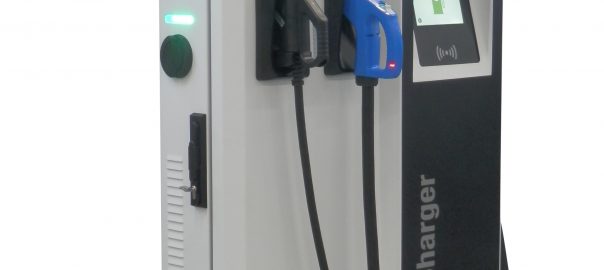
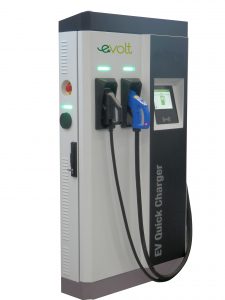
eVolt Raption Rapid Charge Point (image: eVolt)
The new unit completes an 80% charge in 30 minutes with simultaneous charging for two EVs at 50kW DC and 43kW AC. It is smaller and slimmer than its predecessors and has three charging cables that cater for every EV/PHEV model.
Justin Meyer, General Manager of eVolt UK, says reliability is key for Rapid charging:
“While eVolt’s Rapid units have always proved highly dependable, modular power technology makes them even more reliable by reducing the potential for down-time,”
he says.
“The new Raption 50 has been designed with input from our clients. This is one of the ways we make sure our chargers meet their needs.”
In adopting the modular architecture, the Raption range offers flexibility through scalable power:
“The Raption can be scaled down should a local power network not be capable of Rapid charging or if a user only needs to draw 25kW of power,”
Justin adds.
“At the same time the opposite can happen, and we can scale the chargers back up to deliver more power.”