Rapid Charging on the Motorway – Completing the Charge
Ecotricity rapid charger with LCD status display (Image: T. Larkum)
I previously described the process for initialising a charge at an Ecotricity rapid charger, as found at most motorway services. Here I’ll cover the process for monitoring and ending the charge session.
Step-by-Step Guide
12. While the car is charging you will want to monitor it regularly to confirm it is continuing successfully and to see when it has completed. The charge status, the time taken, the amount of electricity used and usually (depending on the car) also the charge level will be shown on the charge point screen.
Rapid charger status screen during charging (Image: T. Larkum)
13. There will also be visual indications on the car, for example the Nissan Leaf has blue lights on the dashboard, the Renault ZOE shows an icon on the driver’s screen, the BMW i3 has an indicator light around the charge socket, etc. However the most convenient monitoring method is via smarthphone, using an app provided by the car manufacturer. You can use this remotely, for example while eating in a services restaurant. Each app functions differently, but they all provide a display of the current charge level. The BMW one can generally be updated on demand (though sometimes requires the app to be killed to achieve this). The Renault one, rather inconveniently, will only update every 30 minutes.
BMW ‘i Remote’ app display during charging (Image: T. Larkum)
14. When you wish to end the charge session you do so first in the Ecotricity app, then follow its instructions.
Ecotricity app display after ending session (Image: T. Larkum)
15. You remove the charge cable from the car and hang it back up on the charge point. Then you notify the Ecotricity app. The app will display the cost of the session (zero if you’re an Ecotricity customer) and the session identification number. You will also usually receive this information soon after by email to your registered address.
Ecotricity app display at end of session (Image: T. Larkum)
16. The session is ended and the rapid charger display will return to its welcome screen.
Ecotricity rapid charger welcome screen (Image: T. Larkum)
To celebrate more than 100,000 plug-in cars having been sold in the UK, 25 electric and plug-in hybrid cars drove from London to Milton Keynes [on] Sunday 18th June.
Organised by Chargemaster, the road trip covered around 100,000 meters in cars as diverse as the Nissan Leaf to the Tesla Model X, and BMW’s i3 to the Volvo XC90 T8.
The convoy all safely completed the journey of a little over 60 miles, showcasing the variety of plug-in cars on sale in the UK at the moment.
Coinciding with the sales milestone were two celebrations of Chargemaster’s own – 100,000 home charging sessions have been carried out on a single week, and Chargemaster’s Polar network has seen 100,000 public charging sessions so far in 2017.
David Martell, Chief Executive of Chargemaster, said:
“Today was a pivotal moment for the EV market, to mark a significant milestone in vehicle adoption and to celebrate two 100,000 milestones of our own. Thank you to the team, and everyone that made the day so special – here’s to the next 100,000 EVs.”
Sales of electric cars will never reach their potential unless the UK commits to providing easy access charging for everyone says Hampshire firm InstaVolt.
Tim Payne, InstaVolt CEO
The company will be using National Clean Air Day tomorrow (Thursday June 15) to highlight the importance of an inclusive strategy for motorists rather than focussing on home charging points. The company installs and maintains electric vehicle charging points and believes that the UK is currently too focused on home charging, when the country should be making points accessible to all drivers.
“Around 30 per cent of UK households don’t have off-street parking so that means that more than eight million potential buyers are unlikely to buy an electric vehicle unless it’s easier to charge in public places”
said Tim Payne, CEO of InstaVolt.
“We’re caught in a chicken and egg situation where people simply won’t buy an electric vehicle until the infrastructure is there. At the same time, companies are hesitant to install charging units until they know there’s a buoyant market to use them. People don’t fill up their cars with petrol or diesel each night – they stop in to fill up as and when they need to. We need to make it just as easy to do so with electric vehicles.”
Tim believes that building a network of rapid chargers at the roadside is the key to boosting use of electric vehicles in the UK.
“Research consistently shows that a fear of not being able to charge up is one of the biggest factors stopping people from buying an EV” he added. “When you couple this with the number of people who don’t have access to home charging, it’s a recipe for failure. If we can install rapid chargers at service stations, petrol forecourts and shopping centres across the UK, people will be much more confident in buying and driving electric vehicles.”
InstaVolt is set to install 3000 rapid EV charging units across the UK by 2020. Last month it signed a deal with Silicon Valley giant ChargePoint to purchase more than 200 of its electric vehicle rapid charging solutions. The units, which can add hundreds of miles of range in just 20 minutes, will be installed later this year, marking the first time the rapid charging systems will be deployed in the UK.
They will be strategically placed close to popular routes across the country, enabling drivers to easily charge their vehicles during long journeys. It will offer a pay-as-you-go service with no subscription and will be installed at no cost to the landowner.
Tim says that ultimately, the private and public sector should be working together to make the UK’s roads an easier place to drive an electric vehicle.
Andersen has launched its first charge point – the A1 – offering EV drivers a premium option for home charging. The Andersen A1 is inspired by Scandinavian minimalist design, and hides away the cables within the unit.
Andersen A1 Charge Point
As part of a second wave of new charge points coming to the UK market, Andersen is aiming their product at those who want a sleeker, more stylish design. Although existing options perform well and offer a reliable home charge option, there are few on the market that look stylish.
Now though, charge point manufacturers are opening up the options available to buyers with a more expensive, but also more aesthetically pleasing product. There is a choice of five colours on offer too.
David Simpson, Technical Director at Andersen, said:
“The whole idea came from my own frustration with the home charge points that were available. I’d just bought an EV and I was looking for a charge point. I wanted one that didn’t have messy cables or flashing blue lights – just something that would sit happily on the side of my house.”
Jerome Faissat, Managing Director at Andersen, said: “A home charge point is something an electric car owner uses on daily basis and they’re often mounted in very visible places on the front of your house.
“The A1 is designed to complement the style of your home and work perfectly for you all the time. You can choose the colour you want and tidy the cables away if they bother you. It was important for us to create something that looked timeless and functional to last for many years.”
Andersen A1 Charge Point, Various Colours
Priced from £1,499 excluding OLEV grant and installation, Andersen has partnered with Just Energy Solutions as its OLEV accredited installer.
I wrote last week of what is required to fill out the on-line application for the POD Point charge point. Once I had applied things moved pretty quickly.
Attaching the POD
The following day I got an email outlining the name and time of an installation appointment a week later. They also sent me a link to click should I need to reschedule. Two days before the install, I got a further email confirming I was still available and confirming that the engineer would arrive between 1pm and 3pm.
Come the day, a minor glitch. 3pm came and went and no engineer. I followed up with an email at 3.40pm, and 10 minutes later got a call from the engineer saying when he would arrive. So at 4.15, the installation began.
My installer turned out to be Mohamed Aly and was very knowledgeable and enthusiastic. He had the whole job done and dusted in an hour and a quarter.
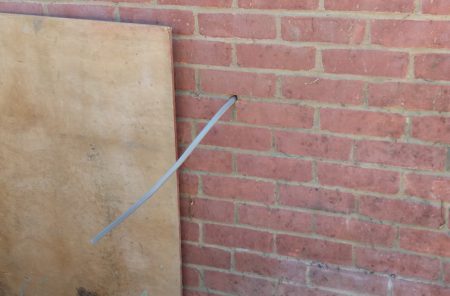
First he laid the cable and drilled through to the desired mounting point for the POD, and then attached the POD.
Lay the cable and drill through
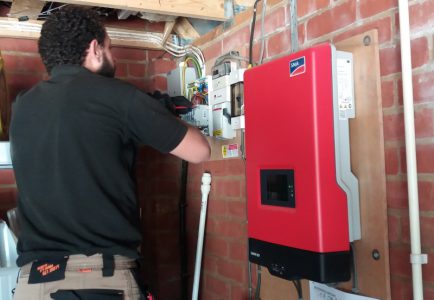
At the other end, he now connected to the mains. You can see my Photo-Voltaic Solar Array converter to the right. Mohammed commented that he used to install Photo-Voltaic systems, and that the SMA inverter I have was the most reliable he ever came across.
Connect to the mains
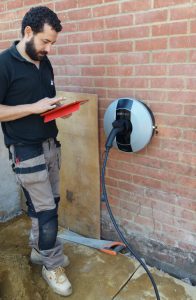
The final step was commissioning the system and connecting it to my WiFi router. A neat process in which he connected his tablet wifi to the POD, then selected the router from the list and ‘handed’ it over to the POD.
Connect to WiFi
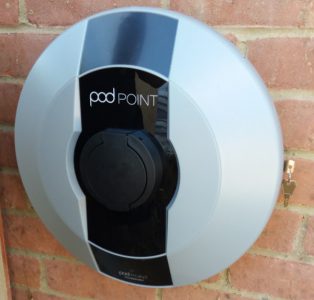
The finished POD. We did test it, and it all worked as expected. Many thanks to POD Point and to Mohamed.
People who have never owned an electric car don’t understand how different charging one is compared to fuelling a petrol or diesel car. Therefore I’m going to explain what charging an electric car is like so that potential owners can understand it better.
Home charging a Nissan Leaf (Image: Nissan)
The point I want to get across is that charging an electric car is much easier and more convenient than filling a fossil-fuelled car. That’s an idea that can be difficult to grasp. Now that I’ve upgraded to electric (I’m on my second all-electric car) I could never go back, any more than I’d give up my smartphone and make do with a landline.
Here I’ll concentrate on the ins and outs of home refuelling, and cover charging away from home another time.
Charging System
Most electric cars come with a charging cable (fitted with a 13 Amp plug) that can be used to charge the car; such cables can be bought separately where they are not supplied with the car. One name given to these items is ‘granny cable’ as they can also be used to charge up while visiting relatives.
BMW i3 ‘occasional use’ charging cable (Image: BMW)
Another name they are given is ‘occasional use cable’ as they are not intended to be used frequently. They will also be slow to charge the car (12 hours or more) as a standard home socket is not capable of providing as much power as the car can potentially take.
Instead most car owners will have a special charge point installed at home to charge their car. This often comes free with a new car. It is typically wired straight into the main house consumer unit. It will be capable of passing higher power than a standard socket – usually either 16 or 32 Amps – and will be designed for frequent use.
Using a third-party ZOE granny cable while visiting my brother (Image: T. Larkum)
These charge points can be installed either inside a garage, or on a garage or other outside wall. Sometimes they’re just put on a post beside the driveway. They are all waterproofed and can be used in all weathers (including heavy rain). They usually come fitted with a tethered cable to match the car but sometimes just have a socket to which the owner can connect different cables, for example if the unit has to charge electric cars with different types of connector. The pros and cons of having a tethered versus untethered charge point are covered elsewhere.
Charging an Electric Car: Frequency
How often does an electric car need to be charged? This is an important question, and is key to why charging is more convenient than conventional refuelling.
The obvious answer, at least to someone used to a conventional car, would be “when it’s empty”. That’s because most people let their cars run low on fuel before refilling. There is no good reason for this; it simply reflects the fact that conventional refuelling is so inconvenient that it is to be avoided whenever possible. It takes time, and usually also involves a diversion from where you actually want to go.
With an electric car you could choose to do the same thing, relying on public charge points, and that can work if you can’t do home charging. However for the majority of electric car owners with a home charge point the easiest thing is simply to charge at home overnight every night.
Charging a Renault ZOE on the drive (Image: Fraunhofer ISE)
Electric cars use Lithium-Ion batteries, similar to those found in mobile phones (though they have significantly more sophisticated charge management systems than phones and so last longer). Lithium-Ion likes to be kept charged unlike previous technologies (e.g. Nickel-Cadmium batteries) that you were supposed to run down before recharging. Therefore it does no harm to plug in every night and so have the car battery fully charged every morning ready to go.
Using a dedicated high power charge point allows a typical electric car to be charged in about 4 hours. It’s also fine to only partly refill it. Therefore it can be perfectly practical to drive, say 100 miles during the day for work, then go home and – those evenings when it’s useful – top it up for an hour or two and go out again for, say, another 50 miles.
Charging an Electric Car: Process
It’s very easy to charge an electric car once you have a dedicated charge point. If you are lazy, like me, then you have a tethered one with its cable permanently attached so you don’t have to unpack a cable each time. Similarly, I choose to leave mine switched on permanently for convenience.
In this case, charging is as simple as the following:
Open the charge point door on the car
Uncurl just enough of the charge cable to insert its connector into the car’s charge socket
The car will automatically start to charge when it sees the electrical connection made. It will control the charge and finish it automatically.
On my original Renault ZOE the charge point door was unlocked using a button on the key fob or a switch inside the car. The charge socket was in the nose and so required walking around to it to insert the connector. The total time taken was about 15 seconds; this would also be typical for the Nissan Leaf.
Charging a Nissan Leaf in the garage (Image: Chargemasterplc.com)
On my current BMW i3 the charge point door is always unlocked if the car is unlocked, and the charge socket is on the driver’s side. Therefore I can insert the connector after I have parked the car and as I walk out of the garage; there is literally no additional time taken to set the car for charging. The Hyundai IONIQ Electric also has the socket on the rear quarter, though on the passenger side.
Charging a BMW i3 on the drive (Image: BMW)
People sometimes ask me how long it takes to charge my car. They probably expect to hear me say ‘4 hours’ or whatever, but actually it takes me personally no time at all, not a single minute. That’s because I don’t care how long it takes for the battery to fill up while I’m in the house (and probably asleep).
Charging a Hyundai IONIQ Electric on the drive (Image: T. Heale)
With my i3 having a range of about 120 miles, and my commute being 45 miles, it’s not even a problem if I forget to charge for a day or two. However, like with your smartphone, making charging it a daily routine is generally the best option.
Summary
One of the great things I love about a car that’s electric is no longer having to spend time fuelling it. It’s just 100% full every morning when I get in, as if by magic. I certainly don’t miss having to travel to petrol stations, often standing in the dark and rain, to hand over large amounts of money.
Now instead I fuel the car myself using renewable energy. During the week I charge it from wind (courtesy of our renewable electricity supplier) and a fill-up costs about £2.50. At the weekend I can charge it from our solar panels for free.
I Have my New Car Ordered – Now I Need a Charge Point
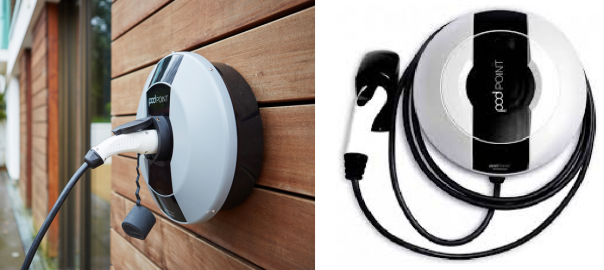
Untethered and Tethered Charge Points (Image: POD Point)
With my new Leaf, I get a new, FREE, POD Point charge point.
Thanks to a Nissan discount of £264 and the government OLEV scheme discount of £500, there is no charge for me at all for the entry level unit, although there are a couple of upgrade options you can choose.
Here is a quick guide to what to expect when you are ready to get your system installed. This blog covers the on-line application, with a separate blog that covers the installation.
Ordering my New Charge Point
The process starts with an email from POD Point to start the application. It was pretty straightforward and the pictures below step through the choices offered. The three choices I made of most significance to me were the following:
1) Upgrade to a 7kW charger. This cost £95. This seemed good value and future proofs me for longer range cars in the future.
2) Upgrade to a key so that I can lock the charger if necessary. This cost £30. I am not sure if electric thieving is likely.
3) I chose to have an un-tethered system with a type 2 socket so that it could work with any car. This was no charge. POD-Point tell me there is no difference in charge between a tethered and un-tethered system.
1 – The initial email from POD Point
2 – website starting point
3 – charge power choice
4 – tethered/untethered choice
5 – extras: key, cable, freestand
6 – Order summary showing total price less the nissan discount
7 – A statement that I have bought/leased a new car and have suitable off-street parking for a chargepoint to qualify for the OLEV grant
8 – 2nd Order summary including the OLEV grant
9 – payment for my extras
10 – payment summary
11 – address for installation
12 – installation specific questions
13 – statement of whether I do or don’t want the OLEV grant
14 – formal grant application. This needed a form downloaded, filled in and uploaded. Not particularly difficult and definitely worth it to save £500.
Half a century ago, the General Motors assembly plant was the largest employer in Fremont, California, and the town was known for its dragstrip.
Today, that plant makes Tesla electric cars and Fremont is a part of the San Francisco Bay Area’s Silicon Valley, creating advanced technology for the world.
Tesla Factory, Fremont, California
The city has now taken another step into the future, requiring that all new houses be delivered ready for the installation of electric-car charging stations.
According to the East Bay Times, the city of Fremont has announced that any new housing project must include both solar panels and the electrical wiring required for the installation of a charging station.
The town, across the bay from Palo Alto—where a similar regulation was adopted in 2013—prides itself on being the ZIP Code with the highest concentration of electric-car owners in the state.
That makes it likely to have the highest such concentration in the U.S.
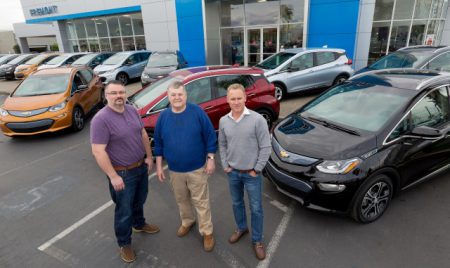
First 2017 Chevrolet Bolt EV Buyers, Fremont, California: Bobby Edmonds, Bill Mattos and Steve Henry
When the first 2017 Chevrolet Bolt EV electric cars were sold in December, Fremont Chevrolet was the site—because it sells more Chevy Volt plug-in hybrids than any other dealer in the country.
It’s exactly 3 miles from the dealer to the Tesla factory, formerly the GM-Toyota joint venture known as New United Motor Manufacturing Inc. or NUMMI.
The required coverage of the solar panels will be determined by the size of the new project.
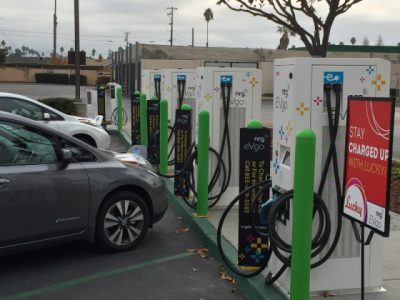
EVgo DC Fast-Charging Site in Fremont, California.
As for the charging stations, the wall hardware itself will not be mandatory.
New buildings will, however, have to be equipped with the electrical setup needed for later installation.
For commercial or multifamily projects, the ruling goes even further, requiring that at least 10 percent of the parking spaces have charging stations installed
A new track can simultaneously charge two cars driving in opposite directions.
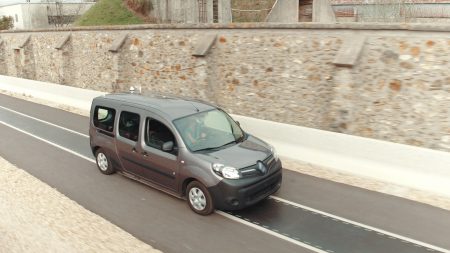
Renault Kangoo EV used in Qualcomm’s tests. Qualcomm
Forget about better batteries, what if you could just drive your EV forever? Qualcomm just showed off technology called dynamic electric vehicle charging (DEVC) that juices an EV via road-embedded wireless charging hardware while you’re driving. During the demonstration, two Renault Kangoo vehicles equipped with Qualcomm’s “Halo” DEVC receivers were charged simultaneously while moving down a 100 meter test track.
Based on Qualcomm’s wireless electric charging (WEVC) tech, the track can charge vehicles driving at highway speeds in both directions (both in forward and reverse) at 20 kW max. If it works, the tech could be used in a system that lets you call a car using a smartphone, get picked up where you are and be whisked to your destination autonomously (as shown in the animated video, below).
Qualcomm will now hand its DEVC charging system to Vedecom, which
“will evaluate the operation, safety and efficiency of energy transfer to the vehicles for a wide range of practical scenarios, including vehicle identification and authorization on entering the track, power level agreement between track and vehicle, speed and alignment of vehicle along the track.”
Shell will start to equip its 870 service stations in the Netherlands and in Belgium with fast electric chargers /Belga
The Dutch oil company Shell is starting to equip its petrol service stations with fast electric chargers too, starting with 20 stations in the Randstad in the Netherlands.
“Only 15 to 20 minutes to charge up to 75%”,
says Machteld de Haan who is responsible for the Shell staions in the Benelux and France.
“Just enough time for a freshly made sandwich with coffee and a sanitary stop on the way”.
Electrical cars are still a niche. In the Netherlands around 15.000 fully electric cars are cruising the roads, in Belgium about 4.300 according to the latest figures.
“But the market can grow fast in the future and we feel the moment is right to step in”,
de Haan says. Last year Shell opened Europe’s largest service station in Luxembourg with 51 fuel pumps and not one electric charger, but now Shell is determined to make the switch.
In the Netherlands Shell is market leader with 600 service stations, in Belgium Shell accounts for 270 stations. Machteld de Haan won’t give any forecast on when all these service stations will be equipped with chargers.
“People will still need fossil fuels for decades. In rolling out the chargers we won’t look at what others do, but take into account our own infrastructure only. The charging stations will have a prominent position, next to the fuel pumps.”