Category Archives: Charging

Electric Car Benefits in Milton Keynes

Following the success of our first eBook we have decided to do another one. The first one was a guide to charging your electric car at home. This one is specific to the Milton Keynes area, where we are based (though of course we deliver nationwide). Milton Keynes is the best city in the world for giving incentives to electric car drivers.

If you are considering an electric car and you live near, work in or visit Milton Keynes, then this is the guide for you.

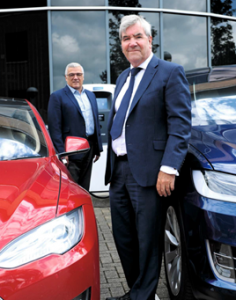
Red Tesla Model S in the new MK showroom (Image: T. Larkum)
Red Tesla Model S in the new Milton Keynes showroom (Image: T. Larkum)

This eBook tells you all you need to know about the benefits of an electric car in Milton Keynes:

  • Charging in and around Milton Keynes
  • How to get free parking in Central Milton Keynes
  • How to get free parking at MK railway station
  • The Experience Centre, with free test drives and lessons
  • Planned future benefits, e.g driving in bus lanes

f

Click on the image, enter your name and email, and download your free guide.

If it leaves any questions unanswered, just get in touch (contact details here and in the eBook).

Dr Trevor Larkum
FuelIncluded.com
MyRenaultZOE.com

Electric Avenue: MK City Centre Hub

Electric Car Heaven 4: Future Benefits

In January 2016, Milton Keynes was awarded Go Ultra Low City status alongside Bristol, London and Nottingham and secured multi-million pound investment from the UK Government. The cities and regions each received a share of £40 million funding by proposing innovative ideas to encourage drivers to choose an electric car.

Electric Avenue: MK City Centre Hub

Milton Keynes Council received £9 million funding to further its work developing modern vehicles to tackle harmful emissions, reduce its carbon footprint, and continue to make Milton Keynes one of the most sustainable cities in Europe.

The Green Parking Permit scheme was the first proposal from any winning bid to be delivered using Go Ultra Low Cities funding. The Electric Vehicle Experience Centre is the latest proposal to be delivered.

Future plans for the funding in Milton Keynes include:

  • Charging Hubs, where electric vehicles can be fully recharged in around 30min: EV Rapid Charging Hubs are being established at the Coachway at M1 J14 and in the City Centre
  • Charging posts close to residential areas: Milton Keynes will commit to providing a charging point to any resident of the City who buys an EV, either at home or on a nearby street if the buyer does not have off-street parking
  • Priority for EVs in bus lanes
  • Destination charging at popular locations including supermarkets, hotels and leisure facilities
  • Trialling the latest developments in technology such as inductive charging
  • Information and signage: Signage will be provided giving motorists clear information on facilities for EVs.


With regard to the Charging Hubs, this project will see Chargemaster supply its latest charging infrastructure to set up two filling-station-style EV rapid charging hubs and 50 destination chargers across the town.

f

U.K. Law Would Require EV Charging at Gas Stations

The legislation will allow the government to require the installation of charge points for electric and hydrogen vehicles at motorway service areas and large fuel retailers, and to establish common technical and operational standards.

The U.K. government introduces legislation requiring that every gas station and motorway service center install electric charging points.

The Queen’s Speech, marking the start of the post-election Parliamentary session, included the introduction of the Automated and Electric Vehicles Bill.

Government briefing papers say the legislation will ensure the U.K. remains at the forefront of developing new technology in electric and automated vehicles.

The legislation will allow the government to require the installation of charge points for electric and hydrogen vehicles at motorway service areas and large fuel retailers, and to establish common technical and operational standards.

The legislation is designed to make the regulatory framework keep pace with the fast-evolving technology for EVs; extend compulsory motor-vehicle insurance to cover automated vehicles; and to ensure compensation claims continue to be paid quickly and easily.

It is intended to allow innovation to flourish and ensure the next wave of self-driving technology is invented, designed and operated safely in the U.K.

The government says the aim is to

“ensure a world-class infrastructure which supports the rapid adoption and use of electric vehicles by consumers as more mass-market models become available, helping improve air quality.”

This supports government ambitions for the U.K. to

“lead the world in EV technology and use,”

with almost every car and van to be zero-emissions by 2050.

Read more: Wards Auto

Electric Car Heaven 3: Free Electric Car Driving Lessons

We have written at length about the new Electric Vehicle Experience Centre (EVEC) that has just been opened in Milton Keynes by Chargemaster. It provides help and advice on electric cars, and provides the opportunity to test drive a range of vehicles.

In association with the EVEC, the AA has launched an electric car driving course. In an AA-Populus Survey of 16,000 drivers, one third said they want to start learning to drive again – but in an electric car.

AA Driving School and Drive Tech trainers have developed the Drive Electric experience in conjunction with Chargemaster. It provides a free one-hour electric driving lesson and it is aimed at showing people how to get the best out of an electric car.

It may eventually go nationwide but is being trialled initially in the Milton Keynes area. More information is available here: AA Trust Launches Drive Electric.

f

Scotland hosts first electric car rally - Stirling to Glasgow

Electric Car Incentives 2: Scottish Government – Loans and Grants

In addition to the generous incentives the UK Government provides for electric cars, there are additional incentives in Scotland. Primarily these are a loan towards purchasing an electric car and a grant towards the cost of a charge point.

Scotland hosts first electric car rally - Stirling to Glasgow
Scotland hosts first electric car rally – Stirling to Glasgow


Electric Vehicle Loan

The interest-free Electric Vehicle Loan, funded by Transport Scotland (an agency of the Scottish Government), currently offers drivers in Scotland loans of:

  • up to £35,000 to cover the cost of purchasing a new pure electric / plug-in hybrid vehicle
  • up to £10,000 to cover the cost of purchasing a new electric motorcycle or scooter

The loan has a repayment term of up to six years. The purchased electric vehicle, motorcycle or scooter should be the only plug-in vehicle owned by the applicant and must be eligible for the ‘plug-in car, motorcycle and van grants’ funded by the Office for Low Emission Vehicles (OLEV). Second hand vehicles are not eligible.

With the exception of an initial deposit, applicants must not have made any other payment towards the purchase of the vehicle before receiving a loan offer under this programme as funding is not provided retrospectively.

The program is administered by the Energy Saving Trust, and expires at the end of March 2018. For more details see Electric Vehicle Loan.


Home Charge Point Funding

Energy Saving Trust can provide £500 funding towards the cost of a 32 amp home charge point installation. This is on top of the £500 provided by the Office for Low Emission Vehicles (OLEV).

The typical cost for a home charge point and installation is approximately £1000.  As part of its Electric Vehicle Homecharge scheme, OLEV currently offers applicants £500 towards this cost. EST will provide up to £500 further funding on top of this. For the cost covered by OLEV you will not need to make any payment to your supplier, as they will receive this money from OLEV directly. For the costs above what OLEV cover, you will have to pay your supplier and the Energy Saving Trust will then provide you with your (up to £500) reimbursement. Any remaining costs above the £500 provided by OLEV and the £500 provided by the Energy Saving Trust you would need to pay for yourself.

For more details see Domestic Charge Point Funding.

f

Electric charge point CMK (Image: One MK)

Electric Car Heaven 2: Parking in Milton Keynes

Milton Keynes isn’t just the best place in the world for electric car charging, it also has a remarkably friendly parking policy for electric cars. This allows for free parking with a parking permit, and also at designated charge points without a permit.

Electric cars in charge point bays - no 'RESERVED' marking so they do not need to be plugged in
Electric cars in charge point bays – there is no ‘RESERVED’ marking so they do not need to be plugged in

Parking Permit

The bulk of parking spaces around Central Milton Keynes are Standard Tariff (so-called ‘purple’) bays – and electric cars can park in these spaces for free with a Green Parking Permit (GPP). There are an impressive 15,000 of these parking spaces in CMK. Applications for the GPP are made through the Milton Keynes Council website.

Purple bays are arranged around the outside of most of the Milton Keynes blocks, with the exception of the main shopping centre blocks which are Premium Tariff (‘red’).

In addition, the GPP allows for free parking in Off Street Standard Tariff Car Parks (there is one of these off Avebury Boulevard) and in Premium Tariff and Peak Permit Parking (‘black/red stripes’). These latter are typically at the ends of blocks close to the shopping areas.

The Council provides a handy Milton Keynes Parking Map (PDF) with a colour key which indicates the different tariff locations.


Charge Point Parking

Furthermore, electric cars can park at charging points for free, independent of any Permit, even though many of these locations are actually in the expensive Premium areas. It can therefore become a little complicated determining the exact restrictions that apply. The Council website states:

All rapid chargers (currently available for 2 hours only) and electric vehicle spaces with ‘Electric Vehicle Charging Only‘ marked on the signage, can only be used by electric vehicles that are plugged in and charging. Electric vehicle motorists do not need to pay to park if parking in these spaces whilst they are plugged in and charging.

We also operate dual restriction bays which are reserved for electric vehicles only during 7am – 10am and 4pm – 6pm. During the core hours of 10am – 4pm any vehicle can use the spaces, subject to the surrounding parking restriction. Electric vehicles do not have to pay to park in these bays.

Electric charge point CMK (Image: One MK)
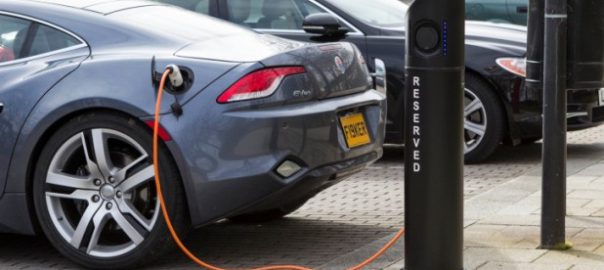
A ‘RESERVED’ charge point in CMK – the car must be plugged in (Image: One MK)

A simpler way to understand this, as it was explained to me by a council official, is that there are no restrictions on an electric vehicle parking in a charge point bay for free, except that if the charge point has “RESERVED” painted down its side then the EV must be plugged in.


Milton Keynes Station Parking

Milton Keynes is a major commuter town with many people driving to MK Station to take the train to London. The parking at the station is not included in the Council scheme. However, it also provides free parking for electric cars under a scheme provided by London Midland, the operators of the rail line (this scheme also covers other stations along the line). I have detailed this scheme previously: Free Electric Car Parking at Milton Keynes Station.

f

Electric cars charging in Central Milton Keynes

Electric Car Heaven: Charging in Milton Keynes

Milton Keynes has probably the greatest concentration of electric car charging points of any location in the world. This arguably makes it the best candidate destination city for electric car drivers anywhere in the world.

Electric cars charging in Milton Keynes (Image: T. Larkum)

Of course, those are difficult statements to confirm since there aren’t international league tables of such things. However, a look at international charge point maps like Plugshare certainly seems to indicate that it has as many standard power charge points (some 170) as other candidate ‘hot spots’ such as Los Angeles in the US and Oslo in Norway. If you look further into the density of high power rapid chargers (56) it appears to win hands down against all comers.


Charge Point Locations

More to the point, however, is that charge point locations are very well organised in Milton Keynes. While in other cities the growth and placement of charge points appears to be organic, i.e. nearly random, they are well placed in MK. Specifically the city centre is arranged in blocks on a grid (in the American style) and charge points are placed along at least one and usually both of the long sides of each block. One block can have as many as a dozen standard speed chargers.

The rapid chargers are arranged more strategically. In the city centre there is one rapid to every one or two blocks. Outside the centre, in the suburbs, there is one to every second or third housing estate.

Rapid Chargers next to Milton Keynes Central railway station parking (Image: T. Larkum)
Rapid Chargers next to Milton Keynes Central railway station (Image: T. Larkum)

The result of having so many charge points in Milton Keynes is that anyone can visit the city in an electric car and be confident of finding somewhere to charge for the return journey. With a typical EV range of 80 miles this means that MK can welcome visitors from as far afield as Southampton in the south, Gloucester in the west and Nottingham in the north – they won’t have to charge on the way in or back home.


Chargemaster / Polar Network

The charge points in MK are part of the Polar network operated by Chargemaster. Therefore to make use of them it’s necessary to use a Polar app or swipe card, either on subscription (Polar Network) or Pay As You Go (Polar Instant).

With that arranged, it is possible to find a charge point near almost anywhere in the city centre. Their locations can be seen on the council’s charge point map (PDF) and on the online Polar Live map.

This makes MK the perfect place for EV owners, whether visiting occasionally for shopping or commuting in daily for work.

Part 2: Parking

f

Our electric car is driving on sunshine

Our solar panels occupy only a third of our roof area. Even so, on a summer day they produce about the same power our Volkswagen electric car draws as it charges from a plug in the garage.

Electric car on the road. ‘We are literally driving on sunshine,’ write James and Lesley Willis. Photograph: EPA

So, to the extent that we top up during the day, we are literally driving on sunshine: nil use of resources, nil pollution, and, in the context of your article (Battery cars may eat up more than Hinkley Point’s capacity by 2030, 13 July), nil load on national power generation infrastructure. Going for a drive in serene, effortless near-silence, knowing that it hasn’t cost anybody anything, is quite simply wonderful.

The rapid increase in the number of distributed solar power installations is producing an unmanageable peak on sunny days. But our experience illustrates that there is an excellent match between renewable energy and electric vehicles. Electric cars are big batteries on wheels, storing far more power than they need for journeys. They could be made to play a dynamic part in balancing the uneven generation inherent in many forms of renewable energy.
James and Lesley Willis
Alton, Hampshire

Zoe Williams suggests (Is a car maker about to save the planet? 10 July) that “the goal has to be an electric car powered by renewable energy”. A seemingly admirable aim but one that implies that the only problem is atmospheric pollution. Unfortunately, the motor car also encourages sprawl, making our cities less compact and sustainable and resulting in healthy travel alternatives (walking, cycling, public transport) becoming more difficult. It divides communities, both by splitting them with transport corridors and by isolating users in their car bubbles. It maims and kills, which may become more of an issue, as electric cars are quieter. It requires road space that is increasingly not available, causing issues from congestion and excessive travel time to access and pavement parking. And, given that a high percentage of pollution in the life-cycle of a car is in its production, how much is actually avoided?

Source: The Guardian

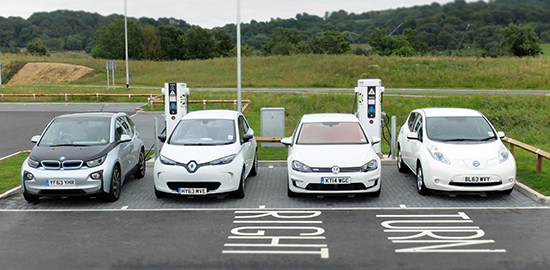
A row of electric cars at a rapid charger station (Image: Ecotricity)

Electric Car Charging Networks 1: The Electric Highway

A row of electric cars at a rapid charger station (Image: Ecotricity)

I have previously covered the ins-and-outs of charging your electric car at home using a charge point or a 13 Amp cable:

If you want to charge your car away from home, and can’t get by with a 13 Amp ‘granny cable’, then you will need to join one or more of the national charging networks. That gives you access to the public charging points available around town centres and on the motorway and trunk road systems.

There are a number of sites where you can look up charging points, including:

In an occasional series I will cover the biggest networks: Electric Highway, Polar Network, POD Point and so on. Here we begin with the Electric Highway, created by Ecotricity and now owned and operated by Gridserve.


Electric Highway (Updated for 2022)

Website: Gridserve Electric Highway
Operated by: Gridserve
Online Map: Charge Point Map

Operator’s Description

“Our low-cost, rapid and high power charging infrastructure is reaching every corner of the UK, covering 85% of the UK’s motorway network.

We provide rapid and high powered charging at some of the lowest rates in the UK. Our next generation chargers are supported by renewable energy from our solar farms.”

Our BMW i3 on charge at Corley Services (Image: T. Larkum)
My BMW i3 on charge on an Ecotricity DBT rapid charger at Corley Services (Image: T. Larkum)

Our View

If you join just one network it probably has to be the Electric Highway (EH) as they have a virtual monopoly on charging at motorway service areas (the exception being Tesla with their Superchargers). The good news is that the majority of services now have at least one rapid charger, an increasing number have two and some have even more. So for long distance driving with your electric car you can pretty much get around most of England by charging at motorway services. Coverage outside England (in Scotland and Northern Ireland, and particularly in Wales) is however poor.

The reliability of Ecotricity charge points has historically been quite poor, but this has started to improve since the takeover by Gridserve.

Curiously, apart from at motorway services the majority of EH rapid chargers are in the car parks of IKEA superstores (due to a partnership deal between them – see IKEA Electric Vehicle Charging).

The majority of EH rapid chargers were large white units manufactured by DBT-CEV. These provide DC charging at 50kW for CCS (BMW i3 etc.) and Chademo (e.g. Nissan Leaf and Mitsubishi Outlander) connectors, and AC charging at 43kW (Renault ZOE). Typically the first ones installed were ‘single headed’ with just Chademo cables for the Leaf. Later they were ‘double headed’ with the addition of a Type 2 cable for the ZOE. Current installs are ‘triple headed’ with the addition of a CCS cable for the i3 and Hyundai IONIQ.

My Renault ZOE charging at an Ecotricity 22kW medium-fast charger (Image: T. Larkum)

Note that most EVs with a Type 2 connector (not the Leaf or Outlander) can be charged with any rapid through the Type 2 cable but only the ZOE can use it at full power (43kW or 22kW). Some can use it at reduced power (e.g. the i3 can use 11kW) but most will drop down to 7kW, like charging at home. You should use the CCS or Chademo connector for rapid charging, and only use the Type 2 if these aren’t working (it will be much slower).

Before using DBT rapids Ecotricity installed a small number of ‘medium’ chargers providing 22kW. Some of these are still in place and can be seen alongside the DBT ones; again, you should make sure that you understand which charger and cable/connector is most appropriate for your circumstances.

Fleet in focus: Chargemaster

Chargemaster uses electric vehicles on its own fleet to prove to companies that plug-in cars make good business sense, John Maslen discovers.

The company behind the country’s biggest electric vehicle (EV) recharging network is now using its fleet to prove the significant potential of zero-emission motoring in business.

Chargemaster is used by thousands of private owners, businesses and councils, with more than 50,000 customers across the UK and Europe. In the UK, it operates the Polar network, which has more than 5,000 recharging points.

It is also the official charging partner for most of the leading plug-in vehicle manufacturers, including BMW, Kia, Mercedes-Benz, Mitsubishi, Nissan, Renault and Toyota, along with a range of other fleet providers, such as leasing giant Alphabet.

For Chargemaster’s founder and chief executive officer, David Martell, the company’s own vehicle choice is a public vote of confidence in the future of electric vehicles within the fleet market.

He says:

“We are showing customers through our vehicle choices that we are serious about the potential growth in the market. We are also giving them confidence that plug-in vehicles are a viable fleet choice.”

Chargemaster operates a fleet of around 40 electric cars, including battery electric vehicles (BEV), range-extenders and plug-in hybrid electric vehicles (PHEVs).

They are used for everything from management cars to vehicles for sales staff and pool cars, with models including the BMW i3, Nissan Leaf, Mitsubishi Outlander, Renault Zoe, Vauxhall Ampera, Volkswagen e-Golf and Tesla Model S.

From its Luton headquarters, the company serves customers throughout the country, so different types of technology are allocated for different types of usage.

For example, drivers who cover higher mileages, such as sales staff, will receive range-extenders or PHEVs, while managers with lower mileages can operate BEVs.

Read more: FleetNews