Category Archives: Charging

Electric Vehicles and Electric Vehicle Charging: Risk and Opportunity

UK data shows that by September 2022, there were 1 million licensed plug-in vehicles (EV) in the UK. This equated to 2.5% of all licensed road using vehicles, up from 1.6% at the end of September 2021[1]. Additionally, the UK government currently plans to prohibit the sale of new internal combustion engine (ICE) vehicles in 2030[2].


Opel Corsa-e Electric Car (Image: Opel.com)

What’s the issue?

  • EVs provide significant advantages, with benefits including:
  • Quieter engines reducing urban noise pollution.
  • Emit less emissions, though debates rage if they are truly ‘green’ bearing in mind the associated costs of mineral extraction and battery recycling.
  • Cheaper maintenance costs as simpler drive trains reduce opportunities for components to fail.
  • Cheaper running costs as electricity rates allow a cheaper cost per mile in comparison to diesel and petrol vehicles. EVs becomes even more economical where homeowners have access to solar charging for their vehicle[3].

What are the risks?

Electric vehicles commonly rely on lithium ion batteries to generate electrical power. However, when damaged or improperly manufactured these batteries can fail. Failure can raise the surrounding temperature and subsequently become the source of thermal runaway resulting in catastrophic fire damage to the vehicle – potentially also spreading to surrounding infrastructure and buildings[4]. As a result, damaged battery packs may lead insurers to write off otherwise perfectly suitable vehicles.

Read more: Marsh

It’s Time to Go Green!

If you would like to know more about Solar Panels and the PowerBanx range of home battery systems, and get a free instant quote, please complete our online form:

Mr. Bean says ‘our honeymoon with electric cars is coming to an end.’ It’s just the beginning.

Mr. Bean loves cars.


Over the weekend, the respected British comedian Rowan Atkinson, famous for his portrayal of a clueless social misfit in his eponymous British series, wrote about “feeling duped” for buying an electric car.

“Our honeymoon with electric cars is coming to an end,” he lamented in an opinion piece in the Guardian. “Sadly, keeping your old petrol car may be better than buying an EV.”

I can see why Mr. Bean might suggest that. I’ve been driving a 2010 Honda Fit for quite a while, and I’m sure it will keep chugging well after my odometer’s recent lap of the 100,000-mile mark.

But Atkinson, who says he has a “lifelong passion for the motorcar” and an undergraduate degree in electrical engineering, argues that people should consider keeping their internal combustion engines as long as possible, while we develop hydrogen and synthetic fuel alternatives.

On one front, Atkinson is right. EVs are not perfect. The industry, for example, has a lot of room to improve on how it sources battery materials, whose mining has ravaged communities and ecosystems around the world. Prices are high. Charging infrastructure is spotty. Supplies are tight. He points out some real problems in the current market.

But based on what we know about emissions and automobile engineering, EVs are the better choice for millions of people right now.

Read more: WashingtonPost

It’s Time to Go Green!

If you would like to know more about Solar Panels and the PowerBanx range of home battery systems, and get a free instant quote, please complete our online form:

Electric Car Line-up (Image: Go Ultra Low)

Osprey Charging opens ‘South West’s largest EV charging hub’

Osprey Charging has opened the “South West’s largest [electric vehicle] EV charging hub” consisting of 16 ultra-rapid chargepoints.

The EV charging hub is located on the A38 Devon Expressway at Salmon’s Leap in Buckfastleigh and designed to support EVs of all types.

Each charger is capable of providing 300kW charging for vehicles able to accept this high power without wasting power on lower-capability cars, Osprey said. This allows customers of the hub to add 100 miles of range in 15 to 25 minutes.

Osprey also stated that it will provide local residents, businesses and visitors with reliable EV infrastructure, help improve air quality, reduce noise pollution and support local decarbonisation efforts.


An extra stop at Sedgemoor (Image: T. Larkum)

“I’m incredibly proud of what we’ve created at Salmon’s Leap. We purchased the land so have been able to precisely design the space and install hardware that maximises availability and ease of use of chargers for all types of vehicles and drivers,” said Ian Johnston, CEO of Osprey Charging.

“Our largest site yet, it is a significant milestone for the Osprey team as we work tirelessly to ensure that our nationwide infrastructure deployment of rapid EV charging stations continues at an unprecedented pace.”

Osprey was amongst a number of founding members of the new trade association ChargeUK. Revealed in April 2023, the association is aiming to invest £6 billion by 2030 in EV charging and double the size of the UK EV charging network in 2023.

Read more: Current+

It’s Time to Go Green!

If you would like to know more about Solar Panels and the PowerBanx range of home battery systems, and get a free instant quote, please complete our online form:

Electric dream? What it’s really like to drive 285 miles to The Lakes in a leccy car

With its rugged landscape, winding country lanes and laidback lifestyle, you wouldn’t necessarily put The Lake District down as being an electrifying hotspot.

However, the folks at BMW have teamed up with 15 UK National Parks  – including The Lakes – as part of a three-year initiative called Recharge in Nature, which aims to install electric vehicle (EV) charging points at some of our best-loved beauty spots.

It’s a wise move. With sustainable tourism and off-grid adventures being big business these days, eco-friendly destinations are becoming a must-have on our in our holiday tick list. (Not to mention the boom in staycations due to the pandemic and cost of living crisis.)

Being England’s largest and most visited National Park, The Lakes are the first to be kitted out with charging points in three locations, Windermere and Ambleside, Hawkshead and Coniston.

But just how well will this eco-conscious initiative work in reality?

To find out I was loaned the newly launched fully-electric BMW iX1 and told to head to the Langdale Hotel just outside Ambleside – a mere 285 miles away from my Essex home.

Advised that the car had a range of between 259 and 270 miles on a single charge, and able to recharge up to 80% of the range in less than half an hour, it looked like we’d need just one pit stop along the way, so we were more than excited to jump in our fancy new wheels and head towards the M6.

Read more: Metro

It’s Time to Go Green!

If you would like to know more about Solar Panels and the PowerBanx range of home battery systems, and get a free instant quote, please complete our online form:

Scottish Water Renault Kangoo electric van (Image: Renault)

Busting EV myths – Breaking down the biggest misconceptions surrounding EVs

Despite the expected shift towards electric and zero emission vehicles, there’s still a lot of controversy surrounding them. Are they really any cheaper to run? What’s their true environmental impact? In this article, Simone Bruckner, managing director of resistor manufacturer Cressall, breaks down the biggest myths surrounding electric vehicles (EVs).


MINI Cooper Concept (Image: MINI)

With more than a quarter of a million new electric car registrations last year, uptake of EVs is definitely on the increase. More than one in five of us expect to be driving an EV within the next five-to-ten years. But there are still a lot of misconceptions surrounding EVs that keep potential buyers on the fence.

EV’s have insufficient range

Many potential buyers are concerned about EV range. Their concern is well-founded in part, with the Nissan Leaf’s lowest range sitting at just 73 miles back when it was launched in 2011.

Thankfully, EV technology has improved in leaps and bounds since then, and most EVs now sit comfortably within the 200-to-300-mile range mark. And these figures aren’t restricted to high-end models either, with models like Hyundai’s Kona and Kia’s e-Niro entering the market at around £35,000 and offering modest real-world ranges of around 250 miles according to Autocar.

99 per cent of car journeys in England are less than 100 miles, and the average length of a trip was less than ten miles pre-pandemic. Based on these numbers, EVs have a perfectly sufficient range for the vast majority of travel.

Read more: Altenergymag

It’s Time to Go Green!

If you would like to know more about Solar Panels and the PowerBanx range of home battery systems, and get a free instant quote, please complete our online form:

A California bill could help make EVs a blackout solution

The state might require every electric vehicle to be capable of powering your home — and the grid — through a process called bidirectional charging.

Chris Bowe was preparing for his daughter’s ninth birthday party in February when a drenching storm knocked out power to his neighborhood in Hayward, California. Minutes before the party began, Bowe connected his electric Ford F-150 Lightning to a panel in his garage, sending electricity from the pickup truck to his house.

“It was dark out, parents were dropping off their kids, and our house was lit up,” said Bowe, who works as a FedEx manager in the Bay Area. “They were like, ‘How do you have power?’”

Bowe kept the lights on using bidirectional charging, which allows electric vehicles to not only receive electricity but discharge it as well. It’s a feature that a proposed California bill would require that all EVs sold in the state offer by model year 2027.


BMW i3

Making an EV bidirectional capable is a matter of equipping it with the right software and hardware, and some, like the Nissan Leaf, Kia EV 6, and the Lightning, already provide the feature. Other manufacturers have been slower to roll out the technology. Tesla, for example, says its cars will be bidirectional by 2025.

Read more: Grist

It’s Time to Go Green!

If you would like to know more about Solar Panels and the PowerBanx range of home battery systems, and get a free instant quote, please complete our online form:
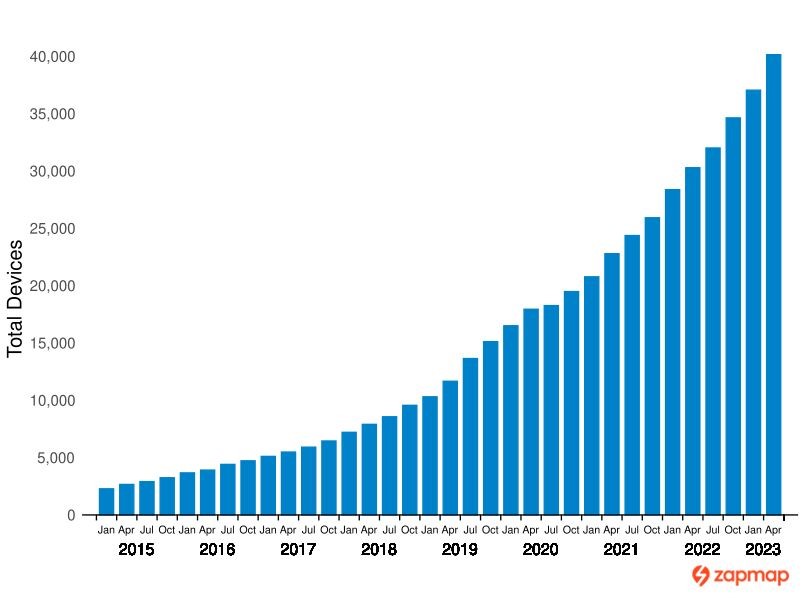
New UK charge points (Image: Department for Transport)

EV charging points increase by 8% in first quarter of 2023

The UK government has published new Electric Vehicle (EV) charging point statistics showing the number of installed devices increased by 8% in the first three months of 2023.

As of 1 April, there were 40,150 public electric vehicle charging devices installed in the UK, while the total installed devices increased by 3,095, an increase of 8%.

“Since 1 April 2022 the number of installed public devices has increased by 9,860, a 33% increase,” the government said. “The number of rapid charging or above devices increased by 39%, an additional 2,153 public devices installed.


New UK charge points (Image: Department for Transport)

Of the installed devices, “7,647 were rated “rapid” devices or above, this represents 19% of all charging devices”, while “22,338 were rated “fast” chargers, this represents 56% of all charging devices”.

In terms of location, 19,044 charging points were designated as “destination” chargers (47% of all devices), while 13,571 were “on-street” chargers (34%).

Since 1 January 2023, total installed charging points increased by 3,095 (8%), with rapid charging devices increasing by 760 (11%).

Read more: Current+

It’s Time to Go Green!

If you would like to know more about Solar Panels and the PowerBanx range of home battery systems, and get a free instant quote, please complete our online form:

EVs and the grid—it’s all about give and take

There is no disputing that we need more flexibility within the grid in the UK, and across countries globally, if we’re to accommodate an influx of new energy resources. Large volumes of renewables are and will continue to feed in, while increased demand from the electrification of transport and heat continue to cause strain during peak times. In the UK, although there is flexibility within the grid, the nation’s energy regulator Ofgem (Office of Gas and Electricity Markets) has recently proposed to create an energy marketplace that aims to address the challenge of how we unlock value from assets that are connected to our distribution networks.


New LEVC electric van (Image: LEVC)

Using electric vehicles (EVs) as an example, there is a huge long-term potential for both give and take on the grid. Advancements in smart charging will transform the way that EV users charge their vehicles, opting to take from the grid at times that suit the grid’s capacity—offering the potential to avoid peak times and essentially manage the ‘surplus’ energy that exists within our systems at other times of the day—and vehicle-to-grid (V2G) is offering drivers a way to feed power back into the grid in times of a supply deficit by discharging back into the grid to plug supply shortfalls.

Read more: automotiveworld

It’s Time to Go Green!

If you would like to know more about Solar Panels and the PowerBanx range of home battery systems, and get a free instant quote, please complete our online form:

ChargeUK established to double the size of UK EV charging network in 2023

ChargeUK, a new trade association which launched today (28 April), is aiming to invest £6 billion by 2030 in EV charging and double the size of the UK EV charging network in 2023.

The association, which brings together 18 EV charging companies, will look to increase the availability of charging in addition to accelerating investment and delivery. This will be achieved via collaboration with government and other stakeholders to break down barriers and shape policies and regulation.

Founding members of the organisation include: Be.EV, Believe, bp pulse, char.gy, ChargePoint, Connected Kerb, ESB, evyve, Fastned, Genie Point, Gridserve, Ionity, Mer, Osprey, Pod Point, PoGo Charge, RAW Charging and Shell Recharge.

“The formation of ChargeUK is an exciting day and is a demonstration of the EV charging industry’s growing size and importance to the UK economy,” said Ian Johnston, chair of ChargeUK and CEO of Osprey Charging Network.

“Together we are investing billions of pounds to get more charge points in the ground right across the country. These numbers reinforce our commitment to the UK’s net zero future. We will continue to be a proactive partner to government as we deliver a world-class charging infrastructure, giving the nation’s drivers confidence to transition to EVs.”

Read more: Current+

It’s Time to Go Green!

If you would like to know more about Solar Panels and the PowerBanx range of home battery systems, and get a free instant quote, please complete our online form:

How much does charging an electric car cost? Is it cheaper than petrol?

Your electric car charging costs are simple to calculate. Here’s how to work it out

There are plenty of reasons for going electric: that pesky CO2 stuff, for one thing. But there’s another incentive for making the switch other than doing your bit for the polar bears: electric car charging costs.

You see, charging an electric car has been – historically, at least – cheaper than filling up with conventional fuel. And that means over the course of electric vehicle ownership, you could save yourself a lot of money in running costs. Really.

There are, of course, a couple of important caveats: to make the numbers work, you will need to do the majority of your charging at home. This is where electricity is most affordable (even with energy costs ballooning) and some tariffs will allow you to make the most of cheaper overnight rates when demand is low.

Public charging points – including the so-called ‘rapid’ chargers popping up at motorway service stations – tend to be a lot more expensive. And while they’re a godsend for topping up quickly on a long journey, you will be paying for the privilege. So much so that the price per mile of driving might not be that much different to that of a petrol or diesel car. Boo! Hiss!

Read more: TopGear

It’s Time to Go Green!

If you would like to know more about Solar Panels and the PowerBanx range of home battery systems, and get a free instant quote, please complete our online form: