Category Archives: Charging

Charging Station in Sunderland (Image: Fastned)

UK’s first electric car charging forecourt to open

First of 100 planned electric forecourts will open in November, offering 30 electric car chargers, plus shops, cafes and relaxation areas…

A new electric forecourt in Braintree, Essex aims to bring added convenience to electric car owners and make electric vehicle (EV) charging as simple and stress-free as using petrol stations.

Instead of the rows of petrol and diesel pumps you get in a conventional service area, the electric forecourt has 30 EV chargers, including six Tesla Superchargers. Twelve of the other chargers are capable of operating at up to 350kW so they can add 200 miles of range to a car in as little as 20 minutes.

If drivers need assistance with charging or technical information about their vehicle, there is a phone next to every charger that can be used to call a dedicated helpline manned by EV experts from the AA.

Charging Station in Sunderland (Image: Fastned)

While drivers are waiting for their cars to charge, they can relax and shop in the two-storey building on site. On the ground floor there will be a number of shops and cafes, and on the first floor there’s an airport style lounge, business meeting room pods and a wellbeing area. The facility has free superfast wi-fi.

There is also an education centre attached to the main building where people can find out more about electric vehicles and buy or lease one.

Toddington Harper, Founder and CEO of Gridserve, which is behind the project, said: “Our UK-wide network of electric forecourts will eliminate range and charging anxiety, and represent so much more than the electric equivalent of modern petrol stations.

“We will deliver a fully loaded customer experience, offering the best of British retail and customer service to cater for a full range of consumer and driver needs.”

Read more: whatcar

It’s Time to Go Green!

If you would like to know more about Solar Panels and the PowerBanx range of home battery systems, and get a free instant quote, please complete our online form:

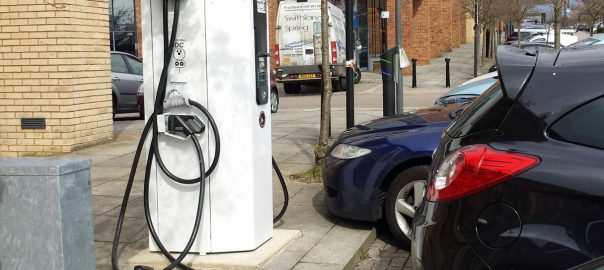
One of the many Polar rapid charge points around Milton Keynes, this one is in Central MK (Image: T. Larkum)

Zap-Map launches EV charging payment interoperability service Zap-Pay

A new electric vehicle (EV) charging payment interoperability service has been launched by Zap-Map.

Zap-Pay allows EV drivers to use a single app to pay for charging across different networks, with Engenie the first network signed up to the service.

Drivers using Zap-Pay will be able to pay for charging at any of the network partners as part of a pay-as-you-go tariff, with ESB EV Solutions, LiFe and Hubsta amongst others set to be introduced to the platform in the autumn.

Zap-Pay is to be rolled out across other UK networks in 2021 with the hope of providing “unrivaled coverage” across the country.

It bares resemblance to other new services launched by other players in the EV space, most notably the EV payment interoperability platform launched under Octopus’ Electric Juice umbrella, which also has Engenie signed on. Octopus’ also aggregates charges onto a single bill, targeting the fleet demographic.

One of the many Polar rapid charge points around Milton Keynes, this one is in Central MK (Image: T. Larkum)

Zap-Map is also developing new features to support the electrification of commercial fleets and other e-mobility services, it said, which are due to be rolled out over the next twelve months.

Zap-Pay was created due to the various different apps and cards required to charge on different networks across the UK, with a recent Zap-Map survey finding that charger anxiety – concern over being able to access the right chargepoint when needed – was an issue for 68% of EV drivers.

It is to also provide live status updates, charging history, PDF VAT receipts and 24/7 customer support.

At the time of its launch, it is live on ten Engenie chargepoints across four locations – Stratford, Gloucester, Chepstow and Bristol. By the end of this month, it will be rolled out across the whole Engenie network of rapid chargepoints.

Following Good Energy taking a 12.9% stake in the company in March 2019, Zap-Map told Current± it was working on the development of Zap-Pay before confirming in December 2019 it would be launched in early 2020.

Read more: Current

It’s Time to Go Green!

If you would like to know more about Solar Panels and the PowerBanx range of home battery systems, and get a free instant quote, please complete our online form:

Ubitricity Electric Avenue project lamppost charging (Image: Siemens)

Average EV range exceeds 200 miles

The average range of the latest electric cars exceeds 200 miles, according to new research from Cornwall Insight.

It analysed the WLTP-reported range of all the electric vehicles (EVs) currently available in the UK and found that, on average, EVs can cover 202 miles.

“Range anxiety is one of the key barriers to EV adoption, but, our latest research, shows that the average range for electric cars stands at around 202 miles. Suggesting that the range offered by electric cars at present is practical for a range of scenarios. The improvement in mileage is due to growing investment and more models being announced by car manufacturers,” said Tom Lusher, analyst at Cornwall Insight.

Ubitricity Electric Avenue project lamppost charging (Image: Siemens)

Tesla models were found to offer the longest range, with the Model X achieving more than 350 miles from a single charge.

The research also highlighted that cheaper EVs, like the Peugeot e-208, Kia e-Niro and Hyundai Kona can now comfortably offer more than 200-miles of range when compared to older models, like the Volkswagen e-Golf.

Lusher added: “The fleet industry represents a large proportion of the transport industry and the mileage issue has dulled uptake, however, as overall mileage of EVs are improving we are now approaching the point where EVs will make a viable alternative to petrol or diesel.”

Read more: FleetNews

It’s Time to Go Green!

If you would like to know more about Solar Panels and the PowerBanx range of home battery systems, and get a free instant quote, please complete our online form:

Peugeot e-2008 electric SUV (Image: Peugeot)

Peugeot e-2008 review: EV crossover driven in the UK

Looks like a normal 2008 to me…

That’s because it is. PSA doesn’t do a special, electric-only model like the Renault Zoe or Honda e. Rather than spend a vast amount of time and money designing and building a bespoke EV platform, it engineered its so-called ‘CMP’ architecture to accept both petrol/diesel and electrified powertrains. Every car that’s based on it (the 208, 2008, DS3 Crossback, Vauxhall Corsa and soon, Vauxhall Mokka and Citroen C4) gets the option of electric propulsion.

And these cars are not for zero-emission virtue signallers. PSA’s electric cars look and feel almost exactly like their petrol-powered counterparts. That’s the point – to normalise what is for many still a scary, new technology. You just fill them with electrons instead of inflammable liquid.

Surely the electric ones are more expensive?

Peugeot e-2008 electric SUV (Image: Peugeot)

They are. The e-2008 is available in all the same trim levels as the regular 2008, with prices (including the Government’s £3,000 grant) coming in at around £5,600 more than the equivalent petrol auto if you’re buying outright.
But you’re not buying outright, are you? Lease direct from Peugeot, and you’ll pay around £60 more per month for the electric-powered car. Remember, though, that the EV is exempt from road tax and BIK (potentially saving company car drivers thousands) and a full charge should only cost a little over £7 if you do it at home, while a full tank of petrol costs £50.

Yes a tank of fuel will get you further than a fully-charged battery, but not that much further.

How far can the e-2008 go on a charge, then?

Far enough. Peugeot claims between 191 and 206 miles, which is a smidge less than the mechanically largely identical e-208 because of the e-2008’s increased size and weight. We think 160 miles is a fair estimate of what most people will see, but pop it into Eco mode, amp up the regen and switch off the air conditioning and obviously you’ll go further.
In a 65-mile test the e-2008 managed 3.9 miles/kWh, which is actually very good. Its range computer is annoying though. Rather than counting down progressively as you cover distance, like other EVs, it tends to stick at one reading for miles, then loses a load of range in one big lump when you gently accelerate up a slip road. This is annoying and not massively confidence-inspiring.

A three-pin plug takes 24 hours to fully charge the e-2008, so if you’re got a driveway definitely get yourself a 7kW wallbox. It does the same in less than eight hours – a good night’s sleep. Find one of the relatively few 100kWh chargers out in the wild, and your e-2008’s 50kWh battery will charge to 80 per cent of its capacity in just 30 minutes.

Read more: Top Gear

It’s Time to Go Green!

If you would like to know more about Solar Panels and the PowerBanx range of home battery systems, and get a free instant quote, please complete our online form:

BP Chargemaster to trial EV charging at M&S sites as first 50kW chargers installed

The three new 50kW chargers, located at Maidstone Eclipse Park in Kent, are the first of a five-store trial. They are backed by 100% renewable electricity and feature contactless payment terminals and connectors for all capable EVs.

They form part of BP Chargemaster’s Polar network of public chargers, and are therefore also accessible with a Polar Plus membership RFID card or the Polar Instant PAYG app.

Matteo de Renzi, CEO of BP Chargemaster, said that the company expects the rapid chargers will bring new customers to the stores “as they are in the right locations to support those driving along the Strategic Road Network and provide a great opportunity a brief stop”.

The site of the first three chargers is just off junction 7 of the M20, with the installation funded by investment from BP Chargemaster.

Helen Milford, director of stores for M&S, said: “As we create a store estate for the new world it’s critical our shops are in the right locations, digitally connected and offer trusted value products and services such as the rapid chargers – we’re looking forward to seeing the customer response to our trial in Maidstone.”

Read more: Current

It’s Time to Go Green!

If you would like to know more about Solar Panels and the PowerBanx range of home battery systems, and get a free instant quote, please complete our online form:

IONITY rapid charge points at Leeds Skelton Lake Services (Image: IONITY)

Over 18k EV chargers installed across UK as London continues to take the lead

The number of electric vehicle (EV) chargers installed across the UK has risen to 18,265 according to figures released by the Department for Transport (DfT).

The figures – which are released quarterly – are sourced from Zap-Map data and show the number of chargers in the UK excluding domestic and workplace charging.

Of the 18,265 chargers installed 3,206 are rapids (43kW+), with the number of chargers jumping up since the October 2019 figures, which showed there were 15,116 chargers and 2,495 rapids, as well as increasing since the April 2020 figures, where there were 17,947 chargers and 3,107 rapids.

IONITY rapid charge points at Leeds Skelton Lake Services (Image: IONITY)

However, whilst there has been an increase in the previous quarter, it is clear that the rate of deployment has slowed, likely due to the impacts of the COVID-19 pandemic which saw EV charger installations halt in March.

London has continued to maintain its lead, with the region having the highest level of charging device provision per 100,000 of population. It is also slightly ahead in rapid charging device provision, according to the statistics, although Scotland wins out on rapids with the highest level of provision.

Read more: Current

It’s Time to Go Green!

If you would like to know more about Solar Panels and the PowerBanx range of home battery systems, and get a free instant quote, please complete our online form:

Another sustainability milestone for Ecocabs

Sustainability pioneer Ecocabs, a taxi operator in Hexham in the North East of England, are proud to announce the arrival of the first Ford Tourneo Custom Plug-In Hybrid Vehicle (PHEV) to be operated anywhere in the UK.

Technology is developing all the time, but currently all-electric vehicles cannot fulfil the operational demands of a rural taxi service in terms of practicality due to the limited range and lack of fast charging points. This is where the hybrid vehicle makes much more sense for a rural operator currently.
The vehicle is purpose-built to help transport passengers more efficiently than ever. Smart, hybrid technology helps keep emissions to a minimum, whilst intelligent design creates a refined and sophisticated interior for passengers.
Commenting on the purchase of the eco-friendly 9-seater vehicle, Matthew Kirkby, founder and Managing Director of Ecocabs, said, “Sustainability remains top of our agenda at Ecocabs, and the introduction of the new Ford Tourneo continues our commitment to cutting the CO2 emissions of our fleet, and reducing our overall impact on the environment.”

About Ecocabs
Ecocabs — the sustainable taxi, travel and tourism support company, based in Hexham — provides community taxi services in Tynedale and surrounding areas, and supports sustainable travel and tourism across much of Britain.
Ecocabs offers guided tours and support to increasing numbers of health-conscious, eco-aware travellers and tourists seeking more sustainable holidays and pastimes. Based in Hexham — close to the Hadrian’s Wall Path and Hadrian’s Cycleway — Ecocabs is ideally situated to support walkers and cyclists wishing to experience the history, countryside, sites and attractions along the Roman Wall.

Ecocabs also supports cyclists tackling the various coast-to-coast cycle routes, as well as the Sandstone Way — the 120-mile mountain biking route between Berwick upon Tweed and Hexham. Further afield, Ecocabs supports nationally known activities, including the 3-Peaks Challenge, during which walkers scale the three highest mountains of Scotland, England and Wales — Ben Nevis, Scafell Pike and Snowdon — all in 24 hours.

About the Ford Tourneo PHEV
The new Ford Tourneo Custom Plug-in Hybrid (PHEV) uses two sources of power to get passengers where they need to be more efficiently than ever. An advanced electric powertrain, with zero emissions, can be used for shorter trips, while on longer journeys the multi award-winning 1.0 litre EcoBoost engine kicks in to extend the Tourneo’s range. The vehicle uses technology designed to maximise efficiency without compromising on the reliability and flexibility customers expect in a Tourneo.

Source: Ecocabs

It’s Time to Go Green!

If you would like to know more about Solar Panels and the PowerBanx range of home battery systems, and get a free instant quote, please complete our online form:

POD Point Rollout at Tesco Stores (Image: Tesco/POD Point)

Peugeot e-208 wins ‘Electric Small Car of the Year’ award at What Car? Electric Car Awards

The Peugeot e-208 Allure Premium has been named the ‘Electric Small Car of the Year’ at the inaugural What Car? Electric Car Awards, beating a host of rivals to the title, including Honda E and Renault Zoe.

The Peugeot e-208 is the company’s first new generation full electric vehicle. It comes with an electric 50kWh, 136hp powertrain that’s capable of up to 217 miles of range (WLTP) from a single charge and supports rapid charging of up to 100kW, reaching 80 percent charge in as little as 30 minutes.

POD Point Rollout at Tesco Stores (Image: Tesco/POD Point)

“All things considered, the e-208 is the best small electric car you can buy” said What Car? Editor, Steve Huntingford. “It has a good real-world range, the suspension does a great job of keeping you comfortable, and the interior is as eye-catching as it is classy. We particularly like the Allure Premium version, because it’s attractively priced, but still comes with loads of kit, including climate control, wireless phone charging and a 10.0in infotainment system with phone mirroring.”

David Peel, Managing Director of Peugeot UK, added that the company is following a unique philosophy around the ‘power of choice’ that allows buyers to choose the right powertrain that suits their needs and that Peugeot’s electric vehicles come with the same practical features as their petrol or diesel vehicle counterparts, with no compromise in capability, interior space or technology.

In other categories, the Hyundai Ioniq Electric has been named the best Electric Family Car on sale. The multi-award winning Kia e-Niro won Best Electric small SUV and the SEAT Mii electric won Value Electric Car of the Year.

Read more: Renewable Energy Magazine

It’s Time to Go Green!

If you would like to know more about Solar Panels and the PowerBanx range of home battery systems, and get a free instant quote, please complete our online form:
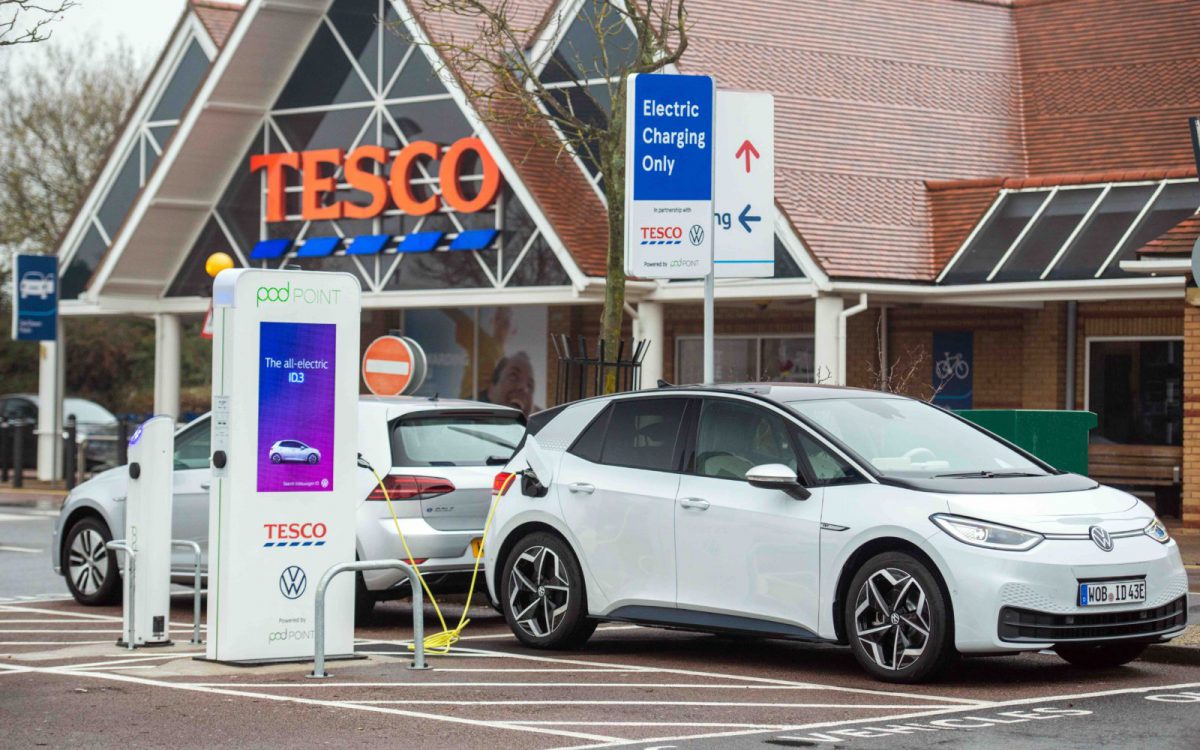
EVs Are Not A Problem For The Electric Grid, They Are The Solution

One of the stock arguments you will hear against the wide adoption of electric vehicles is about how the power supply grid is going to cope with all these high-voltage devices drawing current to recharge.

A home EV charging station will require somewhere between 2kW and 7kW when it is replenishing a car battery. If all EVs are plugged in at once, surely the grid will collapse and power stations will be overextended? Dogs and cats will live together, and mass hysteria will break out? But not only is this a complete misunderstanding of EV charging habits, it could be getting things completely the wrong way round. Here’s why.

First, let’s give the negative argument some thought. There were about 33 million passenger cars in the UK in 2019, according to the UK Department of Transport, and there were nearly 274 million registered cars in the USA in 2018, according to the Federal Highway Administration of the US Department of Transportation. If all of these are swapped for EVs with batteries with at least 50kWh, and you charge them all at once at 7kW, you could be asking the UK grid to supply 231GW of energy for at least seven hours, and the US grid 1.9TW. UK power stations supplied 86.9TWh in Q1 2020, which is an average of 39.8GW per hour. The USA had a capacity of 1.1TW at the end of 2019.

This is obviously never going to work. There’s not enough capacity on either grid. But of course, it never would have to. One of the big misconceptions about EVs is that you charge them every day like a phone. This also leads to gross miscalculations about how long the batteries will last, but let’s not get into that argument right now. A survey by Statista published in January 2020 stated that in 2017 UK motorists drove on average 4,500 miles per year for private use, and the trend since then has been down. That’s just 12 miles a day, and with lots of EVs now providing a 200-mile range on a single charge, on average you’ll be charging your EV twice a month. So, in reality, assuming an even distribution of charging, the UK grid could easily cope with everyone owning an EV and charging it twice a month on average. American drivers use their cars a lot more – 13,500 miles a year, according to the US Department of Transport. But that’s still only six charging cycles a month for an EV with a 200-mile range, which is well within current capacity.

Read More: Forbes

It’s Time to Go Green!

If you would like to know more about Solar Panels and the PowerBanx range of home battery systems, and get a free instant quote, please complete our online form:

POD Point Rollout at Tesco Stores (Image: Tesco/POD Point)

Engenie joins Octopus Electric Juice roaming service in ‘crucial step’ for seamless charging

POD Point Rollout at Tesco Stores (Image: Tesco/POD Point)

Octopus Energy has added a new electric vehicle (EV) charging network to its roaming service Electric Juice.

Engenie – which operates over 150 rapid charging stations at over 100 UK locations – is the latest to come on board to the service.

Its charging locations, including London’s first rapid charging hub, will now be included in the Electric Juice network, with Octopus stating that with this addition the network now has “significant” inner-city and on-the-road coverage.

This follows on from the launch of the Beta version in May, which saw Char.gy be the first to join the network, which allows drivers to pay with their Octopus Energy account across both Char.gy and Engenie’s networks.

This is to be expanded across other charging locations as more networks are added, Octopus said, helping to eradicate the often-cited barrier to electrification of different networks requiring different apps and payment cards.

Read more: Current News

It’s Time to Go Green!

If you would like to know more about Solar Panels and the PowerBanx range of home battery systems, and get a free instant quote, please complete our online form: