Category Archives: Energy and Climate Change

News and articles on climate change, vehicle pollution, and renewable energy.

From heatwaves to hurricanes, floods to famine: seven climate change hotspots

Global warming will not affect everyone equally. Here we look at seven key regions to see how each is tackling the consequences of climate change

It could have been the edge of the Sahara or even Death Valley, but it was the remains of a large orchard in the hills above the city of Murcia in southern Spain last year. The soil had broken down into fine white, lifeless sand, and a landscape of rock and dying orange and lemon trees stretched into the distance.

A long drought, the second in a few years, had devastated the harvest after city authorities had restricted water supplies and farmers were protesting in the street. It was a foretaste of what may happen if temperatures in the Mediterranean basin continue to rise and desertification grows.

All round the world, farmers, city authorities and scientists have observed changing patterns of rainfall, temperature rises and floods. Fifteen of the 16 hottest years have been recorded since 2000. Carbon dioxide and other greenhouse gas emissions steadily climb. Oceans are warming and glaciers, ice caps and sea ice are melting faster than expected. Meanwhile, heat and rainfall records tumble.

The evidence for the onset of climate change is compelling. But who and where is it hitting the hardest? How fast will it come to Africa, or the US? What will be its impact on tropical cities, forests or farming? On the poor, or the old? When it comes to details, much is uncertain.

Mapping the world’s climate hotspots and identifying where the impacts will be the greatest is increasingly important for governments, advocacy groups and others who need to prioritise resources, set goals and adapt to a warming world.

Read more: The Guardian

Mayor reveals zero emission London transport plans

Mayor of London Sadiq Kahn has revealed the proposals that will help achieve his aim of dramatically cutting vehicle emissions in the capital. The plan is to make London’s transport network zero-emission by 2050.

The Ultra Low Emission Zone and T-Charge proposals are already confirmed to come into force in the near future, but zero-emission zones will be launched in phases, with central London and town centres first from 2025, inner London between 2035 and 2040, and a blanket London-wide zone by 2050.

Between now and 2025, a ‘major expansion in electric vehicle charging points’ is planned, along with the installation of at least 15 hydrogen refuelling stations in and around London. These investments in infrastructure will continue in a significant manner to encourage expansion until at least 2035.

In terms of public transport, all new buses bought will be hybrid, electric, or hydrogen, before all buses operating in the capital being zero-emission of hybrid from 2030. All buses will be zero-emission between 2035 and 2040.

All new taxis will need to be zero-emission capable from the beginning of next year, with the same rule for new private hire vehicles by 2025. From 2030, only zero-emission capable taxis and private hire vehicles will be able to operate in London.

The overall aim of these proposals is to improve air quality and reduce congestion. Despite a predicted expansion in London’s population to 10.5 million over the next 25 years – with a forecast additional 5 million trips each day by 2041 using current models – Kahn’s plans aim to cut the number of car journeys by three million each day.

Read more: Next Green Car

BMW and PG&E Prove Electric Vehicles Can Be a Valuable Grid Resource

Nearly 100 plug-in cars and a stack of second-life EV batteries successfully responded to dozens of demand response calls.

The concept of using electric vehicles as a grid resource is no longer just theory. A pilot program recently conducted by BMW and Pacific Gas & Electric successfully demonstrated that electric vehicles can serve as reliable and flexible grid assets, which could eventually save money for both utilities and EV owners.

The BMW i ChargeForward Project is one of the best examples to date of a utility and an automaker working together to develop new technologies and use cases for electric vehicles (EVs) and their batteries.

“One of the things that we really wanted to test here was, how can we work closely with an automaker?”

said David Almeida, electric vehicle program manager at PG&E.

“We are an old company, and we’re a large company. Automakers are old companies, and they’re large companies. We both have our own internal bureaucracies. And so, one of the challenges I wanted to understand when we were setting this up was, how do we make those two independent entities work well together?”

“By and large, we didn’t have any of those institutional challenges that I was [worried about],” he said. “We ended up working very closely, I think partially because we’ve got this common shared goal of increasing electric transportation.”

With the i ChargeForward pilot, BMW was required to provide PG&E with 100 kilowatts of grid resources when called upon, through a combination of delaying charging for nearly 100 BMW i3 vehicles in the San Francisco Bay Area and drawing from a second-life stationary battery system built from reused EV batteries, for the duration of 1 hour. The grid services demonstrated in the pilot included day-ahead and real-time signals that were modeled after existing proxy demand resources from the California Independent System Operator (CAISO), in order to test whether these resources could eventually participate at the wholesale level.

Read more: Green Tech Media

Queen’s Speech introduces an Electric Vehicles Bill

New Bill unveiled in Queen’s Speech to require charging points to be fitted at services and fuel stations, support driverless cars and keep insurance claims simple

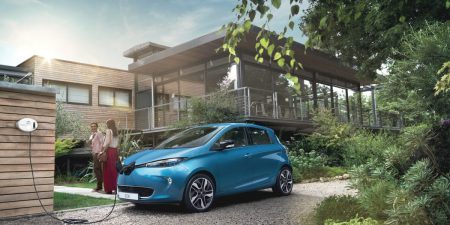
Renault ZOE

Motorway services and petrol stations may be forced to install electric charging points as part of Government plans to ensure the UK

“remains a world leader in new industries”.

An Automated and Electric Vehicles Bill will be introduced to encourage the use of electric and self-driving cars, the Government announced in the Queen’s Speech.

The first all-electric car to be built in the UK rolled off of the production line in 2013, and the Government wants

“almost every car and van to be zero-emission by 2050”.

Of more than 36.7 million licensed vehicles in the UK, just over 100,000 have been purchased with help from a government plug-in car grant.

Registrations of electric vehicles are increasing, with 13,800 being registered in the first quarter of 2017, a 17% rise on the same period the year before.

Plans to fund the additional electric charging points have not yet been announced, although the Government said it was committed to spending £600m during this Parliament to support the ultra-low emissions market.

The new law also aims to support British manufacturing and innovation by allowing self-driving cars to operate in the country.

Source: Platts Garages

Ridesharing may not replace personal vehicle sales, but supplement them, says report

OEMs have been concerned for some time that the rapid rise of mobility services such as Uber and Lyft will lead to a fall in the number of vehicles purchased by consumers. However, a new report has found that, for current vehicle owners, this assumption may simply not be true.

Strategy Analytics’ new report ‘Impact of Ride Sharing Frequency on Vehicle Purchase Intention’ discovered that, for current vehicle owners, increasing ridesharing usage actually raises the likelihood they will purchase another vehicle within the next five years. This is in part because current frequent rideshare users, who also own their own vehicle, have greater transportation needs than those that do not.

The ridesharing service therefore fills a niche of convenience, but does not supplant the user’s need for their own personal vehicle. This may be due to mindset – for example, with a user used to the comfort of cars preferring to use a service like Uber rather than public transport in situations when using their own car is not possible (such as due to a lack of parking or when intoxicated).

However, the report does follow consensus evidence that desire for car ownership is weakening at the lower, younger end of the market, with millennials with no children that use ridesharing at least once a week being much less likely to purchase another vehicle within the next five years, compared to all respondents that had children.

Report author and director of syndicated research at Strategy Analytics’ UXIP (User Experience Innovation Practice) Chris Schreiner said:

‘The question of how emerging transportation options like ridesharing and car-sharing will impact vehicle sales is a very complex one to answer. Issues of cost, convenience, usability, privacy, type of journey, and length of journey all impact transportation choices.
‘Frequent ridesharing users do not seem likely to delay their next vehicle purchase, but it is still possible that they might choose a less expensive or lower class vehicle.’

This could lower the residual values of more premium vehicles, and raise demand in the volume segment. This is because private consumers tend to buy used cars (with fleets buying new).

Read more: Autovista Group

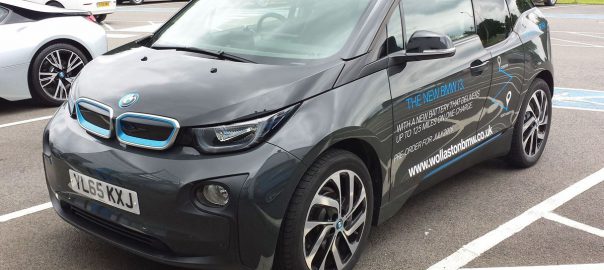
The i3 waiting for us (Image: T. Larkum)

Falling costs, new revenues fuel Britain’s big battery boom

Britain is emerging as a hotbed for utility-scale battery development, with two of Europe’s three biggest projects under way there and several companies joining a race that could shake up the energy market.

The i3 waiting for us (Image: T. Larkum)
The BMW i3 (Image: T. Larkum)

Rapid growth of solar and wind energy means power supplies depend increasingly on whether the wind is blowing or the sun shining. As a result, utilities are looking for new ways to store renewable energy for release into the grid when supplies are low.

In the UK the challenge is especially acute because the buffer between supply and demand is tighter than in other European countries as old fossil fuel plants close, while Britain lacks Germany’s supply lines to import power and maintain grid frequency – the change in direction of the electrical current – when local supplies drop.

“(Renewables) intermittency means the frequency on the grid changes more quickly than before so we need faster technology which can react to that,”

said Cathy McClay, commercial head at the British National Grid system operator.

Last year, National Grid held one of the world’s first tenders to supply rapid grid balancing services on four-year contracts.

“The National Grid tender required such a fast response it almost exclusively created a market for batteries, which isn’t something we have seen elsewhere in Europe,”

said Andy Houston, senior analyst at UK-based consultancy Poyry.

Swedish utility Vattenfall [VATN.UL] is developing battery projects in the Netherlands and Germany but chose Britain for its largest — 22 megawatts (MW) — at the Pen y Cymoedd wind farm in Wales after winning a National Grid contract.

“Britain’s National Grid tender is one of the best opportunities for batteries,”

said Sebastian Gerhard, Vattenfall’s head of battery projects.

Vattenfall is using lithium ion batteries purchased from German car manufacturer BMW (BMWG.DE), the same as those used in its i3 electric cars, stacked together in portacabin-sized units. Vattenfall estimates the drive to create commercially viable electric cars has sent battery costs tumbling by around 40 percent since 2010.

Energy trader Vitol [VITOLV.UL] is building two battery plants in Cumbria and Kent through subsidiary VPI Immingham after winning two National Grid contracts with joint venture partner Low Carbon, and aims to hook them up to the grid by the end of the year.

Read more: REUTERS

This is how Big Oil will die

Big Oil is perhaps the most feared and respected industry in history.

Oil is warming the planet — cars and trucks contribute about 15% of global fossil fuels emissions — yet this fact barely dents its use. Oil fuels the most politically volatile regions in the world, yet we’ve decided to send military aid to unstable and untrustworthy dictators, because their oil is critical to our own security. For the last century, oil has dominated our economics and our politics. Oil is power.

Yet I argue here that technology is about to undo a century of political and economic dominance by oil. Big Oil will be cut down in the next decade by a combination of smartphone apps, long-life batteries, and simpler gearing. And as is always the case with new technology, the undoing will occur far faster than anyone thought possible.

To understand why Big Oil is in far weaker a position than anyone realizes, let’s take a closer look at the lynchpin of oil’s grip on our lives: the internal combustion engine, and the modern vehicle drivetrain.

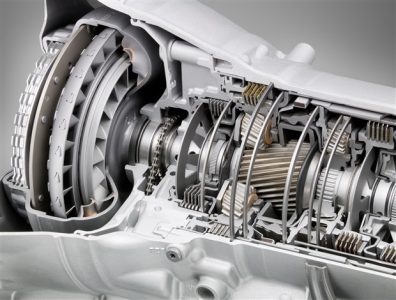
BMW 8 Speed Automatic Transmission

Cars are complicated.

Behind the hum of a running engine lies a carefully balanced dance between sheathed steel pistons, intermeshed gears, and spinning rods — a choreography that lasts for millions of revolutions. But millions is not enough, and as we all have experienced, these parts eventually wear, and fail. Oil caps leak. Belts fray. Transmissions seize.

None of these failures exist in an electric vehicle.

The point has been most often driven home by Tony Seba, a Stanford professor and guru of “disruption”, who revels in pointing out that an internal combustion engine drivetrain contains about 2,000 parts, while an electric vehicle drivetrain contains about 20. All other things being equal, a system with fewer moving parts will be more reliable than a system with more moving parts.

And that rule of thumb appears to hold for cars. In 2006, the National Highway Transportation Safety Administration estimated that the average vehicle, built solely on internal combustion engines, lasted 150,000 miles.

Current estimates for the lifetime today’s electric vehicles are over 500,000 miles.

Read more: NewCo Shift

Hyundai Motor Company Increases Production Capacity of IONIQ Electric by 50%

Hyundai Motor Company is planning to increase production capacity of ‘IONIQ Electric’, which is its main electric vehicle, by 50% as number of potential buyers has greatly increased compared to its original prediction on demands in South Korean market. It is expected that this will resolve inconvenience of customers who have to wait 4 to 5 months to purchase IONIQ Electric.

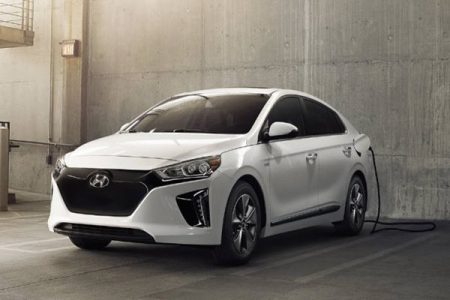
Hyundai Motor Company’s IONIQ Electric

According to electric vehicle industries on the 6th, Hyundai Motor Company is planning to increase an output of IONIQ Electric, which is produced from its production plant in Ulsan, from 1,200 (based on per month) to 1,800. Half of this output is supply for South Korean market and the other half is for foreign markets such as the U.S., and Europe. Quota for South Korean market will also increase from 600 per month initially to 900 per month. It is expected that delivery of IONIQ Electric will be pushed forward when people have to wait between 4 to 5 months to purchase one. Increased output will first be applied to IONIQ Electrics that need to be delivered between July and August.

Hyundai Motor Company has increased production facilities when contractors including Ministry of Environment (ME), which is in charge of supply of electric vehicles, started complaining due to recent rapid increase in number of buyers of IONIQ Electric and it has also set its yearly sales goal high. It has increased yearly sales goal in South Korean market from 6,000 initially to 8,000.

But even this won’t help Hyundai Motor Company to make another upward revision as 5,581 IONIQ Electrics were already sold by end of April and the number of IONIQ Electric owners will rise to about 7,000 by end of May if people who already paid deposits are included.

Read more: etnews

Renault-Nissan to build energy storage plant from EV batteries to rival power stations

The Renault-Nissan Alliance is planning to build a 100MW energy storage plant big enough to power 120,000 homes, which can replace a gas or coal-fired power station, sources told Reuters. It is widely seen as a pilot project that could lead to a major new business opportunity for OEMs.

Following trialling using electric vehicle (EV) batteries for home energy storage, this is a further sign the Alliance is planning to establish an energy storage division. The energy storage plant intentions highlight the Alliance’s growing confidence in the powerful position OEMs will find themselves in following the upcoming electric vehicle revolution.

Energy storage plants – essentially gigantic batteries – help save costs and emissions by charging up in times of cheap excess electricity supply. This is when, for example, wind farms generate too much electricity than needed on a windy day. The storage plants then sell the electricity back to the grid at peak times, when the high demand means the electricity commands a higher price.

This helps solve two key problems holding back efficiency in the energy sector: the need to smooth out the variable energy generated from wind and solar, and the desire to remove the need for gas- or coal-fired power plants to be idling on standby for most of the day, and switched on ad hoc in order to meet times of peak electricity demand.

The Renault-Nissan project both aims to cultivate this demand for a second-hand battery market, as well as encouraging the development of energy infrastructure (which can have 10-year lead times) that will synergise with booming EV sales over the next decade. If successful, the expected high demand for these second hand EV batteries would help drive down the costs of electric vehicles (and raise residual values), and also provide an attractive mechanism for recycling the power cells which contain environment-harming heavy metals.

Read more: Autovista Group

Solar Charge Points charging electric cars (Image: T. Larkum)

‘Spectacular’ drop in renewable energy costs leads to record global boost

Falling solar and wind prices have led to new power deals across the world despite investment in renewables falling

The Solar Charge Points at Devon Cliffs - and only 2/3 of the cars shouldn't be parked there! (Image: T. Larkum)
Solar Charge Points for electric cars (Image: T. Larkum)

Renewable energy capacity around the world was boosted by a record amount in 2016 and delivered at a markedly lower cost, according to new global data – although the total financial investment in renewables actually fell.

The greater “bang-for-buck” resulted from plummeting prices for solar and wind power and led to new power deals in countries including Denmark, Egypt, India, Mexico and the United Arab Emirates all being priced well below fossil fuel or nuclear options.

Analysts warned that the US’s withdrawal from the Paris climate change agreement, announced last week by Donald Trump, risked the US being left behind in the fast-moving transition to a low-carbon economy. But they also warned that the green transition was still not happening fast enough to avoid the worst impacts of global warming, especially in the transport and heating sectors.

The new renewable energy capacity installed worldwide in 2016 was 161GW, a 10% rise on 2015 and a new record, according to REN21, a network of public and private sector groups covering 155 nations and 96% of the world’s population.

The new record capacity cost $242bn, a 23% reduction in investment compared to 2015, and renewables investment remained larger than for all fossil fuels. Subsidies for green energy, however, are still much lower than those for coal, oil and gas.

New solar power provided the biggest boost – half of all new capacity – followed by wind power at a third and hydropower at 15%. It is the first year that the new solar capacity added has been greater than any other electricity-producing technology.

“A global energy transition [is] well under way, with record new additions of installed renewable energy capacity, rapidly falling costs and the decoupling of economic growth and energy-related carbon dioxide emissions for the third year running,”

said Arthouros Zervos, chair of REN21.

Read more: The Guardian