Boris Johnson to announce plans at CBI conference, telling business leaders the UK is at a pivotal moment
Boris Johnson will seek to boost the UK’s clean energy credentials after a tricky UN climate crisis conference by announcing that all new buildings in England will be required to install electric vehicle charge points from next year.
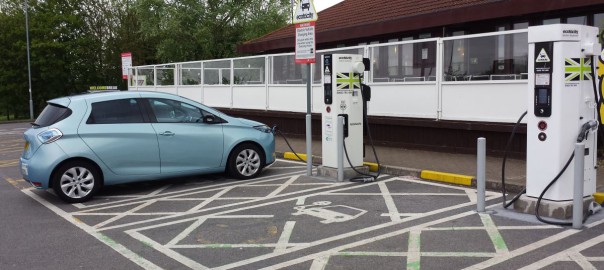
Electric cars charging in Milton Keynes (Image: T. Larkum)
In a speech to the Confederation of British Industry (CBI) in the north-east of England on Monday, the prime minister will reveal plans, briefed as “world-leading”, to toughen up regulations for new homes and buildings.
From next year developers on sites such as supermarkets and office blocks will be required to install electric vehicle charging points, in an attempt to help phase out the use of petrol and diesel cars before sales of them come to an end in 2030. The government expects the move to lead to 145,000 new charging points each year.
If you would like to know more about Solar Panels and the PowerBanx range of home battery systems, and get a free instant quote, please complete our online form:
Fleets and company car drivers will benefit from competition on pricing for electric vehicle charging at motorway services after exclusive agreements were ruled out as part of Competition and Markets Authority (CMA) investigation.
Gridserve, which acquired the Electric Highway from Ecotricity in June, has offered legally-binding assurances, known as commitments, to the CMA.
It says that it will not enforce exclusive rights in contracts with Extra, MOTO or Roadchef, after 2026, which currently cover around two-thirds of motorway service stations.
In doing so, Gridserve has committed to reducing the length of the exclusive rights in the current contracts with MOTO by around two years and Roadchef by around four years (the contract with the third operator, Extra, is due to end in 2026).
An extra stop at Sedgemoor (Image: T. Larkum)
Furthermore it says it will not enforce exclusive rights at any Extra, MOTO or Roadchef sites that have been granted funding under the UK government’s Rapid Charging Fund (RCF).
This means that, where funding has been granted, competitor charge point operators will be able to install charge points regardless of the exclusive element of the Electric Highway’s contracts.
Each of the motorway service station operators – Extra, MOTO and Roadchef – and Gridserve have also offered commitments not to take any action that would undermine the above commitments.
Andrea Coscelli, CMA chief executive, said: “One of the biggest stumbling blocks to getting people to switch to electric cars is the fear that they won’t be able to travel from A to B without running out of charge.
“Millions of people make a pitstop for fuel at motorway service stations every day, so it’s crucial that people can trust that electric charge points will do the same job.
“Healthy competition is key to ensuring that drivers have a greater choice of charge points where they need them, and for a fair price.”
If you would like to know more about Solar Panels and the PowerBanx range of home battery systems, and get a free instant quote, please complete our online form:
Renault Retail Group has switched its fleet of courtesy cars to fully electric Renault Zoe models.
The business operates 15 dealerships in England and Wales and operates 164 courtesy cars.
Renault ZOE 2020 (Image: Renault.com)
The new electric vehicles (EVs) replace a selection of petrol-powered Renault Clio, Captur and Dacia Sandero models.
Ludovic Troyes, managing director of Renault Retail Group, said: “The 100% electric Renault Zoe has been prominent in the EV market for nearly 10 years, bringing zero-emissions motoring within the reach of everyone. By switching to electric courtesy cars, Renault Retail Group is giving all our customers the opportunity to experience the benefits of electric motoring, so they too can take advantage of affordable running costs whilst being kinder to the environment.”
If you would like to know more about Solar Panels and the PowerBanx range of home battery systems, and get a free instant quote, please complete our online form:
Electric cars could help to power millions of households in the coming years, simply by harnessing their battery power. The electricity in the vehicle’s battery could be plugged back into the grid, instead of being stored. The technique was pioneered in Japan and our research will help understand how best to use it in the UK.
Many electric vehicles (EVs) are being produced with the ability to use their onboard battery to send power back to the electricity supply they are connected to. Whether that is the owner’s house, or the electricity grid more generally, these technologies have been led by governments and electric car manufacturers mainly in order to balance the demand on the power transmission network, or grid.
The ability to use these huge connected batteries complies with the future management and provision of cleaner grids – instead of burning fossil fuels to generate electricity, we should harness clean renewable sources such as wind and solar when abundant, and store the electricity in batteries for when not. So by charging electrical vehicles from renewable sources, we can lower our greenhouse emissions.
BMW iX3
The plan sounds great, but is made tricky because electricity is difficult to store. But we already store huge amounts of electricity – in our cars. With around 1% of the UK’s 27 million households currently owning an EV, each with an average 60kWh battery, these 300,000 EVs could store an incredible 18GWh of electricity which could usefully be used to power houses. That’s more than the Dinorwig pumped storage plant in Snowdonia, the UK’s biggest storage facility, which stores around 9GWh.
By 2030, the UK could have almost 11 million electric vehicles on the road. Assuming 50% of these vehicles were able to feed unused energy back into the grid, this would open up opportunities to power 5.5 million households.
How do we make it happen?
In order to allow cars to power the grid on a technical level, three things need to happen. First, a two-way transfer of power from the car to its charging point should be made possible. This system is known as vehicle-to-grid and was first introduced in Japan after the Fukushima disaster and the following power shortage.
If you would like to know more about Solar Panels and the PowerBanx range of home battery systems, and get a free instant quote, please complete our online form:
The Long Range version of the facelifted MG SZ EV could be a game-changer for the fast-growing manufacturer
Verdict
The new MG ZS EV still offers no-nonsense, no-frills electric motoring – just over a longer distance than before and for slightly more money. It’s a bargain EV for those prioritising range and roominess on a budget, but there are compromises to make on quality. It won’t suit everyone, but it’s an appealingly affordable electric SUV.
This could be a sliding doors moment, not just for MG – a brand that is steadily building solid sales figures in the UK – but for Britain’s electric car market. It’s the facelifted ZS EV, a heavily revised version of MG’s compact electric SUV that arrives with some updates usually associated with an all-new car, not a mid-life refresh.
It doesn’t look hugely different, with a new, smarter front grille joined by updated headlights, a fresh rear bumper and a revamped colour palette. It’s still very much an amalgamation of common small family SUV design themes, but it’s what’s underneath that counts. That’s because while the old ZS EV was only available with a 44kWh battery enabling 163 miles of range, this new version offers two choices.
ZS EV (Image: MG)
A 51kWh car will come early next year offering 198 miles of range and a cost likely in line with the pre-facelift model’s price tag of around £25,000. But arriving in MG showrooms at the end of November is this 72.6kWh Long Range version.
On paper, it takes the ZS into entirely new territory. Up to 273 miles of range is claimed, and this facelifted model is priced from £28,495 after the £2,500 plug-in car grant – or £319 a month on a typical three-year, 10,000-mile per annum PCP deal with a 10 per cent deposit and a £1,500 contribution from MG. The figures really are a big pull, because similarly sized electric SUVs such as the Peugeot e-2008 and Vauxhall Mokka-e cost more, and also won’t get you nearly as far on a full charge.
An electric motor with 154bhp and 280Nm of torque drives the front axle, a slight rise in power but a decrease in peak torque over the previous model. The new ZS’s battery only contributes an additional 10kg to the kerbweight, which is good given the extra range that’s on offer.
With a 98 per cent charge, we saw a predicted range of 267 miles, rising to 280 miles in Eco mode. Over 127 miles of motorway, B-roads and London city streets we averaged 3.7 miles per kWh. With the battery’s usable capacity standing at 68.3kWh, it translates to a real-world range of around 252 miles, strong figures for an electric car of this size and price.
If you would like to know more about Solar Panels and the PowerBanx range of home battery systems, and get a free instant quote, please complete our online form:
A new design to make electric vehicle (EV) charge-points “instantly recognisable” has been revealed.
Transport Secretary Grant Shapps said the design “could become as iconic as the Great British postbox or black cab”.
Consultancy firm PA Consulting, which created the design in partnership with the Royal College of Art, said it has “an instantly recognisable circular handle”, while its materials, size and black colour “help it to blend into the UK’s diverse surroundings, whilst remaining visible for EV drivers”.
Mr Shapps described its unveiling at the Cop26 climate summit in Glasgow as “a crucial step”.
New UK charge points (Image: Department for Transport)
He said it will “raise awareness of the electric vehicle programme (and) help millions more drivers make the switch to cleaner and greener cars”.
The UK is “on track to become a global leader in zero-emission motoring,” he added.
The Department for Transport, which commissioned the project, said it will “provide greater choice to industry and local government, as well as raise awareness and generate excitement around electric vehicles”.
A series of announcements on low carbon transport are being made on “transport day” at Cop26.
The Government has said new heavy goods vehicles (HGVs) sold in the UK will need to be zero emissions by 2040.
The phase-out will begin with a requirement for new trucks of 26 tonnes and under being net zero by 2035.
If you would like to know more about Solar Panels and the PowerBanx range of home battery systems, and get a free instant quote, please complete our online form:
Transporting heavy loads is not something BEV (battery electric vehicles) have proved to deal well with so far.
The massive battery pack they have to carry and the long times required to charge them will be a hindrance compared to FCEVs (fuel cell electric vehicles). On the other hand, small commercial vehicles will do just fine, as Renault proves with the new-generation Kangoo Van E-Tech.
The new van now presents a 45-kWh battery pack, more than double the Kangoo Z.E., which featured a 22-kWh unit. The benefits were also extended to the electric motor, which is more than twice as potent as its predecessor. While the Kangoo Z.E. had a 44 kW (59 hp) motor, the Van E-Tech has one that delivers 90 kW (121 hp).
Kangoo-ZE-ML20 (Image: business.renault.co.uk)
Despite the two-fold improvements, that did not apply to the range. Instead of 170 kilometers (107 miles) of range under the NEDC cycle, it now presents 300 km (186 mi) of range, only under a more severe testing cycle: WLTP. We suspect the lower number than expected has to do with the testing method and the third-generation Kangoo being slightly larger (and heavier).
Renault has been a pioneer in using heat pumps in electric vehicles – with the ZOE – and the new Kangoo Van E-Tech is no exception. Renault says it extracts heat from “the air around the vehicle” without using energy in an electrical resistor. The company also said that the heat pump works best between -15ºC (-17.22ºF) and 15ºC (59ºF).
If you would like to know more about Solar Panels and the PowerBanx range of home battery systems, and get a free instant quote, please complete our online form:
The latest car sales data for Oxford reveals that 30 per cent of new cars bought in the city are electric.
Oxford has seen one of the most dramatic increases in EV uptake nationwide, with sales almost doubling in the past 12 months.
Ubitricity Electric Avenue project lamppost charging (Image: Siemens)
According to data from New AutoMotive, an independent transport research group supporting the uptake of electric vehicles in the UK, EV sales now stand at almost 30 per cent of the overall market in Oxford, a year ago, it was just 16 per cent.
If you would like to know more about Solar Panels and the PowerBanx range of home battery systems, and get a free instant quote, please complete our online form:
For the first time ever, sales of electric cars are forecast to exceed those of diesel ones in the UK next year, thanks to a fall in up-front prices and improvements in public charging infrastructure
More electric cars are expected to be sold in the UK than diesel models next year, in what experts say will be a “watershed moment”.
Fully electric battery cars have already outsold diesel cars for several months this year, but 2022 is now projected to be the first time it happens across a year.
Dacia Spring 2021 (Image: Dacia.co.uk)
A total of 260,000 electric cars are expected to be sold in 2022 versus 221,000 diesel models, according to figures published yesterday by the Society of Motor Manufacturers and Traders (SMMT), the UK automotive trade body. The figures do not include hybrid models.
“It’s brilliant. I think it is a watershed moment in terms of EVs [electric vehicles] finally coming in from the cold and being a mainstream solution for people,” says David Bailey at the University of Birmingham, UK.
If you would like to know more about Solar Panels and the PowerBanx range of home battery systems, and get a free instant quote, please complete our online form:
The MG ZS EV has received a substantial update for 2021, including a redesign and new battery options
The facelifted MG ZS EV is now on sale, starting from £28,495 after the Plug-in Car Grant deduction. The refreshed model has received a significant midlife facelift with an exterior redesign, a refreshed interior, upgraded tech and a pair of new battery options, one of which has boosted the maximum range of the budget-focused SUV to 273 miles.
The increased range figure offered by the new MG ZS EV pitches it directly against models such as the Nissan Leaf and Renault ZOE, with the larger-battery version offering a far longer range than the entry-level Kia e-Niro.
2021 MG ZS EV: prices and specifications
The refreshed MG ZS EV is available in three trim levels, starting with the SE version. This model costs from £28,495 after the PiCG, and gets LED headlights, adaptive cruise control, keyless entry and start, a 360-degree parking camera, a 10.1-inch infotainment touchscreen and sat nav. It also features vehicle-to-load (V2L) charging, which allows owners to power or recharge other electrical devices.
ZS EV (Image: MG)
Stepping up to the Trophy model costs from £30,995 after the grant deduction. This model adds a panoramic roof, heated front seats, electrical adjustment for the driver’s seat, faux-leather interior trim, roof rails, rain-sensing automatic wipers and a wireless phone charging pad. Above this, the Trophy Connect adds extra connectivity with connected live services for weather, traffic and Amazon Prime. Prices for this flagship model start from £31,495 after the grant deduction.
Every version of the MG ZS EV gets an array of standard safety features dubbed ‘MG Pilot.’ This features active emergency braking with pedestrian and cyclist detection, lane-keep assist, lane-departure warning, traffic-jam assist, high-beam assist and speed-limit assist.
Design
The redesign of the new MG ZS EV includes a blank, closed front grille incorporating the charging port, to set it apart from the petrol model. The LED headlights have also been tweaked and there are a new set of aerodynamic alloy wheels with a two-tone paint finish. A new tail light design, restyled rear bumper and a new rear diffuser with silver trim inserts also feature.
A further addition to the refreshed model is a useful charging status indicator located in the nose-mounted charging port. This features four LEDs, giving owners a visual indicator of charging progress.
If you would like to know more about Solar Panels and the PowerBanx range of home battery systems, and get a free instant quote, please complete our online form: