All posts by Jo

BMW i3 Shows What Nissan Leaf & Chevy Bolt Are Missing

The priority in the EV market right now is for cars to offer the best driving range around and this is why many manufacturers are pushing for 200 miles as the new bare minimum.

The latest Chevrolet Bolt is already capable of offering 238 miles of EV range and the next-gen Nissan Leaf promises something similar. BMW, on the other hand, seems unbothered by it because the i3 is still viewed as a success despite not able to keep up with rival EVs on the sales front.

For BMW, they are targeting a niche market that wants luxury and exclusivity. While the i3 may be far behind its rivals in terms of driving range, it does come with a couple of features that reflects well on BMW’s luxurious status.

One of the features which many are pleased for is the suicide doors. As how you can see in the picture above, the door layout is just so rare to come by these days that it automatically became the single most attractive feature on the i3.

Even those that have purchased the i3 cannot get bored of the suicide doors hence we are not expecting the feature to go away on the next-gen BMW i3.

Source: NSE Voice

BMW 530e iPerformance review: Come in from the cold – this is the plug-in hybrid worth scrapping

Drive a diesel car in London? Monster! Recent emissions revelations have turned you into an outcast. It doesn’t matter that you quite like your powerful diesel BMW 5 Series, and you’re not going to buy a bloody Prius – so what can you do?

Right on cue, BMW has launched a plug-in hybrid version of its astonishingly capable new 5 Series, called 530e iPerformance. The name’s a mouthful – we’ll stick with 530e – but the figures are jaw-dropping: more than 140 mpg, 46g/km CO2 and NOx emissions so minuscule, they don’t even come into it.

And, as if it couldn’t get any better, the government will give you £2,500 if you buy one, taking it down below £30k – not far shy of the best-selling BMW 520d.

BMW took us to its spotless and very Germanic Munich garage for a trial drive. While BMW’s reps were light on the details, we did learnt that the car, is in essence a 2.0-litre turbo petrol 5 Series hooked up with a BMW i3 electric motor and a battery with enough juice to do 31 miles on electric power only.

Once the battery is flat, the engine kicks in, as it does in the plug-in hybrid Mitsubishi Outlander PHEV. There are several driving modes to give you different styles of eco-ness, including one that will fully charge the battery on the move. BMW’s done this with potential future city centre legislation in mind – if combustion engines are banned from certain areas, the 530e will still be allowed in.

Sensibly, you’ll just leave it in auto, and let the system work out what’s best. I did this and found the engine was off more than it was on, allowing me to cruise through Munich in silent, futuristic electric-assist serenity. It’s nothing like having a grunty old diesel clattering away: even a posh V8 5 Series isn’t this silent. And 0-62mph in 6.2secs is pretty fast, too; it’s a Tesla experience in an executive BMW.

Read more: City A.M

2017 BMW i3 REx (94 Ah) — Modern-Day Sci-Fi

Twenty years ago, if you had asked me what cars would be like in 2017, I’d probably tell you they’d be able capable of flight.

I always had this image in my head, as a child, that cars be able to just hover and fly around by the time I was old enough to drive. Maybe I watched too many sci-fi movies as a kid but that was always my vision. Fast forward to today and the automobile is a lot less sci-fi than I had previously imagined. Eight-year old me would be crushed. However, if there was ever a car that could get close to my childhood dreams, it’s the BMW i3 and I just spent a week indulging my inner child’s imagination.

Before we talk about that, let’s take a quick look at what’s new about the i3. BMW launched the i3 2013, as a 2014 model, and back then it was absolutely state-of-the-art. It had almost 100 miles of range, which was about standard for the time, but it was made almost entirely of carbon fiber and had looks like something from Minority Report, both inside and out. So it shocked the world and put BMW on the EV map.

Since then, though, the i3’s charms have wained in the EV community. Other cars had surpassed the i3 in terms of electric range, such as the Chevy Bolt and updated Nissan Leaf. So BMW was forced to give its i3 an update of its own, bumping up its range to over the 100-mile mark, which seems to be the point where customers’ range anxiety becomes less of an issue. So BMW swapped the standard i3’s battery out for a larger, 94 Ah battery that packs a very solid 114 miles of total range. The Bavarians also added some new colors and “Worlds”, as well as some new options, such as a moonroof in North America (finally). And now, the BMW i3 is more competitive in its current market. Though, it still gets some flak for its range. But I’m here to tell you that none of that matters. At least not to eight-year old me.

Stepping into the i3 is an experience unlike anything else in the automotive world. Firstly, just look at it. Nothing else on the road looks even remotely as funky, futuristic or interesting as the i3. It looks like it’s from another world and my eight-year old self would go insane over it, especially in the new Protonic Blue paint color. I know this because kids love the i3. They point and jump around, trying to get their friends to notice what seems like a spaceship to them driving down the street. When it’s parked, people take pictures of it at all angles, regardless of if anyone’s inside of it. It’s a head-turner, like it or not.

Read more: BMW Blog

Oil Majors Can No Longer Ignore The Electric Car Threat

Many carmakers, and not just Tesla, have been developing electric vehicles, betting on the expected continuous rise of battery-powered cars in the future. Now it’s not only carmakers that predict that EVs will make up a substantial part of new vehicle sales in a decade or two—oil majors are admitting it too.

France’s Total SA expects EVs to account for up to 30 percent of new car sales by 2030, which could lead to oil-based fuel demand peak in the 2030s, Total’s Chief Energy Economist Joel Couse said at Bloomberg New Energy Finance conference earlier this week.

Couse reckons that after 2030, fuel demand “will flatten out” and “maybe even decline”, in what Colin McKerracher, head of advanced transport analysis at Bloomberg New Energy Finance, described as the “most aggressive” projection by an oil major about the rise of EVs.

Other oil majors have their projections about peak oil demand as well, ranging anywhere from as early as the next decade, to nowhere in sight. At the same time, analysts believe that EV sales will only rise, but the pace will greatly depend on incentives and government policies. Meanwhile, many carmakers are preparing for the EV surge and entering the battery-powered car market.

France’s Total sees that growth as potentially leading to peak oil-based fuel demand in the 2030s. Other majors also have ideas about the impact of EVs on global oil demand.

Shell’s chief executive Ben van Beurden said in March that oil demand could peak as early as in the next decade.

“We have to acknowledge that oil demand will peak, and it could already be in the next decade. It could happen. There are people who believe it will grow forever but I don’t subscribe to that,”

van Beurden told the CERAWeek energy forum, as quoted by The Telegraph.

BP, in its Energy Outlook 2017, said that an extra 100 million battery EVs could lower oil demand by around 1.4 million bpd. Still, the UK oil major sees oil demand peak in the mid-2040s, with many drivers to factor in, including global GDP growth, efficiency trends, and climate policy. According to BP, the penetration of the EVs will depend on how fast battery costs would continue to drop; the size and durability of government incentives; how conventional cars’ efficiency would improve; and how consumer preference towards EVs would shift.

Read more: Oilprice.com

Watch This Nissan Leaf Rally Car Display its Off-Road Chops

The madmen of Scotland-based Plug In Adventures, along with RML Group, have created a monster. It’s a formidable off-roader called the Nissan Leaf AT-EV (all-terrain electric vehicle) and it will be the first EV to do battle in the Mongol Rally this summer.

Plug In Adventures is a group of EV enthusiasts who like to do weird stuff with electric cars. They’ve teamed up with RML Group, a high-performance automotive engineering firm, to modify this Leaf into something Nissan probably never intended. Modifications for rally prep include Maxsport RB3 rally tires, braided brake lines, skid plates of sorts, a roof rack with a light bar, and mudflaps despite having fake mud graphics behind the wheels.

Nissan UK has made a demo video showing off what the Leaf AT-EV can do. It should be able to silence any naysayers of the little EV’s potential off-road when properly modified. Granted, it’s not quite rock crawling in Moab, but it’s still pretty impressive. See for yourself what this beast can do.

Read More: The Drive

Chevron is first oil major to warn investors of risks from climate change lawsuits

Big Oil’s lies about the existential risk posed by its product are now catching up with the industry and threatening profits.

For the first time, one of the major publicly owned fossil fuel companies admitted publicly to investors that climate change lawsuits poses a risk to risk to its profits.

You’re probably thinking that seems like an obvious admission. After all, 190 nations unanimously agreed in the December 2015 Paris climate deal to leave most fossil fuels in the ground because of the existential threat they pose to human civilization.

But this is Big Oil — the industry that has been denying or pretending to deny the existence of climate change for over half a century.

In the “risk factors” section of Chevron’s 2016 10-K financial performance report to the Securities and Exchange Commission (SEC) — amid a discussion of how those pesky climate rules governments are enacting might hurt demand for its product — is this sentence:

“In addition, increasing attention to climate change risks has resulted in an increased possibility of governmental investigations and, potentially, private litigation against the company.”

Naomi Ages, Greenpeace USA’s climate liability project lead, said this is the first time a major oil company admitted that such investigations and private litigation were

“a material risk to the company and its shareholders.”

Red more: Think Progress

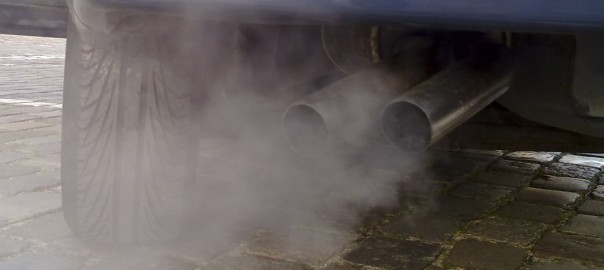
Car exhaust pollution (Image: Wikipedia)

Nearly 40 million people live in UK areas with illegal air pollution

Nearly 40 million people in the UK are living in areas where illegal levels of air pollution from diesel vehicles risk damaging their health, according to analysis commissioned by the Labour party.

The extent of the air pollution crisis nationally is exposed in the data which shows 59% of the population are living in towns and cities where nitrogen dioxide (NO2) pollution breaches the lawful level of 40 microgrammes per cubic metre of air.

Car exhaust pollution (Image: Wikipedia)

Labour says the air pollution crisis is a “national scandal”. Sue Hayman, shadow secretary of state for environment, food and rural affairs, said a Labour government would bring in a new clean air act to tackle what was a public health emergency.

“Labour will not allow the Tories to use the snap general election or Brexit to kick this issue into the long grass or water down standards that would put millions of UK adults and children at risk,”

said Hayman.

She said the party was committed to putting in place a network of clean air zones across the UK where there are high emissions, and would act at an international level to close loopholes in emissions testing of vehicles.

The analysis published by Labour shows more than 38 million people, representing 59.3% of the UK population, are living in areas where levels of nitrogen dioxide pollution are above legal limits.

Local authorities including Aberdeen, Birmingham, Bournemouth, Burnley, Derby, Chelmsford, Leeds, Northampton, Richmond and Sheffield – among many others – have NO2 levels above the legal limit.

Read more: The Guardian

Electric Vehicles Are on the Rise: Here’s How to Sustain Their Growth

The struggle for electric vehicles to gain legitimacy in a world dominated by supersized SUVs and overbearing big rigs is something of a David and Goliath story.

The underdog just landed a blow right between the eyes of America’s major car manufacturers.

In April, Tesla became the most valuable automaker in the US, passing General Motors in total market value. GM has since regained the lead by a slim margin, edging Tesla in market cap by a little more than a billion dollars.

The release of the Model 3 alone promises to nearly double the number of electric vehicles (including hybrids). That’s not quite as impressive as it first sounds considering there were more than 260 million vehicles in the US as of 2014, according to the Bureau of Transportation Statistics. In other words, EVs will still account for less than one percent of all vehicles.

Strong policy needed

There is potential for EVs to reach a market share of 30 percent or greater by 2030, but that will require radical shifts in environmental and regulatory policy, according to John Axsen, an associate professor at Simon Fraser University in British Columbia who studies green technology, consumer behavior and environmental policy.

“As long as gasoline vehicles are able to belch pollutants and greenhouse gas emissions ‘for free,’ then EVs will have a disadvantage,”

he says by email to Singularity Hub.

“Economists call this a market failure. So nearly all the good research out there shows that strong policy is responsible for any success we’ve seen so far, and that we’ll need more strong policy to see any real success going forward.”

There are very few places where such policies exist. For example, Norway has reached 25 percent market share for EVs because it has huge taxes on fossil fuels, huge taxes on conventional vehicles, and very substantial financial and non-financial incentives for EVs, according to Axsen.

Supply needs to meet demand

Another impediment to EVs reaching a tipping point is supply, according to Axsen. There are relatively few makes and models available, particularly in truck and van classes. “And then, many car dealerships are not carrying these EVs in their inventory, and research shows that many dealers in Canada and the US are not even trying to sell the EVs to customers,” he notes.

Elon Musk and Tesla, meanwhile, are not satisfied with just building the world’s most advanced EV compact cars and sedans. The company recently announced it would next tackle a mini-bus, pickup truck and even semi-truck. The latter would be a particularly disruptive technology, especially if Tesla outfits it with the company’s Autopilot system.

Phasing out fossil fuels

“Electric vehicle technology is getting better, and a few regions are showing the market potential,”

Axsen says, such as California, Norway and the Netherlands. Both European countries plan to phase out fossil fuel vehicles by 2025.

Despite such successes, Axsen emphasizes that without changes in policy, the EV market will likely continue to hover around one percent, perhaps hitting 10 percent by 2030. he adds.

“The strongest policies, which encourage automakers to sell a wide variety of EVs, can push market share as high as 30 to 45 percent by 2030,”

Read more: SingularityHub

Should you buy a used electric car?

With more coming onto the used market, is now the time to go electric?

The used market for electric cars is pretty attractive. If you’re buying. If you’re selling then it can be a distressing experience as the initial depreciation on many electric cars is proving very high [Fuel Included Editor’s Note: of course with a PCP lease, you get a guaranteed final value and so are protected from unexpected depreciation]. The market seems to feel concerned that technology is moving so fast that an electric car even a few years old may be ‘old tech’ fairly soon, and that is reflected in the prices. Which, if you’re buying and you understand the market, can be very good news indeed.

For example, you can pick up a used Nissan Leaf for under £6000 these days. A car like that will give you free access to London and other zero-emission zones, will cost very little to keep powered up, will be cheap to tax and doesn’t cause pollution – at the tailpipe.

Of course there are things to watch out for. Older cars will almost certainly have less range, so range anxiety really is a thing. And the other anxiety thing is the battery. Will it last? Is it included in the price or is it leased? These are vital questions.

If you buy a more expensive electric car like a Tesla or a BMW i3, then the battery is something you’ve bought along with the rest of the car. Many others are only offered with a leasing deal on the battery, with charge that scale up as mileages mount.


A Nissan Leaf or a Renault Zoe fall into this group along with many others. Battery lease costs are around £70pcm. And don’t forget you’ll need to add a charger at home. This can be in the £279 to £354 range depending on speed of charge.

So all that is something to factor in while you’re looking at fuelling costs of only about 2p per mile. Maintenance costs can be as little as a quarter what a comparable petrol or diesel car would cost too, so there are definite compensations.

Nissan Leaf

Used prices from: £6000
Real-world range: 60-90 miles
Battery warranty: from 5 years/60,000 miles

The top-selling Leaf can be had with a battery either bought outright or leased for £70pcm with an annual limit of 7500 miles. Later models with 30kWh batteries have a greater range.

BMW i3

Used prices from: £14,000
Real-world range: 80-100 miles
Battery warranty 8 years/100,000 miles

The achingly contemporary looking i3 includes the battery in the price. The looks are backed up by carbonfibre and aluminium, with the battery array low in the floor so it drives well.

Renault Zoe

Used prices from: £5000 (with leased battery)
Real-world range: 70-100 miles
Battery warranty n/a

Second only to the Leaf, the Zoe offers practical space and is a very useful car as well as being quite fun to drive. The leased battery can take a fast charge as another practical bonus.

Read more: Independant

Tesla Powerwall display (Image: T. Larkum)

How Batteries Could Revolutionize Renewable Energy

All over California, there’s evidence of the state’s goal to lead the country in renewable energy. Enormous farms of shiny solar panels have popped up across southern California, and gigantic wind turbines dot the landscape outside nearly all the major cities.

There are less flashy—and less visible—investments in renewables going on, too. Tucked away in warehouses, trailers and industrial parks are lithium ion batteries that, if all goes well, will play a critical role in helping California hit its ambitious target: to have 50% of all electricity come from renewables by 2050.

Tesla Powerwall display (Image: T. Larkum)

Some green energy sources come with a built-in challenge: the wind and the sun can’t be turned on and off at will. When it’s windy and sunny, an abundance of energy may be harnessed—but any excesses go to waste. That’s where batteries, the most common type of energy storage, come in. Batteries solve that problem by allowing utility companies to collect excess electricity and store it for times when the sun may not be shining or the wind not blowing.

“Networks care about reliability,”

says Logan Goldie-Scot, an energy-storage analyst at Bloomberg New Energy Finance. “Energy storage is being viewed by network operators as a potential tool in their toolbox, and that hasn’t been the case up until now.”

Batteries will also change the power sector as homeowners and businesses install their own products. Batteries at homes, offices and other commercial buildings allow customers to save electricity collected by their solar panels and use it at times when electricity prices are highest. One in four businesses with more than 250 employees has already deployed batteries to help with their electricity management, according to a Deloitte study. Regulatory changes that encourage battery owners to sell back stored electricity when it’s in high demand could increase interest in batteries, analysts say.

Batteries installed in electric vehicles, for instance, will also affect the electric grid as automakers continue to expand their offerings. Experts say the impact will both stress and help utilities manage their electricity supply. The stress comes as vehicles create a new demand for energy, but at the same time, batteries in those vehicles act as a storage unit of their own that may offer new flexibility. The largest battery in a Tesla, as one example, can store enough electricity to power the average American home for more than three days. Utilities have begun exploring programs to encourage electric vehicle owners to charge their cars when there is extra power on the grid.

Read more: Time