Monthly Archives: November 2018

Global oil demand under growing threat from electric cars, cleaner fuel

LONDON (Reuters) – Electric vehicles and more efficient fuel technology will cut transportation demand for oil by 2040 more than previously expected, but the world may still face a supply crunch without enough investment in new production, the International Energy Agency (IEA) said on Tuesday.

Oil demand is not expected to peak before 2040, the Paris-based IEA said in its 2018 World Energy Outlook.

The IEA’s central scenario is for demand to grow by around 1 million barrels per day (bpd) on average every year to 2025, before settling at a steadier rate of 250,000 bpd to 2040 when it will peak at 106.3 million bpd.

“In the New Policies Scenario, demand in 2040 has been revised up by more than 1 million bpd compared with last year’s outlook largely because of faster near-term growth and changes to fuel efficiency policies in the United States,” the agency said.

The IEA believes there will be around 300 million electric vehicles on the road by 2040, no change on its estimate a year ago. But it now expects those vehicles will cut demand by 3.3 million bpd, up from a previous estimated loss of 2.5 million bpd in its last World Energy Outlook.

Read more: Reuters

White Tesla Model S (Image: T. Larkum)

45% of Current Electric Car Drivers Plan to Buy a Tesla Next

You’re going to be shocked — the electric car that respondents most frequently said they were most likely to buy next (or for the first time in the case of non-EV drivers) was the Tesla Model 3.

Over 100,000 reservations ($1,000 each) were placed for the car in under 24 hours — even before the car was shown. The demand was through the roof and ended up being the single biggest product reveal in history by certain key metrics. So, it is not a surprise in the least that this electric car tops the list of “expected next EV model.”

That said, the Tesla Model 3 didn’t account for the majority of answers, demonstrating that the electric car market is broad and goes far beyond the Model 3. Delving into the less desired models is perhaps more interesting than dwelling on the Model 3’s dominance, since they get much less attention but are still cars that many consumers are eager to place in their garages.

White Tesla Model S (Image: T. Larkum)

As with our first two EV owner reports, one thing that stands out is how loyal many consumers are to the brands and models they are currently driving. Many Volt drivers plan to get a Bolt, many LEAF drivers plan to get another LEAF, and many Tesla drivers are filling out their family fleets with other Tesla models or are upgrading to the latest and greatest versions of the Tesla vehicles they already have.

Read more: Clean Technica

Tesla showroom in Milton Keynes (Image: T. Larkum)

Tesla (TSLA) surpasses BMW’s valuation as one soars and the other slips

Tesla’s stock (TSLA) is surging since announcing record profits and the company is now worth more than BMW as the stock of the latter is slipping following disappointing financial results.

The California-based electric automaker’s market cap is now worth over $59 billion while BMW’s slipped below 49 billion euros ($55 billion) yesterday after it announced lower than anticipated profit for the last quarter.

While it’s hard to directly compare Tesla to other automakers because the company is more than an automaker due to its growing energy division, most of its revenue currently comes from its automotive business.

Tesla showroom in Milton Keynes (Image: T. Larkum)

As a premium automaker, BMW is probably one of the best comparisons for Tesla.

But even though Tesla’s production increased significantly this year, the two automakers deal in completely different kinds of volume.

The BMW Group delivers over 2 million vehicles per year between all its brands while Tesla is currently producing vehicles at a rate of about 360,000 unit per year.

Nonetheless, investors are betting on the company’s future and they are encouraged by its growth and profitability over the last quarter.

The Model 3 is already disrupting the midsize premium sedan market, which has been an important market for BMW.

BMW’s sales of midsize sedans have been down in the US, where Tesla is mainly delivering the Model 3, this year.

The German automaker’s BMW 3 Series is seen as one of the biggest losers in the rise of the Model 3.

Read more: Electrek

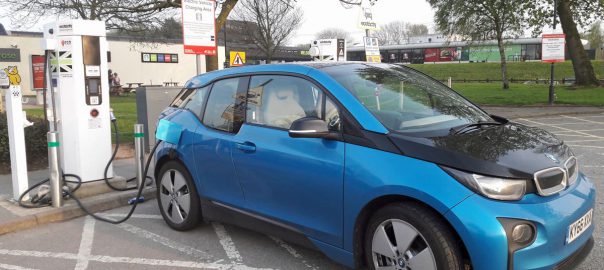
Our BMW i3 on charge at Corley Services (Image: T. Larkum)

Utilities, automakers and big oil: the future of EV charging

Utilities, automakers and big oil companies will drive the deployment of electric vehicle charging infrastructure, according to a new report by EY, which warns that despite market uncertainty, investment needs to be made or “it’s highly likely they’ll be late to the party”.

‘Driving the electric vehicle revolution’, released as part of the consultancy’s Renewable Energy Country Attractiveness Index (RECAI) publication, suggests that the key investors in the future of e-mobility have already been determined.

However, they face considerable uncertainty over how quickly EVs will displace traditional vehicles, and how what forms of charging will actually be required. Investment now could see heavy losses from low utilisation, or lead to stranded assets if the wrong charging infrastructure is deployed.

Much has been made of the split between home, workplace and destination, and public charging networks, with many in the UK sector expecting public charging to be the least utilisation option.

Our BMW i3 on charge at Corley Services (Image: T. Larkum)

However, those deploying such infrastructure have suggested that this will be needed to solve the issue of range anxiety for drivers concerned their EVs won’t make the distances required, while also being used to meet current driving behaviour which sees people ‘fill up’ at petrol station-like EV charging hubs.

According to Michael Cahill, management consultant at EY, the danger to any investors in this space will be in not acting soon enough to capture a portion of the market.

“If they don’t invest now, it’s highly likely they’ll be late to the party. But, equally, players might not want to risk investing too early and narrowly in a market where technology and policy is constantly developing,” he said.

Read more: Current News

Hyundai Kona Electric (Image: Hyundai)

Hyundai’s Kona Electric tops ‘real range’ test for zero emission cars

Hyundai’s Kona Electric achieved a ‘real-world’ range of 259 miles on a single charge during a What Car? Real Range test – the highest of any vehicle tested.

The compact SUV, which Hyundai says has a range of up to 300 miles, was one of 13 electric cars tested, with the brand’s Ioniq achieving the highest energy efficiency and lowest cost per mile.

It covered 3.9 miles per kWh – 11% further than any model from a rival brand. It achieved a real-world range of 117 miles. Hyundai says its range is 174 miles.

Hyundai Kona Electric (Image: Hyundai)

Tony Whitehorn, president and CEO of Hyundai Motor UK, said: “The results of the What Car? Real Range tests are a terrific endorsement of our zero-emissions models.

“Achieving not only the highest ‘real-world’ driving range, but also the best efficiency and lowest cost-per-mile figure of any brand is testament to our commitment to reducing the environmental impact of our vehicles.

“These cars are a compelling proposition for both fleet and retail customers, and we’re confident that Kona Electric and Ioniq Electric will continue to attract praise from media and motorists alike.”

Read more: Fleet News

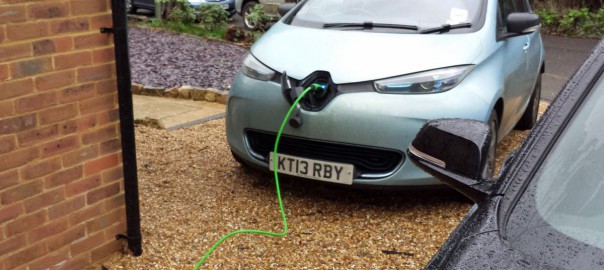
Figure 4: Charging on Christmas Day (Image: T. Larkum)

ScottishPower follows up renewables shift with electric vehicle supply offer

ScottishPower has launched an ‘end-to-end’ electric vehicle deal alongside a car retailer to offer drivers an EV of their choice with an installation of a home charger, powered with green electricity.

Following last month’s announcement that the company had sold its gas and hydro assets to be 100% powered by wind, the company has continued its shift to decarbonised technologies with the new agreement with vehicle dealership Arnold Clark.

This will allow buyers to purchase or lease an EV, book a home installation of a charge point from Wallbox, and sign up to an exclusive 100% renewable electricity tariff as part of the same package.

Figure 4: Charging on Christmas Day (Image: T. Larkum)
Home Charging (Image: T. Larkum)

ScottishPower’s chief executive Keith Anderson said:

“After removing carbon from how we generate electricity we believe the decarbonisation of the UK’s transport system has to be next. This means industry and government working together to build the infrastructure so we can charge electric vehicles as well as building clean and cheap renewables to bring down the cost of motoring.

“The UK needs to decarbonise transport faster and we have to make the switch to electric vehicles simpler.”

Read more: Current News

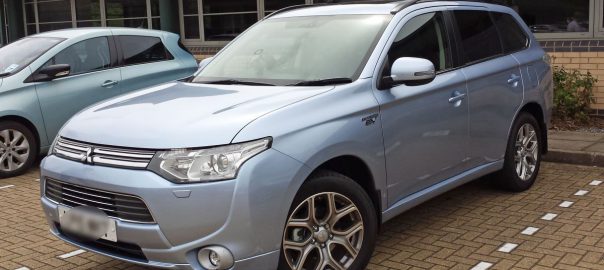
Mitsubishi Outlander PHEV (Image: T. Larkum)

PHEVs’ exclusion from the Plug-In Car Grant was inevitable

The government’s announcement that Category 2 and 3 hybrid cars will no longer be eligible for its Plug-In Car Grant seems totally incongruous in terms of environmental and societal policies, CO2 targets and other influences.

Private motorists, company car drivers and fleet managers have been buffeted around by continuously changing messages and strategies for too long.

Hybrids are now widely perceived by many as the obvious step amidst today’s anti-diesel climate and the near future looked very promising thanks to the procession of new hybrid models in the pipeline, such as PHEV iterations of the Honda CR-V, SKODA Superb and Volvo XC40.

Mitsubishi Outlander PHEV (Image: T. Larkum)

The government’s cessation of monetary support for plug-in hybrid vehicles will leave many prospective car leasing and finance customers scratching their heads, with monthly rentals or repayment costs set to rise by around £65 on a 3-year contract.

Between now and 2020, only eligible fully-electric vehicles that can travel at least 70 miles without emitting any CO2 will receive the reduced level of £3,500 support.

Although it’s understandable that the government wants people and businesses to adopt full EVs sooner rather than later, this move is a blow because only a small number of vehicles like the Nissan Leaf and Renault Zoe will be eligible and their compactness may limit interest, as does the Tesla’s price tag.

In other ways, though, the exclusion of plug-in hybrids from the PICG hasn’t come as a surprise. Introduced in 2011, the PICG was never expected to be a limitless pot of gold and was originally widely expected to expire around five years later.

Read more: Fleet News

OVO Vehicle-to-Grid (V2G) charging (Image: T. Larkum/Fuel Included)

EDF Energy prepares launch of V2G offer following agreement with Nuvve

EDF Energy is to offer its business customers vehicle-to-grid (V2G) chargers, as well as using them on its own sites, after partnering with charger supplier and technology developer Nuvve.

The supplier is expecting the partnership to result in up to 1,500 installations of V2G chargers, while hoping to unlock 15MW of additional energy storage capacity at its own sites.

This represents the largest planned deployment of V2G technology in the UK, overtaking Nissan and OVO Energy’s plans to install 1,000 chargers under a government-backed innovation project.

OVO Vehicle-to-Grid (V2G) charging (Image: T. Larkum/Fuel Included)
Vehicle-to-Grid (V2G) charging (Image: T. Larkum/Fuel Included)

Using the V2G chargers, idle EVs are able to be used to participate in the energy services markets at times, or be used to power onsite demand.

EDF Energy expects its business customers to utilise their fleet or workforce vehicles to tap into these revenues and energy savings using its new offer, taking advantage of the expected increase in EVs entering the commercial sector.

Read more: Current News

Fastned targets UK EV charging market following €11 million fund raise

Dutch fast electric vehicle charging provider Fastned has set its sights on the UK as one of four markets to be targeted following an €11 million (~£9.6 million) fund raising.

The company issued bonds last month offering 6% interest per annum over five years to be paid quarterly in arrears. The proceeds are now to be used to expand Fastned’s network beyond the Netherlands and Germany, where it currently has 78 operational stations, to include Belgium and the UK.

The company has 12 fast charging stations under construction and expects to use the latest funding boost to expand this further.

Bart Lubbers, co-founder of Fastned, said:

“More than 5,000 people have now invested in Fastned. These people believe in our mission and in our company. They see that the growth of electric mobility is accelerating.

“Where our stations used to get only a few visitors per day, we now see multiple cars charging at the same time. Our best station already attracts more than 100 visitors a day! This is just the beginning and people are seeing that.”

Read more: Current News

Copyright: arisanjaya / 123RF Stock Photo

Why Fleets Will Drive Adoption of Electric Vehicles

Electrification is one of the most significant trends in transport today.

Future demand for both electric vehicles (EVs) and the associated electric vehicle supply equipment (EVSE) will, of course, be driven by increased adoption of electric vehicles by individuals and businesses. In this post, I will be making the case that the economics of EVs prove particularly favorable for fleet operations, focusing on full-battery as opposed to plug-in hybrid electric vehicles (BEVs vs. PHEVs).

Electric Vehicles Have Operating Cost Advantage

Electric vehicles are cheaper to operate than those powered by fossil-fuels.

To start, electric powertrains have lower energy costs on a per-mile basis than internal combustion engines. They convert energy into motion more efficiently, with today’s BEVs attaining the miles per gallon equivalent (MPGe) of around three times the MPG of their traditional counterparts. Electricity and gasoline prices vary significantly by region, with some countries imposing heavy taxes on transport fuel.

Copyright: arisanjaya / 123RF Stock Photo

Beyond enjoying lower energy costs, BEVs have fewer moving parts than internal combustion engine vehicles (ICEVs) and forgo liquid fuels entirely. Below is a list of part replacements/maintenance/issues that BEV owners do not need to worry about:

  • Oil changes, oil filters
  • Spark plugs, wiring, ignition coils
  • Muffler, timing belt, catalytic converter, air intake filters
  • Fuel filters, fuel injector cleaning
  • Engine sludge
  • Emissions checks
  • Less frequent brake replacement due to regenerative braking

An EV owner does need to be mindful of their lithium-ion battery, as these lose charging capacity over time and may need to be replaced. Fortunately, data from drivers of Tesla and Chevy BEVs point to significant battery resilience.

BEVs are expected to last a long time thanks to their simplicity and lower number of moving parts. For this reason, an owner may find that when a battery does eventually wear out, it may make sense to replace it instead of buying a new vehicle. Furthermore, since grid/building operators are making use of Li-ion batteries to improve power quality and better integrate renewables, the residual value of a lower capacity BEV battery is expected to be far larger than the scrap value of an entire ICEV.

Read more: Arc Web