The simple and very commonplace lamp post will soon become a ubiquitous charge point for electric cards.
They charge at about 5 kW, or 16 amps, not super fast but overnight charging is all most drivers need.
Ubitricity is a German based company who’ve come up with a simple, cheap to install and well managed system for more people on more streets to adopt electric cars.
As sales of electric cars keep increasing we are seeing more and more of them on the road. That simply reflects the rising demand as everyone now knows they will be transitioning away from fossil-fuel cars.
We saw one result of that today. We’re on our way to Devon on holiday in our i3, and called in at Chieveley Services to charge.
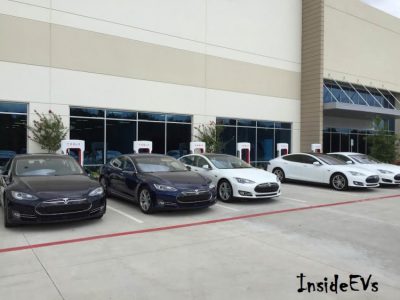
On arriving, there was a Tesla Model S charging at one of the Ecotricity pumps, the one with the CCS connector that the i3 needs. After a brief discussion he kindly agreed to move to the other pump so we could charge.
Once we were charging we went inside for lunch, and I monitored the charging on my phone. As it approached 100% we headed back to it only to find a charging queue for the first time ever!
The Tesla had gone and been replaced by a Nissan Leaf. Waiting to charge were a second Leaf and a Renault ZOE. We moved out of the way for the second Leaf, but the ZOE probably had a half hour wait ahead of it.
This type of situation will probably become increasingly common as more EVs hit the road, at least in the short term. Eventually it is hoped that we’ll see all petrol stations, and perhaps most parking spaces, changed over to be charging points.
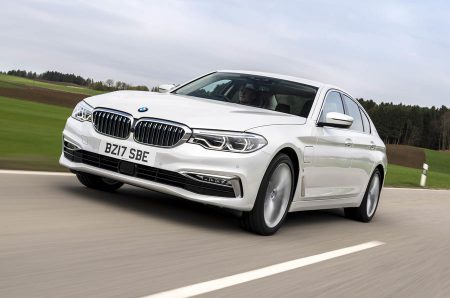
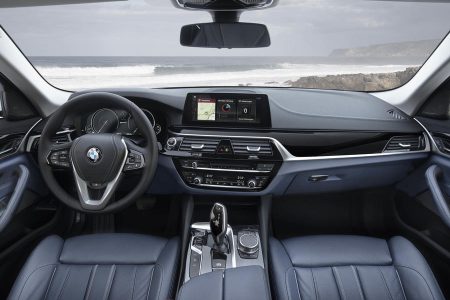
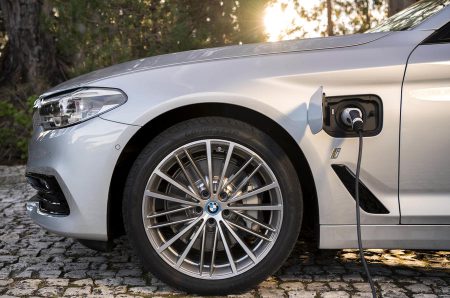
Plug-in hybrid version of BMW’s 5 Series is well-placed to take sales away from its higher-end diesel siblings. Strong performance and handling with favourable running costs.
BMW 530e iPerformance
What is it?
This is the first plug-in hybrid 5 Series. It’s not the first hybrid 5 Series, that being the ActiveHybrid 5 available with the last-generation model range. Less than one percent of the 15,000 or so Fives BMW sells here yearly have been part-electric. The ActiveHybrid 5 was expensive, equipped with six cylinders and 302bhp, 149g/km CO2 performance to suit the US, which is why it made little ground here.
BMW hopes that will change, dramatically, with this new 530e iPerformance hybrid, which is a plug-in propelled by a 181bhp 2.0 litre TwinPower Turbo petrol engine and a 112bhp electric motor. The crucial difference lies in some key numbers: the 530e’s £44,765 list price is £770 more than for a 530d SE and £7405 more than for a 520d Efficient Dynamics, while its 46g/km CO2 emissions score it a 9% BIK rating compared to the 520d ED’s 23% and the 530d’s 26%. That’s vastly more competitive than for the ActiveHybrid 5 and enough, BMW thinks, to see it selling around 5000 plug-in 5 Series in a full year.
BMW 530e
What’s it like?
Start your trip with a fully charged battery and it’s on electric power that you’ll initially travel unless you’ve heavy with the throttle, in which case the petrol engine momentarily assists.
The 9.2kWh lithium-ion battery will realistically allow a 22-mile range, and in near total silence, the only sound being the tyres’ hum. The car remains tranquil even when the petrol engine kicks in, although the four-pot produces a pleasing internal combustion rasp if you ask plenty of it. The transition from one to the other is tremor-free, as you’d expect, and it’s easy to forget that you’re in a hybrid car at all, the ‘Auto eDrive’ driving mode enabling the car to select the optimum mix of power sources depending on the driver’s demands and the terrain advice supplied by the sat-nav. And while it may be saving fuel, the 530e is not slow, breaking 62mph in 6.2sec: pretty rapid for a car that’s partly about economy.
BMW 530e
This twin-engined zest is complemented by a lithe, confident chassis that delivers a supple and sophisticated ride that’s as pleasing as this car’s quiet agility. Only the steering lets it down, the weight at the rim feeling curiously mushy, although it points the car accurately. As always with hybrids, there’s diversion to be had from monitoring the car’s energy usage and the game of trying to see how far you can go on amperes alone.
The AA Trust is launching the first ever free of charge EV driving course in collaboration with Chargemaster.
AA Trust’s chairman Edmund King
The course was launched following an AA Populus survey of 16,239 drivers, of which 32% said they want to learn to drive in an EV.
Drivers were asked, to what extent would you be interested in a free one-hour electric vehicle driving lesson – aimed to show you how to get the best out if an EV – in your local area?
32% were interested (16% extremely interested, 16% interested)
33% males interested, 30% females
35% younger drivers (18-24, 25-34) interested as opposed to 31% older drivers (65+)
Drivers in London were more interested (35%) followed by those in West Midlands and South West (34%)
Drivers in North East least interested (26%) followed by those in eastern region (28%)
Those in Scotland, Wales and Northern Ireland also showed high levels of interest.
AA Driving School and Drive Tech trainers developed the experience in conjunction with Chargemaster and will be piloted in Milton Keynes with a view to be rolled out nationally.
AA Trust’s chairman Edmund King said: “We are approaching a tipping point as more and better electric cars come on stream.
“We want to help drivers understand this exciting new technology at the EV experience centre but we also want to help them get the most out of their electric cars.
“Drive electric sessions, conducted by AA instructors, can either be carried out in the driver’s own electric car, or in one of the EV experience centre’s test drive fleet. The EV Experience and Drive Electric experiences be really put Milton Keynes on the map as the most go-to EV City in the world.”
Chargemaster’s chief executive David Martell said: “The number of electric vehicles in the UK is continuing to grow, and we recently marked the 100,000th plug-in car registration in the UK.
“To get more people driving electric vehicles, getting them behind the wheel is key. The EV experience centre aims to do exactly that, and the drive electric experience sessions from the AA Trust will be a great way to help consumers better understand electric vehicles and how easy they are to live with and how to get the best out of them when driving.”
It was really only a matter of time, and now the world’s top oil companies are seeing EVs as a viable and permanent threat.
Tesla continues to lead the pack with U.S. plug-in sales, but the Chevrolet Volt and Bolt, Toyota Prius Prime, and Nissan LEAF are all faring well, and the outlook for EVs continues to improve. (via Josh B/InsideEVs)
Though makers of EVs are still much more bullish about the timeline for mass adoption, several oil producers are taking note, and many are beginning to change their initial conclusions. BP and Exxon Mobil have bumped up their estimates this year, and OPEC has quintupled its future sales forecast for plug-in EVs.
Bloomberg New Energy Finance (BNEF ) believes that EVs will sell better than ICE vehicles by 2040, totalling 530 million plug-ins on the road at that time, which will account for one-third of the world’s vehicles. According to a study by BNEF, by 2040 EVs will lower the global oil demand by eight million barrels. Chief of advanced-transport analysis at BNEF in London, Colin McKerracher, shared in a note to clients:
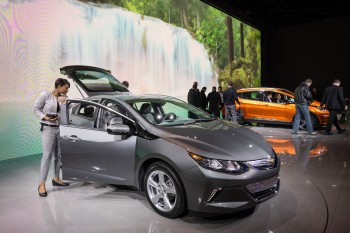
The Chevrolet Volt and Chevrolet Bolt EV on display Friday, February 12, 2016 at the Chicago Auto Show in Chicago, Illinois. (Photo by Steve Fecht for Chevrolet)
“The number of EVs on the road will have major implications for automakers, oil companies, electric utilities and others. There is significant disagreement on how fast adoption will be, and views are changing quickly.”
“What oil companies and car companies are saying is diverging. This is a trillion dollar question, and somebody is going to be wrong.”
Though these estimates will continue to diverge, the truth is that both sides of the equation are seeing that the popularity of EVs is and will continue to increase, which will drop the demand for fossil fuels. While oil companies may be attempting to make it seem like they aren’t concerned, multiple recent forecasts sing a vastly different tune.
OPEC’s previous 2040 estimate was 46 million EVs, and now the group representing 14 nations is forecasting 266 million.
Exxon Mobil initially predicted 65 million electric cars by 2040, but has now upped it to 100 million.
Norwegian-based Statoil ASA sees an electric vehicle market share of 30 percent by 2030.
The International Energy Agency raised its 2030 EV fleet size from 23 million to 58 million.
BP bumped its future outlook up by a whopping 40 percent, to 100 million plug-ins on the road by 2035.
Obviously, these estimates are markedly different, but the trend is the same. OPEC’s recent oil market report shows that due to EV sales, oil demand in Asia could see significant declines as soon as next year.
There are many variables, which make these type of estimates difficult. Fuel cost and battery costs are two of the most obvious, but another gray area lies in government support and subsidies (or lack thereof).
According to BNEF, top world automakers combined plans show estimated sales of six million EVs per year as soon as 2025, and eight million by 2030, and these estimates continue to rise.
The new rules will help households generate and store electricity and sell it back to the National Grid.
File photo dated 24/11/10 of electricity pylons as a Parliamentary report has found that electricity prices have soared because of constant intervention in the energy sector by successive governments.
The first phase of a four-year £246m Government investment into battery technology has been launched in a move that could help bring down household electricity bills.
The long-term vision includes creating giant battery facilities around the National Grid to store excess wind and solar energy for when demand rises.
In addition, new rules will help households with solar panels to generate and store their own electricity with new battery technology and sell it back to the Grid when they do not need it. They will also reduce costs for people and businesses who power down appliances at peak times and use electricity at cheaper times.
The Government and Energy regulator Ofgem estimate that consumers could save between £17bn and £40bn by 2050.
Business and Energy Secretary Greg Clark unveiled details of the first phase, known as the Faraday Challenge, on Monday.
This includes a £45m competition to establish a centre for battery research which he said would help make the UK a world leader in the design, development and manufacture of electric batteries. This will be spearheaded by the Engineering and Physical Sciences Research Council (EPSRC) to bring the best minds and facilities together to create a ‘battery institute’ to make products more accessible and affordable.
A three-month consultation earlier this year on an industrial strategy to increase UK productivity and growth attracted more than 1,900 written responses from businesses and organisations.
A shift to cleaner energy and technologies such as electric cars has made the design, development and manufacture of batteries a top industrial priority. Mr Clark said:
“A smarter energy system will create new businesses and high-skilled jobs, while making sure our infrastructure is able to cope with demand.”
Gareth Redmond-King, head of climate and energy at WWF, said battery storage was a “game-changer” in the ability to produce clean power from renewables.
“These technologies give us flexibility to run on solar when the sun isn’t shining, and be powered by wind when it is still.
“It will support the transition to electric cars and enable our homes to be more efficient – which means cheaper, as well as cleaner and greener energy.”
Yet to be convinced that electric cars are the future? EV stalwarts are hoping this unique ‘experience centre’ located in a shopping centre in Milton Keynes could be the encouragement you need to swap your diesel for a plug-in – and we’ve been for a behind-the-scenes look at the showroom which is being described as a “landmark moment”.
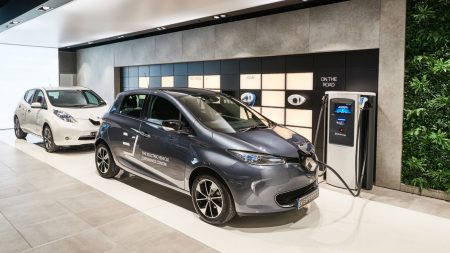
Renault ZOE ZE40
The EV experience centre is operated by Chargemaster using Government funds through Milton Keynes’ Go Ultra Low City status. It’s not a pop-up dealership – there’ll be no hard sell, just experts on hand to talk people through electric cars and advise about whether they’ll fit into their lifestyle.
“[There’s] a series of myths people have about electric cars,” transport minister Jesse Norman told Motoring Research during our preview of the EV experience centre.
“They think about whether they might be expensive or whether they’re hard to charge, and how long that takes. An experience centre that actually gives a person the experience of actually sitting behind the wheel or potentially driving it, that just knocks down a whole series of these myths and that makes it much easier to think about buying one.”
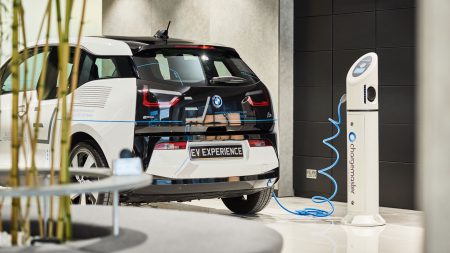
BMW i3
The showroom, located in Centre:MK, is multi-brand, displaying cars from partners including Renault, Mitsubishi, Volkswagen, Nissan, BMW and Kia. The experts on hand won’t be on commission and will be able to give independent advice on which – if any – electric car suits a particular person’s needs.
If an electric car won’t fit a person’s lifestyle, they’ll be honest that they’re better suited to a conventional petrol or diesel car – while, although Tesla isn’t a partner, a visitor with a big budget after a long range and high performance will be pointed in the direction of a Tesla dealership.
“With 17 million people a year coming into this particular shopping centre in Milton Keynes, that’s potentially an awful lot of people who are potentially going to be impressed by it,”
UK to pioneer energy innovation through batteries in homes as energy department announces £246m research funding
Renewables will be able to provide more of the UK’s energy when companies are able to store it more efficiently. Photograph: Danny Lawson/PA
Batteries and renewable power sources are on the verge of bringing about an “epochal transformation” of the UK that could make energy clean, abundant and very cheap, according to a cabinet minister.
As the government unveiled plans for a more flexible energy system and £246m of funding for battery research, Greg Clark told the Guardian that a smarter grid would “radically” bring down bills.
“Energy, for the last 100 years, for good reasons, we’ve rationed the consumption of [because] it’s been very expensive and environmentally-damaging to consume fossil fuels. [But] given the possibilities we are on the cusp of at the moment, we might move to a world where energy is clean and abundant,”
said the business secretary.
Storing intermittent renewable power in batteries so it was ready when the grid needed it would bring down costs for everyone, including vulnerable and low income energy consumers, he said.
“If only we can capture it [power from the sun and wind] then we can go from energy being a worrying cost to people, to being, if not free, then very cheap,”
Clark said, speaking in Birmingham on Monday as he put energy at the centre of the government’s industrial strategy.
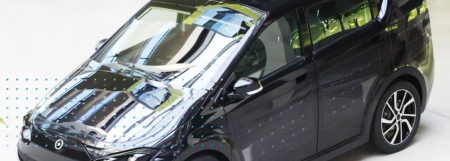
German start-up manufacturer Sono Motors has presented its solar car, the Sion, in Munich. Sold without a battery, the vehicle has a range of 250km and will sell for €16,000.
The Sion features integrated solar cells, which generate additional energy to top up an electric vehicle (EV) battery, creating an extra 30km of range in a day. The company’s vision is to offer a mobility concept for the future which does not produce CO2 emissions or use oil. The Sion also offers drivers the opportunity to extract power from the vehicle and offer it to other users, in a form of bidirectional charging. The company believes ‘with the Sion’s output of 6.6kW, other electric cars can be charged.’
Sono Motors aims to either sell a battery for an additional €4,000, or offer a monthly lease, similar to that offered by Renault. The company hopes the car’s design will make it a popular choice for both families and commuters, with its low price bringing it in line with the traditional automotive market, in a sign that EV prices are beginning to come down.
A statement released by the company to coincide with the launch comments: ‘Sono Motors first attracted attention after launching a successful crowdfunding campaign in the summer of 2016. For the development and production of the vehicle, the company is working together with well-known contract manufacturers and system suppliers from the European automotive industry. A total of 5,000 reservations of the Sion are required to start serial production in the second quarter of 2019. Shortly before the presentation of the solar car, more than 1,200 reservations had already been placed.’
As Sono Motors sees sharing as the future of mobility, the Sion comes equipped with three mobility services: ‘powerSharing, rideSharing and carSharing.’ An app allows Sion users to share power, rides and even the car itself with other users.