Monthly Archives: August 2017

BP in talks with electric carmakers on service station chargers

LONDON (Reuters) – BP (BP.L) is in talks with electric vehicle makers on partnering to offer battery re-charging docks at its global network of fuel service stations as it seeks to benefit from the move away from diesel and petrol cars, Chief Executive Bob Dudley told Reuters on Tuesday.
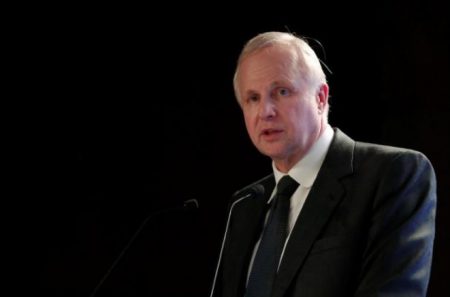
BP Chief Executive Bob Dudley addresses the gathering during a media interaction in New Delhi, India, June 15, 2017.

The expected rapid growth in the use of electric vehicles in the coming decades is threatening oil companies’ business model as demand for some road fuels could plateau as early as the late 2020s, according to some oil company estimates.

Looking to take a slice of the growing market, London-based BP is however examining different ways to get involved in the sector.

“We have discussions going on with a lot of the EV manufacturers to have a tie-up with our retail network for charging,”

Dudley said in an interview.

Rival Royal Dutch Shell (RDSa.L) has already launched a pilot scheme to install battery charging docks at a few of its service stations in Britain and the Netherlands.

The number of electric vehicles on roads is forecast to grow significantly in the coming decades, particularly in cities, with BP estimating that there will be 100 million by 2035, up from 1.2 million in 2015.

Dudley has been a vocal advocate of the oil and gas industry’s need to take part in the move away from fossil fuels toward using cleaner sources of energy in order to combat global warming.

But BP, along with rivals including Shell have yet to come up with a clear plan for increasing their interests in renewable energy production such as solar and wind.

“We’ll be ready for this world but we’re not going to dive in too deeply,”

he said, referring to BP’s previously unsuccessful ventures into renewable energy, including solar power.

BP will make investments in future technologies but these will be small percentage stakes in companies or partnering with them, he said.

FILE PHOTO: A general view of a new BP petrol station on the outskirts of Mexico City, Mexico, March 9, 2017.

Dudley said BP was also studying autonomous vehicles and the potential for combining natural gas with solar power generation.

Read more: REUTERS

Van and taxi drivers offered pathway to electric vehicle transition

Drivers of old and polluting vans and taxis have been offered fast-track options and incentives to purchase electric vehicles (EVs), with revamps to licensing and a new £42m taxi fund set to increase compliance with the diesel vehicle phase-out.

From January 2018, no more new diesel taxis will be licensed in London

Following on from Environment Secretary Michael Gove’s launch of the Air Quality Plan last week, which included a ban on all new petrol and diesel cars and vans from 2040, both Transport for London (TfL) and the Department of Transport (DfT) have launched new EV initiatives.

Mayor of London Sadiq Khan announced on Friday (28 July) that TfL would host a £42m fund to encourage owners of older and polluting diesel black cabs to retire them from the Capital’s fleet.
Owners of black cabs between 10 and 15 years old can check whether they are eligible of a “delicensing” scheme and to apply for a grant worth up to £5,000 to retire a taxi. The three-year scheme will attempt to speed up the process of tackling the illegal pollution levels in London’s air as part of a long-term goal of making the Capital a zero-carbon city by 2050.

“London’s filthy air is a health crisis that needs urgent action,”

Khan said.

“The plans announced by the Government this week go nowhere near the action needed. Cleaning up London’s taxi fleet will play a significant part in our toxic air battle and there will be no new diesel taxis licensed in London by the end of this year.

“However, it is important we financially support drivers to help them retire their oldest vehicles and upgrade to greener models. I hope this fund helps deliver a new generation of zero-emission taxis on our roads and paves the way for the Government to offer a diesel scrappage scheme so all London motorists can ditch their dirty diesels.”

From January 2018, no more new diesel taxis will be licensed in London, and the London Taxi Company officially rebranded after unveiling its new electric model. Taxis are thought to be responsible for 16% of NOx and 26% of particulate matter (PM) road transport emissions in central London.

The Government already offers a Plug-in Taxi Grant, part-funded by the Mayor, which offers up to £7,500 for new EV taxi purchases. When combined with the new delicensing payment, drivers can save up to £12,500 on new purchases.

Read more: edie.net

The electric jolt that roused Big Oil

Identifying a tipping point is not always easy. But when one of the world’s most powerful oil bosses says he is in the market for an electric car, there can be little doubt.

The UK’s electric vehicle drive has put the energy sector on the road to change

Ben van Beurden, the Royal Dutch Shell boss, last week delivered the clearest indication yet that the burgeoning electric vehicle industry is already hastening the decline of global oil demand.

“When that will be is not certain. But that it will happen, we are certain,”

he told investors.

It was not so much a foil to the group trebling second quarter profits as a statement of intent: for “Big Oil” it is time to adapt or die, and Shell intends to adapt.

The Anglo-Dutch giant is already shifting its focus from drilling for oil to natural gas, but within the next year Shell will unveil early plans for a deeper presence in renewable energy and the electrical chain to tap the boom in electric vehicles.

“Everyone is repeatedly surprised at how fast electric cars are coming forward,”

Professor Dieter Helm told The Telegraph in April. The number of new registrations of plug-in cars has grown from 3,500 in 2013 to more than 100,000 at the end of May.

“But the political pressure to adopt this technology is increasing all the time. It’s not due to concerns over climate change – it’s city air pollution,”

he said.

Shell boss Ben van Beurden CREDIT: EPA/BART MAAT

And so it was in the UK last week when the Government’s bid to tackle the country’s worsening air pollution followed the example set by France two weeks earlier in pledging to halt the sale of combustion vehicles by 2040. At the same time, government put the battery boom front and centre in its industrial strategy with £246m of funding for research and development.

Read more: The Telegraph

POLAR charging network to be powered with 100% renewable electricity

  • UK’s largest electric vehicle charging network switches to 100% renewable energy
  • Electric drivers benefit from a reduced emissions footprint from POLAR charging points
  • Cost of POLAR network membership remains the same with no price increase

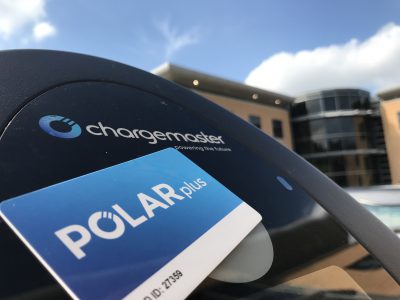
The UK’s largest electric vehicle (EV) charging network, POLAR, which includes Charge Your Car sites, is switching to 100% renewable electricity from 1st August.

The electricity consumption of the POLAR network, operated by Chargemaster, will be certified and matched to energy generated from renewable sources by OVO Energy, one of the UK’s largest independent energy providers. It means that every mile driven by EVs charging on the POLAR network will be matched by renewable energy.

The electricity consumption of the POLAR network, operated by Chargemaster, will be certified and matched to energy generated from renewable sources; meaning every mile driven by EVs charging on the POLAR network will be matched by renewable energy.

Chargemaster, the UK’s largest provider of electric vehicle charging infrastructure, provides over 40,000 EV drivers with access to more than 5,600 public charging points in the UK across the POLAR and Charge Your Car networks. Combined, they represent more than 40% of all the charging points in the UK and, in the first half of 2017 supplied vehicles with more than 500,000 kWh of electricity.

The POLAR network is growing significantly, with Chargemaster installing more than 250 of its UK-manufactured Ultracharge rapid chargers this year. POLAR plus membership, which provides unlimited access to charging points in the network (over 85% of which are free to use) costs just £7.85 per month and will not increase with the switch to renewable energy. In addition, new members benefit from free membership for the first three months.

Electric vehicles already reduce local air pollution, as pure electric vehicles, and plug-in hybrid and range-extender models running in electric mode, produce no tailpipe emissions.

Even when charged with electricity from the National Grid, the emissions footprint of electric motoring is still lower than the average new car in the UK. However, this benefit is increased if electric vehicles are charged using renewable energy, which ensures that electric motorists are truly ‘zero emission’, with no fossil fuel-generated electricity used when charging.

David Martell, Chief Executive of Chargemaster said,

“Switching POLAR, the UK’s largest EV charging network, to renewable energy is great news for EV drivers in the UK. It reduces the overall emissions of electric motoring, removing the upstream footprint of electricity generation in the same way as drivers have eliminated their tailpipe emissions.”

Source: Chargemaster

Is the Tesla Model 3 launch today the D-Day for electric cars? I think so

It is hard to overstate the significance of today’s Tesla Model 3 launch at the Fremont California factory. It very well could be the beachhead that electric cars need to tip the scales over gasoline cars in the US and the world.

Will we be witnessing history tonight? Let’s put it into perspective…

Tesla has over 400,000 reservations for the vehicle which haven’t been road tested by the public as of this writing, haven’t been in showrooms and really hasn’t been even seen in person by all but a few lucky folks. Keep in mind that at the beginning of this year there was only just over half a million EVs on US roads and just slightly more in all of Europe or China.

Tonight’s event will be the beginning of an order of magnitude change. If you want to compare Tesla to Apple, this is making a great electric car available to many more people akin to lowering the price of an iPhone from $600 to $200 (a drop by two thirds) and making it available to a much broader swath of the world.

Do people love their Teslas like Apple folks love their iPhones? Let’s have a look at Consumer Reports numbers (right) of Tesla people who would buy another vehicle from the company.  Tesla is a whopping 15 percentage points above the field and the only maker that is even in the same ballpark is Porsche at a significant 7 points behind.

If the Model 3 is as great as us early believers think it will be, the car will fundamentally change how we move around. Gas stations, oil changing locations, transmission shops will start to disappear and be replaced by huge charging stations between major metropolitan areas. Oil infrastructure including tanker boats and trucks will disappear. Cities will become quieter. Air will become cleaner.

In their place, people will put solar on their rooftop to make free energy. The grid will need to be reinforced but it will grow stronger and more resilient.
The multi-trillion dollar fossil fuel industry will try to buy delays from the government and sway the public with misinformation but at the end of the day, the math simply doesn’t work out. Even if you don’t believe the science of climate change, EVs are better, faster, more fun cars and they move people around more cheaply than gasoline powered vehicles.

Read more: electrek

Charging at Sedgemoor Services on the M5 (Image: T. Larkum)

Electric Cars are Better Than Piston Cars for Long Journeys

After four years of driving electric I would much prefer to take an electric car on a long journey than a piston car. Most people wouldn’t expect that, except those experienced with driving long distances in an electric vehicle.

Charging at Sedgemoor Services on the M5 (Image: T. Larkum)

Some of the benefits are obvious, of course, such as the cheap fuelling costs and reduced environmental impacts (both local pollution and reduced greenhouse gases). However, it’s worth looking at the other aspects as they aren’t often spelled out.

An electric car is much better to drive for a number of reasons. The electric motor itself is quiet and smooth so you don’t have to put up with the noise and vibration of a combustion engine. As well as being less stressful, this also means it’s more enjoyable listening to music, radio, audiobooks, etc.

Further, the lack of a gearbox is a big benefit. Compared to a manual gearbox, there is no need to operate a clutch or gear lever – this is a particular advantage in stop-and-go traffic. Compared to an automatic gearbox, there is smooth acceleration from zero to full speed without the annoying jumps as the gearbox changes its gear or the sound of the gear changes.

Best of all, electric cars have braking regeneration, meaning the motor can act as a brake (and in so doing recharge the battery). This feels like ‘engine braking’ but can be considerably stronger. Electric vehicles with strong ‘regen’, like the Tesla Model S and BMW i3, are best of all as they allow for ‘one-pedal driving’.

Releasing the accelerator pedal causes the car to slow down all the way to a stop. This means it isn’t necessary to use the brake pedal at all, except in an emergency. Using the accelerator alone for speed control makes the driving very easy and relaxing. This is such a benefit that Nissan are promoting it heavily, as the e-Pedal, for the next version of their Leaf.

Of course, if the electric car isn’t a Tesla then it will have less range than most piston cars and this has to be taken into account as there will be a need to charge on a long journey. However, as the range of all electric cars increases, and the infrastructure improves, charging isn’t the issue it used to be.

Even in going from the 80 mile range of my previous Renault ZOE to the 120 mile range of my current BMW i3 I have found charging to become much easier. I now have to stop to charge only after about 2 hours of driving, which is as long as my family is prepared to go without a break anyway.

We’re currently holidaying in Devon, having driven from Northampton. On the way down we stopped twice to charge. The first time we stopped for lunch, so the car just charged while we ate. The second time we stopped for a comfort break, and then just waited an extra 15 minutes or so for the charge to complete.

Quarter of an hour is a small time cost in a journey of 7-8 hours. It would have been quicker if it hadn’t been for some terrible Friday afternoon traffic around Bristol, and the one-pedal driving and other benefits outlined above more than made up for small time spent charging.

The charging itself went really easily both times. The first time we had just a brief delay (although we saw a queue as we left). The second time we were the only EV there and just started and stopped charging as we wanted. And each charge cost me less than £5.

Overall the benefits of driving an EV on a long journey far outweigh the minor inconveniences of charging, so I personally could not go back to driving a piston car. As EV ranges continue to increase, the benefits will become obvious to all drivers.

Europe Notes 54% Growth Of Plug-in Car Sales In June, ZOE Sells 4K

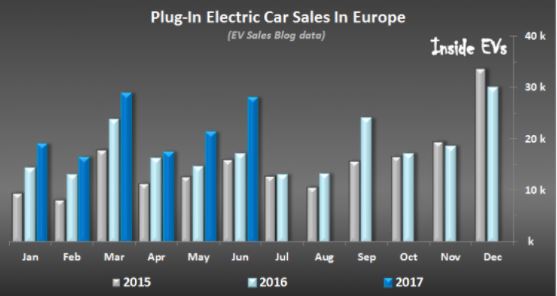
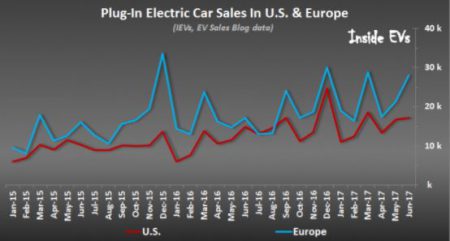
It’s getting better and better in Europe for plug-in vehicles, as some 54% growth was noted in June, with total sales for the month reaching more than 28,000.

Plug-In Electric Car Sales In Europe – June 2017 (data via EV Sales Blog)

The half year numbers have also crested 133,000 (which is up 30% year-over-year), and encourages us that the 250,000 mark will be easy to achieve in 2017 given the traditional year-end weighting of EV sales.

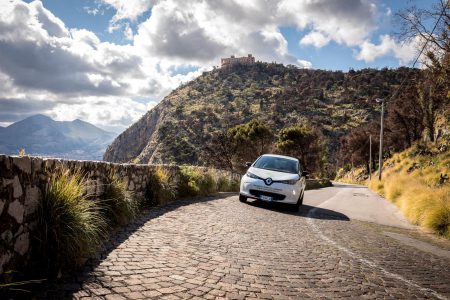
The Eco Tour di Sicilia and Renault ZOE

Overall plug-in market share stands at 1.5%.

Specific to the EVs themselves, the Renault ZOE shines in June, exceeding 4,000 sales – more than double the second best result from the BMW i3!

Models within Top 5 in June or Top 5 YTD:

  • Renault ZOE #1 – 4,189 (#1 17,146 YTD)
  • BMW i3 #2 – 1,634 (#3 10,260 YTD)
  • Nissan LEAF #3 – 1,590 (#2 11,007 YTD)
  • Tesla Model X #4 – 1,552 (#8 5,613 YTD)
  • Mitsubishi Outlander PHEV #5 – 1,435 (#4 9,294 YTD)
  • Tesla Model S #6 – 1,373 (#5 6,580 YTD)

Here is comparison of U.S. and Europe results:

Plug-In Electric Car Sales In Europe – June 2017

Source: Inside EV’s

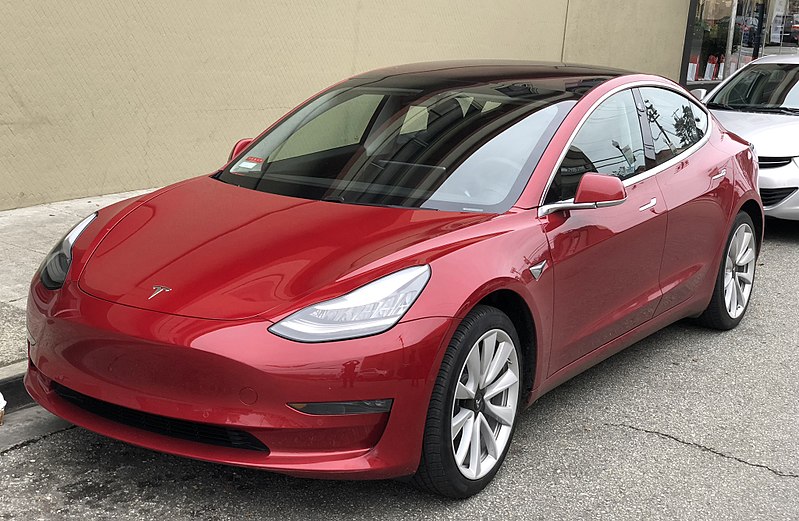
Tesla Model3 (Image: Wikimedia/Carlquinn)

Elon Musk hands over first Tesla Model 3 electric cars to buyers

With half a million orders for the $35,000, 350km-range vehicle, the upstart carmaker faces its biggest test

Tesla boss Elon Musk has handed over the first of what he hopes will be a mass-market electric car to employee buyers, setting the stage for the biggest test yet of the company’s plans to revolutionise the auto industry.

Tesla Model3 (Image: Wikimedia/Carlquinn)

Outside Tesla’s factory in Fremont, California on Friday night, Musk showed off the $35,000 Model 3 which has a range of 220 miles (350 km) on a charge that marks a departure from the company’s earlier luxury electric cars.

Hours before the event, Musk acknowledged it would be “quite a challenge” to build the car during the early days of production.

“We’re going to go through at least six months of manufacturing hell,”

Musk told journalists.

The over half a million reservations are up from about 373,000 disclosed in April 2016. Customers pay $1,000 refundable deposits for the car, which is eligible for tax credits. Any new buyers would likely not receive their car until the end of 2018, Musk said.

A longer-range version of the car is priced at $44,000 and will drive 310 miles (500 km) on a single charge. The cars feature a streamlined dashboard devoid of buttons or knobs, with a touchstream display to the right of the driver.

Tesla faces major hurdles living up to the Model 3 hype. The 500,000 vehicles Tesla vows to produce next year are nearly six times its 2016 production.

Were Tesla to produce, and sell 500,000 cars per year, the company would likely outsell the BMW, Mercedes, or Lexus brands in the United States.

Production delays and quality issues marred the launches of Tesla’s Model S and Model X vehicles, and the company blamed production problems for a shortfall during the second quarter of this year. Musk has said a simpler Model 3 design will greatly reduce potential assembly-line problems.

Tesla has burned through more than $2bn in cash so far this year ahead of the launch. A troubled Model 3 launch could heighten the risks for the company, while a steady delivery of Model 3s could generate a stream of cash that would allow Tesla to avoid going again to the capital markets to fund its operations.

Read more: The Guardian

Electric cars are getting ever more attainable

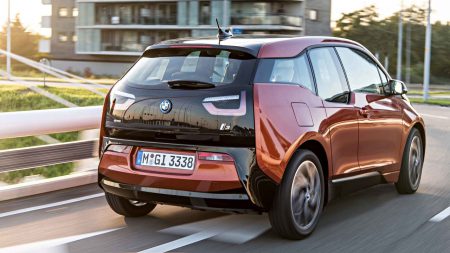
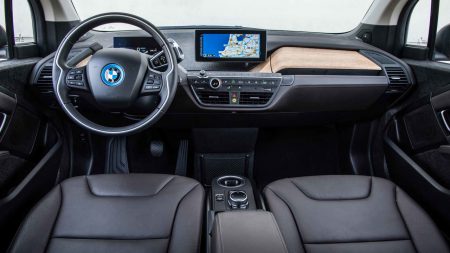
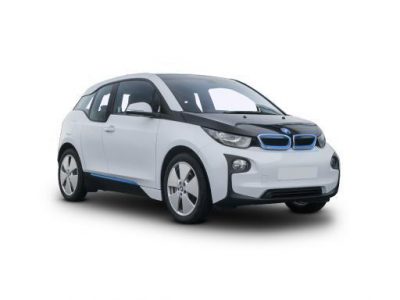
You’ve probably seen the news that the Government is planning to ban the sales of new petrol and diesel cars by 2040, instead encouraging drivers to invest in electric cars in a bid to improve air pollution.While we’re not saying you should rush out to part exchange your petrol or diesel car for an EV, the experts at Cap HPI have pointed out that now seems to be a good time to buy a secondhand BMW i3.

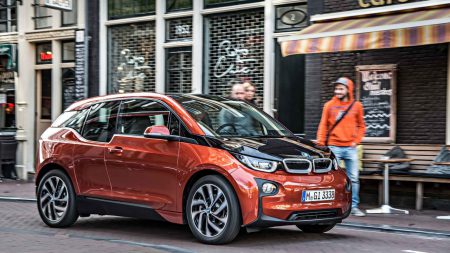
BMW i3

More than 10,700 new alternatively-fuelled vehicles (AFVs) were registered in the UK last month – meaning they now account for a record 4.4% of cars on our roads. This growth in electric and hybrid vehicles has worked wonders for their residual values, which have increased by 7% on average this year – and this is only set to increase as interest builds.

It’s hard to believe that early examples of the futuristic BMW i3 are now three years old, but Cap HPI’s valuation experts have noticed that they’ve now halved in value, meaning you could pick one up for less than £15,000. New, a regular BMW i3 would have been £30,925.

BMW i3

The smart money, however goes on the BMW i3 Range Extender, which can be picked up from around £17,000. Again, that’s a 50 percent saving over new.

“Interestingly it appears to be the range extender models which is driving the recent strong performance as values of pure electric have struggled of late,”

said HPI’s motoring expert Chris Plumb.

“The BMW i3 is a popular choice and is a great second hand buy. It brings a good level of specification and badge prestige.

“The optional range extender can increase the range of the BMW i3 in comfort mode from up to 125 miles to a total of 206 miles. The small, rear-mounted, quiet two-cylinder petrol engine powers a generator that maintains the charge of the battery at a constant level, so that the BMW i3 can continue to drive electrical.”

BMW i3

It’s yet to be confirmed whether the Government’s plans will allow for the sales of cars with a petrol engine – even when, like the i3, combined with an electric motor. Although the regulations will only affect new cars (and the rules aren’t coming into force until 2040), expect more legislation to reduce harmful emissions in the near future – particularly in urban areas. A £15,000 secondhand BMW i3 could save you a lot of money in the long run.

Source: Motor1

Government car ban: which is the best used electric car you should buy?

THE Government has said it will ban all diesel and petrol powered cars from 2040 bringing the curtain down on the era of the internal combustion engine.

Ministers unveiled their court-mandated plans for meeting EU limits on harmful nitrogen dioxide pollution this morning.

They include a £255 million fund to help local authorities come up with ways to improve air quality, ranging from improving public transport and changing road layouts, to charging zones for polluting vehicles if other measures don’t work.

The BMW i3 – one of the UK’s most popular EVs

But much of the focus was on plans to end the sale of all conventional petrol and diesel cars by 2040, to help tackle air pollution and climate change emissions.

The impending shake-up is already having an impact on the electric car market.

Consumer interest in electric vehicles is soaring. The market for alternatively fuelled vehicles (AFVs) saw a record market share of 4.4 per cent in June with more than 10,700 hitting the roads, a rise of 29 per cent.

At the same time the overall used market for electric vehicles has seen values increasing by 7 per cent this year.

Motoring expert Chris Plumb from hpi said:

“Interestingly it appears to be the range extender models which is driving the recent strong performance as values of pure electric have struggled of late. The BMW i3 is a popular choice and is a great second hand buy. It brings a good level of specification and badge prestige.

“The optional range extender can increase the range of the BMW i3 in comfort mode from up to 125 miles to a total of 206 miles. The small, rear-mounted, quiet two-cylinder petrol engine powers a generator that maintains the charge of the battery at a constant level, so that the BMW i3 can continue to drive electrical.”

A used BMW i3 with 15,000 miles on the clock has a used value of £14,650 against a new price of £30,925.

The made-in-Sunderland Nissan Leaf with the 30KWh power train is attracting higher used values than the lower powered 24kWh battery pack as it has a larger range.

According to Nissan, the Leaf has an official range of up to 124 miles (4kWh) or up to 155 miles (30kWh).

Source: The York Press