Monthly Archives: May 2017

Car exhaust pollution (Image: Wikipedia)

Nearly 40 million people live in UK areas with illegal air pollution

Nearly 40 million people in the UK are living in areas where illegal levels of air pollution from diesel vehicles risk damaging their health, according to analysis commissioned by the Labour party.

The extent of the air pollution crisis nationally is exposed in the data which shows 59% of the population are living in towns and cities where nitrogen dioxide (NO2) pollution breaches the lawful level of 40 microgrammes per cubic metre of air.

Car exhaust pollution (Image: Wikipedia)

Labour says the air pollution crisis is a “national scandal”. Sue Hayman, shadow secretary of state for environment, food and rural affairs, said a Labour government would bring in a new clean air act to tackle what was a public health emergency.

“Labour will not allow the Tories to use the snap general election or Brexit to kick this issue into the long grass or water down standards that would put millions of UK adults and children at risk,”

said Hayman.

She said the party was committed to putting in place a network of clean air zones across the UK where there are high emissions, and would act at an international level to close loopholes in emissions testing of vehicles.

The analysis published by Labour shows more than 38 million people, representing 59.3% of the UK population, are living in areas where levels of nitrogen dioxide pollution are above legal limits.

Local authorities including Aberdeen, Birmingham, Bournemouth, Burnley, Derby, Chelmsford, Leeds, Northampton, Richmond and Sheffield – among many others – have NO2 levels above the legal limit.

Read more: The Guardian

Electric Vehicles Are on the Rise: Here’s How to Sustain Their Growth

The struggle for electric vehicles to gain legitimacy in a world dominated by supersized SUVs and overbearing big rigs is something of a David and Goliath story.

The underdog just landed a blow right between the eyes of America’s major car manufacturers.

In April, Tesla became the most valuable automaker in the US, passing General Motors in total market value. GM has since regained the lead by a slim margin, edging Tesla in market cap by a little more than a billion dollars.

The release of the Model 3 alone promises to nearly double the number of electric vehicles (including hybrids). That’s not quite as impressive as it first sounds considering there were more than 260 million vehicles in the US as of 2014, according to the Bureau of Transportation Statistics. In other words, EVs will still account for less than one percent of all vehicles.

Strong policy needed

There is potential for EVs to reach a market share of 30 percent or greater by 2030, but that will require radical shifts in environmental and regulatory policy, according to John Axsen, an associate professor at Simon Fraser University in British Columbia who studies green technology, consumer behavior and environmental policy.

“As long as gasoline vehicles are able to belch pollutants and greenhouse gas emissions ‘for free,’ then EVs will have a disadvantage,”

he says by email to Singularity Hub.

“Economists call this a market failure. So nearly all the good research out there shows that strong policy is responsible for any success we’ve seen so far, and that we’ll need more strong policy to see any real success going forward.”

There are very few places where such policies exist. For example, Norway has reached 25 percent market share for EVs because it has huge taxes on fossil fuels, huge taxes on conventional vehicles, and very substantial financial and non-financial incentives for EVs, according to Axsen.

Supply needs to meet demand

Another impediment to EVs reaching a tipping point is supply, according to Axsen. There are relatively few makes and models available, particularly in truck and van classes. “And then, many car dealerships are not carrying these EVs in their inventory, and research shows that many dealers in Canada and the US are not even trying to sell the EVs to customers,” he notes.

Elon Musk and Tesla, meanwhile, are not satisfied with just building the world’s most advanced EV compact cars and sedans. The company recently announced it would next tackle a mini-bus, pickup truck and even semi-truck. The latter would be a particularly disruptive technology, especially if Tesla outfits it with the company’s Autopilot system.

Phasing out fossil fuels

“Electric vehicle technology is getting better, and a few regions are showing the market potential,”

Axsen says, such as California, Norway and the Netherlands. Both European countries plan to phase out fossil fuel vehicles by 2025.

Despite such successes, Axsen emphasizes that without changes in policy, the EV market will likely continue to hover around one percent, perhaps hitting 10 percent by 2030. he adds.

“The strongest policies, which encourage automakers to sell a wide variety of EVs, can push market share as high as 30 to 45 percent by 2030,”

Read more: SingularityHub

Should you buy a used electric car?

With more coming onto the used market, is now the time to go electric?

The used market for electric cars is pretty attractive. If you’re buying. If you’re selling then it can be a distressing experience as the initial depreciation on many electric cars is proving very high [Fuel Included Editor’s Note: of course with a PCP lease, you get a guaranteed final value and so are protected from unexpected depreciation]. The market seems to feel concerned that technology is moving so fast that an electric car even a few years old may be ‘old tech’ fairly soon, and that is reflected in the prices. Which, if you’re buying and you understand the market, can be very good news indeed.

For example, you can pick up a used Nissan Leaf for under £6000 these days. A car like that will give you free access to London and other zero-emission zones, will cost very little to keep powered up, will be cheap to tax and doesn’t cause pollution – at the tailpipe.

Of course there are things to watch out for. Older cars will almost certainly have less range, so range anxiety really is a thing. And the other anxiety thing is the battery. Will it last? Is it included in the price or is it leased? These are vital questions.

If you buy a more expensive electric car like a Tesla or a BMW i3, then the battery is something you’ve bought along with the rest of the car. Many others are only offered with a leasing deal on the battery, with charge that scale up as mileages mount.


A Nissan Leaf or a Renault Zoe fall into this group along with many others. Battery lease costs are around £70pcm. And don’t forget you’ll need to add a charger at home. This can be in the £279 to £354 range depending on speed of charge.

So all that is something to factor in while you’re looking at fuelling costs of only about 2p per mile. Maintenance costs can be as little as a quarter what a comparable petrol or diesel car would cost too, so there are definite compensations.

Nissan Leaf

Used prices from: £6000
Real-world range: 60-90 miles
Battery warranty: from 5 years/60,000 miles

The top-selling Leaf can be had with a battery either bought outright or leased for £70pcm with an annual limit of 7500 miles. Later models with 30kWh batteries have a greater range.

BMW i3

Used prices from: £14,000
Real-world range: 80-100 miles
Battery warranty 8 years/100,000 miles

The achingly contemporary looking i3 includes the battery in the price. The looks are backed up by carbonfibre and aluminium, with the battery array low in the floor so it drives well.

Renault Zoe

Used prices from: £5000 (with leased battery)
Real-world range: 70-100 miles
Battery warranty n/a

Second only to the Leaf, the Zoe offers practical space and is a very useful car as well as being quite fun to drive. The leased battery can take a fast charge as another practical bonus.

Read more: Independant

Cheapest Electric Cars UK (Image: Fuel Included)

Car Leasing Deals

Car Leasing Deals

Traditionally in the UK we have tended to buy cars outright and then run them into the ground. That has changed in the last few years so that most people buy cars on some form of finance, and there are some good car leasing deals available. The main kinds of finance are Personal Contract Purchase (PCP), and leasing also known as Personal Contract Hire (PCH).

These forms of finance both tend to come to be nearly the same thing for a driver who wants to change their car regularly. In both cases, there is an upfront payment and then a regular monthly payment and the term of the contract will typically be 3 years. It’s much like a mobile phone contract.

Car Leasing Deals

With a PCP you can keep the car at the end of the contract (by paying a larger final payment). With a lease you generally give the car back (though there are even exceptions to this). If you plan to upgrade at the end of the term, they basically come to the same thing. They are both a form of long term car rental (though there are some pros and cons). Therefore people may talk about car leasing deals and actually mean PCP deals or PCH/lease deals. Really they are just looking to get into a new car for a low monthly payment – which is what we do.

Electric Car Leasing Deals

What’s interesting to note is that car leasing deals work really well with electric cars like the BMW i3 or VW e-Golf. They save you a lot of money on fuel (a fill up is typically about £3). Plus the fixed term contract means you get to upgrade your electric car every few years. So it’s just like upgrading to the latest iPhone 7 or whatever rather than being stuck with old technology.

With an electric car that means every few years you’ll get a new car with longer range and better performance. Yet they remain cheap to run and you don’t pay road tax (and often get free parking).

Electric Car Leasing Deals (Image: Fuel Included)`

If you’d like us to work out how much money you can save with a cheap car lease on an electric car, try out the Fuel Included ‘total cost of ownership’ service.

If you just want to see how much an electric car would cost – and in many cases with the first 10,000 miles of fuelling included – take a look below. We provide both fully electric vehicles (EV) and plug-in hybrid vehicles (PHEV):

Tesla Powerwall display (Image: T. Larkum)

How Batteries Could Revolutionize Renewable Energy

All over California, there’s evidence of the state’s goal to lead the country in renewable energy. Enormous farms of shiny solar panels have popped up across southern California, and gigantic wind turbines dot the landscape outside nearly all the major cities.

There are less flashy—and less visible—investments in renewables going on, too. Tucked away in warehouses, trailers and industrial parks are lithium ion batteries that, if all goes well, will play a critical role in helping California hit its ambitious target: to have 50% of all electricity come from renewables by 2050.

Tesla Powerwall display (Image: T. Larkum)

Some green energy sources come with a built-in challenge: the wind and the sun can’t be turned on and off at will. When it’s windy and sunny, an abundance of energy may be harnessed—but any excesses go to waste. That’s where batteries, the most common type of energy storage, come in. Batteries solve that problem by allowing utility companies to collect excess electricity and store it for times when the sun may not be shining or the wind not blowing.

“Networks care about reliability,”

says Logan Goldie-Scot, an energy-storage analyst at Bloomberg New Energy Finance. “Energy storage is being viewed by network operators as a potential tool in their toolbox, and that hasn’t been the case up until now.”

Batteries will also change the power sector as homeowners and businesses install their own products. Batteries at homes, offices and other commercial buildings allow customers to save electricity collected by their solar panels and use it at times when electricity prices are highest. One in four businesses with more than 250 employees has already deployed batteries to help with their electricity management, according to a Deloitte study. Regulatory changes that encourage battery owners to sell back stored electricity when it’s in high demand could increase interest in batteries, analysts say.

Batteries installed in electric vehicles, for instance, will also affect the electric grid as automakers continue to expand their offerings. Experts say the impact will both stress and help utilities manage their electricity supply. The stress comes as vehicles create a new demand for energy, but at the same time, batteries in those vehicles act as a storage unit of their own that may offer new flexibility. The largest battery in a Tesla, as one example, can store enough electricity to power the average American home for more than three days. Utilities have begun exploring programs to encourage electric vehicle owners to charge their cars when there is extra power on the grid.

Read more: Time

Cheap cars for sale

Cheap Cars for Sale

Cheap Cars for Sale

Like lots of people we are always looking for cheap cars for sale/cheap cars to buy. This is because so many of us spend a considerable amount of our income on our car and are naturally interested in saving money. However, it is still relatively uncommon for people to consider getting an electric car. This is despite them being notoriously cheap to run, and therefore good value when considered in terms of the ‘total cost of ownership‘. For example, what other new cars can you buy from £200 per month including fuel? That’s certainly worth considering if you’re looking for cheap cars to buy.

Cheap cars for sale
Cheap cars for sale

Most people’s hesitation with going electric is probably because they assume they’ll be expensive to buy. To be fair, they do tend to be more expensive than an equivalent fossil-fuelled car to purchase. However, it’s not true across the board. Electric cars vary in price all the time and if you’re looking for cheap cars to buy there are bargains to be had (especially on car leasing deals).

Nissan Leaf and Renault ZOE: Cheap Cars to Buy

It’s interesting to note, for example, that the Renault-Nissan alliance seems to price its Renault and Nissan vehicles alternately high and low. This means that when one is expensive the other is cheap. Of course, this may be an accidental result of launch timing. When the Leaf 30kWh launched it was expensive and the ZOE 22kWh was a cheap alternative. Then the ZOE ZE40 launched at a high price. The Leaf had been around for a while so then it looked like the cheap alternative.

Renault ZOE and Nissan Leaf - cheap cars for sale
Renault ZOE and Nissan Leaf

Currently the Leaf is sells at very low prices, partly because the long range ZOE has the spotlight. It is probably also in part because the market knows there’s a long range Leaf on the way. If you’re wanting a cheap car for sale then the current Leaf is your best bet.

The new Leaf will launch in September and should be available to buy by the end of the year. If it follows the usual trend it will initially be at a higher price. Suddenly the ZOE will again look like the cheap alternative.

Both are great cars though and, like all electric cars, are considerably cheaper to run than their combustion equivalents. Please use our ‘Total Cost of Ownership’ calculator if you’re looking for cheap cars to buy and you want to know how much money you could save.

Cheap Cars for Sale Near Me

If you’re specifically searching for ‘cheap cars for sale near me’ then note that we have bases and electric car suppliers in Milton Keynes, St Albans, London, Northampton, Bedford, Cannock, Leicester and Liverpool. This allows us to supply all around the Midlands (including London, Cambridge, Luton, Oxford, Rugby, Kettering, Coventry, Nottingham and Birmingham). However we can deliver all around the country – just contact us for details.

Coral reefs cannot grow fast enough to keep pace with rising sea levels, finds study

Sea floor is getting lower as erosion gets worse

Coral reefs are failing to keep pace with rising sea levels, increasing the depth of the sea and removing a natural form of storm defence, according to a new study.

Researchers were stunned by the amount of reef lost due to erosion at sites in the Pacific off Hawaii, Florida’s Atlantic coast and in the Caribbean, saying it had resulted in water depths not predicted to occur until 2100.

Dead Elkhorn coral near Buck Island in the US Virgin Islands. As coral reef structure degrades, valuable habitat for marine life is lost and nearby coastlines become more susceptible to storms, waves and erosion

They said it was evidence that an “Anthropocene reef crisis” had begun.

Corals are facing an array of problems from bleaching caused by the rising temperatures and ocean acidification to dredging and pollution from the land.

The iconic Great Barrier Reef has been so badly affected that one leading environmental writer was moved to write its obituary.

In the new study, researchers examined two sites in the Florida Keys, two in the US Virgin Islands and also the waters around the Hawaiian island of Maui.

The sea floor was found to be lower at all five sites by anything from nine to 80 centimetres.

All five reefs had lost large amounts of coral, sand and other sea floor materials to erosion.

Dr Kimberly Yates, of the US Geological Survey, said: “Our measurements show that seafloor erosion has already caused water depths to increase to levels not predicted to occur until near the year 2100.

“At current rates, by 2100 sea floor erosion could increase water depths by two to eight times more than what has been predicted from sea level rise alone.”

Writing in the journal Biogeosciences, the researchers warned that the deeper water would increase coastal erosion, storm surges and tsunami hazards.

Read more: Independent

Open-road driving in an electric BMW i3: are we tripping?

Okay, so the BMW i3 is a city car, right? BMW designed it as such and has made no secret of that fact. But what if you aren’t a German living in a large city and in possession of a strong sense of propriety and common sense?

What if, for example, you are a Kiwi who decides it would be a good idea to take an electric vehicle (EV) designed specifically for city life and do a road trip the entire length of the country? She’ll be right mate, it’s a car, after all. That’s what they do, right?

Well, yes and no. But the i3 is still a BMW, remember, and that means even if it was intended specifically for urban dwelling, it is still unusually attracted to open roads and corners.

So it was that I found myself in the same BMW i3 on two different road trips. One was the first leg of an epic journey from the very bottom of New Zealand to the very top. That’s right; Bluff to Cape Reinga. The other was a smaller affair, but up north of Auckland to, erm, drink coffee.

Oh, and by the way, this was the pure electric version of the i3, not the one that packs a small two-cylinder petrol “range extender” engine. You know, the sensible one to take on a long distance road trip.

The epic road trip was part of Leading the Charge, organised by the Better NZ Trust to promote awareness of electric vehicles and clean air and stuff.

All very worthy, but let’s get that i3 out on the open road and get some coarse South Island chip seal under those skinny tyres.

Okay so yes, the i3’s ride is noticeably firm on these roads (and, indeed, most NZ highways), but it is not intrusive. Road noise over the coarse chip seal is noticeable as well, but this is more down to the fact that there is no engine noise to mask it.

Of course power is one thing the i3 doesn’t lack and it absolutely belts up to the legal open road speed limit. Close attention has to be paid to keep it on the legal side.

While the official 0-100kmh sprint is 7.2 seconds, the sheer bulging electrical torqueyness makes it feel far quicker than that.

Cruising is effortless in the i3 on the open road, with overtaking just as silently efficient as the charge up to 100kmh.

Speaking of charging, the i3 now boasts a range of around 200km; at a fast-charging station, it takes around 30 minutes to get it to 80 per cent.

And that is where the other, smaller, more coffee-influenced road trip came in.

Read more: Stuff


Charging points for electric cars could be made available across South West Wales

More charging points could be made available across South West Wales to cater for an increase in electric cars

An electric car show in Swansea has prompted calls for electric car chargers to be placed over Wales

More charging points could be made available across South West Wales to cater for an increase in the use of electric cars.

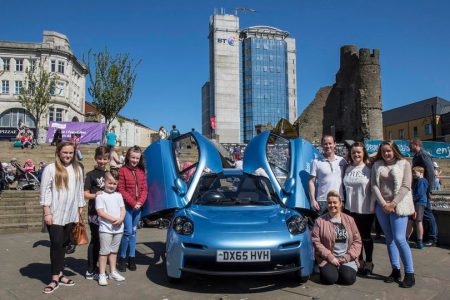
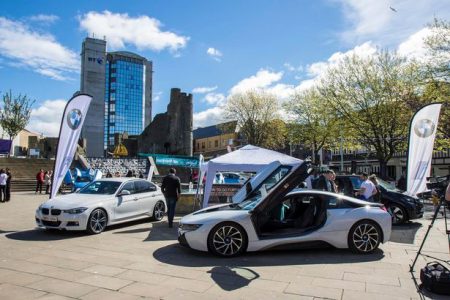
A Clean Air Roadshow organised by Swansea Council took place in Castle Square on Saturday to showcase electric and hydrogen vehicle technology.

Electric cars owned by the authority and Swansea University were on display, as well as a battery-powered one-man from the 1980s car known as the Sinclair C5, while there were also live shows from Titan the friendly robot.

Following the event Swansea Council announced it is exploring the concept of introducing more charging points in collaboration other public bodies in South West Wales.

Martin Nicholls, director of place at Swansea Council, said:

“The Clean Air Roadshow was a great success, with many thousands of visitors coming along to Castle Square from across South Wales and beyond on the day to discover electric and hydrogen vehicle technology.

“With the profile of this type of technology being raised, it’s important we explore how we can help in terms of ensuring the right infrastructure is in place to support it.

“That’s why we’re working closely alongside our local authority, university and health board partners across the region on a study that could see more electric vehicle charging points in place in future all the way from Neath Port Talbot and through the Swansea Bay City Region to Pembrokeshire.

“We support technology of this kind because it’s sustainable and helps Swansea cut its carbon footprint as we look to become a greener, more environmentally aware city.

“We already have a number of electric vehicles in our council fleet, which are used by staff in departments including recycling and corporate building and property services. These numbers are due to grow over coming months.

“This builds on the work that’s already on-going to promote and improve other forms of sustainable transport in Swansea, including cycling.”

An electric car show in Swansea has prompted calls for electric car chargers to be placed over Wales

Read more: Wales Online


A Total Cost of Ownership Comparison of ZOE Vs CLIO

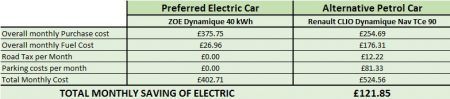
At Fuel Included, we have run our Total Cost of Ownership (TCO) Calculator on a real-life example to help show the way the costs break down, and the considerable savings that can be made.

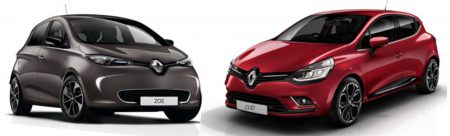
Today we have gone head to head with an all Electric Renault ZOE Dynamique 40 kWh, and a Petrol engined Renault CLIO Dynamique Nav TCe 90.

Renault ZOE and Renault CLIO

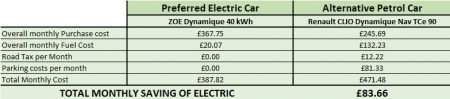
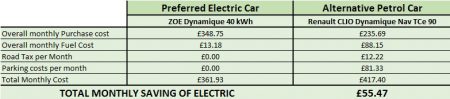
We have taken a commuter travelling into central Milton Keynes each day and parking as our representative driver. These tables show the total monthly cost* by summing all costs for the three year period of the lease and dividing them by 36.

Total Cost of Ownership

Electric ZOE Vs Petrol CLIO cost comparison for 20,000 miles per year
Electric ZOE Vs Petrol CLIO cost comparison for 15,000 miles per year
Electric ZOE Vs Petrol CLIO cost comparison for 10,000 miles per year

Conclusions

Even at the lower ranges of driving there are significant cost savings to be made. However, we see that as the mileage increases, the money to be saved is simply staggering.

Please contact us if you would like us to assess the cost of ownership of an electric car for your use case.

*Assumptions made for these calculations:

  • Petrol price from Sainsbury’s Bedford £1.21 per litre.
  • Electric charging is home charging plus 10 charges per year at £6 per charge from the Ecotricity rapid charge network.
  • CLIO mpg 52 from https://www.honestjohn.co.uk/realmpg/renault/clio-iv-2013
  • Both cars taken on 3 year PCP. Clio prices from http://offers.renault.co.uk/cars/clio/selection?offer=305 and ZOE prices from our current Fuel Included offer.
  • ZOE miles/kWh 4.5 from manufacturers real-world mileage figure divided by battery capacity.
  • Home charging Economy-7 unit cost 7.5p
  • Tax: Clio 1.2L 118 g/km CO2 = £160 in year 1 and £140 per year subsequently.
  • Parking costs based on person parking 200 working days per year in Milton Keynes town centre